Introduction
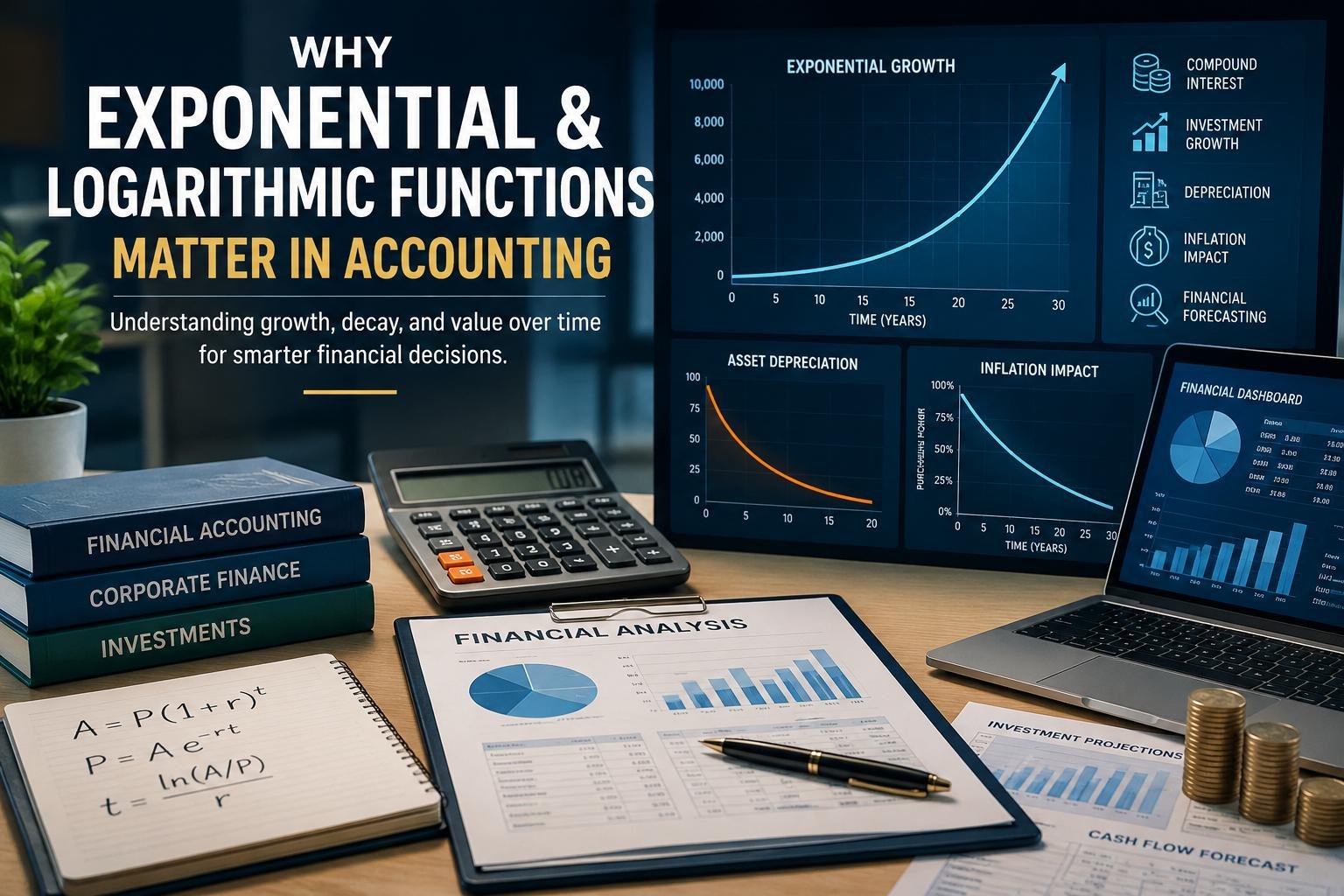
Accounting has a reputation for working with numbers, reports, and financial statements but what you may not know is that behind many of the accounting models are math principles which in turn help companies to make better financial decisions. In this field of exponential and logarithmic functions in accounting are very important. At first these may sound like very complex ideas, yet they are very much a part of daily financial activities like determining compound interest, tracking growth of investments, measuring depreciation and looking at inflation.
In present day we see that which mathematical tools are used by businesses, governments, investors and individuals to determine future financial results and identify long term economic trends. Without exponential and logarithmic functions modern accounting and finance would not be able to accurately value investments, loans, and assets over time.
In practice what we see is that financial values do not usually change in a straight line. Investments may grow very quickly via compounding, at the same time some assets may see their value drop by variable degrees. Inflation may slowly eat into purchase power and also we see that which large scale changes in the market which investors’ present are put into simple terms. Exponential and log functions provide the structure which is required to deal with such issues in an efficient manner.
In many cases the value of financial planning and accounting comes through in how organizations try to predict future profit, determine investment value, or develop long term budgets. These math tools which accountants and financial managers use allow for the development of accurate models that in turn support strategic decisions.
Understanding Exponential Functions
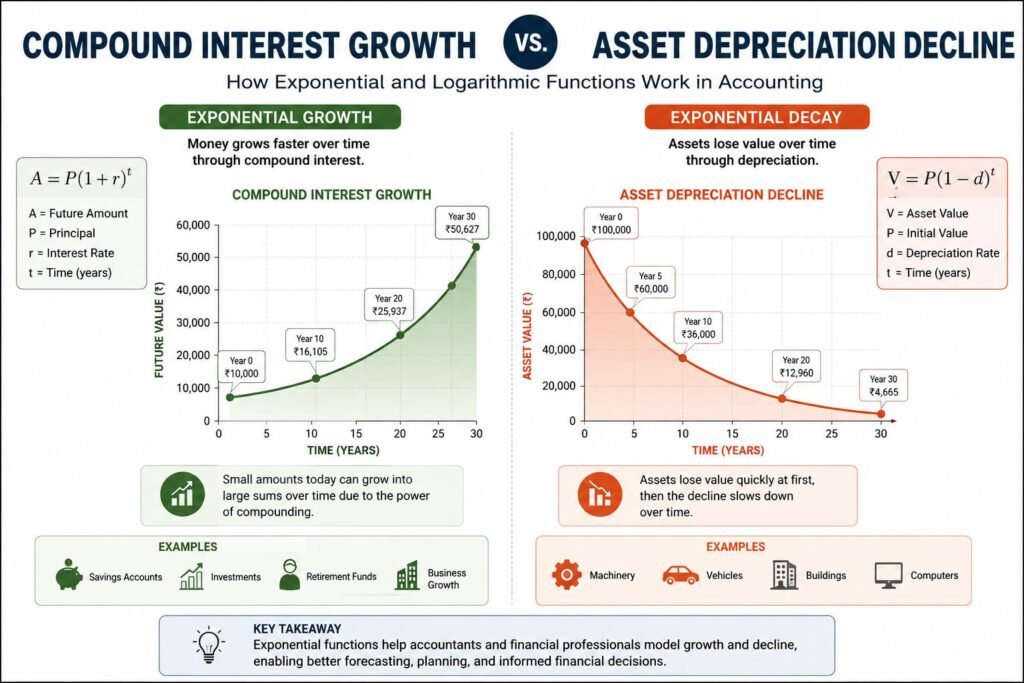
An exponential and logarithmic functions in accounting models a situation in which growth or decay is at a rate that is proportional to the present value. What we have here is that as the quantity goes up it grows or decays at an accelerated rate. In finance we see this type of function a lot as which money often does not just change in the simple interest model but also in one that includes compounding. When interest is put into an account what happens is that in the next cycle, interest is earned on the initial deposit and also added in the past, that it isn’t a linear growth but a more exponential one. Also the value grows at an increasing rate over time.
Exponential growth is a key element in accounting as it better reflects real financial trends as compared to linear growth. In the preparation of long term forecasts for revenue, investments, and market expansion businesses put forth exponential models. Exponential decay is a key concept. We see it in asset depreciation, loan repayment balances, and in the reduction of purchasing power due to inflation.
Compound Interest and Financial Growth
In accounting one of the most used applications of exponential functions is compound interest. With compound interest what happens is that interest which is earned on an investment is reinvested which in turn causes future interest to be based on a greater principal. This process details how over time large growth may be seen in long term investments. Also it is noted that what may at first be a small investment can in fact grow into a large sum when interest is compounded regularly over many years.
For instance a savings account which earns annual compound interest will see slow growth at first, but over time the growth will accelerate as interest is earned on earlier deposits. In the field of finance we see that accountants and financial planners use exponential models to determine future account values and to determine the profit potential of investment options.
Compound interest plays a key role in:
- Retirement savings
- Pension planning
- Business investments
- Loan calculations
- Insurance policies
- Educational savings plans
Businesses also use compound growth analysis in the evaluation of expansion projects. A company that expects annual growth in sales or profits may use exponential forecasting models to determine future earnings. Understanding compound interest is a key concept which accountants use to counsel companies into better financial choices. Also it is what makes individuals to put money in early which in turn is rewarded by the snowball effect of long term investment.
Investment Analysis and Wealth Accumulation
Investors always look to put forth the best returns while at the same time minimizing risk. Exponential functions use in determining how investments grow over time also which in turn help analysts to compare between different investment options.
Financial analysts use growth models which present:
- Future stock values
- Bond yields
- Mutual fund performance
- Business valuation
- Real estate appreciation
When we see investments that grow at the same rate over long timeframes it is very easy to notice that which is why it is a trend to have a long term investment strategy as opposed to short term gains. Accountants also look at past financial data to identify growth trends. Through analysis of exponential trends they are able to do better prediction of future results which in turn they use to advise management on strategic investment decisions.
For companies’ investment growth analysis is a key element of capital budgeting. We see that which large scale investments in new tech, equipment or expansion should create enough future value to pay back the investment. Exponential growth models which we use to determine those future returns and we also use them for effective financial planning.
Depreciation and Asset Valuation
While exponential growth is a model for increasing values, exponential decline is better for the study of depreciation. Depreciation is the loss in an asset’s value over time which results from wear, age, or obsolescence.
Companies own a great deal of assets which include:
- Vehicles
- Machinery
- Buildings
- Computers
- Manufacturing equipment
These over time degenerate in value as they are used. Accountants report on depreciation accurately which in turn affects financial reports, tax payment, and business profit. Certain depreciation methods which do in fact better represent exponential decline as opposed to straight line methods. For instance some equipment may see large drops in value during the first few years of its life and then much more gradual decline in value after that. Exponential models of depreciation play up these issues well.
Depreciation is a key concept for businesses:
- Determine asset replacement schedules
- Estimate maintenance costs
- Calculate tax deductions
- Assess company value
- Prepare accurate balance sheets
In absence of accurate depreciation methods companies may overestimate their assets’ value and make poor financial decisions.
Inflation and Purchasing Power
Inflation is also a field in which exponential functions play a large role. Inflation is a process which over time sees prices go up which in turn reduces what money will buy. Even at a low rate, inflation may play a role during the years, right now something that you think is affordable may run out of pocket in the very near or far future. Also even low levels can grow into larger numbers given enough time and inflation’s impact in this area may leave one with less than they had at present. Also inflation which usually is not as dramatic at the first look can indeed change the dynamics, what may pass for a good financial decision could turn out a different story at the other end of a long term plan. Even small scale, inflation is a powerful force that works over long terms, what does not appear to have an issue in the short term could actually present a large scale concern in a financial plan that spans many years. At lower rates too, inflation has its way, which means that which is cheap today may shoot up in the future.
Accounting and economics put forward exponential models which are used for study of inflation trends and determination of future costs. This in turn enables companies to develop realistic budget and pricing plans.
Inflation analysis is important for: Inflation research is important for:
- Salary planning
- Cost forecasting
- Investment decisions
- Retirement planning
- Government budgeting
For instance retirement planners must put into account what inflation will do to future living expenses. A retirement fund which may be adequate today may in fact run out of money in the coming decades if inflation is left out. Businesses also set product prices and wage scales according to what they expect of inflation. Accurate prediction helps companies to maintain profitability at a competitive level.
The Role of Logarithms in Accounting
While in the realm of growth and decline exponential functions are at home, logarithmic functions are used by accountants to study and simplify these changes. A logarithmic function in fact is the opposite of an exponential function. It is used to see how time is required for a value to either grow or decay to a certain point. In the field of finance and accounting logs are used to simplify large and complex calculations.
For example, log analysis can tell us:
- The time which it takes for investments to double.
- Growth rates of financial assets
- Rates of inflation
- Risk analysis in financial markets
- Business performance comparisons
Logarithms in financial modeling are used to simplify complex growth trends which in turn make it easier for analysts to study.
Measuring Investment Performance
Financial analysts tend to use logarithmic functions in which they compare investment returns over time. As investments generally grow exponentially logarithms do so to improve the simplification of calculations and interpretation.
Log in to see which variables are affected by:
- Percentage growth rates
- Average returns
- Market volatility
- Long-term investment behavior
In the stock market which is a field where asset prices are in constant flux this practice is common. Also log scales are used by analysts to compare performance across various time frames and investment sizes. In also we see that which is true of mergers, acquisitions and capital investments businesses use these calculations. What also plays into it is that through study of growth rates management is able to identify which opportunities are going to be profitable and which to avoid thus mitigating risk.
Risk Management and Financial Forecasting
Accounting is beyond just recording financial transactions. We also see it in terms of forecasting what is to come and preparing for the unknown. Exponential and logarithmic functions in accounting models support in risk management which is a result of the use of these functions to predict how financial variables will change over time.
Businesses are at risk of:
- Inflation
- Interest rate changes
- Market downturns
- Currency fluctuations
- Declining asset values
Using models which are mathematical in nature accountants are able to determine the50 what may be the financial impact of these risks and also put in place strategies which will in turn reduce the chance of large scale losses. Also we may say that accountants through the use of math based models are able to identify what the financial impact of risks may be and also put forward mitigation strategies which in turn will reduce loss.
For instance in the field of finance we see that which banks use exponential models for loan repayment schedules and interest accumulation. Also in the insurance industry we see that which these methods are used to evaluate future claims and set premium prices. Forecast also is a function of what government forecasting models do. Public finance departments use growth projections which in turn they base tax revenue estimates, spending needs, and national debt projections on.
Importance in Business Decision-Making
Today’s businesses are very much into data driven decision making. Exponential and logarithmic functions are the tools which we use to accurately model financial scenarios.
Managers use the terms when determining whether to:
- Expand operations
- Purchase new equipment
- Launch investment projects
- Increase production
- Borrow funds
- Adjust pricing strategies
Exact financial forecasts allow companies to use resources in a most efficient way and avoid non-essential risks. For instance when a company expects sales growth to a certain annual rate, management may base their staffing, inventory, and production capacity plans on that. Also, in regards to depreciation we see that which is used to determine future asset replacement costs. Without these math tools financial planning becomes a game of guesswork.
Applications in Personal Finance
Although we see these concepts in the world of corporate accounting they also play a very important role in personal finance.
Individuals come across exponential and logarithmic functions in:
- Savings accounts
- Mortgage loans
- Credit card debt
- Retirement investments
- Education funds
- Insurance policies
Learning how compound interest works will improve your saving habits and inform your borrowing choices. For instance which individuals have a grasp of exponential growth tend to see the value in early retirement savings. Also small monthly contributions may grow to large amounts over several decades.
On the other hand we see that exponential growth is what causes some debts to become hard to manage. Interest on credit card balances may see large increases if it is compounding. Financial literacy includes also the grasp of these math concepts.
Technology and Modern Accounting Systems
Present day accounting software and in financial systems we see a heavy use of exponential and logarithmic algorithms.
These systems perform tasks such as:
- Interest calculations
- Loan amortization
- Asset depreciation
- Financial forecasting
- Investment analysis
- Inflation adjustments
Automation increases accuracy, reduces human error, and also allows accountants to focus more on analysis and strategic planning. Financial tech firms also have at hand complex math models which they use in the development of investment platforms, banking apps, and economic forecast tools. As time goes by which see great technological change the role of that which is mathematical in the accounting field is becoming more important.
Challenges in Applying These Functions
Although they are very useful at times exponential and logarithmic functions also put us to task. One issue is that of interpretation. Many people have trouble with these concepts which is a result of the fact that exponential growth is non-intuitive. Small shifts in growth rates may produce large results over long terms.
Forecast at times may be inaccurate when we put forth assumptions which turn out to be unsound in regards to growth, inflation, or depreciation. Also it is possible for economic conditions to change suddenly thus reducing the predictive models’ accuracy. Also, it is up to financial analysts to choose the right models for each situation. To use the wrong growth assumptions is to risk poor investment decisions or inaccurate financial reporting. Accountants must apply their professional judgment and economic knowledge.
Conclusion
Exponential and logarithmic functions in accounting plays a role finance which we use to determine how financial values play out over time. We see this in compound interest, investment growth, but also in depreciation and inflation analysis which in turn supports accurate forecast and better inform decision making. Businesses use exponential models for profit prediction, investment evaluation, and asset management. Logarithmic functions which model growth in a simplified way also enable analysts to better interpret financial performance.
These in personal finance we see very much the same principles which play in with respect to savings, borrowing and long term wealth accumulation. Also they are at the core of what we see in modern accounting software and financial technologies.
As the world of finance becomes more data oriented, it is of great importance that we understand exponential and logarithmic functions in accounting which do play a key role for accountants, investors, managers and policymakers. Also we see that these functions play out in the real world in terms of economic planning and strategic financial management. In that which these functions do is to form the base for improved financial analysis, better investment choices, and more reliable long term planning in business and personal life.
Get more well researched information about Exponential and Logarithmic Functions in Accounting here.