Introduction
In the digital era, individuals and organizations receive and give out large volumes of data on a daily basis. Information processing in society is being generated, disseminated, assessed, and stored continuously since sending a simple text message to running a business around the globe. This stream of information is the core of the contemporary society. It could not be possible to make informed decisions, communicate effectively, and manage complex systems without the formalized approaches to information management.
Information processing is needed here. Information processing is the orderly gathering, manipulation, storing, and transfer of information in order to make it significant and useful. It does not only apply to computers, but information processing is also carried out in the same way in the human brain. Information processing is a very important aspect whether it is a student attempting to solve a problem, a hospital attempting to keep records of patients or a company trying to understand the trends in the market.
This article describes the information processing concept, its main steps, which are the input, processing, storage, and output, as well as emphasizes its role in our daily lives. It also demonstrates how the information processing assists in decision-making, communication and organizational effectiveness to enable the readers to realize how information is among the most valuable resources in the contemporary society.
The Concept of Information Processing
Information processing concept can be defined as the process through which raw data is recorded, processed, converted, organized, stored and communicated to obtain valuable outputs. It is a systematic process that sees information being correct, useful and available when one needs it. The notion is relevant in human cognition as well as to computer systems.
In human sense, information processing takes place when we read, listen, think, remember and respond. As an example, in case a teacher is explaining a subject matter, students get the information and process this using their minds, and this information is stored in their memory to be utilized later in the form of tests or discussions.
The same is true in information processing in computing. This process is performed by computers, which take the information in as input and output as output in the form of results with the help of input and output devices.
The point of information processing is that data in itself is not very useful until it is converted to meaningful information. Processing enables organizations and individuals to distinguish trends, make inferences and take suitable measures.
Get to know more on concept of information processing and its use to push modern systems.
What Is Information?
There is a need to differentiate between data and information before one can comprehend the process of information. Data can be defined as raw facts, figures or symbols that are yet to be interpreted e.g; 70, 85, 90.
Data that has been processed, organized and made meaningful are referred to as information. Example: A student had a score of 70, 85, and 90 in three subjects.
The information processing is used to ensure that data meet these standards in order to be used.
Good Information Characteristics.
To be a valuable piece of information, it should have some characteristics. These features make sure that the information may be relied upon and put into practice.
- Accuracy – The information should be accurate and devoid of errors.
- Relevance – It needs to be relevant to the needs or to the purpose of the user
- Timeliness – Information must be at the required time.
- Completeness – Use of all the information required.
- Clarity- It must be simple to comprehend and interpret.
- Reliability – The information source should be reliable.
- Consistency – There should be uniformity of information across systems.
In case information does not possess such attributes, then this information may be misleading and lead to bad decisions being made by the users.
Types of Information
Depending on the use and origin, information may be classified into various groups:
- Personal Information – Addresses, Names, PHN.
- Business Information Sales reports, financial records, customer data.
- Educational Information – grades, research information, attendance history.
- Medical Information – Patients, test results, prescriptions.
- Government Information- Census data, tax reports, legal documents.
All information types have to be worked over and secured.
The Reason Why Information is Important.
In the contemporary society, information is regarded to be as precious as money, land or labor. Competition is done on the foundation of how easily the organizations can gather, process, and utilize information. Governments use information to plan development, deliver services as well as achieve security. Information is used by individuals in their everyday life to make decisions like the decision on schools, jobs or investments.
The lack of appropriate processing of information would make the societies ineffective.
The processes of information processing include stages.
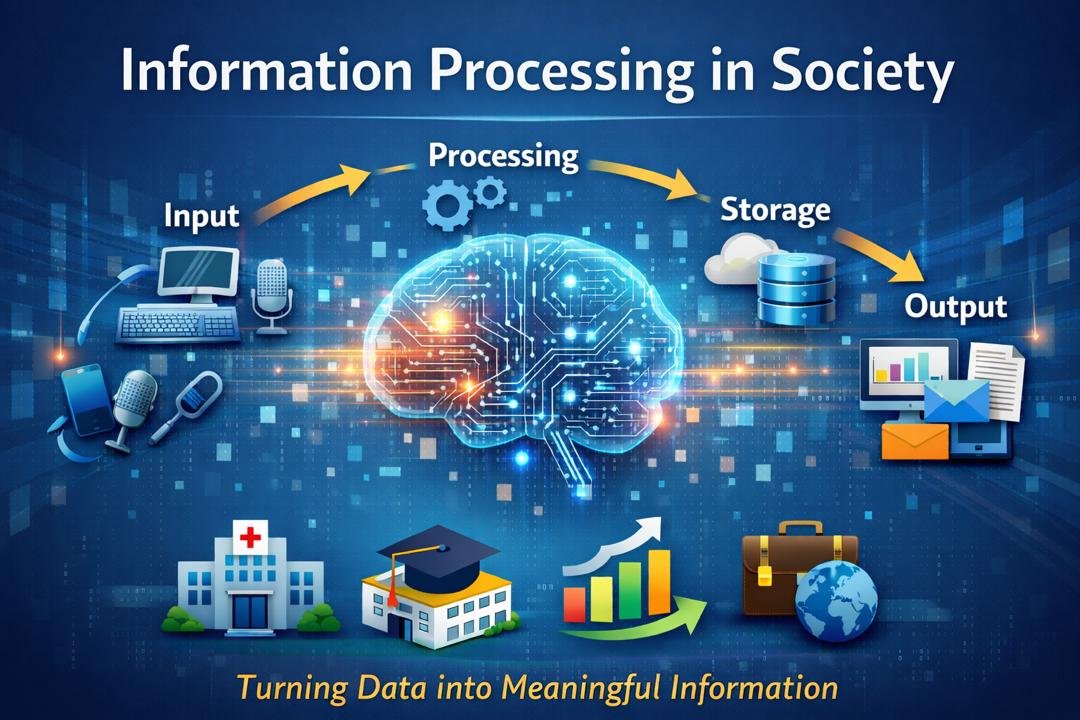
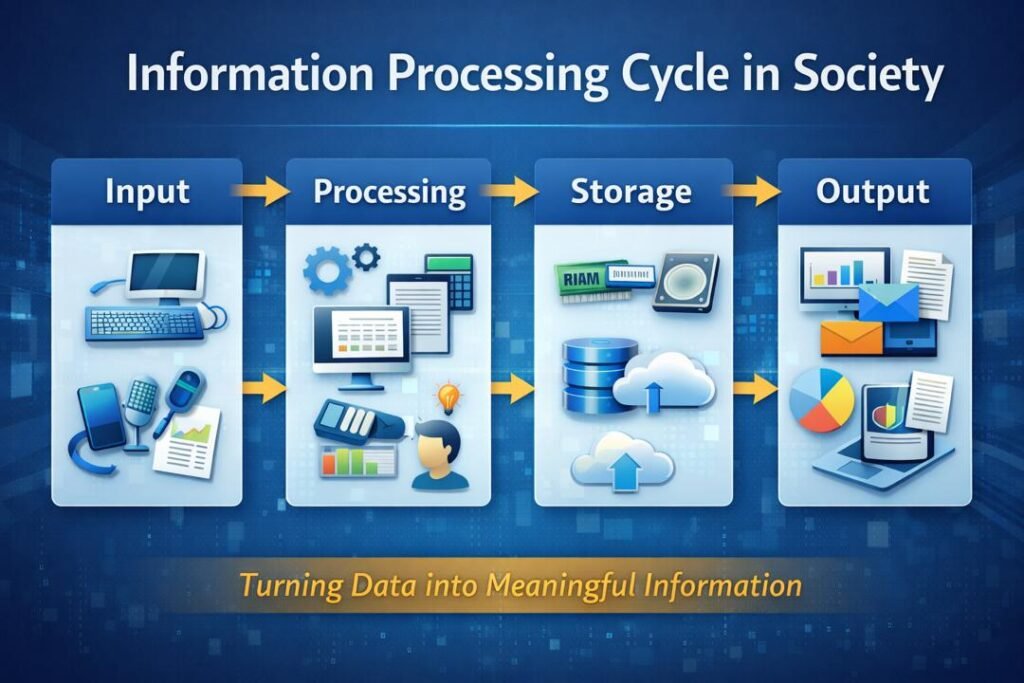
There is a distinct cycle called the Information Processing Cycle through which information processing occurs. The four main stages are:
- Input
- Processing
- Storage
- Output
All the stages are very necessary and cooperate with each other to convert raw information into actual information.
Input Stage
The first process in the information processing cycle is the input stage. It entails the gathering of raw data in different locations.
Examples of Input:
- Typing on a keyboard
- Scanning documents
- Clicking a mouse
- Using microphones, cameras or sensors.
- Filling online forms
The input in the process of information processing in society is done through the senses, which include seeing, hearing, touching, tasting and smelling.
The data can be received in organizations through:
- Customer records
- Financial transactions
- Surveys
- Sales reports
- Social media analytics
The input quality has a direct influence on the output quality. Wrong or partial data results in the wrong results.
Processing Stage
Processing stage is the stage in which data is converted into meaningful information. This phase entails computation, contrast, ranking, categorizing, and examining.
Examples of Processing:
- Calculating total sales
- Sorting student grades
- Evaluation of customer behavior.
- Converting temperatures
- Editing text
Processing in the human sense is thinking, reasoning and problem-solving.
In computer, the Central Processing Unit (CPU) executes processing using software instructions.
This phase is important in the sense that it defines the way raw data is transformed into valuable knowledge.
Storage Stage
Storage stage entails the storage of data and information to be used in the future. Storage enables one to access information at the time of need.
Types of Storage:
- Primary storage: RAM, cache
- Secondary storage: Hard disks, flash disks, cloud storage.
- Human memory: Short term memory and long term memory.
Storage helps in providing information that is:
- For future reference.
- Protected from loss
- Organized for easy access
Managing Organization records include:
- Employee data
- Financial statements
- Customer databases
- Legal documents
Output Stage
The last stage is the output stage where the processed information is given in the form of usable information.
Examples of Output:
- Showing the outcomes on a screen.
- Printing reports
- Playing sounds
- Creating of charts and graphs.
Output in a human being takes the form of speaking, writing or doing things in response to processed information.
Output allows users to:
- Understand results
- Make decisions
- Communicate findings
Significance of Information Processing in the society
The processing of information plays the key role in the functioning of modern societies. It promotes almost all sectors such as education, health, business, government and communication.
Supports Decision-Making
Decision-making has become one of the most significant functions of information processing. Individuals and organizations use the correct information to make the most suitable decisions.
Examples:
- Sales information is used to plan marketing activities by a business.
- A physician uses test results to diagnose a patient.
- A student goes through notes in order to study before exams.
Devoid of adequate information processing, decisions would be made through guesswork as opposed to facts.
Enhances Communication
Communication becomes quicker, explains the message better and makes it more reliable.
Examples:
- Emails
- Social media
- Video calls
- Online reports
Processing also makes sure that messages are:
- Organized
- Accurate
- Easy to understand
This will enable citizens of different countries to exchange ideas and work together.
Enhances efficiency in the organization
Information systems are relied upon by organizations to run things without challenges.
Benefits:
- Faster data retrieval
- Reduced errors
- Better coordination
- Increased productivity
Information processing is applied in banks, schools, hospitals and companies to manage high amounts of data.
Promotes Education and Learning
The information processing tools used by students and teachers include:
- Management learning systems.
- Online libraries
- Digital assessments
These systems assist in storing, processing and presenting information in such manners that enhance learning results.
Improves Healthcare Services
The information processing in hospitals is used to:
- Manage patient records
- Analyze medical tests
- Track treatments
- Improve diagnosis accuracy
This results in improved care of patients and accelerated medical services.
Drives Business Growth
Processed information assists businesses in:
- Understanding customer needs
- Forecast trends
- Reduce costs
- Increase profits
The information is now viewed with the eye to a strategic resource.
Information Processing in Real Life
Even such everyday operations presuppose information processing:
- Checking the weather
- Using GPS for navigation
- Paying bills online
- Watching news
- Shopping online
All activities are linked in the same cycle; input, processing, storage, and output.
Problems Associated with Informational Processing
Notwithstanding these advantages, the information processing has some challenges including:
- Data security risks
- Privacy concerns
- Information overload
- System failures
The companies need to embrace powerful policies to ensure that information is safeguarded and managed carefully.
Conclusion
Information processing is a concept that is essential to comprehending the manner in which data is transformed to useful information. Raw data is processed into useful knowledge that helps in the decision-making process, communication, and organizational efficiency through the four stages, which include; input, processing, storage, and output.
Data processing- both accuracy and efficiency have ceased to be something extra in a world that is more information driven. On an individual level all the way up to international institutions, information processing defines our learning, working, communicating, and developing. The knowledge of this concept can make us understand why information is one of the most valuable resources in the contemporary society.
Get more well researched information about Information Processing in society here.