A T-shirt looks like the simplest item in your closet—until you try to order a batch for an event, a merch run, or a small brand.
Then the questions start:
Why does one tee feel “premium” and another feel thin?
Why do some shrink or twist after washing?
Why does a print look great on one fabric but stiff on another?
This guide keeps things practical. You’ll learn how to use fabric weight (GSM), quick at-home tests for opacity and stretch, what to watch for in shrinkage, and a short list of questions you can send to any supplier.
1) Start with GSM: the fastest way to narrow your choices
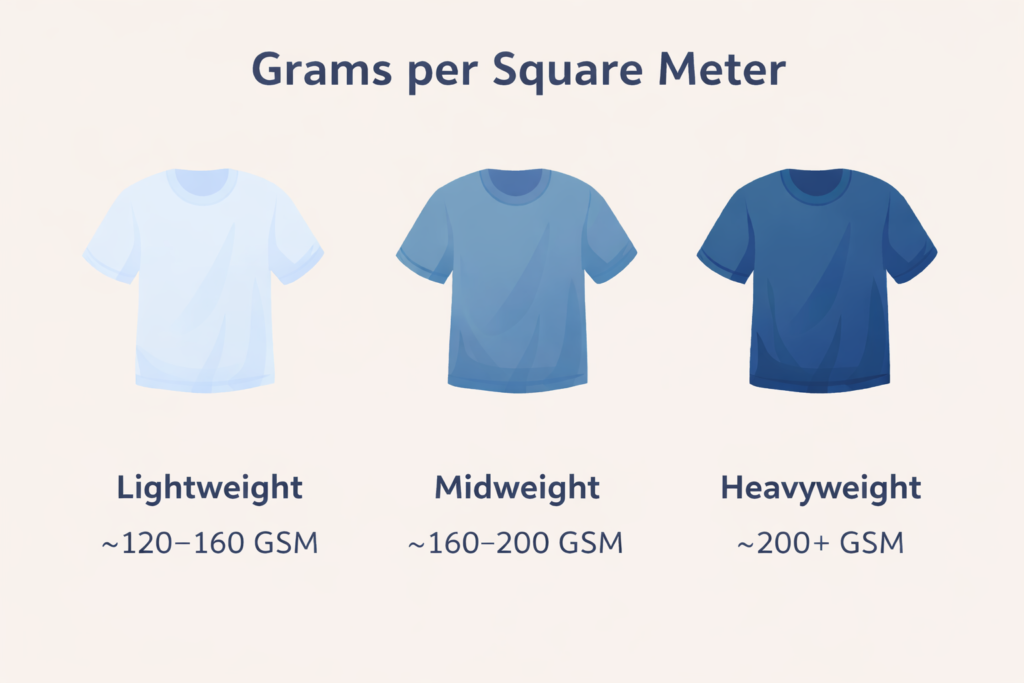
GSM stands for grams per square meter. It tells you how much one square meter of fabric weighs. In textile testing, fabric “weight” is commonly described as mass per unit area, often in g/m².
GSM won’t tell you everything, but it’s a strong first filter:
- Lightweight (often ~120–160 GSM)
Feels cooler and more breathable. Good for hot weather and promo tees. The trade-off: lighter colors can look see-through. - Midweight (often ~160–200 GSM)
A reliable everyday range. It usually balances comfort, coverage, and drape. - Heavyweight (often ~200+ GSM)
More structure and a “thicker” feel. Often better coverage, but warmer and sometimes less flowy.
This overview is a useful starting point for supplier shortlisting, especially for China sourcing, before you kick off outreach: Know more about Chinese T-shirt manufacturers
2) Same GSM, different feel: why does it happens
Two fabrics can have the same GSM and still feel completely different. That’s because weight is only one piece of the puzzle. Differences usually come from:
- Yarn quality and fiber prep (which can affect softness and consistency)
- Knit density (how “open” or “tight” the fabric is)
- Finishing (softening steps or treatments that change the hand-feel)
3) Opacity: solve the “white tee problem” early
Opacity is the most common surprise—especially with white and light colors. Do these two quick checks:
- Backlight test: hold the fabric up to a bright light.
- Stretch test: gently stretch the fabric. If it turns noticeably sheer, the knit may be too open for your use.
If the tee will be printed, stretch matters even more, because the garment will look different once worn than it does flat on a table.
4) Shrinkage: the issue people complain about most
A tee doesn’t only “shrink.” It can change shape—shorter length, narrower width, or even a slight twist after washing.
In the industry, many brands evaluate this using standardized home washing and drying procedures (so results are comparable). These controlled tests simulate real-life use—measuring factors like shrinkage, color retention, fabric softness, and print durability after repeated cycles. This ensures that performance claims are not based on ideal conditions but on how garments actually hold up in everyday wear.
For a practical example, browsing a supplier catalog like custom T-shirt options
shows the wide range of fabrics, blends, and constructions available from lightweight cotton to performance materials—each of which may respond differently to washing and drying conditions.
Because of these variations, standardized testing becomes essential for comparing garments fairly across brands and styles, helping both businesses and consumers make informed decisions about quality and long-term value. For example, ISO 6330 specifies domestic wash/dry procedures used for textile testing.
You don’t need a lab to apply the same idea. Here’s a simple approach:
- Wash and dry a sample the way your customers will.
- Measure it before and after (length and width).
- If the change is meaningful, adjust sizing—or choose a more stable fabric.
What to ask a supplier:
- “What shrinkage range should we expect after washing?”
- “Is the fabric stabilized or pre-shrunk?”
- “Do you wash-test samples as part of QC?”
5) Comfort trade-offs (a simple decision map)
If you only remember one thing, remember this:
- Want cool and breathable → lighter GSM, confirm opacity
- Want soft and premium → pay attention to yarn/finishing, watch pilling
- Want structured and long-wearing → mid/heavy GSM, test wash stability
6) Printing and decoration: match the fabric to the design
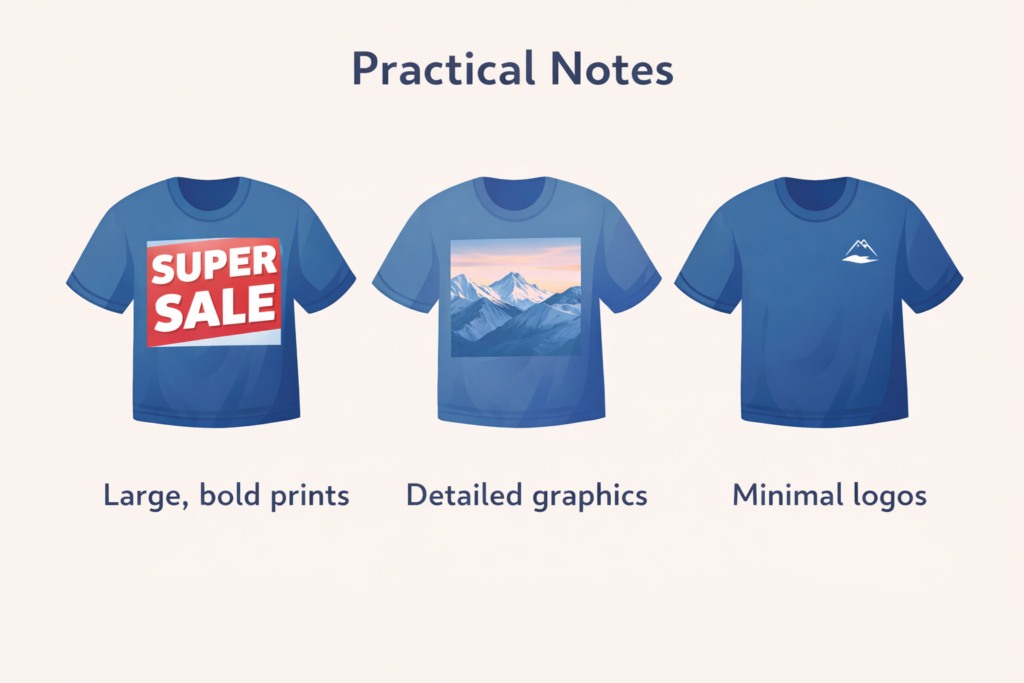
Printing isn’t “one size fits all.” A few practical notes:
- Large, bold prints: denser fabrics often feel more consistent
- Detailed graphics: smoother surfaces can help clarity
- Minimal logos: most fabrics work—wash durability becomes the key
Best practice: Do a small print test on the exact fabric you plan to use. It’s a small step that can prevent expensive mistakes later.
7) Copy/paste: 10 questions to send to any supplier
Here’s a message template that usually gets clearer answers:
- Fabric composition and GSM (g/m²)?
- Knit type and knit density?
- Is it stabilized or pre-shrunk?
- Expected size change after washing (length/width)?
- QC checks before shipment?
- How is color consistency controlled across batches?
- MOQ per color and per style?
- Sampling timeline (first sample + revisions)?
- Can you provide swatches + a pre-production sample for approval?
- Packaging and labeling options?
8) A simple way to stay “people-first” when you source
When you’re comparing fabrics and suppliers, it’s easy to get lost in buzzwords. The best approach is still the simplest: focus on what you can test, what you can measure, and what you can confirm in writing. That’s the same direction Google encourages with “people-first” helpful content: prioritize clear, reliable information that actually helps readers make decisions.
If you want an example of how a supplier presents a general overview—what they produce, what can be customized, and how they organize information, you can browse Valtin Apparel.