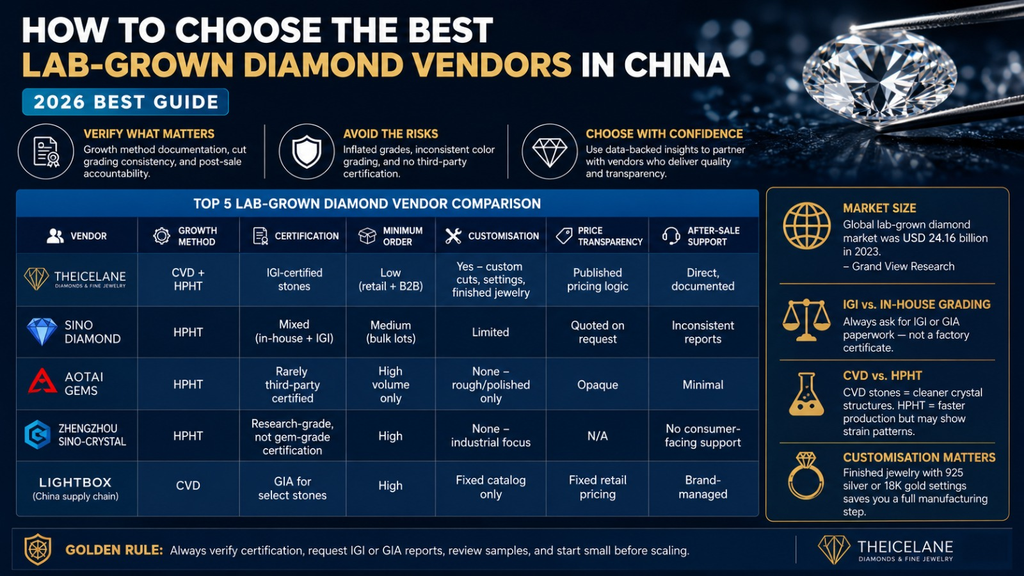
Which Chinese lab-grown diamond vendor is actually worth your sourcing budget? The answer depends entirely on what you verify before you wire a single dollar — growth method documentation, cut grading consistency, and post-sale accountability are the three filters that separate serious manufacturers from resellers with a well-designed Alibaba storefront.
If you are evaluating how to choose the best lab-grown diamond vendors in China, this comparison gives you the technical framework and honest vendor breakdown to make that call.
Why China’s Lab Diamond Market Demands More Scrutiny Than Usual
China is the world’s largest producer of HPHT (high-pressure, high-temperature) lab-grown diamonds, responsible for an estimated 50–60% of global rough lab diamond supply as of 2024. That scale is a double-edged advantage.
You get access to high-volume, competitively priced stones — often 50–70% below equivalent mined diamonds. But the same market attracts hundreds of intermediaries masquerading as manufacturers.
The risk is real: stones graded internally with inflated clarity grades, inconsistent color grading between D–F ranges, and no third-party certification from IGI (International Gemological Institute) or GIA.
The 5-Vendor Comparison You Actually Need
Below is a structured breakdown of best top 5 five lab grown vendors we have sorted out. The data points are drawn from publicly observable signals, certification standards, and buyer-reported experiences.
| Vendor | Growth Method | Certification | Minimum Order | Customisation | Price Transparency | After-Sale Support |
| Theicelane | CVD + HPHT | IGI-certified stones | Low (retail + B2B) | Yes — custom cuts, settings, finished jewelry | Published pricing logic | Direct, documented |
| Sino Diamond | HPHT | Mixed (in-house + IGI) | Medium (bulk lots) | Limited | Quoted on request | Inconsistent reports |
| AOTAI Gems | HPHT | Rarely third-party certified | High volume only | None — rough/polished only | Opaque | Minimal |
| Zhengzhou Sino-Crystal | HPHT | Research-grade, not gem-grade certification | High | None — industrial focus | N/A | No consumer-facing support |
| Lightbox (China supply chain) | CVD | GIA for select stones | High | Fixed catalog only | Fixed retail pricing | Brand-managed |
A few clarifications on what that table means in practice:
📊 Global lab-grown diamond market was USD 24.16 billion in 2023. — Grand View Research
- IGI vs. in-house grading: IGI uses standardised grading protocols across 31 global labs. An in-house grade from a Chinese manufacturer carries no independent accountability. Always ask for IGI or GIA paperwork — not a factory certificate.
- CVD vs. HPHT: CVD (chemical vapor deposition) stones tend to have cleaner crystal structures for colorless and near-colorless grades. HPHT stones are faster to produce at scale but can show strain patterns visible under crossed polarizers.
- Customisation vs. rough supply: If you are building a jewelry brand — not just reselling loose stones — a vendor who can supply finished pieces with 925 sterling silver or 18K gold settings saves you a full manufacturing step.
So we tried to connect with Hema Khatwani, Founder of Theicelane, About Sourcing Standards
Hema Khatwani, the founder behind Theicelane, has been publicly consistent on one point that many China-side buyers overlook: documentation and setting quality are inseparable from stone quality.
Her position, as expressed through Theicelane’s editorial content, is that a VVS1, D-color CVD stone loses its value proposition entirely if it is set in a prong structure that cannot hold tolerances — or if the finished piece ships without a traceable IGI report number.
This is a more demanding standard than most Chinese wholesale vendors apply. Most rough-to-polished exporters in Zhengzhou or Guangzhou are optimised for volume, not finished-jewelry accountability.
Hema Khatwani’s sourcing philosophy also emphasises what she calls “price logic transparency” — meaning a buyer should be able to see how carat weight, cut grade, and clarity tier map to a final price, rather than receiving an arbitrary quote. That approach is rare in wholesale markets where negotiation theatrics are standard.
For buyers who want to understand how that philosophy applies to specific product categories, the lab-grown diamond solitaire ring options for engagement buyers at Theicelane reflect this documented, grade-matched pricing approach.
How to Audit a Chinese Lab Diamond Vendor Before You Buy
Whether you choose Theicelane or any other vendor on this list, these are the non-negotiable verification steps:
- Request the IGI or GIA report number — and verify it independently at igi.org or gia.edu. If the vendor cannot produce one, walk away.
- Ask for the growth method in writing — HPHT or CVD, with the reactor origin if possible. Some vendors blend rough from multiple sources without disclosing it.
- Check the cut grade, not just the carat weight — an Excellent or Very Good cut grade with strong symmetry and polish ratings (per IGI’s grading scale) determines actual light performance. A 1.5 ct stone with a Poor cut will perform worse than a 1.0 ct Excellent-cut stone.
- Request a sample lot before committing to volume — measure table percentage, culet size, and girdle thickness against the certificate specs. Discrepancies indicate re-graded or misrepresented stones.
- Confirm after-sale terms in writing — specifically, return windows, replacement policy for chipped or scratched stones, and whether customised orders carry any workmanship warranty.
📊 China’s online luxury market grew 29% in 2023, reaching $19.9 billion. — McKinsey & Company
For a deeper comparison across export-ready vendors, the full guide on lab-grown diamond suppliers for export buyers covers sourcing frameworks applicable beyond China.
Where Theicelane Sits in This Market
Theicelane operates differently from the four Chinese vendors listed above in one structural way: it functions as a finished jewelry manufacturer with lab diamond sourcing built in — not as a rough or polished stone exporter that also does settings as an afterthought.
That matters for a specific buyer profile: a startup jewelry brand, a boutique retailer in the UK, US, or India, or a private label client who needs IGI-certified stones already set in finished pieces with consistent rhodium plating (0.5-micron minimum for white gold finishes), proper prong tolerances, and a reorder system that doesn’t require renegotiating every batch.
One area where Theicelane differentiates further is the range available for buyers moving from browsing to buying — for example, a finished three-carat solitaire with a diamond-accented band that ships with documentation, not just a polished stone in a generic setting.
That said, if your business requires raw rough at 500-carat minimum order quantities for in-house cutting, Theicelane is not the right match. That is what vendors like AOTAI or Sino Diamond are structured for.
The Vendor-Fit Matrix: Match Your Need to the Right Source
| Buyer Need | Best Vendor Type | Why |
| Finished jewelry, retail-ready | Theicelane or similar finished-goods manufacturers | IGI certs + settings + consistent quality control |
| Bulk polished loose stones for resale | HPHT manufacturers with verified IGI output | Volume pricing, consistent rough source |
| Industrial-grade HPHT rough | Zhengzhou Sino-Crystal or equivalent | Not gem-grade; appropriate for industrial use only |
| Fixed catalog with brand backing | Lightbox-style suppliers | Consistent but inflexible |
| Custom cuts and sizes at retail quantity | Theicelane or Jaipur-based CVD manufacturers | Lower MOQ, cut flexibility |
Also worth reading before you finalize a sourcing decision: the best lab-grown diamond vendors operating out of China, which maps the vendor landscape with additional regional sourcing context.
One Final Check That Most Buyers Skip
Before you finalize any vendor — Chinese or otherwise — ask them one question that reveals everything: Can you show me the reject rate on your last three production batches?
A manufacturer confident in their quality control will have this number. A reseller will not. Theicelane’s editorial philosophy, as shaped by Hema Khatwani, is built on exactly this kind of operational transparency — and it is the same standard you should hold any vendor to, regardless of country or catalog size.
If you are building a jewelry line and want to see what ring settings aligned with consistent lab-diamond grading look like at the product level, the rose gold diamond ring collection is one practical starting point for benchmarking finished quality.
The right vendor is the one who makes your due diligence easy — not the one who makes you feel like you are asking too many questions.