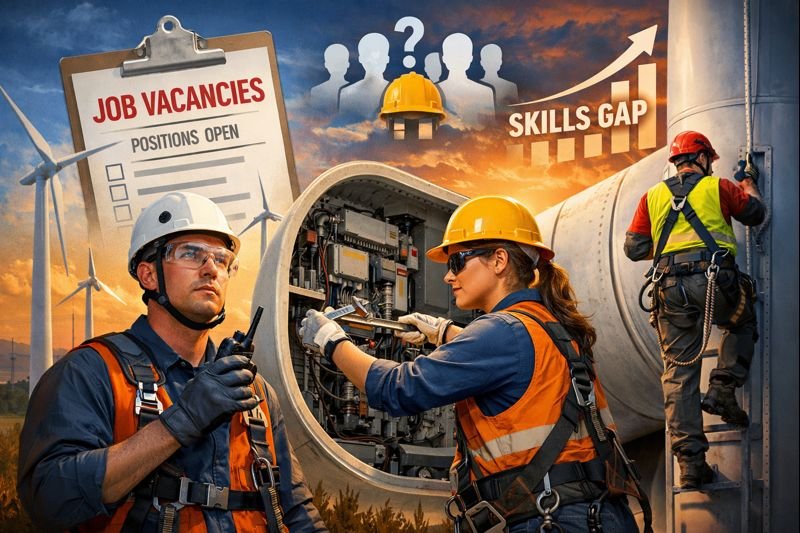
A challenge plaguing the wind sector only continues to grow month after month. With more wind turbines needing installation and maintenance, companies fall farther and farther behind in securing labor as rates of employment lag.
What once was a minor challenge of bringing on new workers has evolved into a major workforce crisis that impacts project schedules and operational budgets across the sector.
Why Are Wind Technicians So Hard to Come By?
Wind turbine technicians require a unique skill set that does not come naturally. Wind technicians possess electrical know-how and mechanical skills; they must be comfortable working at extreme heights and in challenging conditions, all while 300 feet above the ground, troubleshooting what’s wrong with the turbine. Not every technician will be a wind technician, as the job challenges the best skills of someone who may not want to work at those heights.
Not only that, but the physical aspects of the job also deter people. Wind technicians work in remote locations with the most wind, at temperatures that fluctuate from extreme cold to extreme heat, on turbines taller than skyscrapers for most of their days. Even skilled technicians may seek to work somewhere else when faced with these overwhelming conditions.
Compounding matters, trade schools and technical institutions have not yet created enough programs to address the needs of wind turbine technicians compared with other skilled trades. While the need for skilled turbine technicians has exploded tenfold in ten years, programs have not made similar strides. Schools can only accommodate so many prospective students per year to graduate a limited number of qualified laborers per year.
Statistics Behind the Critical Shortage
American Wind Energy Association projects exponential numbers for turbine tech employment needs over the next few years to accommodate construction across both existing turbines and new developments. When accounting for those nearing retirement or leaving the position for less physically demanding jobs, the issue only gets compounded.
Established technicians are worth their weight in gold when completing challenging turbine work, someone who’s been doing it all day for five years knows how to diagnose what’s wrong with the weird noise coming from inside the turbine; they know which components break down first; they know how to get in, get out, and best work through blizzard conditions. Companies offer high salaries for seasoned veterans to stay, but other companies could use their expertise elsewhere for newer builds or assembly.
The competition is fierce, project managers seek to build new wind farms in areas that do not have enough qualified technicians, even at a comfortable distance. Companies look to renewable energy services more now than ever before to fill workforce gaps, specializing in connecting project supervisors with qualified technical workers who boast proper experience and certification.
What Companies Are Doing About It
Some wind farm companies begin training their labor from the ground up. They’ll hire technicians with mechanical or electrical backgrounds, provide an intensive training course, and then pair someone who recently finished with a seasoned veteran for an apprenticeship. The cost is great and time-consuming but worth it to have laborers experienced with the specific equipment and company procedures.
Other companies are getting more creative with compensation, the average base salary for wind technicians is growing exponentially, but companies are also implementing sign-on bonuses, retained bonuses, comprehensive benefits packages, and even offering housing allowances for those who need to move to remote wind farm locations. Some companies experiment with compressed work schedules, working longer hours so days off can be accumulated, but this still may deter people from appreciating a physically demanding job.
However, financial incentives will not attract people without appropriate skills; companies must implement more flexible staffing strategies to get around such challenges.
What Specialized Staffing Provides
Increased interest among companies has resulted in a newfound idea that not all technicians must be hired as full-time employees forever, for maintenance work, sure. But for new development or short-term projects, it’s not economical.
Project-based work meshes well with contracted staffing; for example, the construction of one wind farm may require fifteen technicians for six months but only four technicians afterward as a maintenance crew. There is no economic sense in keeping fifteen on payroll all year round without work, but access to reliable expertise is paramount in new areas.
Contract technicians also provide a new perspective, someone who has worked on three separate wind farm projects across three states has different exposure to equipment configurations and challenging dilemmas than someone who has worked at one location for years and knows nothing else. While sometimes specialized knowledge limits scope, other times it proves immensely valuable during troubleshooting. Company training opportunities take too long to implement (and come at a high price).
The average time it takes to become a certified wind technician is anywhere from six months to two years (depending on which program) through class instruction, initial assessments, and fundamental requirements, not unreasonable considering how extensive the work can be, but unrealistic for those who want immediate job growth when demands grow unexpectedly.
For companies willing to invest time and money into their labor force retention training efforts, they bring forth high costs, beyond training expenses paid out to novice employees not contributing initially; there are wages paid out minus productivity bonuses.
For every novice wind tech who turns out to be hoisted higher than intended (pun intended) or experiences their first winter on a wind farm only to quit since they realize they dislike freezing temperatures on a turbine in the middle of nowhere is a sunk cost.
Learning From Other Industries
Many sectors have experienced this problem before, a skilled shortage. Oil and gas experienced this boom-type issue for decades and utility companies building their infrastructure deals with such challenges across multiple states at various capacities.
What these industries did were successfully develop various internal training programs emphasizing competitive compensation strategies and shifted political connections/partnerships fostering specialized staffing whenever project-oriented work developed.
In wind’s defense, it’s harder for this industry due to continual growth, that oil and gas may eventually stabilize job needs; that as wind grows new capacity year after year, and continues needing technicians like no tomorrow.
What This Means for Project Timelines
The technician shortage hasn’t helped the situation; where projects that should take eight months take twelve or fourteen because crews cannot be fully staffed since they’re still searching for technicians good enough to start right away, all of which delays revenue streams and creates pitfalls between financial projections and actual prospects.
Some companies factor an extended lead time based on workforce planning efforts instead of acknowledging where it used to take two months to find willing workers; they know it now might take four. Other companies try to get projects done faster where crews are currently based, even if it’s not the best location (for wind appeal).
The Bigger Picture
The skilled technician shortage highlights a gap across several industries; a cautionary tale for depleting supplies for specialized technical jobs versus workers who have practical implementations and expertise to fill positions.
In wind energy’s case, however, it’s especially egregious due to how rapidly the sector grows versus any potential worker developments.
Companies that utilize flexible workforce plans, blending permanent employees with project-based workers; hiring those empowered through extensive training without accruing millions in costs; establishing relationships with specialized talent even when no hiring effort occurs, are those companies best suited to push project funding along in uncertain times.
The shortage isn’t likely going away anytime soon, but companies successfully shifting their staffing approach will help facilitate movement through such projects.