Introduction
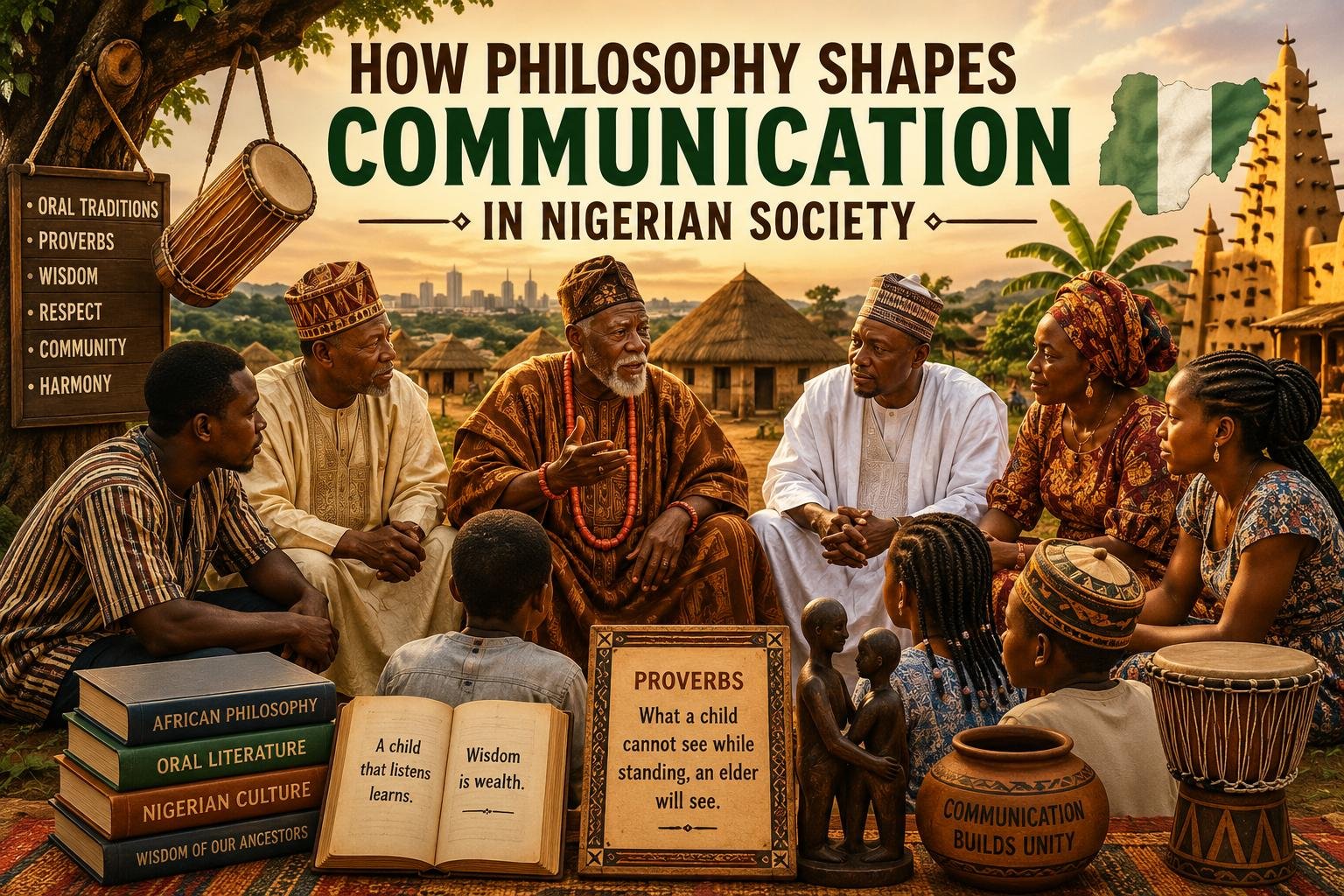
Nigeria is home to over 250 ethnic groups which in turn have their own languages what which makes our country the most culturally rich in the world. In that diversity we also see how philosophy shapes communication in Nigerian society, people connect, associate with each other, resolve issues and run social structures. In our society communication is more than just the trade of words; it is a reflection of deep seated beliefs, moral values, community principles, and culture which have been passed down through the generations.
Philosophy shapes communication in Nigerian society. In Traditional African philosophy we see the value of communal living, respect for elders, moral responsibility, and social harmony. These principles play out in day to day conversation, leadership structures, in our oral traditions, storytelling and decision making. From village assemblies to family talks and political debate philosophy is a factor which shapes Nigerian communication.
In many cultures of Nigeria it is noted that communication is not only throughout and back talk. Proverbs, folktales, riddles, symbols and conversation are used to pass on wisdom, caution, correction and ethical lessons. These methods of communication preserve culture identity at the same time they foster unity and social stability. As modernization and digital communication grows traditional philosophical ideas still play a large role in how we interact with each other.
This article looks at how philosophy shapes communication in Nigerian society we see into the role of oral traditions, ethical reasoning, leadership, social interaction, and communal values. Also put into perspective are traditional thought systems which we see to be very much a part of modern communication patterns in Nigeria.
Understanding Philosophy in the Nigerian Context
In the Nigerian context Philosophy is a system of beliefs, values, ideas and principles that guide human action and social relationships. While in the West philosophy is very much into abstract reasoning and individualism, in Africa it is the community, morality and collective well-being which are put in the fore.
In traditional Nigerian thought the individual is a member of a larger community. This belief plays out in how we communicate which is meant to be a force for peace, respect, and social harmony. In many Nigerian cultures care is taken in what is said to avoid conflict or disrespect.
For instance in the case of the Yoruba wisdom and good character are put at the fore. The Igbo culture is that of dialogue and communal participation, while the Hausa culture which puts forward respect, hierarchy, and controlled speech. Although these cultures vary, they do in fact share philosophical values which in turn play a role in how communication plays out in their societies.
The Place of Oral Traditions in Nigerian Communication
Storytelling as a Philosophical Tool
In the past Oral tradition was the base form of communication in Nigerian society. Before the wide adoption of writing which took place recently communities counted on storytelling to pass down history, morals and philosophical ideas. Stories served not only for entertainment but also for education and social guidance.
Elders told stories to the youth which included lessons on honesty, courage, patience, and responsibility. Also these stories had a philosophy which in turn shaped behavior and community values.
In fact animal stories of the tortoise which are told in many parts of Nigeria are common. The tortoise which is presented as smart but greedy in these tales puts forth lessons on wisdom, selfishness and consequences. In these narratives philosophy is put across in a simple and memorable way.
Proverbs and Deep Meaning
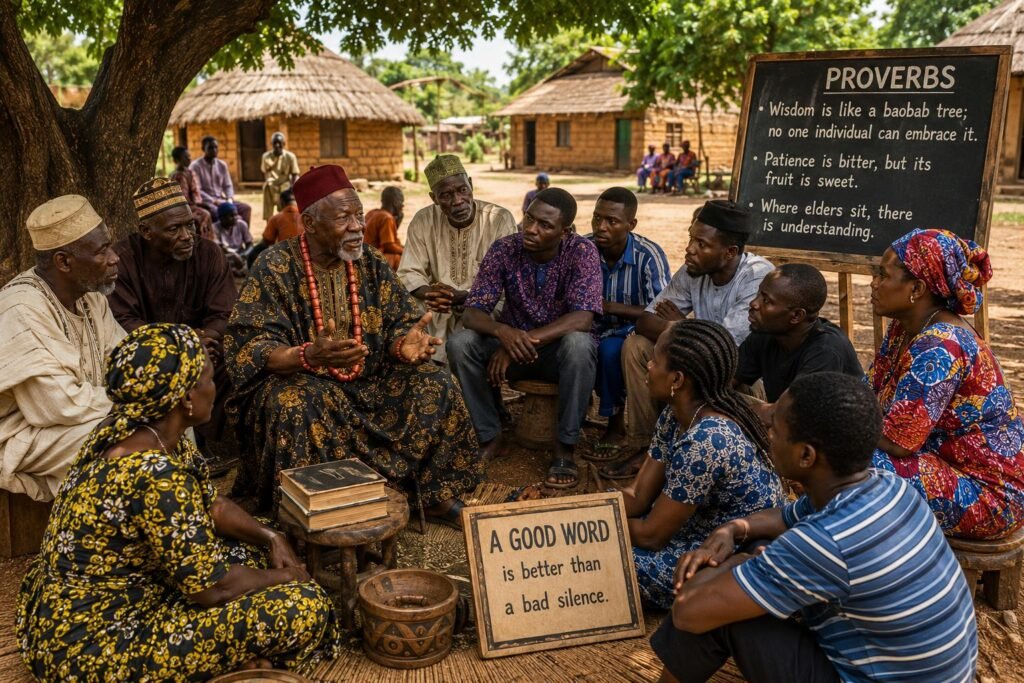
Proverbs are the best way to put forward philosophy in Nigerian culture. They pack wisdom into few words which also include moral lessons and cultural truths.
In the Igbo culture, proverbs are used as “palm oil with which words go down. This is in fact to say that they play a very important role in our mode of communication. Proverbs for Igbo people also serve the purpose of which we speak indirectly, with respect, and in a very intelligent way.
Examples of Nigerian proverbs include:
- A child that washes his hands may sit at the same table as the elders.
- Wisdom is a tree of great size; no man can encircle it.
- What a child can’t see while standing, an elder will see.
These proverbs present to us philosophical thoughts on respect, humility, knowledge, and experience. Also proverbs play a role in maintaining peace by putting an end to harsh argument which at the same time does not sacrifice the important lessons being taught.
Discussion and Conflict Resolution in Nigerian Communities
Communal Dialogue
Dialogue is at the core of Nigerian culture. In many traditional communities they resolve issues through public discussion which includes the elders, family members, or community leaders. This approach is based in the African philosophy which puts social harmony above individual success.
In most Nigerian communities, people get together in forums for each one to put forth his point of view. Issues are for the most part resolved by consensus rather that force. What is aimed at is a repair of the social fabric and not just which party is in the right or which is out of it. Also we see that in which members of the community express their views for resolution of issues that is done in a uniting rather that a dividing way. The community meets as a whole and in that assembly of all, a decision is made with all members’ input which is to heal the community instead of determining the “winners” and “losers.
This philosophical which has stood the test of time influences modern Nigerian society. Families, religious groups, and local organizations still turn to dialogue as a means to resolve differences.
Respectful Communication
Respect is at the core of how communication plays out in Nigeria. We see that younger people are to put forth polite speech to elders and also that leaders are to present themselves as wise and fair.
In some cultures direct eye contact with seniors is a form of respect. Also greetings which are very important reflect on what they believe about human interaction and dignity.
For example:
- Yoruba culture puts great value in kneeling or prostrating during greetings.
- Hausa cultures value reserved and respectful speech.
- Igbo cultures prefer to exchange formal greetings first before getting into serious business.
These precepts present the role of philosophy in day to day actions and social behavior.
Ethical Reasoning and Moral Communication
Morality in Public and Private Speech
Ethical issues play a large role in how Nigerians communicate. We expect that which people will tell the truth, be respectful, and responsible. It is thought that words have power and that what we say may break up relationships and erodes social trust.
In the traditional Nigerian thought which is pro founded in the value of character instead of wealth or status. Also in communication the moral intent behind the words is as important as the words themselves.
Religion plays a role in ethical communication. In Christian, Islamic, and indigenous traditions we see a great deal of stress put on issues of truthfulness, kindness, and accountability in how we speak. Also in Nigeria it is very much the case that which is put forth as right and proper in terms of communication is what is put forward as which will help to maintain peace and social order.
Leadership and Ethical Communication
In Nigerian communities leadership is a philosophical pursuit. Traditional rulers, chiefs, elders, and religious leaders are to be models of wise and honest behavior.
Good leaders are respected for their which of settling disputes, advising the community, and in speech bringing people together. Public speaking is also put forth as a moral duty rather than a political skill.
In today’s Nigeria we see that leaders still draw from culture, proverbs, and philosophy to connect with the public. This is a proof of how past and present thought are connected in our political discourse.
Philosophy and Social Identity in Nigeria
Language and Cultural Identity
Nigeria has a great variety of indigenous languages which put forth philosophical ideas that in turn shape identity and communication. Language in this case is a mirror of how communities grapple with life, relationships, spirituality and morality.
For instance in many cases the focus in Nigerian languages is on collective as opposed to that of which there is extreme individualism instead they present mainly around family, community, and shared responsibility.
Traditional greetings in fact put forth philosophical ideas. We ask about health, family, well-being which is to present the very public rootedness of Nigerian society. Communication is put forward as a means to strengthen social ties as opposed to just the exchange of info.
Community-Centered Thinking
African philosophy puts forth that which makes a person fully human is through their relationships with others. This idea in turn shapes Nigerian communication which in fact encourages cooperation, empathy, and mutual respect.
People are to think of the impact of our words on the greater community. Public shame, honor, and reputation also play large roles in social behavior.
At social gatherings which include weddings, festivals, funerals, and naming ceremonies we see these communication values play out. At such events communities come together to share stories, wisdom, traditions and collective experiences.
Philosophy and Interpersonal Relationships in Nigeria
In Nigerian society interpersonal relationships are shaped by what is for the most part a cultural philosophy which includes respect, family, and collective identity. In which communication between family members, friends, neighbors, and at time even complete strangers we see put into practice shared social expectations that are very much a part of our culture.
In most Nigerian families it is a practice to raise children from a young age to respect elders, to not use offensive language, and to prefer peace in all discussions. These practices are in fact philosophical as they form the base of how we see morality and social responsibility.
Marriage in our culture is also defined by what we put forth in terms of communication. Families we foster patience, wisdom and mutual understanding between partners. Also it is common for elders to step in during conflicts which they resolve with the use of proverbs and moral advice which brings about reconciliation.
Friendship and community association is a product of what we value philosophy wise. In Nigeria we see great importance given to hospitality, solidarity, and empathy. This is why it is common to see people visit neighbors, support relatives, and play active roles in community affairs.
Religion, Philosophy, and Communication
In Nigeria religion plays a large role in philosophy. Christianity, Islam and traditional African religions are the bases for moral issues in speech and interaction.
Religious teachings encourage:
- Honesty in communication
- Respect for authority
- Peaceful conflict resolution
- Compassion and forgiveness
- Wisdom in speech
Religious preachers present parables and proverbs which in turn convey philosophical ideas. Also they put forth ethical precepts and social responsibility in their public instructions.
For instance in many cases Nigerians report that words have spiritual power. That which is put out there like insults, curses, or false accusations is avoided for the fact that it may harm relationships and social harmony.
Religious assemblies also see to it that community dialogue is enhanced which in turn encourages mass participation, counseling, and moral discourse. Through religion philosophical thoughts still play a large role in the pattern of how we communicate in rural as well as urban areas.
Media and Philosophical Expression in Nigeria
The Nigerian media is a reflection of many of our traditional communication values in the face of modernization. In TV shows, radio talks, music, movies, and literature we see put forth issues of morality, leadership, corruption, family values, and social justice.
Nollywood and Cultural Communication
Nollywood which is the name for the Nigerian film industry puts out films that also double as vehicles for philosophy. They deal with issues like:
- Respect for elders
- Consequences of greed
- Community loyalty
- Spiritual beliefs
- Ethical leadership
Characters in many cases use proverbs and traditional sayings which in turn present their wisdom and emotion. This also shows that philosophical communication is very much a part of today’s entertainment.
Music and Oral Philosophy
Nigerian artists also present cultural philosophy through their songs. Traditional and modern artists use lyrics to address social issues, morality, politics, and identity.
Afrobeats, highlife, Fuji, and gospel music are known to put forth issues of perseverance, unity, and ethical living. In this regard music plays a role in that which forages wisdom from one generation to the next.
The Development of Philosophy in Nigeria.
As we see the transformation brought by globalization and technology in our time Nigerian communication patterns are changing very fast. Young people today are more into digital platforms for which communication is of short duration, faster, and less formal.
Also traditional philosophy is very much so today. In Nigeria we see that:
- Respectful speech
- Collective identity
- Moral reasoning
- Family-centered communication
- Community dialogue
Educational institutions, cultural festivals, literature, and indigenous media play a role in the preservation of these traditions for the generations to come.
Also we are seeing an increase in academic research into African philosophy and indigenous communication systems. Scholars are looking at how Nigerian philosophical concepts play a role in global conversations which regard ethics, leadership, peace building, and social development.
Through preservation of our traditional communication methods as we embrace modernization, Nigeria can maintain its cultural identity and put social unity at the fore.
Conclusion
Philosophy shapes communication in Nigerian society. What we say, how we interact, which disputes we resolve in what way and how we put forth ideas is a product of our cultural beliefs, moral values and what has been passed down to us through generations. Communication in this case is more than just the exchange of info; it is a display of identity, wisdom, ethics and social responsibility.
Through the use of oral traditions, storytelling, proverbs, dialogue and ethical reasoning Nigerian cultures present to the next generation key philosophical issues which foster peace, unity, and cultural continuity. Out of respect for elders, in the practice of collective decision making, and in the use of moral speech African societies pass down precepts which in turn inform the leadership and interpersonal relationships that we see today.
Though we see the world being transformed by modernity and globalization which are at play in how we communicate, at the same time it is important to note that our traditional philosophical values are very much a part of our day to day lives in the form of religion, politics, entertainment and what we discuss on social media. These time tested traditions play a key role in what they put forth which is the relevance of philosophy in the structure of our social order and in the definition of our culture.
Philosophy shapes communication in Nigerian society; it is through this that readers can see the in depth nature of the country’s culture as well as the special ways in which language, morality and human relationships are presented out. As Nigeria continues to grow we must also see to it that we preserve these philosophical elements of communication which in turn will do a great job in terms of promoting unity, ethical leadership and cultural pride.
Get more well researched information about how Philosophy Shapes Communication in Nigerian Society here.