Introduction
Forex, also known as the foreign exchange market, is the world’s biggest financial market, and where the currencies of countries are traded against each other with a global network of financial institutions, foreign exchange brokers, businesses, investors and other market players. Forex trading is different from a regular stock exchange in that trading are not conducted in a central exchange, but instead through a series of interconnected electronic exchanges. This can cause market trading to seem complicated for novices, especially as the technology linking traders to currency markets function generally in the background. Today, the forex trading platforms have made this easier by offering a trading platform for users to view the prices of various currencies, analyze charts, manage their accounts and place trades. Even if you don’t have a detailed knowledge of the infrastructure behind the international forex market, you can better understand them if you know how they operate.
What is a Forex Trading Platform?
A forex trading platform (also known as a trading server) is software that enables a trader to engage in a trading transaction with the foreign exchange market via a broker or other trading service provider. A retail trader typically connects to a trading platform, which is the primary link between their trading account and the broker’s trading platforms. A retail trader does not normally communicate with the liquidity providers or banks, but rather through the platform between his account and the broker’s trading platforms. It shows the current rates of the available currencies as well as other information about the market; it also offers tools that can be used to analyze potential trades and manage positions. A platform can be accessed via desktop application, web browser or mobile device, depending on the provider. Platforms may differ in their designs and characteristics, but all serve a basic function: “making financial and technical process into interface that individual trader can play”. There are systems behind every button, price update, chart and order confirmation that process information and communicate the instructions to trade.
Understanding Currency Pairs
Forex trading is done in pairs of currencies since one currency is converted against another. The pair EUR/USD is a combination of the euro and the US dollar, GBP/USD is a combination of the British pound and the US dollar. The first currency is called the base currency; the second currency is called the quote currency. For a platform that shows a currency pair, the price will be the amount of the quote currency needed to acquire one unit of the base currency. In this case, EUR/USD would be seen as 1.1000, meaning that one euro is worth 1.1000 USD. Major, minor and sometimes exotic currency pairs are the most common ones available on platforms. Specific pairs may vary depending on the broker, the market they have, and prices are subject to fluctuation as market participant’s trade currencies.
Bid and Ask Prices
The initial idea that a beginner will come across on the forex trading platform is the bid/ask spread. In general, the bid is the price that a trader can offer to sell a pair of currencies. The difference between these two prices is called the spread, and is typically shown along with both prices. One of the costs associated with trading is the spread and this can vary from one currency pair to another, depending on market conditions, liquidity and the trading provider. In times of market activity, spreads can be relatively tight for the most traded currency pairs, and market conditions can be abnormal and cause spreads to widen. A platform which is constantly updated and updated with the bid and ask prices, so that traders can see the price they are able to get before they place their order.
How the Platform get Market Data Feeds
Forex trading platforms rely on market data feeds to get real-time information on the prices and conditions of the currencies. A broker gets pricing information from one of its connections in the trading process, liquidity provider, financial institutions, electronic communications network or other sources. The info is then handled by the broker’s systems and is later on offered on the broker’s trading system. If the price of the currency changes, the platform can get a new quote and show it to the trader in a matter of seconds. Depending on the platform, market data might encompass historical prices, charts, trading volumes or other data related to the markets. These feeds are important due to the fast and dependable pace at which they are produced, as the prices on forex are volatile. The price of a retail platform is however not a universal price for the entire forex market, as there are other liquidity sources and prices in the decentralized market.
Exchange Interfaces and Platform Attributes
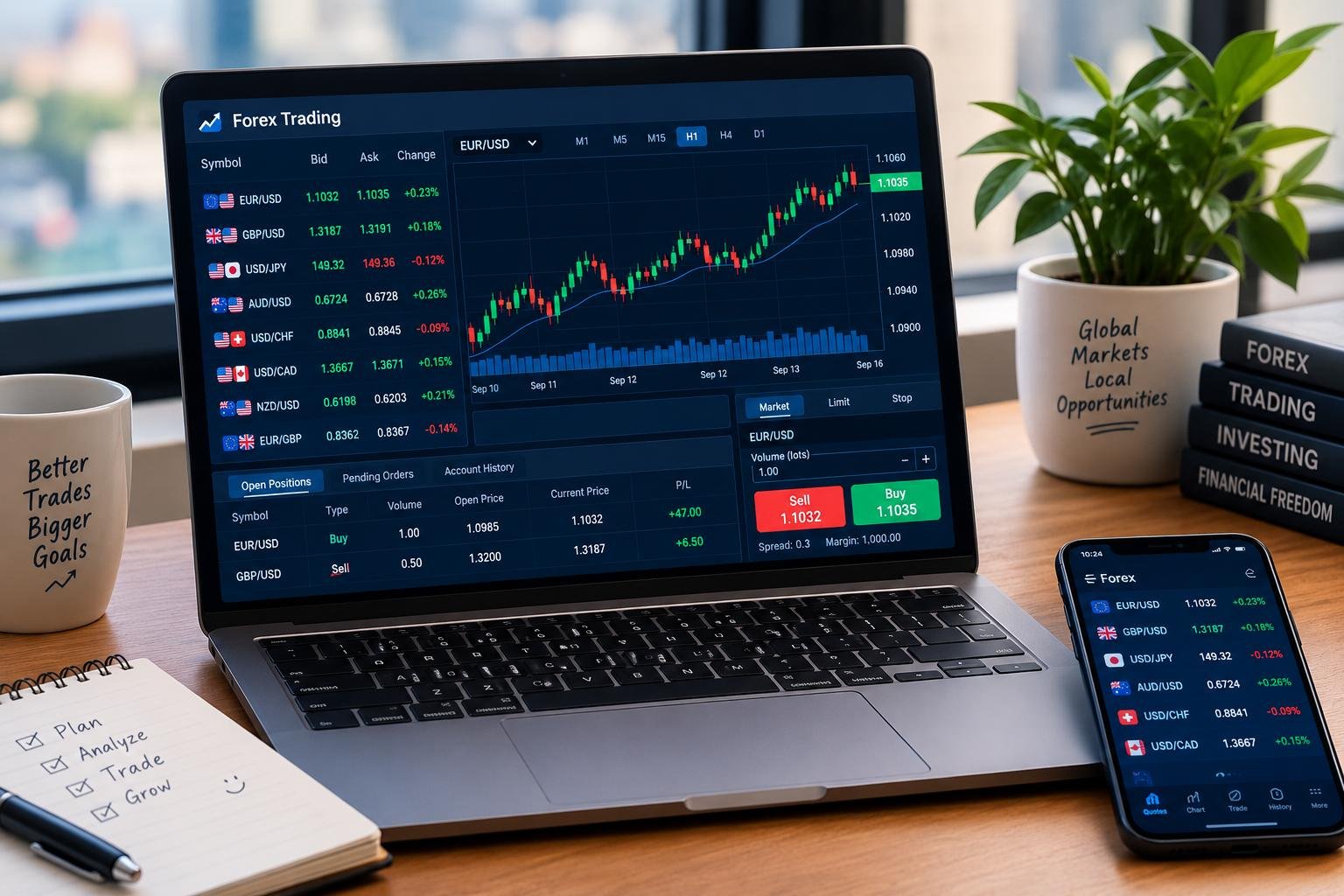
The trading interface is the component of the trading platform which traders interface with directly. It’s common to have a list of currency pairs, live bid and ask prices, charts, order entry windows, an open position list, account balances, and transaction history. These features enable traders to keep track of the market and manage their accounts from a single place, instead of reaching out to various financial institutions individually. Numerous platforms also provide the flexibility to get customized setup of their workspace, letting users decide their currency pair, chart layout, technical indicators, periods and more analytical tools. Mobile platforms can offer some of the same services, but in a smaller window, and let users keep track of accounts, make orders from their smartphones or tablets. Platforms may look and feel very different, but their interfaces work to translate information and trading activities into usable tools for novice traders to learn without engaging with the actual financial technology.
How Forex Orders Work
Any buy or sell order is submitted by a trader when he/she wants to buy or sell a forex position. Typically, they offer a variety of order types, which may differ between platforms and individual brokers. A market order is typically issued by a trader when they want to buy or sell a security at the price they’re able to get in the current market. The difference between the two is that a limit order lets a trader determine the price at which the order will be executed; a stop order can be programmed to be activated when the market hits a given price point. Traders can also employ stop-loss and take-profit orders to help execute trades based on specific conditions, Order once platform send order to broker’s execution system.
What Happens When a Trade is placed?
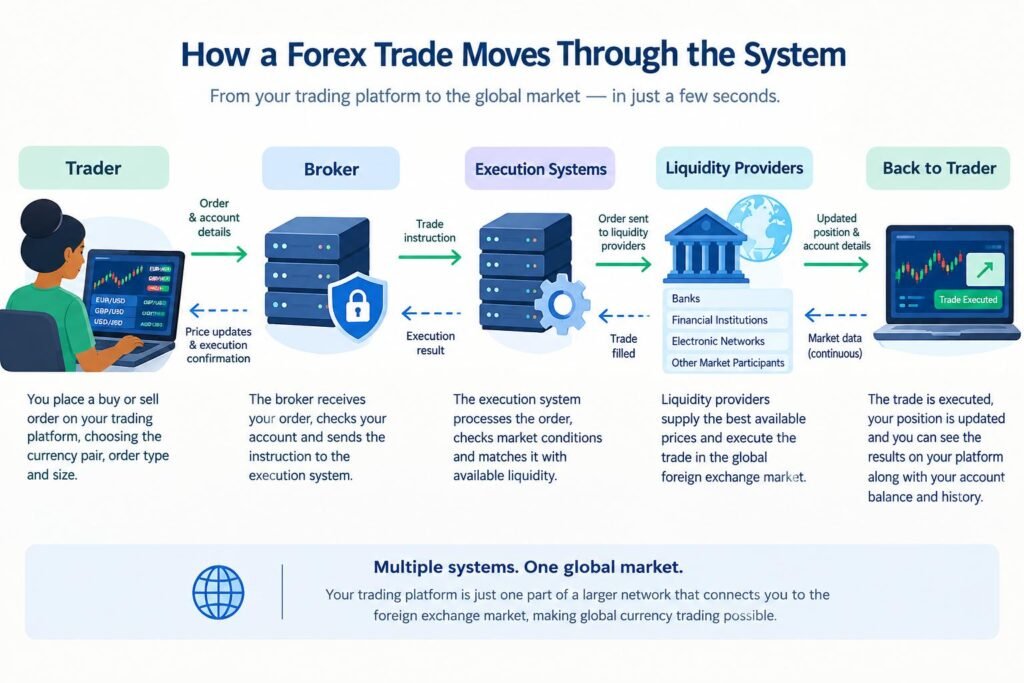
The steps involved in the process that start when a trader clicks a buy or sell button are several technological processes. The platform stores the trader’s order and account details, such as the currency pair, order type, order volume, and price conditions, if any. The platform logs the trader’s order and account details, including currency pair, order type, order size, and price conditions. These instructions are subsequently passed on to the relevant execution system via the broker’s systems. An order can be processed against the liquidity of one or more counterparties, or can be processed in another way made by the broker. The system monitors certain conditions and evaluates if the order can be fulfilled. Once executed, the position is added to the trader’s account and they can see it on the platform. This may occur rapidly, but it’s not always ensured that it will be executed at the exact price that can be seen at the time the order is placed as prices could change in between the order placement and execution.
Charts and Technical Information
Another significant aspect of today’s forex trading platforms is charting. They transform historical and real-time price data to visual representations that traders can analyze for market trends. Different time frames, from very short to several months or years, may be shown, and different types of charts such as line charts, bar charts or candlestick charts may be provided on a platform. Technical indicators and drawing tools can also be added to analyze price patterns, trends, and momentum, or other market characteristics of the trader. These tools are not a guarantee of what a currency pair will do in the future but they do present market information in a manner that could potentially aid traders in analysing price action. The first step to chart reading for beginners is to know the basics: price, time, highs, lows and the buying/selling price. The platform provides the visual data and the trader makes the decisions as to how to interpret the data.
Accounting Management and Trade Records
Forex trading platforms also serve as account-management systems. Typically, users must first open a brokerage account, go through verification processes and deposit money into the account based on the broker’s specifications before they can start trading. After the account is active, the site can present vital facts like margin, open positions, accounted equity, available capital, unrealized loss or gain and transaction history. The features are designed to assist traders in keeping a track of their trading activity and the impact it has on their account. Users can also deposit or withdraw money and adjust their account settings, as well as view statements and control their risk parameters, on the platform or within a connected account management portal, depending on the provider. It becomes crucial to understand these features because forex trading is conducted in a lot of retail environments utilizing leverage, which can magnify both win and loss. It is therefore important for the beginners to know about the money risk involved in trading, account balance and margin requirements before they place any real money order.
Execution Systems: The Role of the Execution Systems.
Once the trading instructions are no longer visible on the platform’s user interface, they are passed to the execution systems for processing. These systems are optimized to deal with high volumes of price updates and orders, and to talk with liquidity providers or other components in the broker’s trading network. If an order comes in, then the system will process the information that includes the currency pair, the quantity of the order, the order type and the conditions where the order should be executed. The final outcome is determined by the infrastructure of the broker, the liquidity in the market and the prices that are present. The process can be very quick with technology, but that won’t eliminate market risk. The price may fluctuate significantly, especially when major economic announcements are made, liquidity is low or when there are any unforeseen developments in geopolitics and finance. It also depends on the market conditions and broker to broker. As such, novices need to be aware that the price that is displayed on a platform isn’t a promise of the actual price, and that hitting a button doesn’t necessarily mean that they will get an immediate result.
How the Different Systems work together
A forex trading platform is just a component of an extensive technological network. The platform is used for the user interface, market-data systems give prices, account systems keep balances and transaction records, and execution systems process trading instructions. Liquidity providers and financial institutions shape the overall market, where transactions take place in the form of currency. These are all linked by communication networks which enable information and instructions to flow between systems. Traders may think that this is an easy process: They pick a currency pair, pick the order, pick a size, and enter a trade. But there are several automated systems communicating in just a matter of milliseconds behind the action. This multi-layered system is what makes it possible for retail traders to enter into a global financial market without having to establish direct trading connections with banks or be familiar with all the technical details.
Selecting and Utilizing a Platform Appropriately
If you are a beginner, you should not only learn the location of buy and sell buttons on a platform you are using, but also understand how it operates. It is important for users to look at the broker that offers the platform, markets available, fees and spreads that may be incurred, account requirements, security features, and any available educational materials. It’s also crucial to know if a platform is regulated or licensed in the jurisdiction as well as know the risks involved in leveraged foreign exchange trading. If you’re a novice, you can make use of a demonstration or practice account to get to know the charts, order windows, account balances, and navigating the platform prior to investing real cash. Traders also need to ensure that they are keeping their account information secure, and that they are using proper security measures. While a well-designed interface can make trading more easily, it may not ensure that it is foolproof. Whether, when and how much to trade is left to the individual user, and access and execution is provided by the technology.
Conclusion
Forex trading platforms have become a significant advancement in the trading world, integrating various elements of the foreign exchange market into one digital environment. The novice can identify currency pairs, check the bid/ask level, analyze charts, choose an order type and place a trade, without even having to deal with transactional systems, communication networks, liquidity providers and banks behind the platform. Once you understand this process, online currency trading doesn’t seem to be a mystery anymore, as every facet that you can see has a technological function. Simplicity and safety are not the same as accessibility, however. Forex prices may fluctuate rapidly, conditions for their execution can differ, users may lose a lot of money in leveraged trading. Understanding how the platform works is thus a key initial step, but it is also essential for a responsible participation to know the costs, the risks of the market, the management of the accounts as well as the conditions under which orders are executed.
Get more well researched information about How Forex Trading Platforms Work here.