Introduction
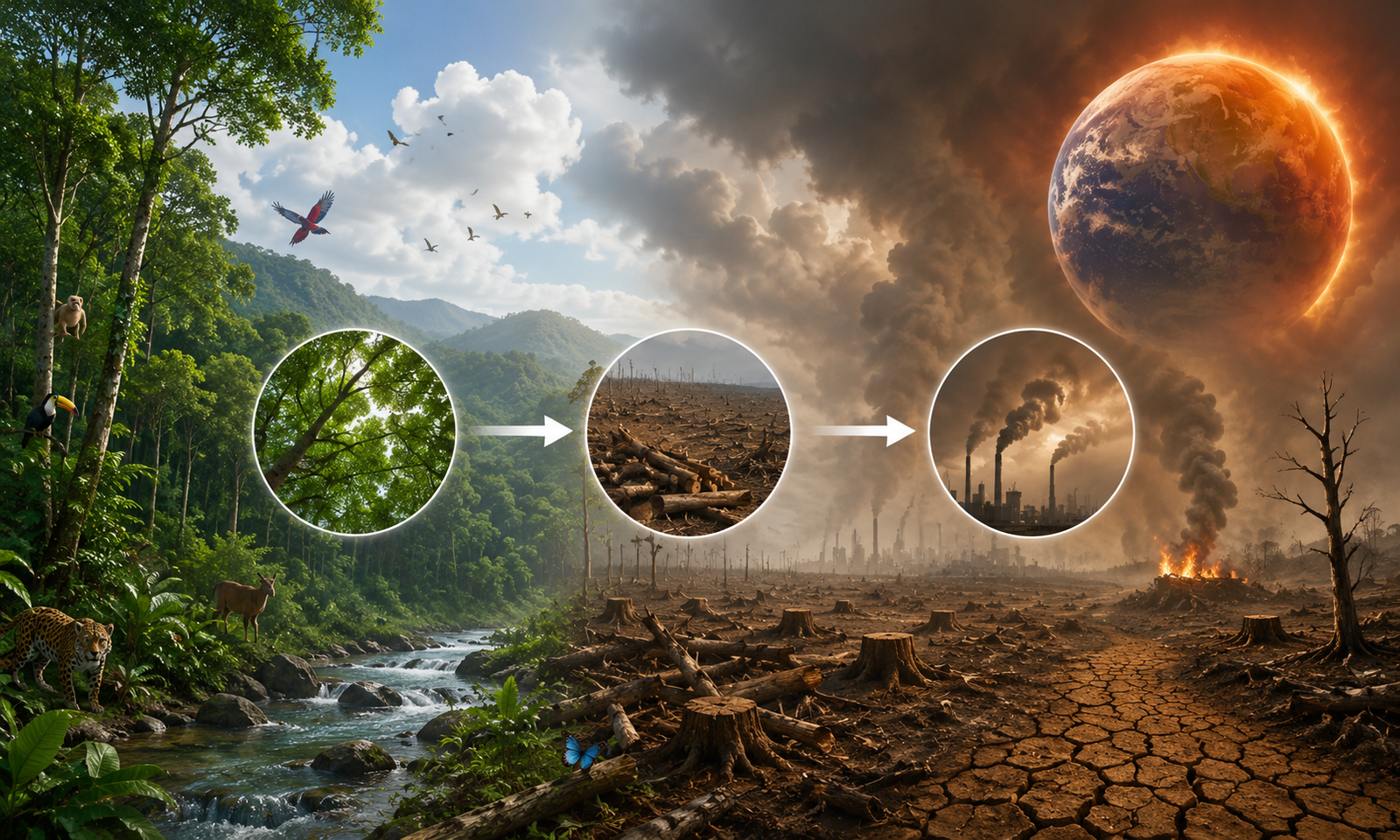
Deforestation is the extensive clearing of forests, usually to farm or city lands, log or mine. Forests are usually regarded as inexhaustible resources, but they are an integral part of the environment for its stability. They help sequester carbon, keep water warm, promote biodiversity and help promote soil structure. Forest destruction has a worldwide and multiple impact on landscape and the environment and is hard to manage, causing larger environmental impacts than the sheer tree removal. The loss of forests is one of the largest contributors to global climate change from the storage of carbon dioxide and a decrease in the Earth’s ability to sequester carbon in the form of forests. Further, deforestation exacerbates the declining condition of biodiversity and undermines soil health, increasing ecosystem fragility and risk. A proper understanding of these interconnections is key in designing action plans and solutions in the long term that foster environmental sustainability and responsible land use.
Deforestation and Carbon Emissions
Increased carbon emissions is one of the fastest and direct impacts deforestation has on climate change. During photosynthesis, trees take up carbon dioxide from the air and store it in their tissues (roots, leaves, branches and trunks). Loss of forests through cutting or burning unlocks this carbon and adds to the amount of GHGs in the atmosphere. This process is particularly bad in tropical rainwater-lands in which very large quantities of carbon are stored. The disappearance of these forests not only releases carbon from the atmosphere, but also degrades an ability to capture new carbon. This has led to greater global warming rates, worsening effects of climate change like temperature and rainfall changes and extreme weather events, and increased deforestation. The further trees are lost, the greater the emissions, which raises the temperature, increasing the pressure on the remaining forests.
Deforestation, Biodiversity Loss and Ecosystem Collapse
Forests are the most bio-diverse ecosystems on the Earth accounting for millions of animal and plant species. Deforestation leads to splitting up or complete loss of such habitats, and wildlife are forced to travel, evolve or die off. Every species contributes to ecosystem balance – either by pollinating or dispersing seeds or controlling pests – and its removal upsets the natural equilibrium. The loss of biodiversity also decreases the resilience of the eco-systems, which means that when faced with stressful factors in the environment (climate change, drought, disease, etc.), they are less resistant and less resilient to change. Wherever there are trees being felled, endangered species that are unable to live outside their environment disappear forever. As the diversity of species declines over time, so do the people’s dependence on specific ecosystem services of the forest, like clean water, fertile soil, or food supply.
Scarification of soils that leads to soil productivity.
Another critical environmental impact of deforestation is soil degradation. The contribution of trees and forest vegetation in maintaining soil structure by stabilizing soil and regulating the moisture, organic carbon through decomposing leaves and plant material is very important. Loss of forests exposes soil to direct sunlight, strong wind, causing rainfall run-off and nutrients loss. This has a cumulative effect which results in depletion of soils’ fertility, less fit for cultivation over the years, and less favorable for natural regeneration. In many deforested areas soil degradation and compaction may lead to desertification whereby the once fertile land is parched and can no longer produce vegetation. Not only does it have a negative impact on local ecosystems, but it also has ramifications for communities that rely on agriculture for a living. Once land has lost its fertility, it will bring long-lasting economic and environmental problems, since the degraded land needs extensive rehabilitation before it’s able to be productive again.
Climate Change Feedbacks and Environment Factors,
Deforestation not only leads to climate change, but can also amplify feedback that exacerbates environmental instability. With rising global temperatures, more greenhouse gas emissions affect forest ecosystems and increases vulnerability to drought, wildfire, and pest outbreak. These disturbances further aid in deforestation, freeing up even more carbon into the atmosphere. Furthermore, less forests affect the local and regional climatic system and change the precipitation patterns by lowering the moisture level in the atmosphere. This can result in continued dry spells in certain areas and in excess runoff elsewhere. Forest ecosystems also help to keep the earth cool; when these ecosystems are lost, so are the mechanisms that keep the earth cool. The process of deforestation and climate change impacts one another, and we see here how these negative cycles can become deeper and deeper, and harder and harder to reverse globally without concerted action.
Sustainable forestry practices and resource management
Responses to deforestation can involve changing land use practices and adopting new forest management policies that are both economically viable and environmentally friendly. An effective method is to use a controlled system of harvesting trees that are chosen rather than clear-cutting, thereby enabling the ecosystems to naturally regenerate. Also, regrowth of harvested areas and the conservation of biodiversity corridors diminish ecological imbalance. The forestry sector is also encouraged by certification systems and environmental guidelines to make responsible practices. The practices of responsible approaches can be discussed further through sustainable forestry practices, which emphasizes the ways in which forests can be used in a way that will ensure their productivity and preserve their ecological integrity. The key principles of sustainable forestry are planning for the longer term, engaging in the community, and implementing policies that aim to minimize damaging uses of the forest while maximizing its economic value. These strategies have the potential to lessen the impacts of deforestation to the benefit of society and the environment while retaining some of the services forests offer our world.
Forest Management and Re-forestation Projects.
Forest Regeneration is a major factor to undo the impact of deforestation. These programs are based upon planting trees in areas where forests have been removed to restore an ecological balance, reproductive capacity for carbon sequestration and rebuilding wildlife habitat. Sometimes reforestation is done with native species to restore ecosystems as close to their natural composition as possible, therefore rewarding good biodiversity protection. Increasing forest cover—through afforestation activity—also plays a role in increasing forest cover globally. Planning is essential to reforestation, including restoration of soil, choice of species and long-term care of trees to ensure survival and development of the forest ecosystem. Whereas communities are often a key requirement; they have the potential to help maintain and protect new forest plantings. Overall, reforestation should not be viewed as a panacea for old growth forest, however, it is an important resource in the mitigation of climate change and as a way to help recover landscapes where they have been degraded.
Conclusion
Deforestation is a daunting and significant environmental problem that has profound implications for climate stability, biodiversity, soil health and ecosystem resilience. One of its effects is that it contributes to carbon emissions which fuel global warming, and habitat destruction results in significant loss of species and ecological imbalance. Meanwhile, soil degradation impacts agricultural production, and is compromising the sustainability of the land. They are all interlinked effects, emphasising the need for integrated solutions that have an action of both prevention and restoration. These include sustainable forestry, responsible land management and reforestation efforts, each of which has a significant impact on the decrease of environmental impacts and on ecosystem recovery. To make it succeed, however, it will take some coordination between all three stakeholders – governments, industries and the local communities – in protecting and managing forests in a sustainable way. When forest policy takes into account the importance of forests in supporting life on Earth, society can begin to pursue more sustainable pathways toward development, protecting natural resources for future generations.