I remember the first time I realized just how powerful a well-timed, personalized email could be in healthcare.
Years ago, my grandfather was navigating a complex treatment plan. Everyone, including our entire family, was overwhelmed with information.
Then, one morning, he received an email from his doctor’s office. It wasn’t a generic follow-up. It mentioned specific questions he had raised during his last visit. And it offered resources directly related to his condition.
This is what you call personalized email outreach. Personalized messages build trust, show empathy, and ultimately improve patient outcomes, but scaling this level of personalization is where the real challenge begins.
But with so many patients, how can healthcare professionals manage email outreach without spending hours personalizing messages for each recipient?
AI-powered automation may be just what you need. In this blog, we’ll explore how AI can elevate healthcare email outreach for a more positive patient experience.
What is AI-Powered Automation?
Artificial intelligence is a technology that enables machines to mimic human intelligence. So, AI can essentially do certain things humans can do, of course, to a much lesser extent. It can learn, reason, and sometimes solve complex problems.
AI technology can also analyze data, identify patterns, understand language, and make recommendations.
While AI enhances personalization, credibility also plays a key role in healthcare outreach, starting with something as simple as a professional email domain.
When combined with AI-powered automation, these emails can be further personalized, adapting the content to individual recipients’ needs and interests.
A professional email domain, alongside tailored AI-driven content, enhances the perception of professionalism, reassuring recipients that they are engaging with a legitimate and responsible healthcare provider.
AI-powered automation combines AI technologies such as machine learning, natural language processing, and predictive analytics to create systems that perform tasks more efficiently.
Because of these capabilities, healthcare providers can use AI to personalize email outreach.
Whether you’re sending tailored appointment reminders or specific health tips, you can use AI to engage your patients and show that you understand their unique needs.
The ultimate result is being able to send the right message to the right person at the right time, like this personalized birthday message from a dental office in Atlanta.

Screenshot provided by author
Another valuable feature AI brings to the table is the ability to analyze patient data to understand patient behavior and preferences. This allows it to predict the best times to send emails and determine the most relevant messages.
When building an email newsletter, this information is critical.
Benefits of AI Automation for Email Outreach
AI automation is a no-brainer for healthcare email outreach for several reasons:
- Save time on big campaigns: AI-powered tools can schedule emails, organize contact lists, and automate sending, making large campaigns easier to manage. At the same time, these tools help refine bulky text into concise, engaging messages, which is especially important when communicating with busy healthcare professionals.
- Get to know your audience better: AI digs into subscriber behavior, like email opens and clicks, to help you understand what types of messages your audience cares about. As a result, you can send messages that are more likely to resonate with your email list.
- Target specific segments: With AI, you can segment your audience by age, medical history, or past engagement. This lets you send relevant, personalized messages that truly speak to each group’s needs.
These benefits are the foundation of a winning email newsletter. In healthcare, your newsletters can feature a broad range of topics, interviews with specialists, medical breakthroughs, and more. Audience segmentation and targeting are vital to your newsletter’s success. They’re also impossible without AI-powered automation.
Understanding the Need for Personalization in Healthcare Email Outreach
Tailored communication is important in healthcare because it helps foster trust and makes patients feel valued. Healthcare is personal. And people often need reassurance that their provider is addressing their unique concerns.
Personalized messages can highlight specific health needs, preferences, and treatment plans, which creates a deeper connection with patients.
According to a 2023 meta-analysis by the Journal of Patient Experience, digitally enabled personalized outreach can help providers deliver a more personalized patient experience.
Plus, studies show that 56% of consumers will return to a business that provides a positive, personalized experience.
And last but not least, emails with personalized messages have an open rate of 18.8% and a clickthrough rate of 2.1%.
But it’s not that simple to achieve this level of personalization. When trying to personalize email outreach, some healthcare providers run into obstacles like:
- HIPAA compliance: Incorporating AI-powered automation into email outreach to healthcare professionals entails a heightened responsibility to prioritize data privacy. Healthcare data is highly sensitive, and even a small oversight can lead to compliance violations, including HIPAA breaches. These incidents can damage trust and expose your organization to costly lawsuits. To protect assets from litigation, you must conduct regular audits of your AI systems, train employees on data privacy best practices, and enforce strict consent management protocols. Establishing a culture centered around data protection safeguards your organization and enhances client and patient trust.
- Data access and integration: Patient data can be stored in multiple places. This makes it difficult to gather and analyze all that information to create targeted, personalized messages.
- Patient consent: Before sending personalized newsletters, you must have explicit consent from patients to communicate with them via email.
- Issues with segmentation: For the most impactful healthcare email newsletters, it’s best to divide your patient base into meaningful groups. This involves segmenting based on health conditions, demographics, and engagement history. This can be difficult to do due to privacy constraints.
- Content creation challenges: You need careful planning and expertise to create compelling content that resonates with each patient group.
- Email deliverability: Email deliverability can make or break any healthcare professional’s outreach efforts, regardless of how well-crafted their messages are. One of the most overlooked technical challenges stems from limitations in SPF records, which can quietly sabotage even the most thoughtfully personalized campaigns. To address technical deliverability issues, tools like SPF flattening solutions help ensure emails reach recipients reliably by simplifying DNS configurations. Instead of wrestling with technical constraints, you can focus on what truly matters—connecting with your recipients through meaningful, personalized communication.
When you appropriately address the legal and individual concerns regarding patient privacy, you build trust with your audience. Nothing is more important in healthcare.
Personalization Strategies Enabled by AI
AI personalization allows healthcare professionals to deliver tailored communication that resonates with patients (read: personalized subject lines).
One of the most effective ways to apply this is by using individual preferences and past interactions in email newsletters.
For example, personalization in healthcare outreach doesn’t stop at names or job titles. If you’re targeting students or early-career professionals, understanding where they’re coming from matters just as much. Platforms like Portage Learning offer flexible online science courses that many pre-health students rely on, which gives you a clearer picture of their goals and timelines.
That kind of context helps you tailor messaging for education paths, prerequisites, or career transitions rather than sending generic outreach. It makes the communication feel far more relevant and timely.
This email is from a veterinarian’s office. It personalizes the message for the furry patient by stating that she’ll be due for her next check-up in 1 year.

Screenshot provided by author
Dynamic content personalization is another great strategy. With this type of personalization, the content of an email changes depending on things like the recipient’s age, interests, or medical background. For example, let’s say you have a female patient.
Her care needs include an annual physical, a mammogram, and a flu shot. So, you could send personalized emails for each need:
- An email with a link to set up an appointment for a physical
- An email reminding her about her upcoming mammogram
- An email to book a flu shot at a local pharmacy or your office
Or, for example, if you have data showing that your customers are interested in learning more about Zepbound for weight loss and the types of food they could consume while taking the medication, this is the type of targeted, relevant email you would send, as shown in the example below:

Image source: Form Health email
You can also use machine learning to determine the best times to send emails, ensuring your messages reach recipients when they’re most likely to engage.
To bring these capabilities together in one place, tools like Rasa help automate and personalize email campaigns while keeping them on-brand.
What you can do with rasa.io:
- Engage subscribers: Create truly personalized email newsletters that keep your audience interested.
- Save time: Put your email newsletters on autopilot and let Rasa do the heavy lifting for you.
- Automation with control: Aggregate, automate, and curate content while still having oversight. Set your scheduling software and let Rasa deliver.
Creating Engaging Email Newsletters With Rasa
To craft healthcare newsletters that keep readers engaged and informed, consider including relevant articles, actionable tips, and the latest industry news.
You should also design your newsletters for engagement. Use clean layouts, eye-catching images, and bold headlines to grab attention.
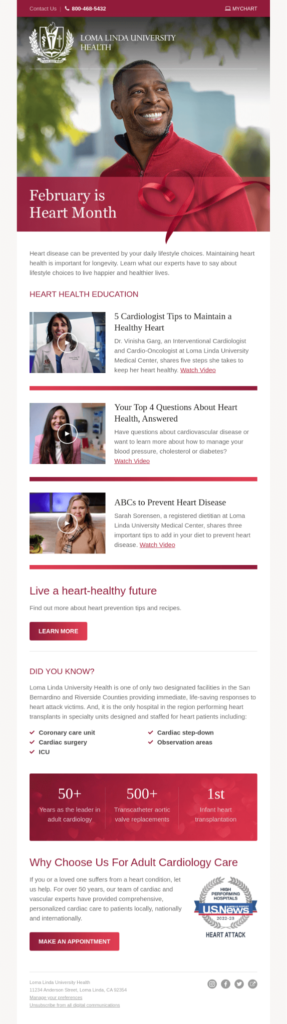
Break up content into easily digestible sections. And make sure every newsletter includes a clear call to action (CTA) like this one from Loma Linda University.
Don’t have the time to craft a newsletter your patients will love?
With Rasa, you can automate content selection based on each subscriber’s interests. As they engage with content, Rasa’s AI learns what they like, so you can personalize future newsletters with articles they’re most likely to read.
Set your schedule and let Rasa handle the timing. That way, your content reaches your audience when they’re most likely to engage.
Overcoming Challenges in Implementation
Implementing AI for email outreach can be a great way to improve the patient experience. But there are a few hurdles to consider:
- Privacy and compliance: AI brings tremendous value to email personalization in healthcare, but it also raises concerns about data protection. Ensuring robust AI data security is crucial for safeguarding sensitive patient information and maintaining compliance with strict regulations. Healthcare organizations can prevent data breaches and build trust with their audience by identifying potential vulnerabilities and implementing proactive security measures. Prioritizing data security ensures that AI tools enhance outreach efforts without compromising confidentiality or exposing sensitive information.
- Choosing the right tool: Find an AI solution that integrates easily with your current systems, such as electronic health records (EHRs) and customer relationship management (CRM) tools.
- Getting the team on board: AI can feel like a big change, so training is key. Give your team a chance to explore the new tools and understand how AI can make patient outreach easier and more impactful.
Real-World Success Stories
Still not convinced about the power of AI to help you streamline patient outreach?
Check out these case studies.
AcademyHealth, a healthcare research organization, wanted to engage its community members in a relevant, personalized way.
It used Rasa’s AI-powered email news brief to deliver important industry information to its entire community.
Results: AcademyHealth saw unique weekly open rates between 45% and 55%, an average open rate of 49%, and an average clickthrough rate of 16%.
The Healthcare Financial Management Association (HFMA) has over 110,100 members. These include:
- Healthcare finance leaders
- Professionals from hospitals and health systems
- Provider organizations
- Physician practices
HFMA wanted to increase engagement with its members.
Using Rasa, HFMA members receive relevant industry news automatically in their inboxes every day.
Results: HFMA saw an increase in open rate to 45% and a click rate of 29%.
Future Trends in AI and Email Outreach for Healthcare
So, what does the future hold for AI and email outreach in healthcare?
New AI technologies, such as predictive analytics and advanced natural language processing, will soon make email even more personalized and intuitive.
Using these tools, you can predict patient needs based on behavior, location, or even social trends. This could make communications even more relevant and timely.
Also, thanks to AI’s fast growth, healthcare email newsletters will become easier to automate and more customized for patients. Expect more dynamic, hyper-personalized emails that adapt to each subscriber’s preferences and learn from real-time interactions.
The future holds more integrated, seamless communication channels that foster deeper connections and patient outcomes.
Conclusion
I was surprised by how much AI could elevate the personalization of healthcare emails. What stood out to me most was the ability to adjust content based on subscriber interactions.
This is huge for healthcare providers who want to deliver a more consumer-centric experience. Just as retailers personalize shopping experiences, your practice can tailor communications to patients’ needs.
And you can do this without the constant manual effort it typically takes to personalize each newsletter, especially when using the right tools.
If you’re ready to apply these strategies in practice, Dutable can help streamline your email personalization efforts.
About the author: Britney Steele

Born and raised in Atlanta, Britney is a freelance writer with 5+ years of experience. She has written for a variety of industries, including marketing, technology, business, finance, healthcare, wellness, and fitness. If she’s not spending her time chasing after three little humans and two four-legged friends, you can almost always find her glued to a book or awesome TV series.