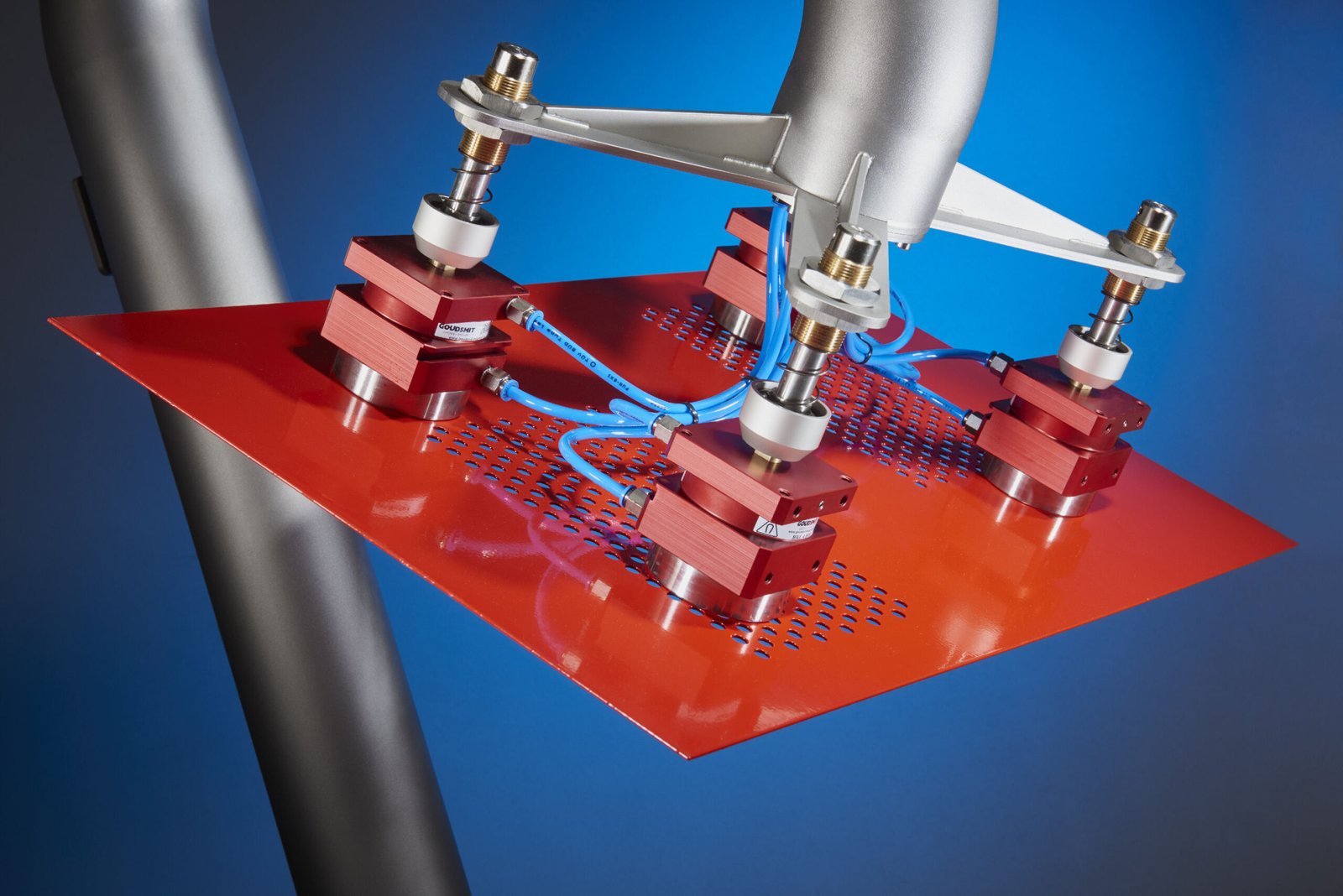
Material handling has always been one of those deceptively simple tasks in manufacturing. Pick a part, move it, place it. Sounds easy, right? But anyone who has worked on a shop floor knows how quickly things get complicated. Different shapes, different weights, high cycle times, and the constant need for reliability. That’s exactly where a magnet gripper starts making a serious difference.
Traditional gripping methods rely on mechanical fingers, vacuum cups, or pneumatic systems. They work well, sure, but they also introduce limitations. Wear and tear, alignment challenges, inconsistent grip, and sometimes just unnecessary complexity. A magnetic gripper, on the other hand, changes the dynamics entirely by replacing mechanical force with magnetic attraction.
So, let’s unpack this properly. What makes a magnetic gripper so effective in material handling? Where does it outperform other technologies? And why are modern robot gripper systems increasingly leaning toward magnetic solutions?
Understanding the Basics of a Magnet Gripper
At its core, a magnet gripper is exactly what the name suggests, a gripping device that uses magnetic force to hold objects. Instead of clamping or suction, it generates attraction toward ferromagnetic materials such as steel or iron-based components.
This simple shift in principle has major implications. Since there are fewer moving parts involved, the gripping action becomes inherently more stable and predictable. There’s no need to worry about jaw alignment, surface contact pressure, or vacuum leakage.
In practical terms, a magnetic gripper allows robots to pick and place metal parts with remarkable speed and consistency. And that’s a big deal in high-throughput environments.
Why Traditional Gripping Methods Face Limitations
Mechanical grippers are widely used, but they’re not perfect. They depend on physical contact, which means:
- Components experience friction and wear
- Grip force must be carefully calibrated
- Irregular shapes complicate holding
- Delicate surfaces risk damage
Vacuum grippers come with their own challenges. Porous surfaces, dust, leaks, and dependency on compressed air can create reliability issues.
Over time, these factors impact productivity. Even minor grip inconsistencies can disrupt cycle times or cause part drops. That’s where a magnetic gripper starts looking less like an alternative and more like a logical upgrade.
How a Magnetic Gripper Improves Material Handling Efficiency
Efficiency in automation isn’t just about speed. It’s about repeatability, uptime, and minimal intervention. A magnetic robot gripper directly contributes to all three.
First, engagement is almost instantaneous. The moment the gripper approaches a metal part, magnetic attraction does the work. No mechanical closure delay, no pressure buildup, no waiting for vacuum stabilization.
Second, there’s reduced mechanical stress. Because gripping doesn’t rely on clamping pressure, part deformation risks drop significantly. That’s especially useful when handling thin sheets or precision components.
Third, maintenance demands shrink. Fewer moving elements mean fewer wear points. That translates into less downtime and more predictable performance.
Magnetic Gripper in Robotics: A Natural Fit
Robotics thrives on consistency. The entire value proposition of automation depends on repeatable actions performed with minimal deviation. A magnetic gripper in robotics aligns perfectly with that philosophy.
Robotic arms performing pick-and-place operations benefit from:
- Stable grip without mechanical adjustment
- Faster engagement and release cycles
- Reduced risk of slippage
- Longer operational lifespan
In many applications, switching from traditional end-effectors to a magnetic robot gripper leads to immediate cycle time improvements. Not dramatic, flashy changes, but steady, measurable gains that add up fast.
Electromagnetic Gripper vs Permanent Magnetic Designs
Not all magnetic solutions work the same way. One important distinction is between permanent magnetic and electromagnetic gripper systems.
Permanent magnets provide constant holding force. They’re simple and energy-efficient but require mechanical separation or shielding for release.
An electromagnetic gripper, by contrast, generates magnetism only when powered. That means:
- Grip can be switched on or off instantly
- Release is precise and controllable
- Force levels may be adjustable
- Integration with control systems becomes easier
For automated robot gripper systems, electromagnetic designs often provide greater flexibility, particularly when handling varied part flows.
Speed Advantages in High-Volume Operations
Material handling tasks are often repetitive and cycle-driven. Milliseconds matter. A magnetic gripper eliminates several micro-delays associated with mechanical or pneumatic actuation.
No jaw closing time. No compressed air dependency. No suction stabilization.
That responsiveness allows robotic cells to operate at higher frequencies without increasing system strain. Over thousands of cycles per shift, the productivity difference becomes substantial.
It’s one of those improvements that looks small on paper but feels massive in real production scenarios.
Handling Complex or Irregular Metal Components
Here’s where magnetic gripping becomes particularly interesting. Mechanical systems struggle with irregular geometries. Complex shapes demand customized fingers or adaptive mechanisms.
A magnet gripper doesn’t care much about shape, as long as the material is ferromagnetic and surface contact exists, attraction holds the part.
This makes magnetic robot gripper solutions highly adaptable in:
- Sheet metal handling
- Stamped parts transfer
- Laser-cut components
- Raw stock movement
Less customization means faster deployment and lower tooling costs.
Stability and Reduced Part Damage
Physical clamping introduces pressure points. That’s unavoidable. In delicate components or thin materials, excessive force can lead to distortion or cosmetic defects.
A magnetic gripper distributes holding force differently. The absence of mechanical compression significantly lowers surface stress. That’s valuable when appearance, tolerances, or microstructures matter.
In finishing or pre-coated metal parts, this advantage becomes even more pronounced.
Energy and Maintenance Considerations
People often assume magnetic systems consume more energy. That’s not always accurate. Many electromagnetic gripper designs are optimized for minimal power usage, particularly when holding does not require continuous high current.
More importantly, maintenance overhead typically drops. No seals wearing out. No pneumatic leaks. No mechanical jaw fatigue.
For plant managers focused on long-term operational cost, these factors can outweigh initial equipment considerations rather quickly.
Integration into Modern Robot Gripper Systems
Automation ecosystems today are highly interconnected. Sensors, PLCs, IoT devices, and machine controllers constantly exchange data. A magnetic gripper integrates cleanly into these environments.
Electromagnetic variants especially allow programmable control, feedback loops, and safety interlocks. This compatibility simplifies system architecture rather than complicating it.
In advanced robot gripper systems, magnetic solutions often complement other gripping technologies, creating hybrid end-effectors capable of handling diverse tasks.
Where Magnetic Grippers May Not Be Ideal
No technology is universal. Magnetic gripping depends on material properties. Non-ferrous metals like aluminum or plastics simply won’t respond.
Very small parts, extremely rough surfaces, or applications sensitive to residual magnetism may also require careful evaluation.
That’s why application analysis always matters more than technology hype.
The Expanding Role of Magnetic Grippers in Automation
As industries push toward faster, more flexible production, gripping technology must evolve alongside robotics. The rise of the magnetic gripper in robotics reflects that shift.
Manufacturers are prioritizing:
- Faster cycle times
- Reduced maintenance
- Higher reliability
- Greater adaptability
Magnetic solutions check many of these boxes with surprising elegance.
Final Thoughts: Why Magnetic Gripping Keeps Gaining Ground
Material handling efficiency isn’t built on dramatic breakthroughs. It’s built on removing friction, delays, and failure points wherever possible. A magnet gripper does exactly that by simplifying the gripping process itself.
Whether deployed as a standalone magnetic gripper, an advanced electromagnetic gripper, or integrated into sophisticated robot gripper systems, the benefits are hard to ignore in metal-handling environments.
Less complexity. Faster operation. Greater consistency. And in industrial automation, those three things quietly drive everything.