Introduction
With the rise of digital banking, instant payments, online payments and interconnected financial services, fraud have grown more complex. Organized fraud rings utilize many different individuals, businesses, devices and accounts to move the stolen funds around. They often try to hide their true identities. This can be very hard to detect as each individual fraud transaction looks like a valid transaction. However, with the increase in complexity, financial institutions are looking to implement more sophisticated fraud detection techniques. Using graph analytics, machine learning and AI, financial organizations are able to look at the relationships between different pieces of information to detect hidden relationships and organized fraud.
Understanding Graph Analytics
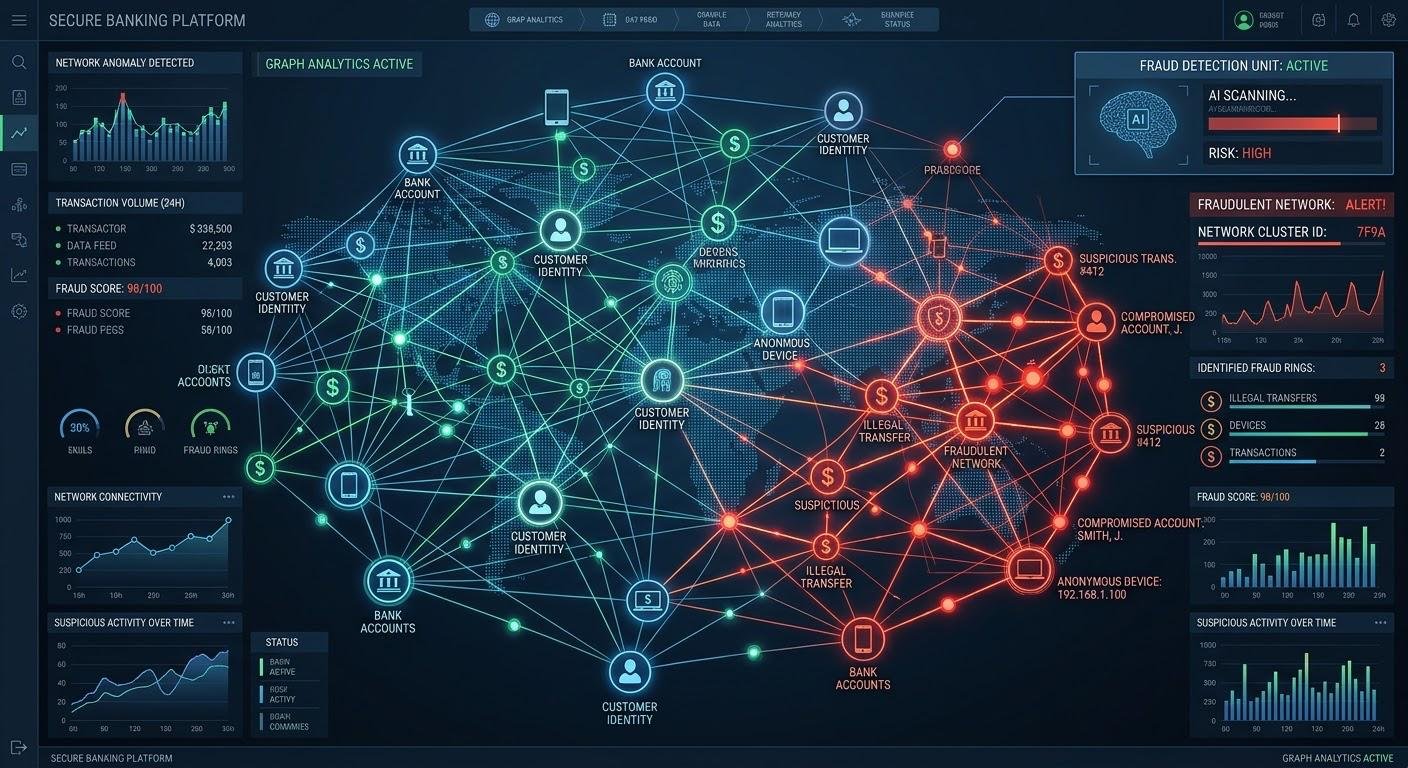
Graph analytics for fraud detection is a technique used to analyze the relationships between different entities. Within the financial industry there are many entities to consider including customers, accounts, cards, businesses, devices, IP addresses, transactions and locations. Each entity is shown as a node with the relationship between them being shown as an edge. For example, you can show how many accounts have received payments from the same customer, using the same device or paying the same business. These would not appear to be connected within a traditional banking system however graph analytics can uncover important characteristics they have in common. This makes it easier for investigators to see how they are connected. With graph analytics financial institutions can detect suspicious patterns, investigate potential fraud rings and understand how the fraudulent funds are moving.
Identifying Hidden Fraud Rings
Traditional fraud detection systems will use set rules to analyze the financial activity within a transaction. They will look at things such as limits, and the risk profile of each individual customer. Whilst this can help detect any suspicious withdrawals, unexpected transfers or payments above a certain limit, it can be challenging if the fraud is spread out across many accounts, institutions or transactions. Graph analytics can help overcome this by analyzing the relationships between the financial activities. For example, showing how many accounts have received small deposits from different sources and then transferring to a common account. Whilst individually they may not look very suspicious, they can show that there is an organized money laundering ring. The relationships between the accounts can be seen with graph analytics as it helps uncover the connections. Financial institutions can then look at the bigger picture.
Mapping Relationships
Mapping relationships is one of the most important uses of graph analytics. It gives banks insight into how customers, accounts, businesses and transactions are linked together. This can help identify relationships that may not have been easily found. For example, many customers may be using the same phone number, address, device ID and business information. Whilst this does not necessarily mean they are involved in criminal activity it can give useful leads if they are also showing suspicious transaction patterns. Graph analytics can help identify accounts that are constantly sending and receiving funds, businesses that are receiving payments from many unrelated customers and groups of accounts with similar transaction patterns. By looking at how many connections there are, how often they are occurring and the direction of the transactions, investigators can find unusual financial relationships. This can help institutions understand the structure of suspicious transaction rings.
Money Mule Detection
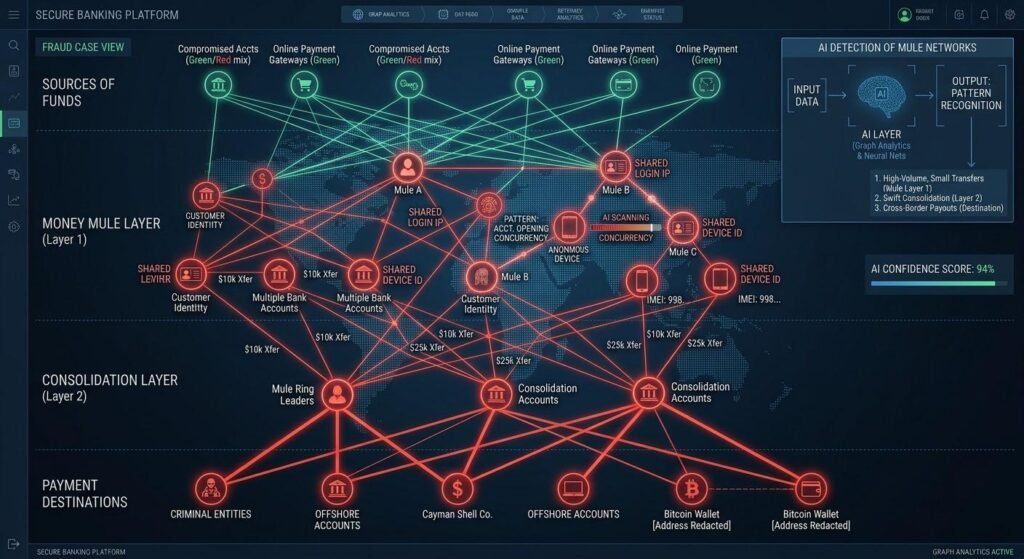
Money mules are people who receive, send or withdraw funds that have been gained from criminal activity on behalf of the fraudster. Some individuals knowingly take part in financial crime whilst others can be tricked into becoming money mules through false job opportunities, relationships or investments. Many criminal organizations will use multiple money mule accounts so it can be difficult for banks to trace where the funds originally came from. Graph analytics can help identify these rings by looking at the relationships between the funds. For example, many accounts may be receiving transfers from many different victims and then sending them to the same account. Using Machine Learning to detect unusual transaction patterns can help identify accounts that are related to previous money mule rings. This will help financial institutions investigate related accounts.
Account Takeover Detection
Account takeover fraud happens when criminals gain unauthorized access to an account and use it to make payments, transfer funds or change information. Whilst individual account takeovers can look like isolated incidents, organized fraud rings can attack multiple customers using stolen credentials, compromised devices and automated logins. Graph analytics can help financial institutions identify this. It can help link together login details, device IDs, IP addresses, transaction history and account access. For example, many customer accounts may suddenly start using the same unknown device or have similar login patterns just before any unauthorized transfers are made. If this is happening across many accounts it could be showing that there is a bigger account takeover happening. Using artificial intelligence can help detect unusual login patterns, behavior changes and predict accounts that may have been compromised. This can help investigate related attacks.
Synthetic Identity Detection
Synthetic identity fraud is when fake identities are created using a mix of real and fake information. Criminals may use stolen identification details, fake names, fake address and altered financial information to create accounts, get credit or access financial services. These can be difficult to detect as they may look legitimate during normal customer verification. Graph analytics can help detect synthetic identity rings by identifying the links between the accounts. For example, many accounts may have different names but share the same phone number, device, address, email pattern or app behavior. Whilst individually they may not be enough to prove fraud, they can be used to detect suspicious identity patterns. Using machine learning can help prioritize the relationships by identifying unusual similarities. New applications can be compared to previously identify fraudulent patterns. This can help financial institutions investigate if the different customers are real or if they are working together to create multiple financial identities.
Coordinated Payment Fraud Detection
Coordinated payment fraud is when criminals organize multiple fraudulent transactions to exploit weaknesses within the payment system, merchant accounts or customer verification. This may involve many accounts, cards, merchants and devices working together to make fraudulent purchases, alter refunds or move the stolen funds. The individual transactions may be within normal spending limits which means traditional fraud detection systems may miss this. Graph analytics can help to provide a full picture by linking together the payment initiator, receiving account, merchant, device and destination. Multiple seemingly unrelated customer accounts may be making payments to the same group of merchants and then receiving suspicious refunds or moving funds. Using artificial intelligence can help detect unusual patterns by looking at the timing, frequency, behaviour similarities and previous fraud patterns. This can help financial institutions identify if there may be organised payment fraud happening.
Machine Learning and Graph Neural Networks
Machine learning helps improve graph based fraud prevention. It can help financial institutions identify suspicious patterns. Traditional machine learning models can look at transaction values, account activity, customer behavior, device information and other factors to predict the likelihood of fraud. However, graph based machine learning can improve this by considering the relationships between the entities. Graph Neural Networks (GNN) is useful as they can learn from the characteristics of the nodes and their relationships. For example, whilst a customer account may not show any obvious fraudulent behavior, if they are linked to many previously identified suspicious accounts this may increase their risk score. GNN can learn from the relationships between the nodes, transaction relationships and network patterns to identify patterns associated with organized financial crime. These can help detect money mule rings, synthetic identities and coordinated payments. However, these should still be used as indicators.
Big Data and Predictive Analytics
To successfully detect fraud using graphs, financial institutions will need to process and analyze huge amounts of information. Big data can help with this by providing the storage, processing power and integration required. Technologies such as distributed databases, cloud computing, streaming data and graph databases can help financial institutions manage complex relationships. Graph databases are especially useful as they are specifically built for storing and querying connected information. Financial organizations can use this to look at transaction history, identify relationships and suspicious patterns. Predictive analytics can be used to help by looking at historical information and using machine learning models to predict the likelihood of future fraudulent activity. This means financial institutions can identify potential risk patterns and prioritize accounts or networks that need further monitoring. This can help prevent financial crime more proactively.
Improving Investigation
Using graph analytics and AI can help improve the investigation process. Financial crime teams will be able to understand how different suspicious activities are related to each other. Instead of looking at hundreds of unrelated alerts, investigators can use graph analytics to look at related accounts, transactions, devices and beneficiaries. This will make it easier to identify key entities and understand how the criminal networks are working. For example, one account may be appearing in many suspicious transaction patterns which suggest it is playing a key role in receiving or sending the fraudulent funds. This can help prioritize investigations, identify potential victims and determine which accounts may need further investigation. Graph analytics platforms can help with case management but human investigation will remain key as there may be legitimate reasons why the financial relationships exist.
Challenges
Implementing graph analytics and AI can pose many challenges. Many financial institutions will be concerned about the amount of computation required. There can be millions of customers, accounts and transactions within large financial networks. To build and update these networks appropriate infrastructure will be required alongside efficient graph queries and plenty of computing power. Data quality can also be a large issue. Incomplete customer information, inconsistent customer identifiers, duplicate information and incorrect transaction information can cause misleading relationships. Financial institutions will need to ensure they have good data integration and validation to help improve their results. False positives can also be an issue when trying to accurately investigate. Legitimate customers may be using the same devices, addresses and payment relationships. Financial institutions will also need to ensure they are keeping sensitive financial information safe and following any relevant privacy regulations. This will ensure they can keep their fraud detection reliable, efficient and responsible.
The Future of AI Graph Analytics
In the future, graph analytics will become increasingly important to detect fraud. As payment systems become faster and financial services become more connected criminals will continue to develop ways to utilize multiple accounts, identities and digital platforms. Financial institutions will need analytics systems that can detect any suspicious relationships before the fraud rings grow too big. Improvements in graph neural networks, predictive analytics and automated investigation tools will help improve detection of new fraud patterns. Improvements in real time data will help financial institutions analyze suspicious transaction rings as they happen. However, to successfully implement this, models will need to be continuously assessed, data will need to be high quality, appropriate infrastructure will be required and financial institutions will need to work together. Human investigation will still be important to validate any suspicious relationships and reduce any false accusations.
Conclusion
Graph analytics and AI are transforming the way financial institutions detect and investigate organized financial crime. By looking at the relationships between accounts, customers, transactions, businesses and devices they can uncover relationships that may have been missed by traditional transaction monitoring. They can be used to detect money mules, investigate account takeovers, identify synthetic identities and prevent coordinated payment fraud. By using machine learning and graph neural networks complex patterns can be identified. Big data and predictive analytics can help analyze vast amounts of information. Whilst there are challenges to overcome such as computation requirements, data quality, privacy and accurate investigation, combining intelligent analysis with human investigation can help make fraud detection more effective. Overall financial institutions that utilize connected intelligence will be in a better position to detect complex fraud rings, identify suspicious financial relationships and protect their customers from increasingly organized financial crime.
Get more well researched information about Graph Analytics and AI in Fraud Detection here.