Introduction
Nigerian media has been instrumental in the political, social, and economic development of the country. From colonial times to the current times of democracy, the press has been used as a means of resistance, education of the people, and accountability. This position has not however been devoid of challenges. The governments, colonial, military, and civilian governments, have always attempted to control, influence, or suppress the media to guard their political power and the state’s interests.
The Nigerian government press has been in a shaky and complicated relationship with the press. In some instances, the media has had some freedom, but in other instances, it has been brutally censored, intimidated, arrested, and shut down. This relationship, which has varied over time, is explored in this article, which follows the history of Nigerian media in significant political periods. It examines how laws and politics shaped press freedom, media ethics, and the independence of the media over the years.
Knowing this history is necessary to understand the plight of Nigerian journalists today and the debate over the freedom of the press in a democratic society.
Colonialism and the Birth of Nigerian Media (1859–1960)
Anti-Colonial Resistance and Early Newspapers
The Nigerian press started when the British colonised the country, having established Iwe Irohin in 1859 under the leadership of Reverend Henry Townsend. The paper was originally religious, but it was later used as a source of information sharing among the locals. The press slowly evolved to be a strong voice of protest against colonial exploitation and racial discrimination as more and more newspapers were started, including The Lagos Weekly Record and West African Pilot.
In the history of Nigerian media, newspapers were used to criticize colonial policies and establish the opinion of the people by nationalist leaders such as Nnamdi Azikiwe and Herbert Macaulay. The press was highly politicized, and it openly confronted British rule and demanded independence.
Colonial Censorship and Oppressive Law
The colonial government soon realized the power of the press and acted with an iron fist. The Newspaper Ordinance of 1903, the Sedition Ordinance, and other laws were put in place to regulate publications that were deemed to be dangerous or subversive.
These acts enabled the colonial governments to close newspapers, fine the publishers, and incarcerate the journalists. The nationalist press never gave up on these restrictions that formed the groundwork of press activism in Nigeria.
This is the time when the press was evidently influenced by the laws and politics, as they used the tools of law to suppress dissent and accidentally enhanced the role of the press as the voice of dissent.
The Post-Independence Optimism and Political Control (1960–1966)
Early Democratic Promise
In the history of Nigerian media, the emergence of independence in Nigeria in 1960 gave hope to freedom of expression and the freedom of the press. The 1960 and the 1963 Constitutions acknowledged the basic human rights such as the right to speech. Journalists were hoping to have fewer restrictions and increased professional autonomy.
Newspapers thrived at this time, and the political discussion was freer. This freedom was however short-lived.
Politics and Media Manipulation in the Region
Soon, the instability of politics, ethnic conflict, and local tension impacted the work of the media. Most of the newspapers got politicized or regionalized, thus undermining journalism’s objectivity. Governments also started to apply defamation and state pressure to attack houses of the critical media.
Instead of being watchdogs, there are media organizations that were used to propagate political propaganda. This deteriorated the ethics of journalism and decreased the trust of the people in the press.
Severe Press Suppression and Military Dictatorships (1966–1999)
Authoritarian Control on the Rise
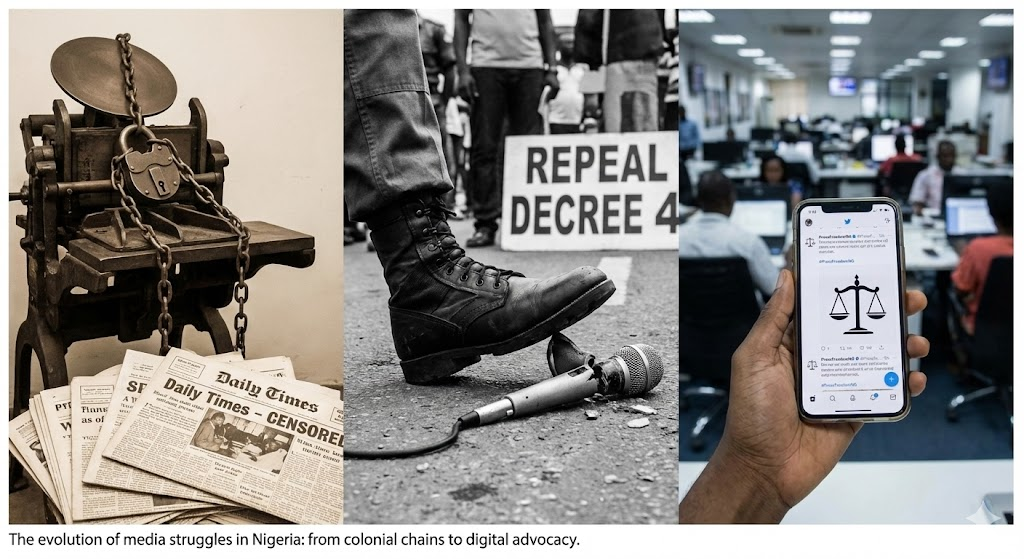
The era of military coups, starting in 1966, was one of the darkest times in the press freedom in Nigeria. Decree-based military regimes that could not be judged were superior to the constitution. The freedom of the press was seriously compromised during these dictatorial regimes.
Orders like the Decree No. 4 of 1984, Public Officers Protection Against False Accusation Decree, made it a crime to report a scandal to government officials, despite the fact that the scandal may be true.
Arrests, Detentions, and Closures of the Media
Journalists were regularly detained, arrested, tortured, and exiled. Publishing houses were closed, and media houses were confiscated. Well-known journalists such as Dele Giwa were the highest-paid journalists, and this underscored the risks of investigative journalism in the military.
The Nigerian press was not suppressed easily despite this repression. Foreign media partnerships and underground publications contributed to human rights violations and corrupt practices getting publicized. The press assumed the status of opposition to dictatorship.
Moral Dilemmas in Military Regimes
Journalism ethics were impacted by the fear of operation. Censorship was the order of the day, and certain journalists did not report on delicate issues as a way of safeguarding their livelihood. Others took bribes or political benefits, and this further diminished professional standards.
Return to Democracy and Constitutional Guarantees (1999–Present)
Democratic Changes and Legal Safeguards
When civilian rule was restored in 1999, it was a new hope for freedom of the press. Section 39 of the Constitution of 1999 provides favor to freedom of expression and the press. Media houses were developed at an accelerated rate, and there was the emergence of personal radio, TV, and online media.
Journalists were also given room to criticize the policies of the government, expose corruption, and also participate in investigative reporting.
Constant Political Push and Legal Intimidation
Difficulties do exist in the post-democratic reforms. Laws like criminal defamation, cybercrime, as well as regulations on national security, are still employed by governments to bully journalists. Reporters are also at times harassed, gagged, and equipment taken by security agencies or broadcast blocked.
This demonstrates that the role taken by laws and politics in press freedom is still a problem and not a solved problem, even within democracy.
Ethics of Media and Journalism in Nigeria
Ownership Influence and Business Pressure
In Nigeria, editorial independence is usually influenced by the ownership of the media. Politicians or business elites own many media houses that are of political interest. This form of ownership may affect news reporting and restrain objective reporting.
There is also commercial pressure such as dependence on advertising and government patronage on editorial decisions.
Professional Bodies and Ethical Codes
Ethical standards are encouraged by the active work of such organizations as the Nigerian Union of Journalists, NUJ, and the Nigerian Press Council. Nevertheless, the implementation is low. The vices of sensationalism, misinformation, and biased reporting continue to be perpetrated especially in the digital media arena.
The New Press Freedom Challenges and the Digital Age
Social Media and Citizen Journalism
Nigeria’s media setting has changed with the emergence of social media. The citizens are also able to report news in real time, and this decreases the level of government control of information. This has enhanced the freedom of expression but has brought about additional issues of fake news and hate speech.
Upholding Government Regulation of Digital Media
The governments have reacted by implementing laws such as bans and codes of digital broadcasting. Although governments claim that these actions safeguard national security, critics believe that they are a way to regulate online speech.
The Civil Society and the Role of the Judiciary
Courts as Guarantors of Press Freedom
Courts in Nigeria have sometimes held in support of journalists and invalidated illegal detentions and censorship. Such choices reinforce the democracy of accountability and freedom of the press.
Organizations of Advocacy and Media Rights
Civil societies and international organizations are still fighting to have freedom of media, law reform and protection of journalists. Their work is useful to keep the problem of press freedom in the discussion.
The Future Of Press Freedom in Nigeria
Press freedom in Nigeria needs powerful institutions, legislation, ethical journalism and popular approval which will be the future of press freedom. The repeal of the repressive laws, journalist protection, and media literacy are necessary.
A free press is crucial to democracy, transparency and national development. Without press freedom, the media will be gagged, and this will affect citizens’ participation in politics and dividend of democracy. A country without freedom of the press will be blind to the government’s excesses.
With good freedom of the press in Nigeria, the country will move forward in development and national growth.
Conclusion
Nigerian media history shows that there has always been a tug of war between press freedom and government power. Through the colonial censorship to military repression and democratic reforms, the press has been subjected to legal, political and ethical setbacks.
This trip is a vivid example of how the laws and politics formed the press freedom in Nigeria, limiting it, sometimes opening it up, but always affecting its course. Nevertheless, the Nigerian media is an important instrument of accountability and democratic development despite the many challenges it has encountered.
Freedom of the Nigerian press is essential for social development and national growth in the country, paving the way for global development.