
The geometric modeling has revolutionized the process of communicating ideas among designers, engineers and architects. Since the first scribbled drawings all the way to computer aided technology, geometric modeling enables the display, editing and distribution of designs in ways that had never been thought of before. The development of these methods is more than a matter of technology, it is also the growing focus on interdisciplinary collaboration.
Manual Drafting was created in the Early Days
Prior to the advent of computers, the design communication would greatly depend on manual methods of drafting. The architects, engineers and designers relied on the pencils, compasses, protractors, rulers, drafting tables to come up with detailed technical drawings. These drawings were not always simple, and it was necessary to accurately measure and pay attention to the details.
The manual drafting was not only time consuming but also full of errors. Any changes on a design would either imply starting all over again or doing tedious corrections, which slowed the process of design. Although such limitations were present, the manual drafting predetermined the principles of geometric representation, scale and proportion, which are important even to this day in the digital workflows.
Collaboration Problems under Manual Business
Co-operation in the drafting process of the manuals was hard. Designers had to be physically present to consult with each other and make changes to drawings. Document sharing was by physical means hence delay and miscommunication was usual. The use of the static drawings implied that complicated design ideas might prove to be difficult to communicate especially when the communication was done to stakeholders who were not conversant with technical drawings.
Introduction of Computer-Aided Design
This changed in the 1960s with the advent of advanced computer-aided design. The first CAD systems were created mainly in aerospace and automotive where the accuracy and sophistication of designs required superior tools. These systems allowed the designers to design, store and manipulate geometric models digitally, minimizing human error and enhancing efficiency.
Study more about high-level computer-aided design
First CAD Innovations
Earlier CAD systems like Sketchpad created by Ivan Sutherland in 1963 gave designers the capacity to engage with a graphical interface with a light pen. Sketchpad came up with the concept of parametric design in which objects can be characterized by mathematical expressions. This proved to be ground breaking as it enabled changes to a single component of a design to automatically propagate other similar components, greatly improving the working together processes.
Commercial CAD software had become more common by the 1970s and the 1980s. Plug-ins such as AutoCAD and CATIA gave access to all 2D drafting and 3D modelling, thus, allowing digital geometric modeling to become accessible to more people. Through the work of designing, it was now possible to be able to work on complex assemblies, simulate behaviors, and have accurate drawings, which was less effort compared to manual processes.
Geometric Modeling Technique Evolution
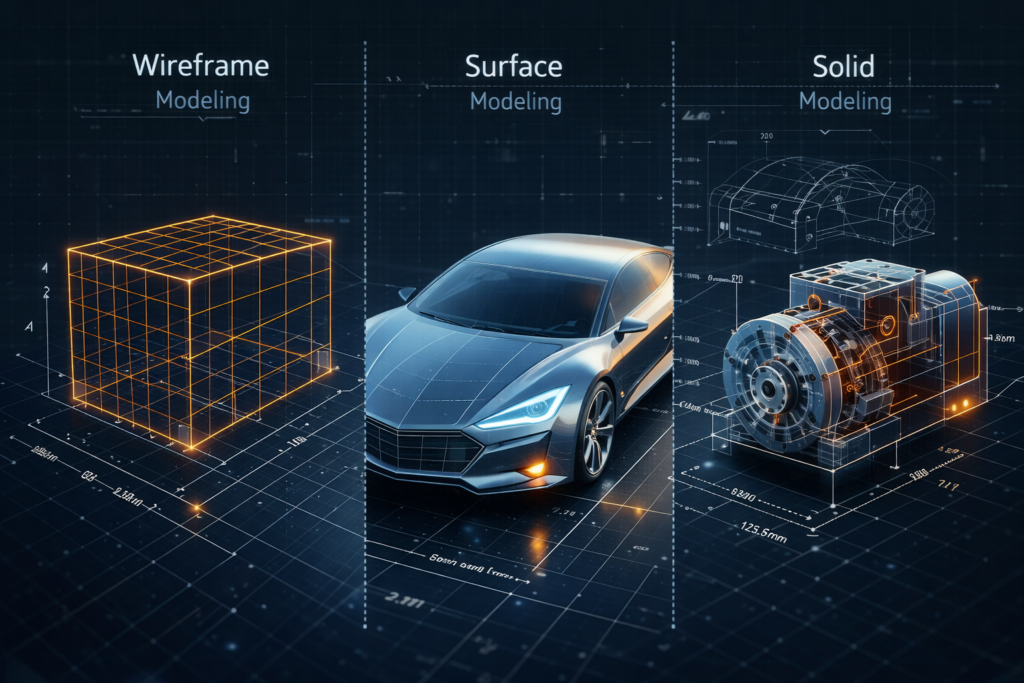
The geometric modeling by itself developed out of the simple wireframe models to advanced surface and solid models.
Wireframe Modeling
Wireframe models were used to illustrate objects with lines and curves to show edges and contours. This method enabled the designers to visualize complicated shapes and make simple measurements. But wireframe models did not have any details of surfaces and volumes and were not appropriate to realistic visualization or simulations.
Surface Modeling
Surface modeling was a response to the shortcomings of wireframes, in that it modeled exposed surfaces of objects. Designers were now able to simulate a better representation of textures, lighting and curvature. Surface models facilitated improved expression of the aesthetic and ergonomic qualities, especially in industrial design and architecture.
Solid Modeling
Solid modeling describes objects as volumetric formations. Solid models, in contrast to surface models, include information regarding both interior and exterior geometry, and allow sophisticated simulation, interference checking and manufacturing analysis. This kind of modeling has gained a common use in the engineering practice and is also applied to enable efficient and accurate communication of designing within multidisciplinary teams.
Effects of Computational Power on Design Accuracy
The more the computational power, the more the geometric modeling capabilities. The complexity and size of models was also limited by the processing speed and memory of the then computers which limited early CAD systems. The high-resolution models, real-time simulations, and photorealistic visualization are the things that modern computing hardware can enable the designers to work with.
Enhanced Accuracy
Manipulation of models in the most accurate way has facilitated less error and better control over quality. An example is parametric modeling whereby the designer can specify the relationship between dimensions such that a modification in one will automatically be made to related components, and geometric integrity can be preserved. The accuracy has been essential in such industries as aerospace, automobiles, and civil construction where design limits are very narrow.
Efficiency and Iteration
State of the art computer tools have radically accelerated the process of design iteration. Designers are able to experiment with a variety of alternative configurations, experiment with different solutions, and optimize the components without using a lot of manual effort. This is not only making the development process faster, but also enhancing collaboration, the team members can share digital models and get the feedback almost immediately.
Application Innovations that Support Cooperation
The contemporary CAD systems are collaboration-oriented. Cloud-based solutions enable different users to make and update models at the same time, irrespective of their geographic location. Version control systems follow the changes, which makes sure that no one has obsolete information on the team.
Integration with Other Tools The tool has been integrated with other tools
The CAD systems have become compatible with other engineering and design applications like the finite element analysis (FEA) and the computational fluid dynamics (CFD). These integrations facilitate the multidisciplinary collaboration, where mechanical engineers, electrical engineers, and industrial designers could work on the same model and utilize their special tools.
Visualization Capabilities
The visualization technologies, such as virtual reality (VR) and augmented reality (AR) have changed collaborative design communication. Teams are able to go through the models in real life situations, identify areas of flaws in the designs and get to feel the products, even before prototypes are created. These features make non-technical stakeholders understand better and it also enhances inter-team decision-making.
Collaborative Design Case Studies
Automotive Industry
Geometric modeling of complex vehicles has eased the design process in the automotive industry. Solid models are used by engineers to test the fit of components, simulate aerodynamics and crashworthiness. By means of collaboration systems, designers, engineers, and marketing teams can reproduce and develop refined design in real-time and development period is greatly shortened.
Construction and Architecture
CAD models are used by architects and construction engineers to coordinate the design of a building, structural analysis, and building sequencing. Exchange of digital models allows teams to find out clashes, streamline layouts and communicate with clients. The use of Building Information Modeling (BIM) also contributes to the improved collaborative processes since all stakeholders will have access to a single model which has geometry, materials, and project metadata.
Geometric Modeling of the Future
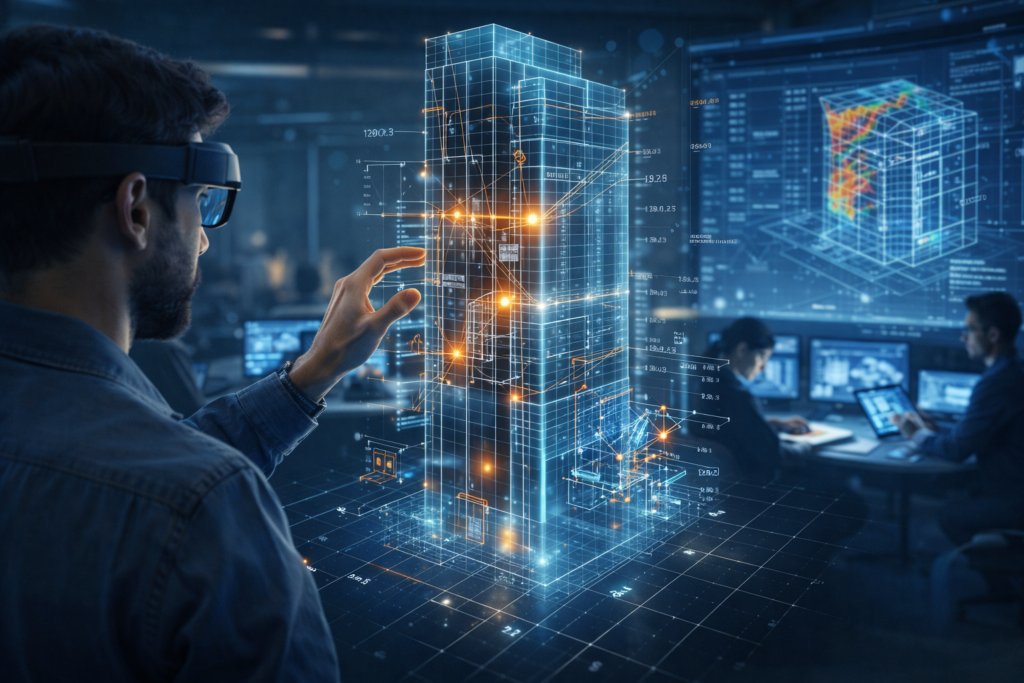
Geometric modeling is being developed at a very fast rate. Machine learning and artificial intelligence (AI) are beginning to help designers create better designs, predict the structural performance, and automate repetitious responsibilities. Collaborative tools are becoming smarter and making real-time-suggestions and identify inconsistencies in models.
Towards Fully Integrated Design Ecosystems
The design, simulation, and manufacturing processes will be integrated in the future in collaborative platforms. Designers can make models that will automatically change according to manufacturing constraints, material properties and sustainability objectives. It is this degree of integration that will ensure that design communication has never been accurate, efficient as well as innovative.
Conclusion
Since manual drafting up to the current computer advanced design systems the geometric modeling has improved the communication process, visualization process and refinements of the design drastically in the teams. More accurate, effective, as well as collaborative workflows have been aided by technological milestones and software advances and the growing computational power. Geometric modeling is no longer merely a means of representation but a major part of design strategy, a means of making the gap between concept and reality and a way of ensuring that different disciplines are able to work together.
