Introduction
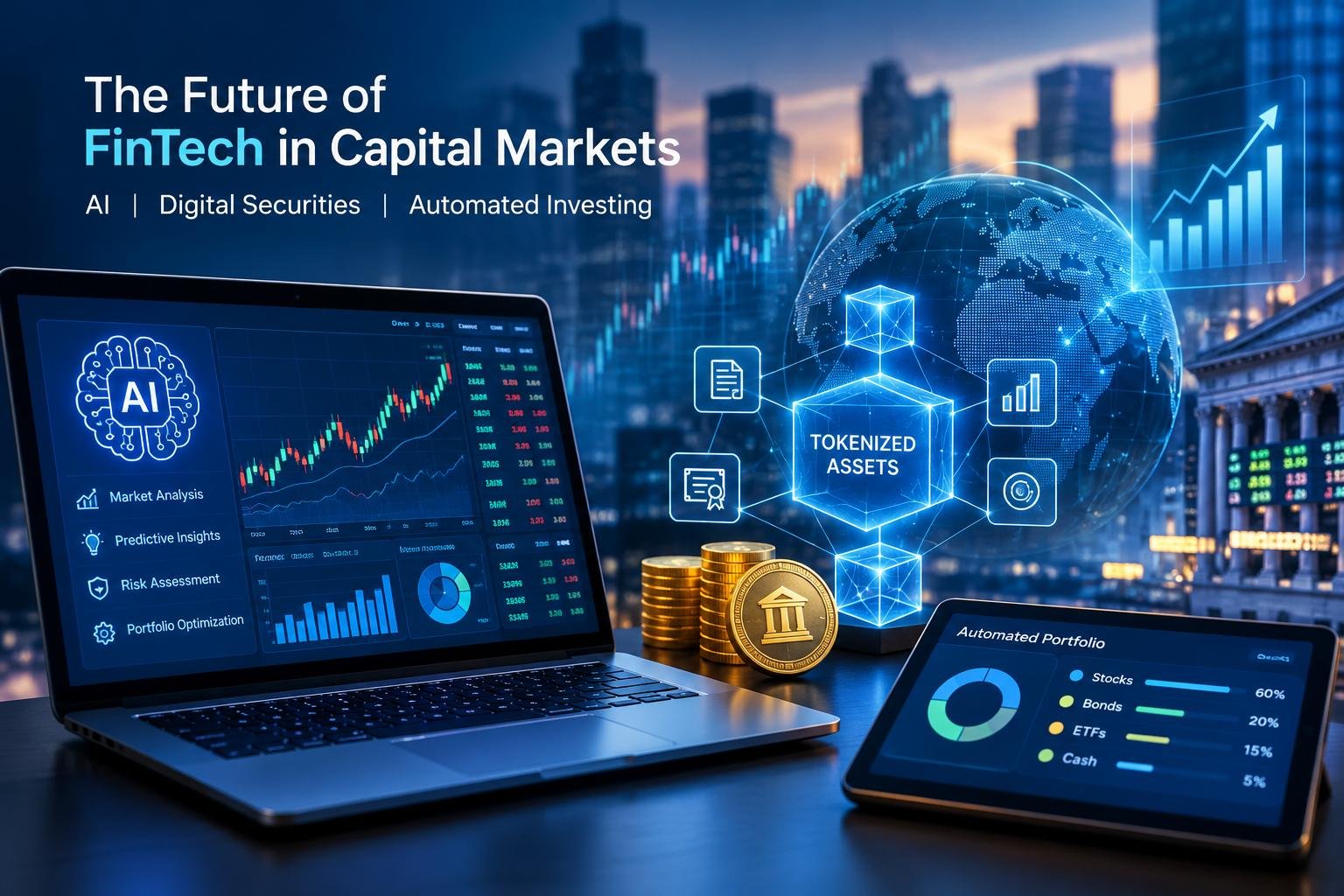
The Financial Technology (FinTech) sector, or FinTech revolution, establishes a new digital bridge between investors, financial institutions, trading platforms and regulators, and it has become a more and more digital way of conducting financial markets. Traditional capital markets have traditionally relied on trusted intermediaries, manual processes and a variety of technology foundations for trading, investment research, compliance and settlement processes. However, these traditional systems are being experimented with in light of the advent of artificial intelligence (AI), blockchain, cloud computing and digital identity. Cloud-based trading platforms offer a significant advantage to financial institutions looking to modernize their trading infrastructure, to scale-up and to adapt quickly to market changes. Concurrently, tokenization of securities and automated investing is paving the way for fresh opportunities in accessing the market. Technologies, however, will not provide for more efficient, inclusive and resilient markets. How well financial institutions achieve the balance of innovating and protecting investors, compliance and efficiency, stability and investor confidence will determine the future of the capital markets.
1. Use of Artificial Intelligence in Trading.
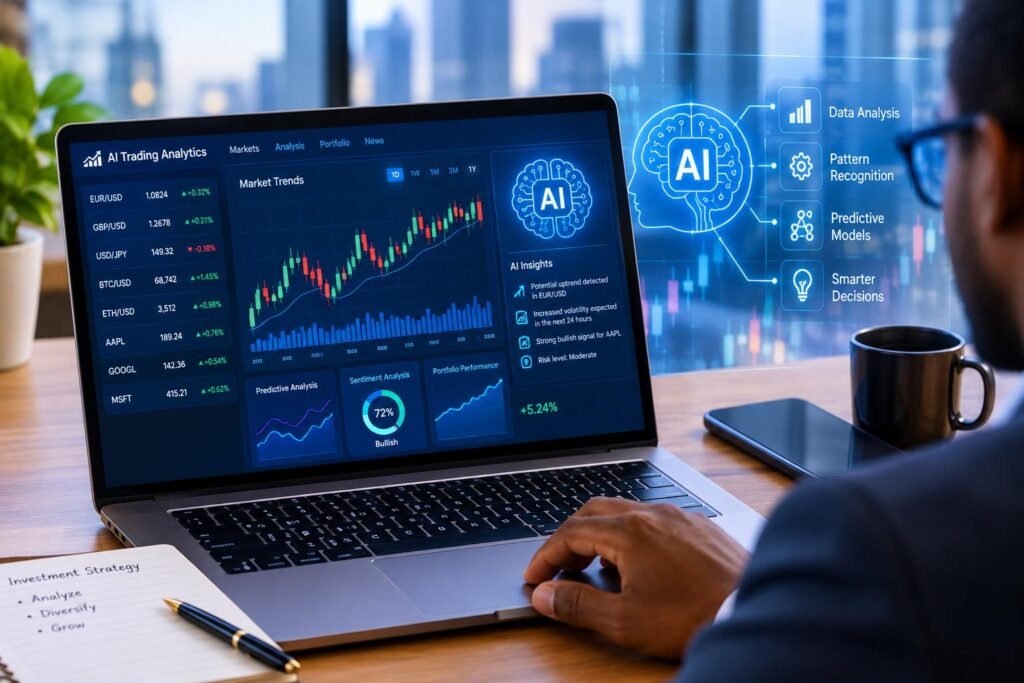
AI is becoming an important player in investment research, as it can process more financial data at a faster rate than humans can do on their own. AI-powered systems can sift through company announcements, economic data, earnings releases, market trends, and news articles to uncover trends that can affect investment choices. NLP may be utilized to summarize long documents, analyze corporate disclosures and analyze new market trends. The skills can reduce the amount of time it takes to conduct initial research, and can aid investment professionals to focus on interpretation, strategy and customer needs. AI tools can also be helpful in performing a scenario analysis to ensure that the rates of change for interest rates, inflation or commodity prices may affect the particular assets. But, findings produced by AI are not necessarily accurate or objective. With the lack of data, historical biases, false data or poorly designed models, bad conclusions can result. Hence, the need for human oversight, independent verification, and clear investment processes will remain vital, particularly in situations where AI-driven recommendations are significant for substantial financial choices.
2. Digital ID & Digital Banking.
In tokenization, financial assets are fractionalized and their ownership rights are specified as digital tokens on a blockchain or other appropriate digital ledger. These tokens can vary in form, as they can be shares, bonds, fund interests or claims on other financial instruments, depending on the legal structure. Tokenized securities could streamline many aspects of issuance, ownership tracking, and transferring assets by providing access to relevant information via shared, digital records. They can offer fractional ownership, too, which means that investors can buy a small portion of a particular asset or invest in multiple assets, without making large initial investments. Issuers’ benefits may include lower administrative burden and wider distribution of investors in various markets when it comes to digital issuance. However, tokenization does not mean there will be no intermediaries and doesn’t ensure that an asset can be traded freely. The securities laws, ownership and custody rights and transfer restrictions remain in effect. The legal nature of a token should match to legal rights in the underlying asset. However, if they are not subject to sufficient protections and safeguarded platforms under a reliable governance system, tokenized securities may pose new risks instead of providing the efficiency benefits that their supporters hope for.
3. Automated Investing and Personalized Financial Services.
The automated investing platform is transforming the way people invest in their portfolios and receive financial advice. Robo-advisers and algorithmic investment platforms take information on an investor’s financial situation, risk tolerance, investment goals, and time horizon to make recommendations and/or manage the investors’ portfolio. Automated systems can automatically adjust investments, track portfolio allocations and execute strategies as needed with minimal manual effort. Individuals who are not able to access traditional wealth management services may find these services to be more accessible to them in their diversified investment approach. AI might also enhance personalization even more by offering investment options, recognizing financial shifts and offering educational guidance. Automation can also help financial institutions provide better experiences for their customers and eliminate mundane administrative tasks. But accessibility does NOT equal suitability! Algorithms can cause investors to have their situations misjudged, make incorrect assumptions or lead to similar trading practices amongst large numbers of investors. Automated investing can also generate false hope when the process of making decisions is made easy for investors and presented in a complex manner. To ensure that automation enhances financial decision-making, there should be clear disclosures, suitable suitability assessments, easy access to human support and effective safeguards.
4. Cloud Computing and Modern Trading Infrastructure
Cloud computing is becoming a critical part of the future of capital markets, where agility is becoming a priority to provide computing capacity, data processing reliability, and speed for access to analytical tools. Trading firms, exchanges, brokers and investment managers can manage computing resources as their workloads fluctuate, without having to keep all infrastructures on their own, by using cloud-based solutions. This agility can help mitigate some of the costs of capital, speed software rollout and enable more effective data analytics. Cloud environments can also provide more sophisticated technology solutions to smaller financial organizations that don’t have the capital to implement comprehensive on-premises solutions. Cloud migration is not without its risks, however, since critical trading functions are being migrated to the cloud. The market can be impacted by issues such as latency, network interruptions, data residency requirements, concentration of services, and cyber threat. Having a few technology providers could lead to a systemic risk in the case of multiple institutions where the same infrastructure is used. Financial organizations should, therefore, have strict vendor assessment and recovery processes, access control and service continuity provisions. The best way to use the cloud is as part of a larger technology plan that emphasizes resiliency, security and regulatory accountability.
5. Compliance and Regulatory Technology
Also known as RegTech, regulatory technology is software, data analytics and automation that assists financial institutions in compliance with regulatory requirements. These tools may have a role to play in the capital markets for transaction monitoring, suspicious activity detection, trade reporting, customer due diligence, and identifying possible market abuse. Machine learning systems can identify abnormal trading activities that are hard to spot using just a few rules, and automated reporting systems can minimize repetitive reporting tasks and enhance consistency. This could help reduce compliance costs, as well as help institutions detect some risks in time. But automation doesn’t mean the end of the need for accountable compliance professionals. Bad data can lead to false alarms or red flags that are not identified. The lack of uniformity in national regulations may also prove to be a challenge to the application of a model for compliance on a national basis. In addition, automated decisions should be understandable to explain to institutions what they have decided and to support them when explaining their decisions to affected customers and regulators. Good RegTech relies on good data governance, regular testing of models, documentation of decision-making process and the manual review of high value cases.
6. Digitally Complex Skills and Digital Literacy.
Digital identity systems can enhance the identification, account opening and access to financial services for investors. Securely verified, reusable credentials could help to eliminate repetitive identity checks and customer onboarding processes among participating institutions. As designed well, these systems can also help to improve anti-money-laundering procedures and minimize opportunities for identity fraud. Meanwhile, it is possible to improve the integration of settlement networks, trading venues, custodians, payment systems, and securities depositories. In traditional securities transactions, several separate processes are typically required to confirm trades, transfer securities and make payments. New payment platforms and distributed ledgers might facilitate more efficient settlement coordination, which could lower the need for reconciliation and counterparty risk. Some may provide for near real-time or atomic settlement, where the settlement of the securities and payment are coupled so that one settlement follows only when the other follows. However, these results can only be achieved if the legal enforcement is in place, reliable cash or payment assets and a consensus exists between participating institutions. There are privacy and surveillance issues as well with digital identity. Interoperability for identities and settlement systems need to be robust enough to secure sensitive information and create clear accountability for errors and disputes, as well as unauthorized transactions.
7. Accessibility and Cost of Markets and Investor Relations
All of these technologies may transform investor financial institution relations. These features such as digital onboarding, fractional investment options, automated portfolio management, and online trading services may help reduce some of these entry barriers. Smaller companies may be able to use analytical tools and infrastructure that were traditionally only seen in big financial institutions. This will also cut down on the administrative expenses, eliminate operational delays, and boost data availability for investments. They should also be able to receive more individualized services, quicker resolutions and clarity on costs and portfolio returns from financial institutions. But, more access to digital does not equate to financial inclusion. A good internet connection and understanding of digital literacy, affordability and the mix of appropriate financial products are still relevant factors. Technological services can also turn away those who find technology-based interfaces difficult to use or do not have a formal identity. Additionally, the cost savings provided by automation may not necessarily be reflected in a reduction of client costs. Financial institutions should then assess innovation according to its real impact on the quality of services, costs of services, their fairness, and investor returns, not simply because it is more technologically sophisticated.
8. Major Challenges and Threats to Uptake
With all its promise, FinTech innovation is beset with significant challenges. One of the biggest is regulation, as many jurisdictions have different securities laws, data protection regulations, licensing requirements and digital asset regulations. The lack of clarity on the applicability of existing laws to tokenization or automated investment services could hinder the adoption of tokenization. Another barrier to implementing legacy technology in this digital age is the fact that many financial institutions rely on technology that is not cost-effective to replace and not easily integrated into the modern platform. Cybersecurity threats also pose a risk, such as ransomware attacks, identity theft, software holes, and attacks on digital asset custody. Fractured markets can also reduce the gains of innovation if a market features different standards on each platform, or if different platforms keep their own records. For this reason, interoperability is key to make systems interoperate without jeopardizing security or legal issues. Concentration risk should also be taken into account if institutions are highly reliant on one or more shared cloud providers, technology vendors or digital infrastructure. The challenges can only be overcome with the cooperation of regulators, technology suppliers, market operators and financial institutions. Useful innovations can be developed while risks can be managed by the use of common technical standards, independent security assessments, carefully designed pilot programmes and clear accountability arrangements.
9. The Road ahead for Capital Markets
It’s hard to imagine that any one technology will define the future of capital markets. Instead, the developments will likely unfold over time as these areas of AI-integrated research, tokenization, cloud systems, automated compliance, digital identity and settlement systems are incorporated. Some of them could be widely used in a large number of applications; other applications might be constrained in their use by economic, legal, or lack of demand. Financial institutions will have to evaluate technologies based on tangible benefits in terms of reliability, cost, and transparency and investor protection. Regulators, on the other hand, should be ready to allow for responsible experimentation, but not to undermine market integrity. Financial transactions are often multi-jurisdictional and involve several intermediaries, so collaboration among different jurisdictions will be particularly crucial. There will also be an education component: investors should be familiar with how a digital product works, the risks it poses, and protective measures that are available. Organizations that take a thoughtful approach to modernizing, invest in cybersecurity, and have a reasonable degree of human oversight may fare better when adapting. Finally, it is important to shift the focus of sustainable progress away from the latest technology and towards creating and maintaining trustworthy and functioning financial markets in the face of technological change.
Conclusion
But FinTech is bringing new opportunities to transform capital markets with new, more sophisticated investment research, digital securities, automated investing, scalable infrastructure and more interconnected financial processes. These innovations may increase accessibility, decrease selected operating costs and enable institutions to provide quicker and more individualized service. But their advantages are dependent on the successful implementation, strong governance, clear regulations, cybersecurity and interoperability. With poor management of automation or disintegration of digital systems, new vulnerabilities can enter, inequalities can be strengthened, and financial institutions’ confidence can be lost. This will be best achieved by an interface between technological innovation and good risk management, investor education and responsible decision-making. There are a number of areas of new technology that have not yet been adopted by capital markets, and it is important to remember that new technology is not the goal; it’s about the result. Striking the right balance between efficiency and resilience and inclusion will enable the industry to progress towards a digital future where projected benefits are not assumed to be realized, but that market integrity and broad industry inclusiveness are maintained.
Get more well researched information about The Future of FinTech in Capital Markets here.