Abstract
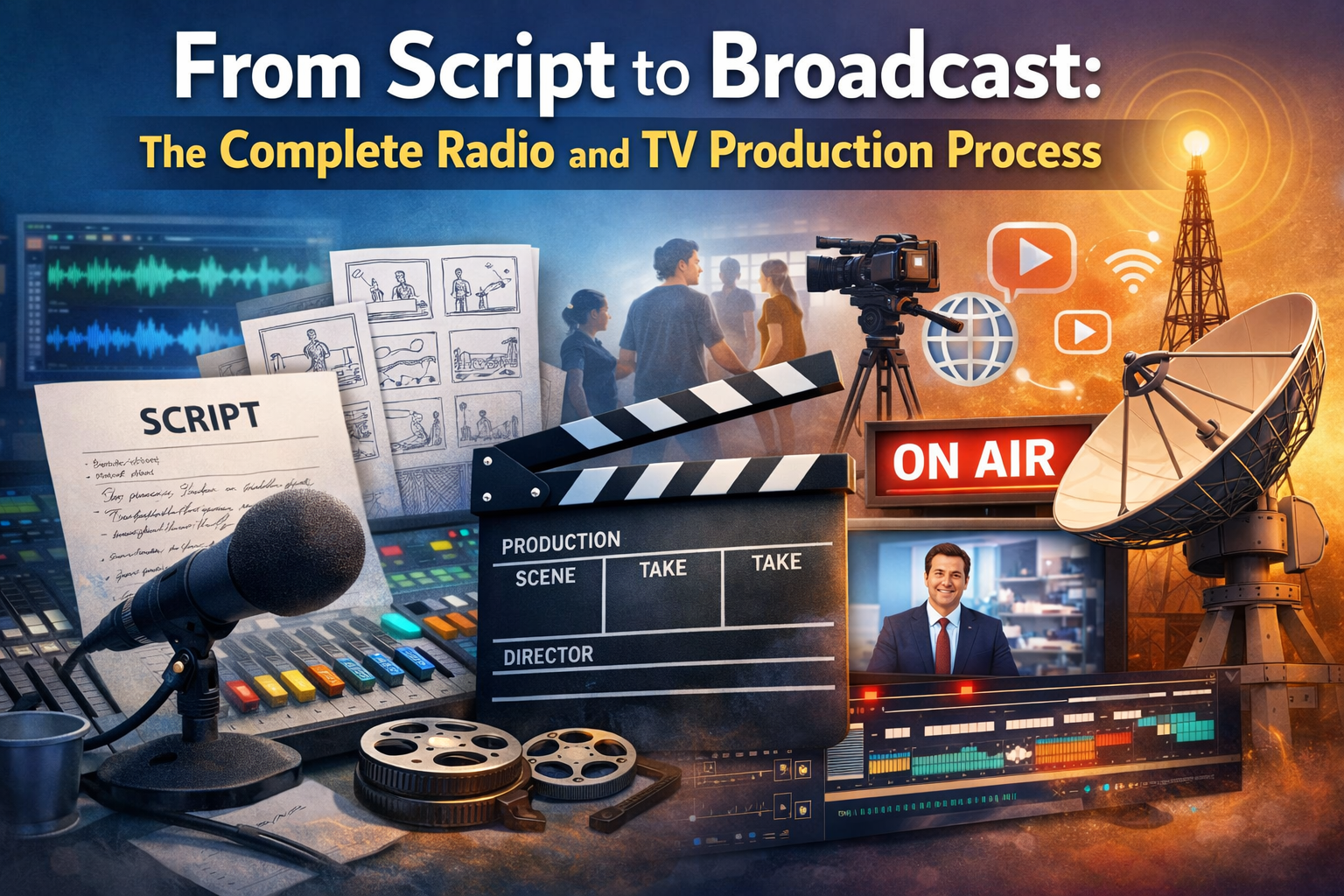
Radio and Television production process is a highly coordinated and organized process that incorporates creative storytelling and technical implementation. This paper provides an academic overview of the production processes in broadcasting in detail, starting with the creation of a script up to its eventual delivery. Using the known media production models, the paper examines the role of scriptwriting, pre-production planning, recording, editing and broadcasting as contributing to the development of interesting content. The paper, in a qualitative and literature-based approach, points out the interdependence of creative and technical skills needed in the contemporary broadcasting settings. The results highlight that effective production of programmes is dependent on good coordination, technical expertise and audience-focused storytelling.
Keywords: Broadcast production, scriptwriting, Radio production, television production, Editing, media workflow, programme development.
Introduction
The broadcast media have continued to be one of the most effective mediums of communication, education and entertainment. Radio and television programmes influence the general opinion of people, inform and offer people of various societies a way to express their cultures. Nevertheless, refined content that is being viewed by audiences is the product of a multi-phase, multi-level production process, which integrates creativity and technical accuracy.
The key point in this process is scriptwriting, which gives the road map of all the production activities. The script is properly written to define the technicalities of recording and editing, as well as the narrative structure. To understand this background step better, refer to this guide to scriptwriting, which describes the form and writing development of scripts to be airable.
This paper will analyse the entire radio and television production process, and how all these steps lead to the end product, which is the broadcast. It also draws attention to the cooperation between innovative specialists and technical ones in the provision of quality media materials.
Literature Review
The mechanisms of broadcast production have been studied by media scholars since time immemorial. McLeish (2015) explains that the process of radio production involves producing pictures of sound, and it takes specific scripting and sound design. Likewise, Zettl (2018) points out that the production of television is a process that is based on a system, and it incorporates pre-production planning, production execution, and post-production refinement.
According to Hilliard (2016), writing the scripts becomes the foundation of both radio and television since it is the way to convert abstract ideas into structured stories. At the same time, Millerson and Owens (2019) emphasize the role of technical coordination and indicate that the current production conditions rely heavily on digital technologies and specialized equipment.
The importance of a combination of creative and technical skills is also mentioned in recent studies. According to O’Donnell (2021), the synergy between the ability to tell stories and the ability to execute them with the help of technology leads to successful programs, especially in the digital era of broadcasting and streaming services.
Conceptual Review
The Fundament of Scriptwriting
The first phase in programme production is scriptwriting. It includes the creation of ideas, the arrangement of narratives, and dialogue or narration that will suit the intended audience. The scripts used in the radio involve detailed sound effects and music, whereas scripts in televisions contain graphics, camera directions, and description of scenes in the script.
It is a good script that is written in a way that makes it understandable, coherent, and appealing to the audience. It is also used as a means of communication within the entire production team, which directs the directors, producers and other technical staff.
Pre-Production Planning
The planning stage is referred to as pre-production, in which the script is converted into a practical production strategy. This stage includes:
- Theory formulation and study.
- Casting and talent distribution.
- TV scouting (location scouting)
- Scheduling and budgeting
- Technical set up (equipment setup, rehearsals)
In the case of radio, pre-production can include voice rehearsal and sound design design. In TV, it involves the production of storyboards and the planning of camera work.
Effective pre-production reduces mistakes in the recording process and also makes the correct utilization of resources.
Production (Recording Stage)
Production stage entails the recording of the audio and video materials, as per the pre-production plan and script.
Radio Production
In radio it is production that is concerned with sound recording. Key elements include:
- Recording by means of microphones.
- Sound effects and background sound.
- Music integration.
Presenters should use proper tone and timing to maintain their output quality since voice artists are required to have clarity.
Television Production
The production of television entails sound and video recording. This includes:
- Shot composition and camera work.
- Lighting setup.
- Sound recording by microphone.
- Staging and organization of scenes.
The director is very vital in seeing that everything is in line with the script.
Post-Production (Editing and Refinement)
It is in the post-production that raw recordings are converted into a finished programme. This stage includes:
- Audio editing (reduction of noise, sound balancing)
- Video editing (editing, transition, effects)
- Audio visual synchrony.
- Graphics and subtitles (TV), subtitles.
Editing helps in the quality improvement of the programme, making it right and consistent to the original script.
Broadcasting and Distribution
The last phase is broadcasting whereby the programme is aired to the people. This can occur through:
- Conventional radio and TV stations.
- Satellite and cable networks.
- Online streaming services.
The process of broadcasting is also technical because it is necessary to guarantee clarity in the signal and appropriate timing. Distribution is also an aspect of modern media settings, which encompasses online media, extending the reach of the audience.
Theoretical Review
The current study is based on the Media Production Theory, according to which content creation is a procedural process in which various stakeholders and multiple stages are engaged in the process. The theory places significance on planning, coordination and execution in the attainment of high-quality media output.
Also, the Uses and Gratifications Theory comes into play since it emphasizes the significance of creating content that fulfills the expectations of the audience. The audience tends to influence the choice of the scriptwriting and the decision of production to make sure that it is relevant and engaging.
Methodology
The article takes a qualitative literature-based approach. It combines the knowledge of scholarly works, industrial publications, and media production manuals. The approach enables the development of an in-depth insight into the production process of the broadcasts without using empirical data collection.
Findings
Combination of Imaginative and Technical ability
The paper indicates that effective production of programmes lies in the smooth combination of creative narration and technical performance. There should be teamwork between the scriptwriters, directors, editors and engineers.
Significance of Structured Workflow
An efficient production process is clearly defined as a way of guaranteeing efficiency and minimizing errors; this is through the process of scriptwriting to broadcasting. The stage consists of further development of the previous stage.
Role of Technology
Digital technology has been used to enhance the quality and efficiency of production to a great extent. The industry has been altered by editing software, high-definition cameras, and digital broadcasting systems.
Audience-Centered Approach
Programmes whose priorities are based on the needs and preferences of the audience have higher chances of success. The decision of scriptwriting and production should be according to the expectations of the audience.
Discussion
The results indicate the multi-dimensional character of broadcast production and interdisciplinary cooperation. The creative basis of scriptwriting and the technical procedures are necessary to make sure that the vision is created successfully.
Radio lacks visuals, thus making the emphasis on voice delivery and sound design more important. On the contrary, television demands dynamism between visual narration and sound audibility. These differences notwithstanding, both media have a structured workflow.
The role of digital platforms is also increasing, making the lines between the traditional broadcasting and the online media more undefined. The various distribution channels now require producers to think of different content since it is necessary to accommodate different audiences.
Conclusion
Radio and Television Production Process is a complex process that involves proper planning, creative thinking and technical skills. The scriptwriting is the starting point, upon which all other processes of production are to be based. Pre-production is done to prepare, production is done to take the content, post-production is done to refine it, and broadcasting is done to deliver the content to the audience.
Finally, the success radio and television production process relies on the fact that these stages are successfully integrated. The concept of organized production and audience-focused narrative is still fundamental as media technologies keep changing.
References
Hilliard, R. L. (2016). Writing for Television, Radio, and New Media. Cengage Learning.
McLeish, R. (2015). Radio Production. Routledge.
Millerson, G., & Owens, J. (2019). Television Production. Focal Press.
O’Donnell, V. (2021). Television Criticism. SAGE Publications.
Zettl, H. (2018). Television Production Handbook. Cengage Learning.