
The art of knowing how to code is usually a challenge, and one of the most rewarding activities is to translate thoughts into applications. Majority of the inexperienced programmers just start typing with lines of code without getting stuck, flustered, or confused. Variables fail, loops fail to execute correctly, and error bars pile up.
Nevertheless, code is hardly the beginning of professional developers. They begin, however, with visual planning, which is an important endeavor that transforms abstract thoughts into simple and logical reasoning. The current paper discusses how flowcharts, choices, pseudocode, and logic models can help the coders sketch their thoughts prior to the scripts being typed. Visual planning is also a technique that allows programmers to reduce the possible errors and makes their work process more efficient and improves their thinking and calculation skills.
And, regardless of whether you are a beginner in scripting or writing any type of a program, it is the knowledge of this process that will transform the way you think and solve problems radically.
The Significance of Pre-Coding Planning
The problem solving is eventually a problem coding. A script, even as simple as it is, has to do something definite and deterministic. It would be like writing code without planning, that you are given the thought of what you want to do and how you wish to write it at the same time.
This overload leads to:
• Logic errors
• Misplaced conditions
• Unnecessary complexity
• Hard-to-debug programs
• Frustration and burnout
Visual planning separates the thinking and typing. It gives your brain time to discover the solution of the problem and then code the solution.
In other words:
An effective blueprint of a clean, functional code is a plan that has been built up well.
Flowcharts and Their Role in Logic Planning
Flowcharts can be regarded as some of the effective and user-friendly planning instruments. The pictorial representation of process steps is a flowchart, which is structured. Flowcharts use a collection of common symbols (i.e., rectangles to represent actions and diamonds to represent decisions) in the representation of how a program traverses the different steps.
The Advantages of Flowcharts to Coders Before Coding Scripts
Flowcharts will make the coding process easier in several powerful ways:
• They make logic very simplified and easily comprehensible.
• Flowchart would somehow compel you to break up big ideas into small manageable units.
• It is a sequential clarity to ensure that you have a purpose in every part of your program.
They Disclose General Lacunae et Logos
Once one of your diagram strands is dead or runs back in the wrong direction, it is easy to tell that it is so; you can tell it way before you even write a single line of code.
They Simplify Debugging
In case the program that you have written is not performing according to the flowchart, it is easier to identify the point at which you have made an error by comparing the code with the original flowchart.
They Give Common Language to Teams
Flowcharts are universal. They are comprehendible even by developers, designers, managers, as well as non-technical stakeholders.
They Aid in Reasoning Calculation
The invention of the flowcharts helps to build the most significant problem-solving skills:
• Breaking down: Breaking down problems into smaller tasks.
• Pattern recognition: The identification of common patterns.
• Abstraction: Attention to the meaningful details.
• Algorithms design: The elaboration of step-solutions.
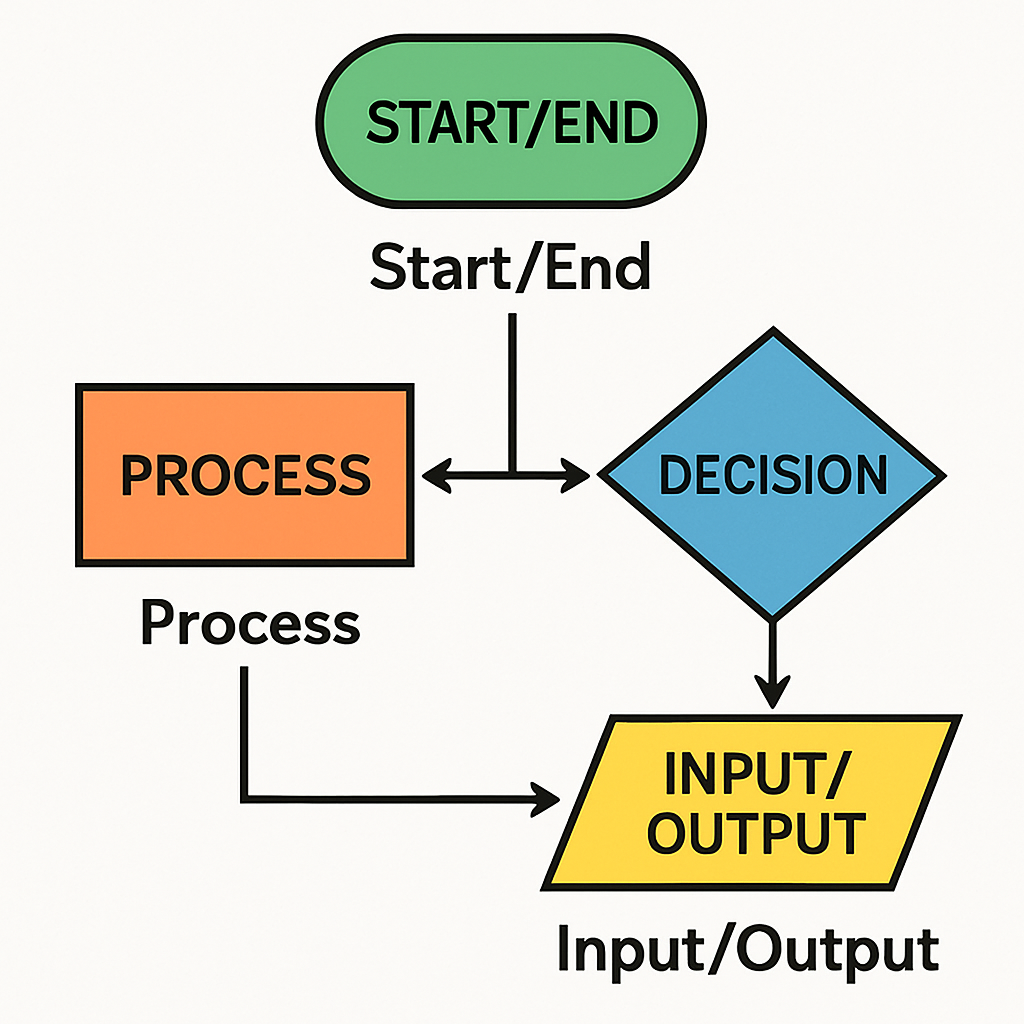
Primary Flowchart Symbols and Their Meanings
Flowchart symbols knowledge helps in the pictorialization of the logic in a structured way.
| Symbol | Meaning | Purpose |
| Oval | Start/End | The marks of the beginning and the end of the program. |
| Rectangle | Process | A step or an action executed by the program. |
| Diamond | Decision | Yes/no or true/false assessment. |
| Parallelogram | Input/Output | The input data, presented data, or printed data created by the user. |
| Arrows | Flowlines | Showing program direction. |
These are symbols that make building blocks of any rational plan.
Sample: Converting a Basic Idea into a Flowchart
Or you need to write a script that checks a number to see whether it is a positive, negative, or a zero number. The flowchart that you would make (theoretically) before coding would look like the following:
Start
Input number
Is number > 0?
• Yes – Output “Positive”
• No – Continue
Is number < 0?
• Yes – Output “Negative”
• No – Output “Zero”
End
By making this drawing, you will ensure that your code will be clean, excellent, and reader-friendly.
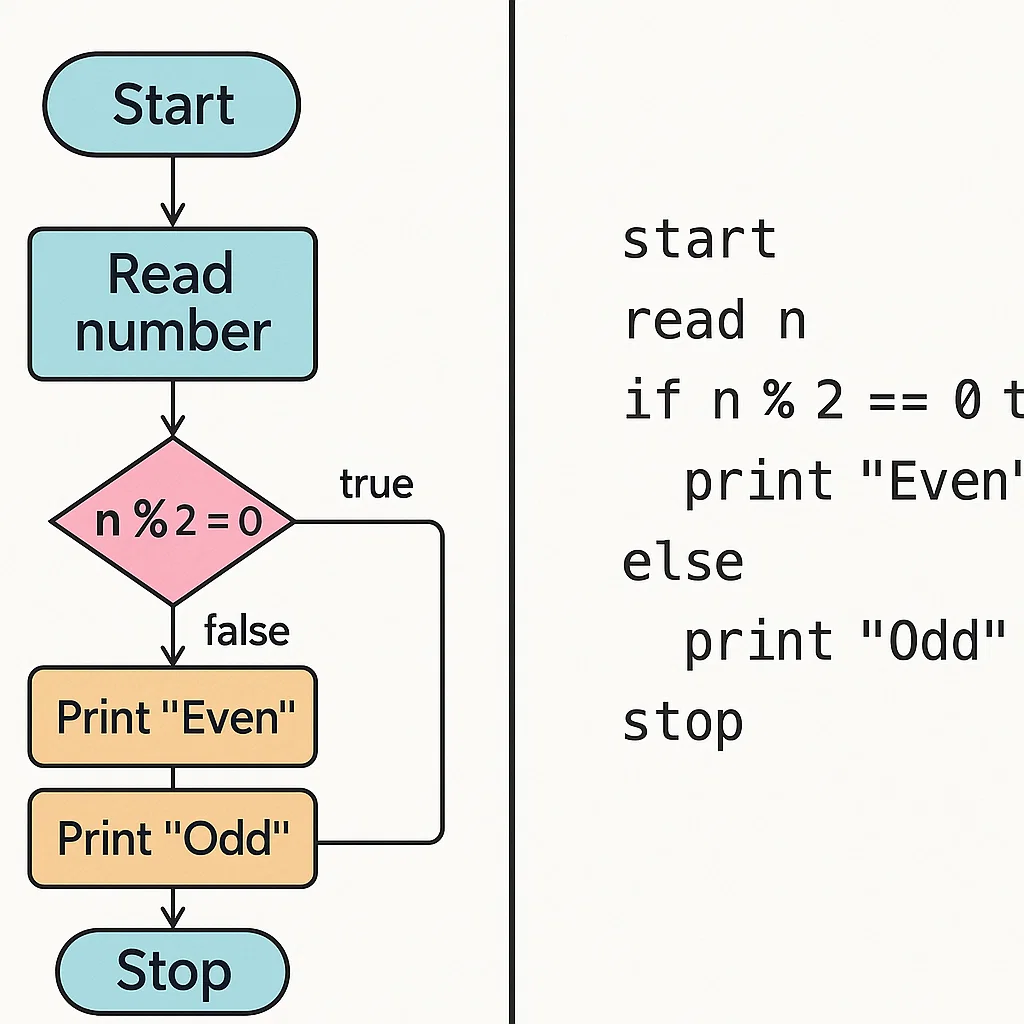
eBay University: Translating Visual Steps into Structured Logic
Pseudocode is another useful method of planning. A flowchart represents a visual representation and the pseudocode represents a textual representation. It resembles code, except that it is not as strict as programming syntax.
Pseudocode is logic-based, as opposed to language-based. It bridges the gap that lies between machine instructions and human thinking.
Arguments in Favor of Pseudocode as the Initial Coding Language
It Allows Syntactically Faulty Logic
Beginners may be easily confused with missing parentheses or commas or conventions in the language. Pseudocode removes such distractions so that the learners can focus their attention on pure logic.
It Produces Flowcharts into an Embryonic Code
A box of a decision is converted into an IF statement each. Every loop is changed into a WHILE or a FOR block. Every process box is transformed to action step.
It Fits Any Programming Language
Pseudocode is universal. Once logic is developed using the pseudocode, it can be translated to Python, JavaScript, C++, etc. with great ease.
It Helps You to Guess What Errors You Are About to Make Before You Code
You can check whether:
• Missing cases
• Confusing steps
• Unnecessary repetition
• Faulty conditions
It Optimizes Algorithmic Investing
A pseudocode makes you think more step-by-step in an algorithmic manner like a computer.
Sample: Pseudocode of the Number-Checking Program
The flowchart above can be translated into the pseudocode shown below:
START
INPUT number
IF number > 0 THEN
PRINT “Positive”
ELSE IF number < 0 THEN
PRINT “Negative”
ELSE
PRINT “Zero”
END IF
END
This is the direct code of reflection of the flowchart and it sets out clear code that will be translated into real code in the future.
Figures and Visual Models: More Than Flowcharts
The flowcharts and the pseudocodes can be regarded as simple instruments and the other diagrams also prove useful in the planning of bigger or more complex scripts.
These are some of the powerful visual aids that may be adopted by beginners:
Decision Trees
These decision trees are broken into branches. They are useful when there are a lot of conditional paths in a script. Useful for:
• AI models
• Classification tasks
• Complicated user input bifurcation
• Multiple-level decisions
They are more logical than nested IF statements.
Data Flow Diagrams (DFDs)
DFDs represent data flow in the system:
• Where it enters
• Where it is processed
• Where it is stored
• Where it exits
This will leave you out of bad data processing before the coding begins.
UML Activity Diagrams
This type of diagram is common to software engineering. They help illustrate:
• Steps in a process
• Parallel operations
• Inputs and outputs
• System-wide flows
UML diagrams are more easily structured in case of projects which include the usage of many modules.
Visual Planning and Coding: Visual Planning Reduces Errors
Visual planning tools do not have mistakes like one makes when prematurely starting the coding.
These are the most common pitfalls that are avoided through planning:
Logical Errors
Logical errors are the errors that make the code run but provide a wrong output. Flowcharts allow logic to be visualized in such a way that you know you are right even before you write any line of code.
Infinite Loops
The correctly developed flowchart would prevent the scenario where loops lack exit conditions, which is one of the commonest errors in novices.
Nonexistent Conditions or Branches
By mapping all the decisions, you are able to avoid going through paths or cases that you had forgotten.
Overcomplicated Logic
Planning reveals the repetitive processes and can be simplified, consolidated, or streamlined.
Debugging Difficulties
When there is a code break, one can effortlessly debug and interpret the break in your diagram.
The Strengths of Pseudocode, Flowcharts, and Diagrams in Empowering Computational Thinking
Computational thinking produces effective code.
Visual planning tools assist in enhancing the four pillars of computational thinking:
• Decomposition: In the creation of diagrams, it is natural to lose large problems in small tasks.
• Pattern Recognition: The visual planning of repeated designs can be reused or optimized.
• Abstraction: Diagrams enable a process to become lean by removing the unnecessary parts of the process.
• Algorithm Design: Flowcharts and pseudocode will take you to creation of logical, structured, and stepwise instructions.
Together, these skills render novices efficient, self-confident problem-solvers.
The Translation of Visual Plans to Real Code
As soon as you have your plan, it is nearly painless to code. You simply type your flow diagram or pseudocode into your language.
An example is that the pseudocode that has been written earlier can be translated into Python code:
number =int(input("Enter a number: "))
ifnumber >0:
("Positive")
elifnumber <0:
("Negative")
else:
("Zero")
The code is clean, direct, and devoid of errors, as the logic was already evident.
Best Practices: Start with the Plan
In order to be a better scriptwriter, the following habits should be adhered to:
• Always plan before coding
Within a couple of minutes, write a flowchart or some pseudocode listing.
• Break projects into sub-sections
It is expected to have its flowchart or diagram in every section.
• Keep diagrams simple
Beauty is rather pragmatism than art.
• Revise as needed
Planning is not a process that takes place one time — continue updating your diagrams as you contemplate.
• Use planning to communicate
Share your flowcharts with your peers, classmates, or faculty.
Summary: The Secret of Planning the Secret of Better Scripts
It is not a single type of coding, which is a thinking process. And the most important thing to do in planning the programs is to visualize the programs first.
Flowcharts, pseudocode, and diagrams help in changing ideas to definite logic which a computer can understand. They limit the number of mistakes, simplify the process of debugging, facilitate the learning process, and make the conversion of the concept to the code simple and pleasant.
One of the most useful habits which a beginner may acquire is visual planning. It sharpens your calculation, increases the scripting proficiency, and confidence as you become a more qualified programmer.
Planning causes you to write an improved code: and your scripts are readable, clever, and far more reliable. Always begin your next project with a diagram, not with code.