Introduction
Journalism is a communication practice that incorporates the what, how and which aspects of information should be released, with accuracy, efficiency and responsibility at the core of the matter. The case of mass communication students who would jump out of the classroom to the newsroom may not be an easy transition. However, what we learn in the classroom, that is the study of language and its components, forms the groundwork, which connects academic study to actual journalism.
The fundamental level of this shift is the usage of language proficiency, grammar, tone, clarity, and structure. All these factors contribute to the narration of the stories, the manner in which the audience receives the information, and even in the manner in which a journalist presents himself/herself as a reliable source. This paper examines the ways in which students can apply what they learn in the classroom in the journalism field with examples and action points.
The Use of Language in Journalism
The nature of journalism is based on language. We can observe this in all the aspects of it through the headline to the news report, feature article and editorial, all of which involve accurate and efficient utilization of language. This is because journalists, unlike casual speakers or writers, will observe such factors as clarity, neutrality and conciseness.
During the lesson, grammar rules, the structure of the sentence and style methods are studied. These concepts are, however, no longer theoretical in the newsroom; they are implemented, and they actually have a direct effect on the reception of the stories by the population.
For instance:
- A newspaper headline can be altered by the presence of a faulty comma in it.
- The sentence structure may mislead the readers if it is poor.
- The use of an inappropriate tone will hurt credibility.
That is why the acquisition of effective language skills is one of the keys of the aspirant journalists. Language competence that, in its turn, provides accuracy and professionalism.
Passing Through Theory into Practice
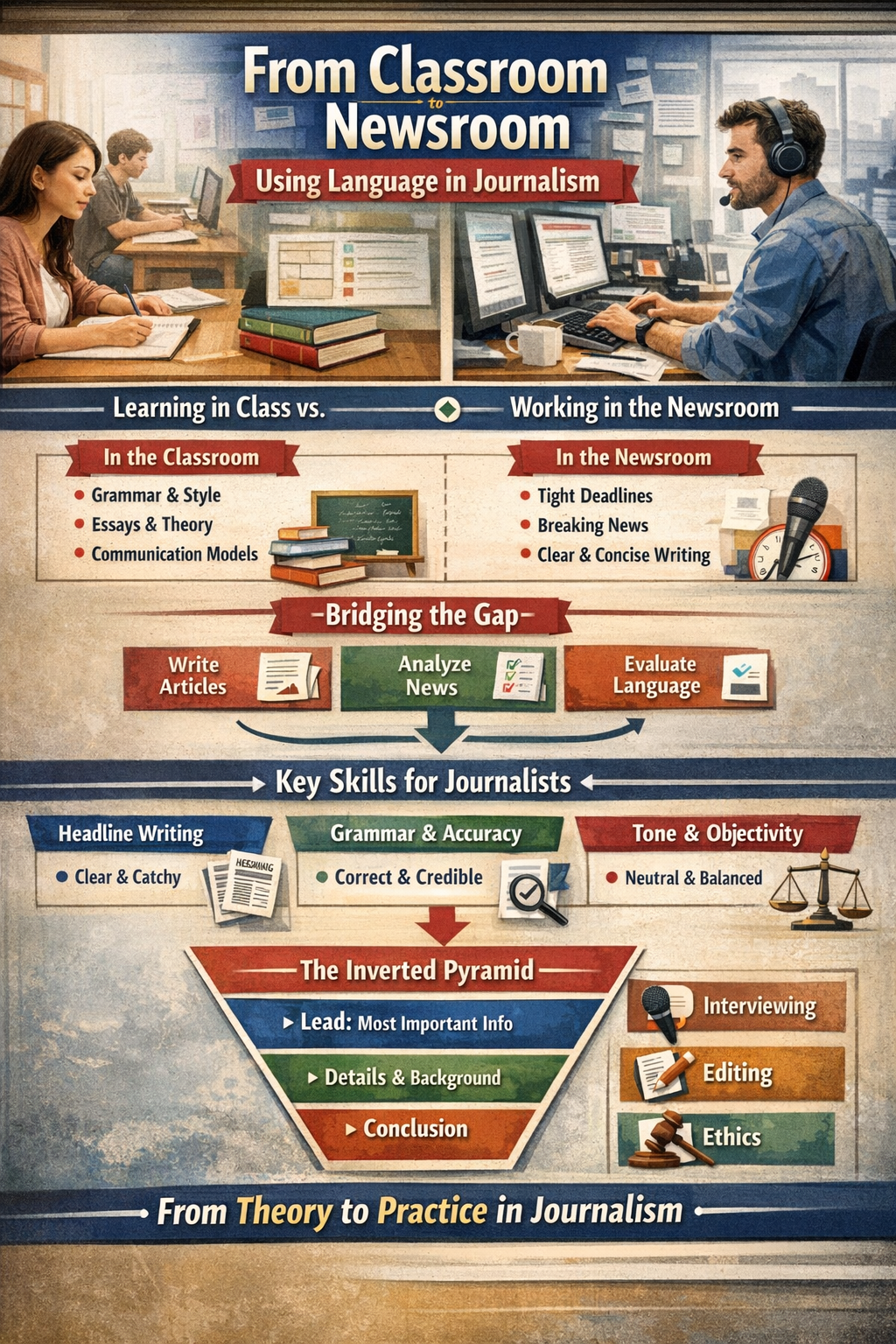
Learning in Classrooms vs. Reality in the Newsrooms
In higher learning institutions, the students concentrate on:
- Stylistic rules and syntax.
- An essay with formulated arguments.
- Theoretical communication models
Newsroom practice, on the other hand, requires:
- Deadlines: Writing under time pressure.
- Simplifying complex information
- Modification of language for various people.
There is nothing wrong with learning new skills, but it is the application of the current ones in the real world.
Bridging the Gap
In order to be successful in transition, the students will need to:
- This should be written on a regular basis in journalistic formats.
- Critical reading of news items.
- Evaluate the professional journalism language usage.
In this way, they start to perceive the way of how classroom knowledge can be translated into practice.
Role of Grammar in News Reporting
Accuracy and Credibility
Grammar is not only about right and wrong, it is about truthfulness. The readers have faith in the journalists who are clear and professional in presenting the information.
For instance:
Incorrect:
According to the report made by the minister, there are numerous benefits in the policy.
Correct:
According to the minister, there are numerous benefits in the policy.
The second sentence is grammatically correct, not to mention that it is more authoritative.
Avoiding Misinterpretation
The quality of grammar can be poor, hence causing ambiguity. Look at the following headline:
The man is caught by the police with a gun.
This could imply:
“The man had a gun”
It would be better to see the version as follows:
“Police Arrest Man with Gun in his Hands.
In this way, word choice and grammar are brought to play.
The Issue of Tone and Objectivity in Journalism
Maintaining Neutrality
The tone is the main difference between academic writing and journalism that needs to be mentioned, and that one is the objectivity of the latter, which is required to be provided, especially in news coverage.
Biased Tone:
The bribing officer had done more than the law permits.
Neutral Tone:
The official is also reported to have breached the law.
The unbiased version conveys the information without giving personal opinion, which in turn enables the readers to develop their own.
Attenuating Tone to the Various Media
It is content that requires a journalist to change tone.
- News reports: An objective and formal report.
- The feature articles: active and vivid.
- Opinions: Convincing and prejudiced.
This is because knowing the tone of your story results in a better connection between the journalists and their audience.
Structure: The Mainstay of News Writing
The style used is the Inverted Pyramid Style.
The inverted pyramid is also one of the most important structures in journalism, where the information is given in the order of its significance:
- Throughout the presentation, the most important information is the lead.
- Body (supporting details)
- Conclusion (background information)
This is a structure that shows the reader the major info that he or she will observe immediately, even without having to read the entire article.
Example
Lead:
On Monday, a fire that occurred in Abuja gutted 20 shops.
Body:
The fire started at 3 am., spreading very fast.
Conclusion:
The officials are investigating the cause of the incident.
This hierarchy consequently enhances the readability.
Writing Headlines
Headlines must be:
- Clear
- Concise
- Attention-grabbing
Example:
Weak headline:
Something Happened in the City Yesterday
Strong headline:
Flood Displaces Hundreds in Lagos.
The 2nd, is accurate and informs the reader at the same time.
Conducting Interviews
During the interviews, it is necessary to use language skills.
- Asking clear questions
- Listening actively
- Paraphrasing responses accurately
Editing and Proofreading
Editing: it is the process of refining the language. Journalists must:
- Eliminate grammatical errors
- Simplify complex sentences
- Ensure consistency
The first draft is transformed into a published article through editing.
Storytelling in Journalism
Beyond Facts
Journalism, as it is practised, also goes beyond reporting facts. It is through story telling which relates with our audience.
These two versions may be taken into account.
Version A
The construction of the road was completed in 2025.
Version B
With a fair share of delays, the long-awaited road project was finally opened in 2025, which relieved thousands of commuters.
The second one makes the info more entertaining as it involves the use of storytelling.
Human Interests and Emotional Relationship
The feature reports are more inclined towards the use of emotion in terms of language to:
- Creating vivid descriptions
- Building empathy
- Engaging reader
Topical Problems and Their Solutions
Excess Use of Technical Words
Learners believe that they are more professional when they use big words in their writings. In the case of journalism, less is more.
Solution
Be straightforward and use simple terms.
Issue of Impartiality
The personal opinions can be introduced into writing.
Solution
Be factual and use facts and confirmed information.
Time Frames
Newsrooms are run on a time constraint.
Solution
Write fast and at the same time do not lose quality.
The Contribution of Technology in Improving Language
In this case, modern journalism is operating under very heavy digital tools that they, on the other hand, use to enhance language in their reports.
- Grammar checking software
- Editing tools
- Online research platforms
Nevertheless, technological aids are not substitutes of basic skills.
Developing Professional Competence
Continuous Learning
Language evolves with time, and the journalists are supposed to be in a continuous learning process. This includes:
- Expanding vocabulary
- Keeping abreast of fashion magazines.
- Practicing regularly
Building Confidence
The practice makes us have confidence. Practice should be done to enable confidence among the students. Students should:
- Write articles regularly
- Young leaders should consult mentors.
- Engage in internships
Ethical Responsibility
Use of language should be done in a responsible way. It is the responsibility of the journalists to:
- Avoid misinformation
- Respect cultural sensitivities
- Adhere to the truth and accuracy.
Conclusion: Language in Journalism
The change of the classroom into the newsroom is a transition that involves theory implementation. What we are taught in the academic level regarding grammar, tone and structure proves to be a very practical tool in real life.
In mass communication, learning language skills is also a necessity for the student, and it is not a choice, as they cannot do without. It is these skills that make them determine the extent to which they can inform, engage, and influence their audience.
By using classroom learning in the real world, students become good journalists who can equally narrate significant stories, besides being reporters of facts. As the practice, critical thinking and dedication are maintained, the transition of being a student to a professional journalist becomes a success.