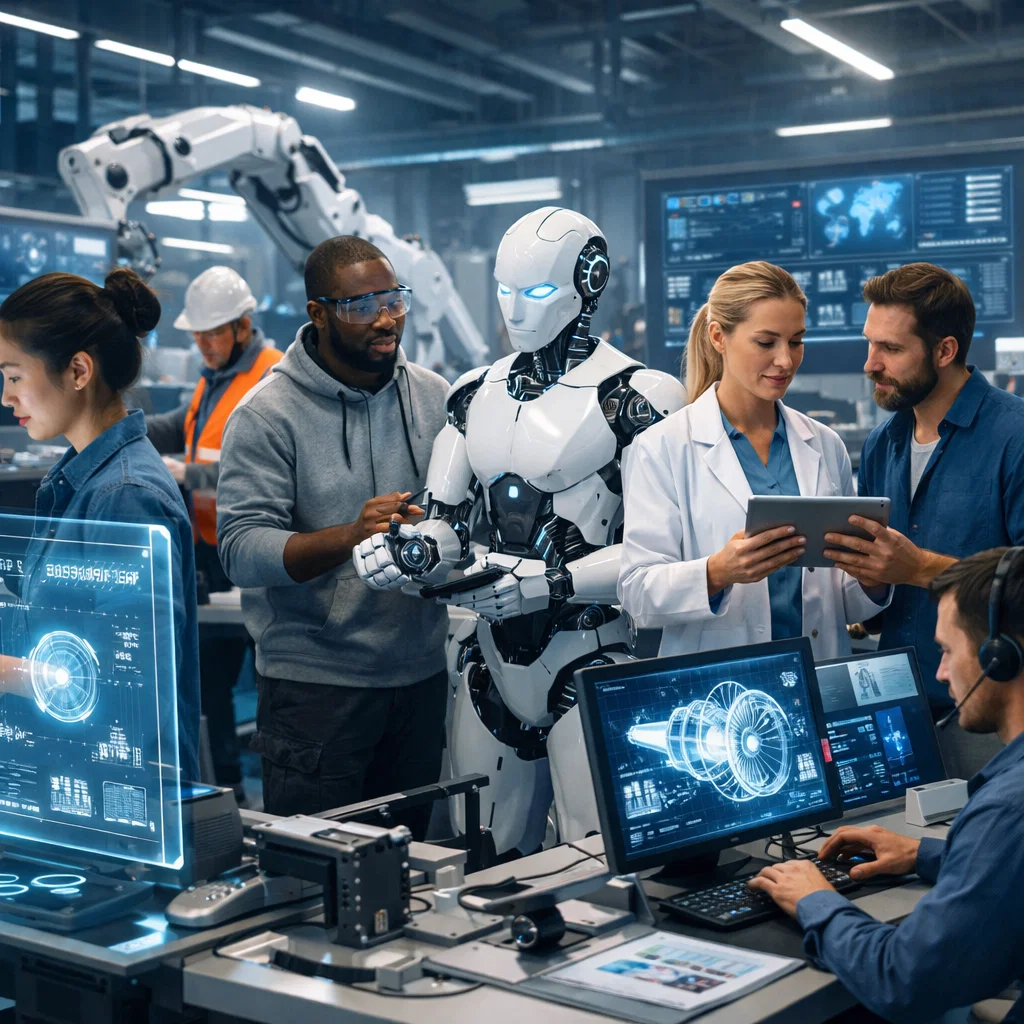
The fast development of automation and artificial intelligence (AI) technologies has resulted in an enormous change in the world of different industries, altering the essence of work and employment in its essence. Though these technologies promise unbelievable possibilities of innovations, efficiency, and economic growth, they also present some ethical issues, specifically, employment displacement, reskilling, and inequality. Since the automation process is constantly growing and developing, developers, organizations, and policymakers need to balance the technological advancements with social responsibility to provide the long-term welfare of the working population and society at large.
This article discusses the ethical concerns related to automation and employment by considering the role of those involved in the creation of the automation systems, the role of those involved in the creation to mitigate the problem of job displacement by exploring the importance of reskilling programs, and the likelihood of rising economic inequality. By pinpointing the most important ethical issues, we hope to raise awareness of the issues that automation raises and propose possible ways of building a more just and more inclusive future of the labor market.
The Part of Automation in Job Displacement
The most direct and noticeable impact of automation is the replacement of jobs especially in the sectors which are based on repetition, manual, or monotony. AI and robotics are already starting to take over human employees in the fields of manufacturing, transportation, and customer support, and this is projected to increase the pace in the next several years. As an example, self-checkout counters at supermarkets, chatbots to assist customers, and so on are already taking the place of many positions occupied by human employees.
Although automation is associated with enhanced productivity, a decrease in the cost of operations, in many cases, it is associated with job losses among workers in weak sectors. To most people, the manual job to a highly technical or automated job change may be hard and most of all, not possible without the corresponding training or reskilling. This is especially worrying to the workers who do not have the skills or education required to survive in a technology driven economy.
The moral issue in this case is not whether automation is unavoidable, but what we can do to accommodate its effects on employees who stand a risk of losing their jobs. When developers and organizations are merely concerned with profit optimization of technology, but also with the welfare of people who have lost their jobs, is that question? Here, one can see the task of the developer and the organization: it should be able to reconcile the development of technology and the social responsibility.
Reskilling and Upskilling: How to Overcome the Skills Gap
With the automation process that replaces some job functions, there is an urgent need to target reskilling and upskilling programs among the displaced employees. Reskilling can be defined as retraining that employees are given new jobs that are less likely to be automated (such as healthcare, renewable energy, or the creative industries). Upskilling, however, involves providing the employees with the skills required to work with emerging technologies and to adjust the emerging job requirements.
Major players in ensuring such transitions are the developers and organizations. Companies can also work with educational organizations and offer training opportunities to workers to equip them with the skills necessary to succeed in new positions. There are already examples of organizations that provide reskilling programs to their employees, including Amazon and Google, and they reskill with such fields as cloud computing, AI, and machine learning. Such efforts not only serve the good of the workers, but also assist the undertakings in equipping a more expert and flexible labor force.
The task of developers in this process is also critical. Being the developers of the technologies which make automation possible, the developers should think over the long-term effects of their work on the labor market. The developers can have systems that are easy to use and that supplement human capabilities by designing systems that are user friendly and that do not replace the capabilities of humans fully. Also, programmers are encouraged to work with policymakers and organizations to develop training programs to enable employees to move on to new positions.
The Economic Inequality and the Threat of an Underprivileged Workforce
Among the most worrying ethical consequences of automation, one should point to the fact that it may lead to the further increase of economic inequality. Since automation is an enhancement of efficiency and productivity, it is also the concentration of wealth on a small number of corporations. The people who possess and have power over the technologies that make automation possible will gain the most, and workers in low-paid and monotonous workplaces will run the risk of being sidelined.
Increasing automation has already contributed to the widening gap between high-skill and high-wage employment and low-skill, low-wage employment. The talented employees in software development, data science, and AI are in great demand and enjoying the economic growth due to automation. The employees in the manual labor and service industries are, however, more likely to face job displacement and wage stagnation.
This widening gap between the haves and the have-nots raises serious ethical concerns as to whether automation is going to predetermine the future of the workforce. Should developers and organizations continue to focus on profit maximization at the cost of workers or are there wider social considerations of their technology innovations? Further, policymakers need to overcome these through social safety nets, progressive taxation, and encouragement of fair wages so that the fruits of automation can be more effectively distributed in society.
The Responsibility of Developers and Organizations
The ethical implications of automation raise questions about the responsibilities of developers and organizations in the design and deployment of AI and automation systems. While technological advancements bring many benefits, the social impact cannot be ignored. Developers have a responsibility to ensure that their creations do not harm vulnerable workers or contribute to the exacerbation of inequality. This responsibility extends beyond the technical aspects of development to include the social and ethical considerations of their work.
Organizations also play a key role in addressing the challenges posed by automation. They must balance the pursuit of innovation and profit with their social responsibilities toward their employees. This includes implementing ethical business practices that prioritize job security, worker well-being, and sustainable growth. Organizations must also engage in transparent dialogues with their workers, labor unions, and other stakeholders to understand the implications of automation on employment and to develop strategies for mitigating its negative effects.
Balancing Technological Advancement with Social Responsibility
As automation continues to reshape the workforce, it is essential to maintain a balance between technological advancement and social responsibility. Developers and organizations must consider not only the economic benefits of automation but also its ethical implications. The future of work should not be driven solely by the pursuit of profit but by a commitment to creating a fair and just society for all workers, regardless of their skill level.
Governments also have a crucial role in regulating the impact of automation on the labor market. By implementing policies that promote fair wages, social safety nets, and reskilling programs, governments can help workers transition to new roles and ensure that the benefits of automation are shared equitably. Moreover, governments must create a regulatory framework that addresses the ethical concerns surrounding AI, such as bias, transparency, and accountability.
Conclusion: A Call for Ethical Leadership
The ethical implications of automation are complex and multifaceted, requiring the collective efforts of developers, organizations, policymakers, and society as a whole. While automation has the potential to transform industries and improve quality of life, it also poses significant challenges in terms of job displacement, economic inequality, and social responsibility.
To ensure that automation benefits society as a whole, developers and organizations must prioritize ethical considerations in the design and implementation of their technologies. They must take responsibility for addressing job displacement through reskilling programs and advocating for policies that promote economic equality. By balancing technological advancement with social responsibility, we can create a future where both innovation and human welfare go hand in hand.