
In today’s networked society, communicative devices are the foundation of almost all aspects of everyday life, including internet access and the streaming of videos, financial transactions, and enterprise networks. Central to this communication are network protocols, which are defined as a collection of rules and conventions that are used for transmitting, receiving and interpreting data across networks. The protocols enable devices, regardless of manufacturer, operating system, or location, to communicate with each other. In the absence of standardized protocols, the digital world would be a chaotic place, where data would be lost, corrupted or incomprehensible in various platforms. To become proficient with networking, it’s essential to know these key network protocols and their functions, as they serve as the backbone of the internet.
Network protocols have a variety of uses; they are used to identify devices on a network, set up and tear down connections, define the format of the data, detect and correct errors, and implement security. Protocols serve as a shared language to enable precise, efficient and predictable device-to-device communication. These protocols work behind the scenes to ensure a seamless and reliable process, whether it’s sending an email, uploading files to a server, or resolving a website name into an IP address. We will discuss some of the most commonly used protocols today, such as TCP/IP, HTTP, FTP, and DNS, and how they help facilitate communication in today’s networks.
Understanding Network Protocols
Network protocol is basically a collection of rules which characterise data exchange between network devices. Just as vehicles are required to follow certain traffic regulations and signals to run smoothly on the roads, devices are required to adhere to certain protocols in order to exchange information smoothly and systematically. From the structure of data packets, to timing and error handling mechanisms.
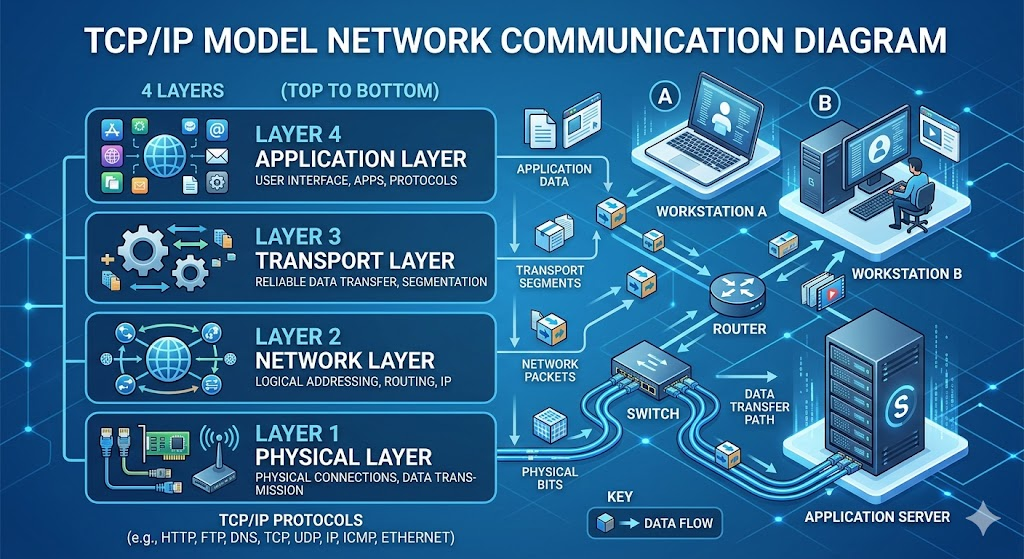
One way to classify network protocols is into the various layers as described in the OSI (Open Systems Interconnection) model or the TCP/IP model. Each layer has its own responsibilities and interacts with other layers in other devices in order to maintain data integrity. The layered approach is imperative to the development and troubleshooting of network systems. Different types of devices from different manufacturers can work in unison since they follow the same standardized protocols. This idea of standardization is the basis of interoperability – any combination of systems working together. The basis of global networking is interoperability – any combination of systems working together— and this idea of standardization is the key.
For a more detailed understanding of the role and functions of various network protocols and their applications, one can study other specialized resources that provide more in-depth information on particular network protocol functions, advantages, and real-world applications.
Transmission Control Protocol / Internet Protocol (TCP/IP)
The internet protocol suite is also known as Transmission Control Protocol / Internet Protocol (TCP/IP). The Transmission Control Protocol and Internet Protocol (TCP/IP) is one of the basic protocol suites used in today’s networks. TCP/IP is the foundation of the internet and helps devices communicate with each other seamlessly across the globe.
Internet Protocol (IP)
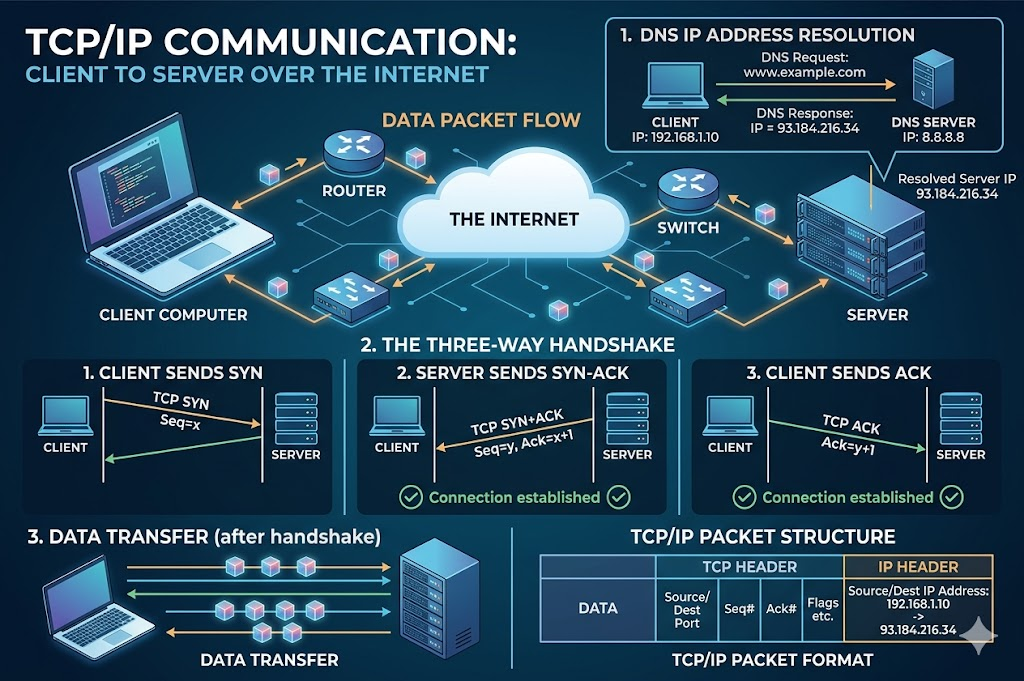
Part of the task of the Internet Protocol is to route and address data packets on networks. Each device in a network has an IP address, a unique ID that identifies the device within the network. IP assures that data is delivered to the right destination device. The two versions commonly used today are called IPv4 (32-bit) and IPv6 (128-bit) addressing.
IP segments the data stream into smaller packets that can be sent over various routes to the destination. When they are received, they are put back together in order to form the original data. This technique helps to optimize traffic flow in networks and ensures that data can still be transmitted efficiently even if certain pathways are congested.
Transmission Control Protocol (TCP)
The Internet protocol suite includes the protocol known as Transmission Control Protocol (TCP). IP provides address and route management and TCP provides reliability for data transmission. It creates a link between the sender and receiver, ensures that all data packets are transmitted correctly, and asks for the packet to be sent again if it is missing or there is a problem with it. This allows TCP to be quite reliable and essential for applications that require the integrity of the data including web browsing, e-mail and file transfer.
TCP uses a protocol called a three-way handshake, in which the sender and receiver send signals to each other to signal that they are ready to send data. This handshake guarantees that the communication is synchronized, both devices are ready to send and receive information correctly, etc.
Combined, the TCP/IP suite is a strong protocol suite that supports almost every communication on the internet. If TCP/IP did not exist, the world’s internet would not be the vast network of computers and devices that exists today, since they would not know how to identify one another and guarantee that data would be reliably delivered.
Hypertext Transfer Protocol (HTTP)
Hypertext Transfer Protocol (HTTP) is the protocol used for communicating on the World Wide Web. HTTP is a protocol used for formatting and transmitting messages between Web browsers and Web servers. The acronym HTTP stands for Hypertext Transfer Protocol. When you enter a website address into your browser, HTTP tells the browser how to locate and request information from the server and how to respond to the server when it has information to send back to you so you can see the webpage.
HTTP is request-response based. The client (usually a web browser) requests a specific resource, such as an HTML page, image, or video, from the server. Then the server will process the request and send back the requested resource and status information that shows that it succeeded, failed, or that it contained errors.
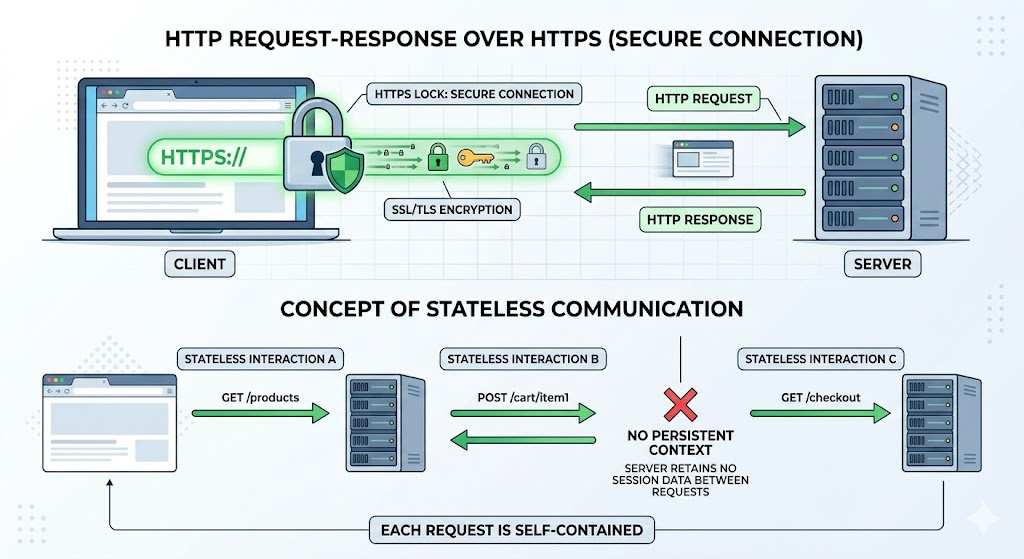
HTTP is a stateless protocol, so it doesn’t keep state, every request contains no information relating to the previous one. This makes protocol design easier and increases scalability, but requires other technologies, such as cookies and sessions, to preserve user state, such as a shopping cart or logon status.
This protocol is more secure, HTTPS, which uses SSL/TLS encryption to guarantee data is transferred securely between client and server, and can’t be intercepted or altered. HTTP and HTTPS are important because they define the protocol of the Web, which allows any different company’s browser and server to communicate in a common manner.
File Transfer Protocol (FTP)
A protocol to transfer files between computers on a network. The File Transfer Protocol (FTP) is a standard network protocol used to transfer files between a client and a server. When users need to transfer large data volumes reliably they use FTP in website management, data backup and cloud services.
FTP uses two channels: a “command channel” and a “data channel. The command channel is for transmitting commands (e.g., upload, download, etc.) whereas the data channel is for transferring data (e.g., the data in the file). This separation enhances efficiency and allows multiple files to be transferred simultaneously without confusion.
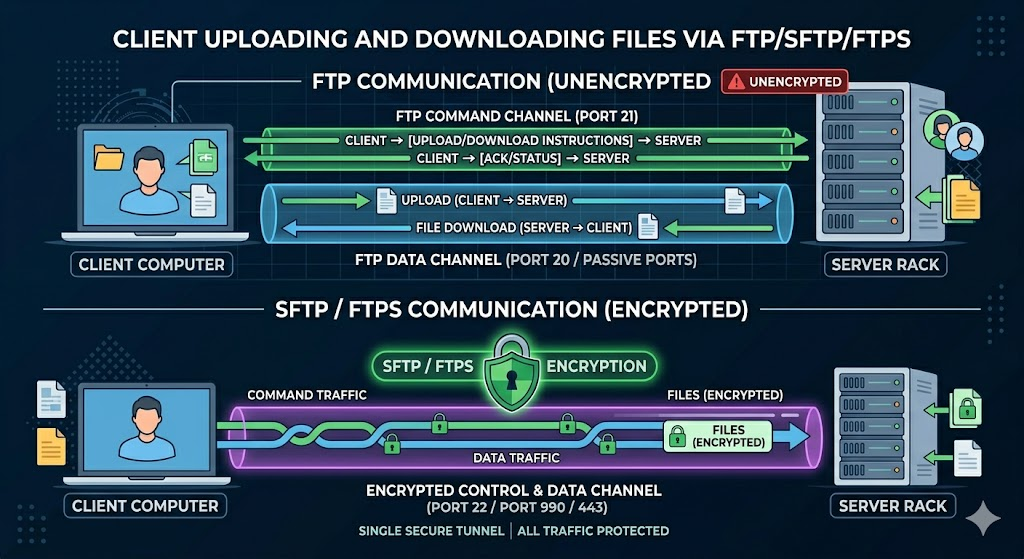
FTP provides authentication; only certain files and/or directories will be accessible to specific users. Some modern implementations also support secure versions such as SFTP and FTPS, which use encryption when transferring data to make it impossible for adversaries to eavesdrop and steal data while it is being transferred.
This is why FTP is essential for businesses and organisations that have to transfer large amounts of files on a frequent basis. A standard protocol ensures that clients and servers from various vendors can communicate with each other seamlessly, with no need for any compromises or incompatibilities in the way that they operate.
Domain Name System (DNS)
The Domain Name System (DNS) is sometimes likened to the Internet’s “phonebook.” Humans like to use memorable domain names such as www.example.com, while devices like computers, servers and networking equipment use the numerical IP address. DNS converts domain names to IP addresses, which helps devices find and communicate with each other over networks.
When a user types in a URL into a Web browser, the Web browser sends a query to a DNS server to look up the domain name to an IP address. After solving, the browser is able to communicate with the web server via the IP address. This action takes place in mere milliseconds and makes for a smoother user experience.
DNS also provides support for redundancy and caching. There are many domain-to-IP mapping servers throughout the world that store copies of the mappings, allowing users to access websites even if one of the servers goes down. By storing frequently-used IP addresses in the local memory, caching can significantly decrease the latency of requests.
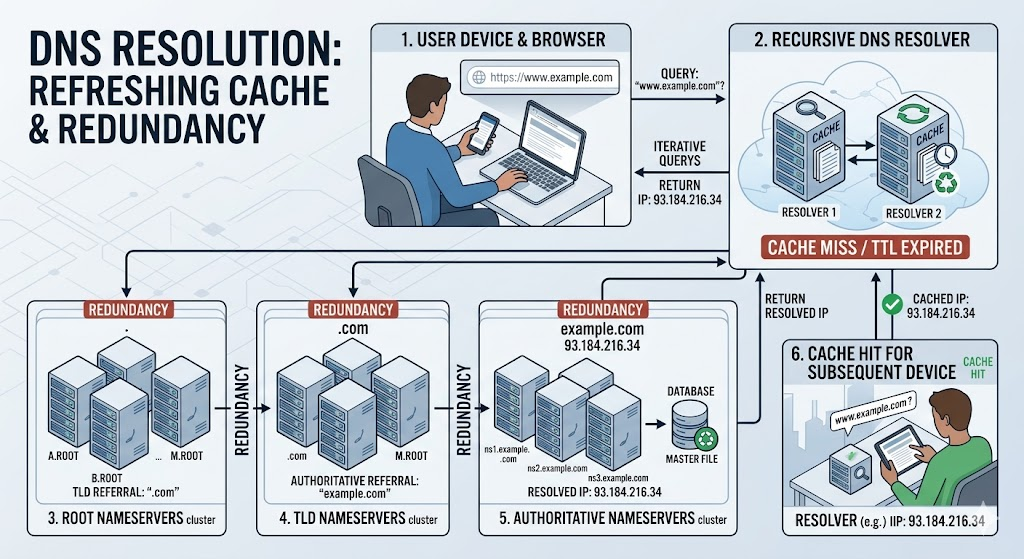
The internet would be much less convenient without DNS, as users would have to keep track of complicated numerical IP addresses for each website. By providing a standardized system for name resolution, DNS plays a crucial role in the functionality and accessibility of the global internet.
The Importance of Standardized Protocols
To be able to communicate, devices with different manufacturers, operating systems, and locations around the world must be standardized. Suppose each company comes up with their own protocols, the outcome would be broken networks that don’t work together. The flow of information on global networks would be unreliable, and there would be limited communication.
Standardized protocols also enhance reliability and security. Protocols establish error handling procedures, retransmission methods, and security measures to make sure data arrives securely and free from errors. This is especially important in sectors like banking, e-commerce and healthcare, where data integrity and confidentiality are key.
Additionally, standardised procedures make network management and troubleshooting easier. Systematic diagnosis of problems by network administrators, based on known problem behaviours and rules defined by the protocols. This predictability ensures high uptime and enables networks to scale effectively to handle millions of users and devices connecting simultaneously.
Conclusion
Network protocols are the usually unsung heroes of today’s communication systems. Communication between devices needs rules and frameworks, such as protocols like TCP/IP, HTTP, FTP, and DNS. These fundamental network protocols ensure the seamless integration of the digital world, its scalability, and trustworthiness.
They are crucial for coordinating data transmission and complex transactions, ensuring the smooth operation of the internet, online services and enterprise networks. The role of understanding not only helps to understand the technology that drives our digital lives but also helps to understand the importance of standardization in creating a connected and reliable global network. Network protocols will continue to drive communication, facilitating innovation, collaboration, and access to information on a scale never before seen as technology evolves.
The evolution of network protocols also involves adapting to new technologies like the Internet of Things (IoT), 5G networks and edge computing. As these developments continue to expand, they require even more advanced, effective and secure protocols to handle the ever-growing number of connected devices and data volumes. To keep interoperability, protocols must support faster speeds, reduce latency and provide increased security measures.
Understanding and learning these fundamental network protocols enables students, IT professionals, or enthusiasts to understand the internet’s underlying mechanisms. Understanding protocols isn’t merely technical; it is empowering, enabling persons to optimize networks, troubleshoot communications problems, and also play a role in developing new communications technologies. In essence, network protocols form the invisible threads that weave together the digital world, ensuring that devices, services, and users can interact seamlessly across borders and time zones.
To conclude, the significance of the network protocols in communication systems can not be neglected. They give shape, stability and uniformity to the society that is connected across the world. These protocols work together to keep the digital world operating, whether it’s ensuring the integrity of data using TCP/IP, web communication with HTTP, file transfers with FTP, or resolving domain names with DNS. The importance of these protocols will continue to grow as networks become larger and more complex. The protocols are essential for ensuring that global communication systems are efficient, secure, and reliable, especially as they become more complex and interconnected.


