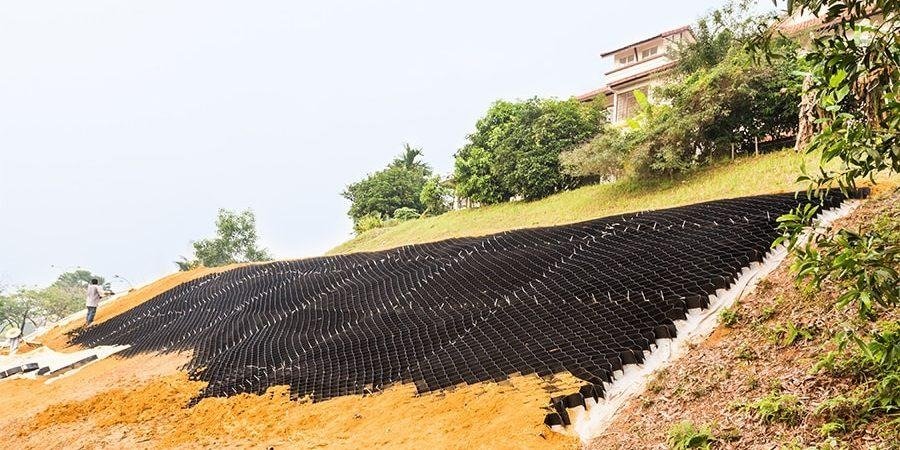
Erosion usually is not something that comes with obvious warning signs. It is a lot quieter than that. Subtle. Easy to overlook at first.
A small amount of soil washed away after a storm. Roots left exposed where the grass used to grow. A hill that looks just a bit different than it did last season. Most property owners see these things but hardly think about them. Until the damage starts to require real money.
From the point of view of a contractor, erosion is one of the problems that can be very easily prevented. And proper grading which is done very early and right is almost always the key to effective erosion control solutions.
What Erosion Actually Does to a Property
Erosion is not merely about the loss of dirt. It is also about the loss of support.
When water flows over land uncontrollably, it picks up soil particles along the way. The soil may be serving various purposes such as holding a foundation, supporting a driveway, or stabilising a slope. Once it is removed, the land responds differently. It becomes less predictable. Less secure.
Eventually, erosion will cause a problem of uneven ground, drainage failures, cracked slabs, and structural stress. And once these issues arise, the solutions are hardly ever straightforward.
That is why expert erosion control solutions are more preoccupied with prevention rather than cure.
Different Types of Erosion, Same Underlying Cause
Erosion presents itself in several different forms, such as surface erosion, rill erosion, and deeper channel erosion. They vary in appearance but generally originate from the same source.
Water flow that is not controlled.
Rain, surface water, and melting snow always flow downhill. If the site grading does not direct that water properly across and off the property, then erosion will be the result. The greater the slope, the more the problem. The weaker the soil, the quicker it will deteriorate.
This is when professional grading techniques become essential. It is not just about relocating the soil but also purposely molding the ground to be in harmony with water rather than opposing it.
Why Grading Is the Backbone of Erosion Control
You could put up fences. Lay down tile. Employ reinforcement materials. But if you don’t do proper grading, these methods won’t get you very far.
Grading dictates the direction and the speed of flow. It controls where water waters and how quickly it gets there. Slopes are changed to diminish the speed of the runoff. Pits or basins are designed, not random.
Hence it is very common that most effective erosion control solutions go back to grading corrections. Change the slope and all the other things will work properly.
Residential Properties Aren’t Immune
Okay, erosion has not been a problem only for commercial or rural areas.
Residential properties have been experiencing it especially houses on the slope or properties with poor drainage. The soil near the foundations gets washed away. The grass is dying. You noticed the walkway getting loose.
Professional residential excavation services are the answer to this problem. Correctly grading a home’s exterior protects the foundations, increases the beauty of the landscape, and prevents water from being a constant problem.
Most homeowners don’t know how much damage erosion causes until they cannot avoid doing the repairs.
Common Erosion Control Methods (And Why They Work)
Effective erosion control solutions usually involve the integration of different methods.
Grading changes the physical features of the land. Water is guided away through the drainage systems. Stabilisation methods hold the soil in its place. Vegetation is also used at times to strengthen the slopes naturally. The main point is overall planning. Each technique is a different form of assistance to the others. The absence of one causes the system to become non-functional.
Experts in residential excavation services allow these features to function collectively rather than them being gradually tacked on one after another over time.
Why “Quick Fixes” Usually Fail
It’s really easy to give in to the temptation of making temporary erosion fixes. They’re cheaper to do at first. They’re quicker to put in. And they appear to be effective, at least for some time.
However, erosion is a really tough thing. It doesn’t give up just because you put on a patch. Water figures out different routes. Soil keeps on shifting. And the problem usually comes back, this time even more severely.
Long term erosion control solutions are all about changing the way water and land interact. That’s why grading plays such a big part in it. Instead of just dealing with signs of the problem, it really gets to the root cause.
The Role of Soil Type and Slope
Clay can retain water. Sandy soil, on the other hand, drains quickly. Loose material gets washed away more easily than densely packed soil. All these things affect how grading and erosion control are done.
Steep slopes require extra care. Water flows faster down the hill, thus the risk of erosion is higher. Good grading mainly attempts to lessen the angle of the slope and also directs water to safer routes.
Those professionals with a great deal of experience in offering residential excavation services are knowledgeable about the relationship between the soil and the slope and thoroughly versed in the methods of controlling both.
Final Thoughts
Erosion continues unabated, but it certainly can be stopped.
By applying proper leveling methods and carefully designed erosion control solutions, the properties can be kept solid, safe, and efficient for many years to come. The soil functions as intended, and there is no opportunity for issues to arise.
If soil erosion is dealt with thoroughly at the beginning, it is something that property owners hardly ever need to think about. And that is precisely how it should be.
