
Introduction
Note-taking is an academic skill that students need to master for effective learning, but is much underestimated and is often hurriedly and poorly executed. The ability to take effective notes does not simply mean reproducing what a teacher or a lecturer says, but involves listening, recalling and re-stating in your own words the content that is being presented to you. If properly done, note taking will enhance comprehension, aid in retention and will facilitate revision during exams or assessments.
Students with good note taking skills tend to have a better grasp on the material covered in the lessons and will be able to remember more of what they hear, as their notes are not just a representation of what they were told, but a personal learning resource. Taking notes is a crucial skill that is needed for academic success and overall improvement in this fast-paced academic environment where much information is taught within a short period of time.
Why is it important to learn to take good notes?
The ability to take notes is critical to academic success, as it allows students to absorb, process, and think about what they are seeing or hearing. Students’ own writing deepens their understanding and memory of the content. This process also aids students in highlighting ideas, distinguishing important information from irrelevant information, and ordering information in a logical way.
Also, notes prepared with care can be used as a reference for revision when the time comes and hence less burden for the students to learn topics again for revision. Note-taking is also great for focus in lectures because students will be more likely to concentrate when they are also taking notes. Students who take notes regularly will develop discipline, critical thinking skills, and independence in their learning, becoming more confident and independent.
The Cornell Method of Note-taking
The Cornell Method is one of the most popular note-taking methods in use in education that aims to structure and filter information for students. In this method, the paper is arranged into three sections – narrow left side for cues or questions, wide right side for detailed notes, and a summary section at the bottom for key points. In a lecture, students record the key points in the right-hand column, summarizing key points and examples.
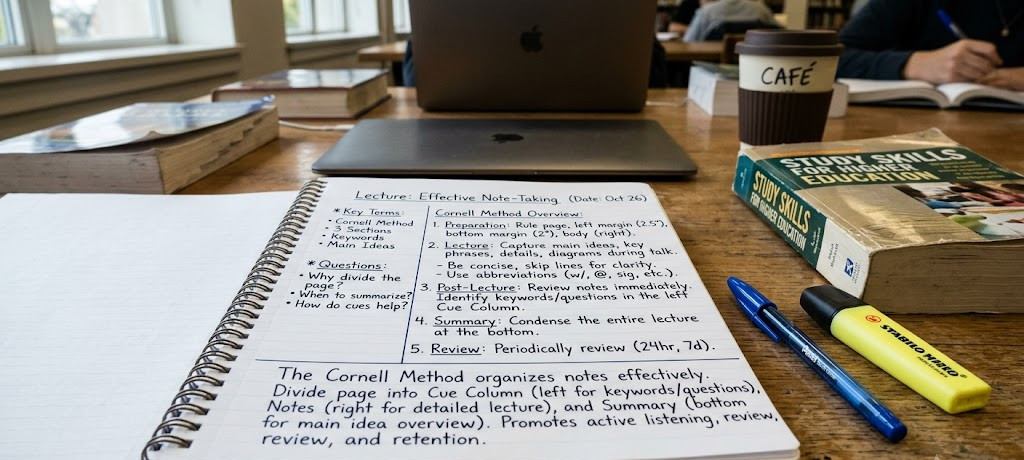
They look at their notes and make additional questions/keywords in the left-hand side to assist with recall and comprehension after class. Lastly, they review the whole page in the bottom of the page in a couple sentences to reinforce the lesson. This systematic procedure is very effective as it promotes active learning, enhances recall on revision and promotes an organised approach to learning. The Cornell system differs from note taking, which is unstructured, in that it creates a powerful study tool that enhances learning and retention.
Mind Mapping Note Taking Technique.
Another effective note-taking technique is called mind mapping, which emphasizes the visual element of learning and connects ideas rather than sequential prose. This approach is much like a tree diagram, with the main concept in the center and concepts being extended outwards in various directions. The branches may then branch again into smaller sub-branches, which display relationships between concepts in an easily readable and organized visual format.
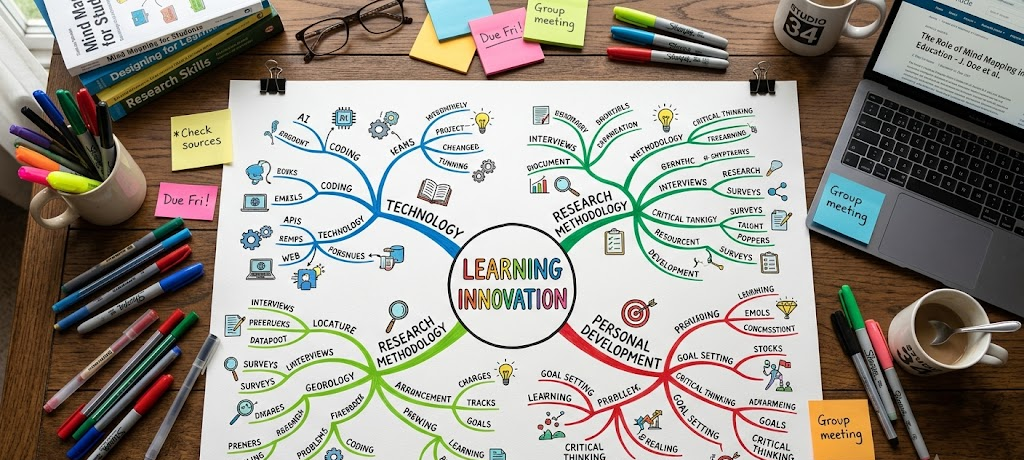
This method is particularly helpful in subjects that require sophisticated thinking, such as biology, literature, history, etc., where it is crucial to understand relationships between topics. Create mind maps to help students get the overview of the class and also to grasp detailed information and recall it in exams. It is also the source of creativity as students can represent ideas with colors, symbols and images. Mind maps are more flexible and engaging than traditional linear notes, and enable learners to structure information in a way that is more natural for their brain.
Use of digital tools to take notes and modern learning.
Digital note takers have gained popularity in recent years because of their portability, flexibility, and organization features, which make it convenient for students to take notes. Using apps like Microsoft OneNote, Evernote, Google Keep, and Notion, students can make, save and arrange notes on their phones, tablets and computers. A huge benefit of digital note taking is that you won’t worry about losing physical notebooks and will have easy access to your notes anywhere with an internet connection.

Also, these tools can be used for integration of multimedia, which allows students to record images, sound, links and even video to support their understanding of topics. Moreover, digital notes can be searched and searching for information is quicker than flipping through hand written pages. Digital note taking, on the other hand, demands discipline and a great deal of control over the devices, as distractions can be a problem if not managed. Digital tools can greatly enhance organization and enhance the efficiency of revision, and, overall, academic productivity, particularly for students with a lot of assignments.
Comparison of different note taking systems to achieve academic success.
There are different types of note-taking that have their advantages and disadvantages, and are appropriate for various learning styles and academic requirements. The Cornell Method is very structured and is best suited for students who like to have revision materials that are structured, exam oriented, etc. It promotes active recall and summarization and it’s great for subjects that demand detailed understanding and memorisation. Mind mapping, however, is ideal for Visual Learners and topics that require seeing relationships between ideas; students can clearly and creatively see connections.
Digital note-taking tools provide flexibility and convenience, particularly for students who like using technology in their learning, and require access to notes both on one device and across a range of devices. But digital techniques might need more self-control to avoid distractions. Contrast this with traditional handwritten approaches, such as Cornell or mind maps, where the physical nature of writing can help to better retain information. Finally, more than one method may be used, depending on the subject, the way a student learns and what he or she wants to learn, and a mix of methods might be most effective.
The skills of effective note-taking.
Note taking is a task that can be used to the student’s best advantage if he or she practices several best practices that enhance clarity, organization, and retention. During lessons, be sure to listen to the class, rather than attempt to write down every single word, which can result in confusion and lack of understanding. Rather, students should identify important concepts, examples, and explanations and restate in their own words. Secondly, notes should be revisited regularly after class to serve to reinforce learning and to fill in any gaps in information.
Third, headings, bullets and symbols help to structure notes more effectively and to facilitate revision. Students should also not use too many words per line on their notes as they are easier to read later on if they are neat and organized. Another good strategy is to mix them up – for theory subjects use the Cornell Method; for conceptual topics use mind maps. Last but not least, consistency is essential: regular note taking helps to develop good study habits that enhance students’ test-taking confidence and performance in exams.
Conclusion
Note taking is a basic academic skill that has a direct impact on the understanding, retention and the use of information by the students. Each of these methods has its own strengths and can be used to improve learning outcomes, depending on the method chosen.Each of these approaches has its own advantages and can be adapted to improve learning outcomes based on the approach chosen. Success doesn’t require a single technique, it requires knowing which techniques to use for which subjects and for one’s own learning style.
Students can learn to take good notes, thereby converting what they learned in class into knowledge which is easily remembered and easily revised. Through time, the skill develops to result in better grades, better organization and increased confidence when taking tests and evaluations. In the end, note-taking is not a skill that is learned through writing—the skill is to think, process and comprehend information better.