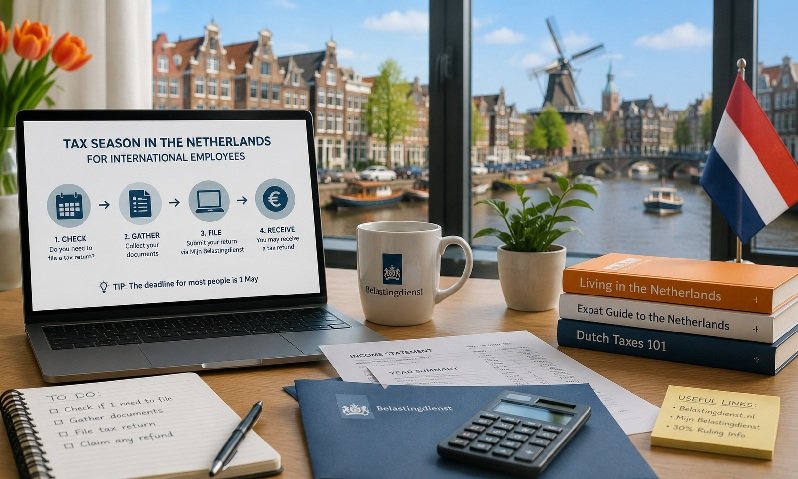
If you’ve recently moved to the Netherlands for work, your first Dutch tax season can feel a little intimidating. Letters from the Belastingdienst (the Dutch Tax Administration) start arriving, colleagues casually mention deadlines, and suddenly you’re wondering whether you owe money – or are owed some back.
The good news: the Dutch tax system is well-organized, mostly digital, and surprisingly fair to international employees. Once you understand the rhythm of the year, it becomes routine.
Here’s a clear walkthrough of how the Dutch tax season works when you’re employed in the Netherlands.
When Is Dutch Tax Season?
The Dutch tax year matches the calendar year – January 1 to December 31. The filing season for the previous year opens on March 1 and the standard deadline is May 1.
A few key dates to remember:
- March 1 – filing opens, and pre-filled returns become available online.
- May 1 – standard filing deadline for individuals.
- July 1 – usual deadline if you request an extension (free and easy to do).
- September–December – most refunds and assessments are processed.
If you file before April 1, the Belastingdienst guarantees a response before July 1 – useful if you’re expecting a refund.
Who Has to File?
Not every employee in the Netherlands is required to file an income tax return. Your employer already withholds payroll tax (loonheffing) from your salary each month, which often covers what you owe.
However, you must file a return if:
- You receive an invitation letter (aangiftebrief) from the Belastingdienst.
- You had income from multiple employers or sources.
- You owned property, including a mortgage on your Dutch home.
- You had foreign income, investments, or savings above certain thresholds.
- You were partially employed and partially self-employed.
Even when filing isn’t mandatory, many internationals choose to file voluntarily – because it’s the only way to claim back overpaid tax. For a deeper look at how the process works step by step, this guide on filing a tax return in the Netherlands walks through everything from required documents to expected refund timelines.
The 30% Ruling: A Game-Changer for Expats
If you were recruited from abroad to work in the Netherlands, you may qualify for the 30% ruling – one of the most significant tax benefits available to international employees.
Under this scheme, up to 30% of your gross salary can be paid tax-free as a reimbursement for “extraterritorial costs” (the additional expenses of living abroad).
Key points:
- You must have specific expertise that’s scarce on the Dutch labor market.
- You must have lived more than 150 km from the Dutch border for at least 16 of the 24 months before being hired.
- The benefit currently lasts up to 5 years.
- Your employer applies for it on your behalf within four months of your start date.
Even if you don’t qualify for the full 30%, partial benefits and a special exemption on worldwide assets may still apply.
Pre-Filled Returns: Your Best Friend
One of the most pleasant surprises of the Dutch tax system is the pre-filled return. When you log into Mijn Belastingdienst using your DigiD, much of your information is already there:
- Your salary and withheld tax (from your employer)
- Mortgage interest and property values (from banks and the WOZ register)
- Bank balances and investment account values
- Healthcare insurance details
Your job is mostly to verify, correct, and add anything missing – such as donations, study costs, or foreign assets.
Deductions International Employees Often Miss
Even with pre-filled returns, certain deductions don’t appear automatically. Watch for:
- Mortgage interest deduction (hypotheekrenteaftrek) on your primary residence.
- Public transport commuting costs when your employer doesn’t reimburse them.
- Healthcare costs above a certain threshold.
- Charitable donations to ANBI-registered institutions.
- Study costs for qualifying education (rules have tightened).
- Alimony payments to a former partner.
Claiming these can turn an expected payment into a meaningful refund.
What About Foreign Income?
The Netherlands taxes residents on their worldwide income, but tax treaties protect you from being taxed twice on the same earnings. If you have savings, property, or investments abroad, you’ll need to declare them – even if they were taxed in another country.
The 30% ruling also offers a useful “partial non-resident” option that can simplify how foreign assets are treated. A short consultation with a tax advisor in your first year often pays for itself many times over.
How Refunds and Assessments Work
After filing, you’ll receive a preliminary assessment (voorlopige aanslag) within weeks, followed by a final assessment (definitieve aanslag) later in the year.
If you’re owed a refund, it lands directly in your Dutch bank account. If you owe money, you’ll get a payment schedule – usually with the option to pay in installments.
A Few Practical Tips
- Get a DigiD early – without it, you can’t access Mijn Belastingdienst.
- Keep digital copies of your salary slips, jaaropgaaf, and donation receipts.
- Don’t ignore the blue envelopes – ignoring them leads to estimated assessments, usually not in your favor.
- Request an extension if you need it – it’s free and avoids late-filing fines.
Final Thoughts
For international employees, the Dutch tax season is less about scrambling at the deadline and more about taking an hour to review what’s already been done for you. The system is transparent, the deductions are real, and the refunds – once you know what to claim – can be surprisingly generous.
A little preparation in your first year goes a long way. By your second, you’ll be the colleague casually explaining the jaaropgaaf to someone new in the office.
Resources like UnitCity cover Dutch tax and administrative topics specifically with international residents in mind.