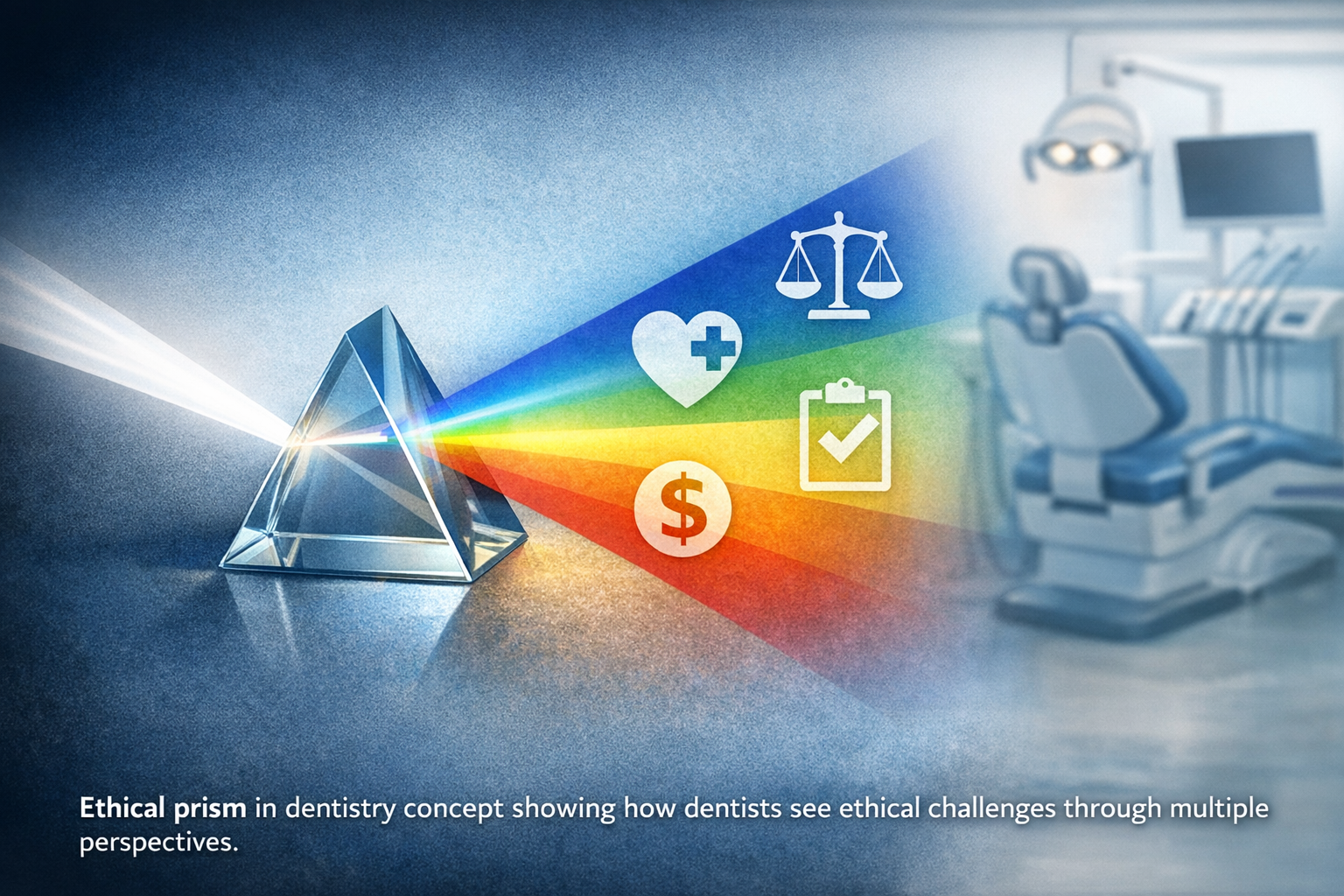
There are cases that actually challenge the moral judgment of a clinician in addition to the technical ability, which occur very often in the modern dental practice. Ethical issues in dentistry may be simple matters such as patient consent or challenging cases dealing with conflicting professional standards and or resources, or cultural concerns. To dental students and new professionals in the field, it is important to develop a definite, systematic thinking about the ethical decision-making process. It can be conceptualized in the sense of an ethical prism- a type of framework of personal views that assist dentists in viewing and analyzing situations through various moral lenses before making a choice about a course of action.
This article discusses the notion of an ethical prism and it gives practical suggestions on how dental workers can build their own ethical frames, think reflectively, and use systematic moral reasoning to act accordingly when dealing with ethical dilemmas.
Knowing the Concept of an Ethical Prism
Ethical prism is a term that is used concerning the way a professional perceives ethical dilemmas and divides complicated issues into simple and practical understanding. Much in the same way that a physical prism can deflect light into the colors which it comprises, an ethical prism enables clinicians to break down dilemmas, distinguish between the moral factors in a problem, and the interaction between various ethical considerations.
The creation of an ethical prism is not a memorization of certain strict rules. Rather, it is a process of developing a subtle knowledge of the professional duties, patient rights and societal expectations, and personal values. An effective prism allows dentists to balance the competing interests and determine the possible outcome and the solutions that can be chosen following the ethical and clinical standards.
Significance of Ethical Prism in Dentistry
Moral decision making as a subject in the dentistry profession is highly important since it directly influences the health and wellbeing of patients, their confidence and autonomy. Errors in judgment, whether accidental or not, may have far-reaching implications on the wellbeing of patients and the professional standing. Satisfaction of patients, minimization of legal liability, and a culture of integrity in the dental practice can be improved through effective navigation of the ethical dilemma.
Some of the typical ethical issues a dentist can encounter include:
- Informed Consent: It is the ultimate aim of the nurse to ensure that the patient is informed about the advantages, risks, and options of a procedure and not led to think that they are being pressed into anything.
- Confidentiality: How to keep confidential patient data in a digital records age.
- Resource Allocation: Equitable decisions in situations where resources (treatment time, access to care, etc.) are scarce.
- Cultural Sensitivity: Striking a balance between the cultural or personal belief of a patient and the recommendation of treatment.
Ethical prism can guide professionals to overcome such challenges because it is a structured method to weigh options, predict outcomes, and make decisions in a transparent way.
Constructing a Personal Ethical Framework
The ethical prism requires the development of a personal ethical framework to begin with. This paradigm becomes a benchmark on which to assess the real world dilemmas by combining the professional standards and personal values. Dental students and professionals can pursue a number of steps:
Identify Core Values
The basis of ethical prism is the understanding of what one really values. The dental practitioners ought to ponder on the things like:
- Beneficence: Doing the best in the interests of patients.
- Non-maleficence: It is better to avoid harm.
- Autonomy: The right to the autonomy of patients to make informed choices regarding their care.
- Justice: Being equal and just to patients.
- Professional Integrity: Being honest, transparent and ethically accountable.
By writing these values down and prioritizing them based on personal and professional priorities, it is possible to define the standards of decision-making in complicated cases.
Familiarize Yourself with Ethics Codes and Guidelines of Study
Professional codes developed by the organizations, like the American Dental Association (ADA) or the World Dental Federation (FDI) guide ethical practice in the field of dentistry. Knowledge of these guidelines gives a legal and this ethical decision-making framework. To get further advice on systematized ethical reasoning, students can visit such sources as this ethical decision-making model that provides practice-applied steps in dilemma analysis and the formulation of the ethically sound decision.
Think about Personal Experiences
An ethical prism is crucial to the process of reflective practice. Through the reflection on previous experiences, dental students will be able to find common trends in their reactions to moral dilemmas and see the areas of their development. Recording or talking about the situations with mentors might help promote the understanding of personal biases and tendencies.
Ethical Decision Making Tools
Ethical prism is best suited with structured decision making tools. Various models may help dental professionals to go through complicated dilemmas:
The Four-Component Model
This model involves:
- Moral Sensitivity: The awareness of the decision that a situation is ethical.
- Moral Judgment: This is the ability to compare choices and decide which course of action is the morally desirable one.
- Moral Motivation: This is the ability to make moral beliefs rather than self interest or convenience.
- Moral Character: It is the ability to perform an ethical act despite the pressure.
Through the systematic use of this model, dentists will be able to resolve dilemmas into steps that can be handled and make sure that their actions are a choice and not a reaction.
Consequence-Based Evaluation
The method is also referred to as utilitarian reasoning and it involves the assessment of the possible outcomes:
- What is the decision that will have the best outcome to the patient or community?
- What are the dangers of injury or discontentment of each course of action?
Although consequence based reasoning is useful, it must be complemented with principle based ethics to ensure that the core patient rights are not affected.
Principle-Based Reasoning
This is based on following ethical standards (autonomy, beneficence, non-maleficence, and justice) despite the outcomes. Where the result is not clear, the reasoning based on principles gives a stable guide to morality.
Flowering Reflective Thinking
One of the pillars of the creation of an ethical prism is reflective thinking. Dentists should also proactively take time to reflect on the moral aspects of their decision as opposed to depending on technical skills. Methods of inculcation to promote reflection are:
- Case Study Analysis: Discussion of actual or imaginary ethical problems and assessment of responses to them in a variety of ways.
- Mentorship and Peer Discussion: Discussing with senior colleagues on how to do things differently.
- Ethics Rounds: Round table discussions in which difficult clinical cases are discussed with ethical implications.
By reflecting on the matter, dental students will be able to bring their prism up to sharpness and navigate the intricate moral terrain.
Ethical Prism in the Real-Life Sense
The prism of ethics is indeed an important tool, especially when it is used in clinical practice. Take the following as examples:
Case 1: Informed Consent, Low Health Literacy
Lack of health literacy poses a problem to a patient when they find it hard to comprehend the risks of treatment. The dentist is ethically prismatic, that is, he thinks about:
- Autonomy: Making sure that the patient makes an informed choice.
- Beneficence: Preventing the harm to the patient by explaining risks.
- Justice: Making the same quality of care and information available to other patients.
By reflection and organised communication, the dentist is able to flex their way to ensure the dentist understands without being forced and this is how the dentist acts ethically in decision making.
Case 2: Public Health Dentistry Resource Allocation
A dentist is required to make decisions about who receives immediate care at the place of limited dental chairs and staff at a community clinic. The dentist uses his ethical prism to assess:
- Justice: Clinical priority in preference to social status.
- Non-maleficence: Helping patients through avoiding unnecessary delays.
- Beneficence: Making the best possible community good.
In this case, the prism assists to strike a balance amid conflicting demands and reflecting an ethical stand.
Conquering the Obstacles of Ethical Decision-Making
Ethical prism is not something developed easily. Dental practitioners and students can encounter:
- Conflicting Principles: A situation involving a conflict between ethical principles that might seem to be incompatible with each other e.g. patient autonomy/professional responsibility.
- External Pressures: These are a financial incentive, institutional policy, or cultural norms that affect decision making.
- Uncertainty: These are situations where predictability of the outcomes is not present, as well as information incompleteness.
To overcome all these challenges, it is necessary to:
- Perpetuate learning on ethics and patient-centered care.
- Consult peers in order to expand thinking.
- Be professionally courageous to support ethical standards when it comes to outside influences.
Ethical prism is dynamic because it improves with the experience of professionals and makes them more sensitive to morality.
The Method of Education in Making an Ethical Prism
Dental education is very instrumental in creating ethical awareness. Moral dilemmas can be handled with the help of structured ethics coursework, mentorship programs, and clinical rotations focusing on reflective practice to provide students with the necessary tools. The following are some of the useful educational strategies:
- Ethics Simulations: These are simulations in which students are required to role-play scenarios involving complex cases.
- Case-Based Discussions: Discussions of previous clinical dilemmas and discussion of alternative ways of solving them.
- Inclusion in Clinical Training: Incorporating ethical principles into everyday decision-making as opposed to making ethics a theoretical topic.
Dental schools achieve this by focusing on reflection, discussion, and organized analysis and assist students in building the ethical prism slowly, which they bring to practice after graduation.
Conclusion
An ethical prism is not just a theoretical model, but it is a vigorous model that assists dental professionals to navigate the intricacies of ethical decision-making. Dentists can find themselves in dilemmas with confidence, integrity and compassion by integrating basic ethical principles, reflective listening and decision-making.
It is necessary to constantly reflect, refer to professional codes, and be able to adjust to feedback to build your own ethical prism. By developing this lens thoughtfully, dental students and dental practitioners do not only increase their capacity to act ethically in response to ethical dilemmas but also the trust, safety, and well-being of their patients. With a constantly changing healthcare environment, the ethical prism can be a crucial tool in gaining a clear vision, making a rational move, and living up to the highest standards of dental practice.