In the digital world today, it seems as though sending an email or streaming a HD video or accessing an application in the cloud happens in a flash and without any effort. But behind the convenient user experience is a complex network of hardware and software and standard conventions governing the flow of information. A computer network is not just a collection of wires and signals; it’s a living, breathing entity that is built to ensure data is delivered to its intended destination with accuracy, security and speed. To appreciate how data flows through these networks, you need to explore how information is broken down into manageable chunks and how hardware throughout the world routes the information. It’s a deep dive into the fundamental concepts of data transmission, which illuminate the unseen processes that fuel our interconnected world.
The Foundation of Data Movement: Packets and Protocols, 2nd Edition
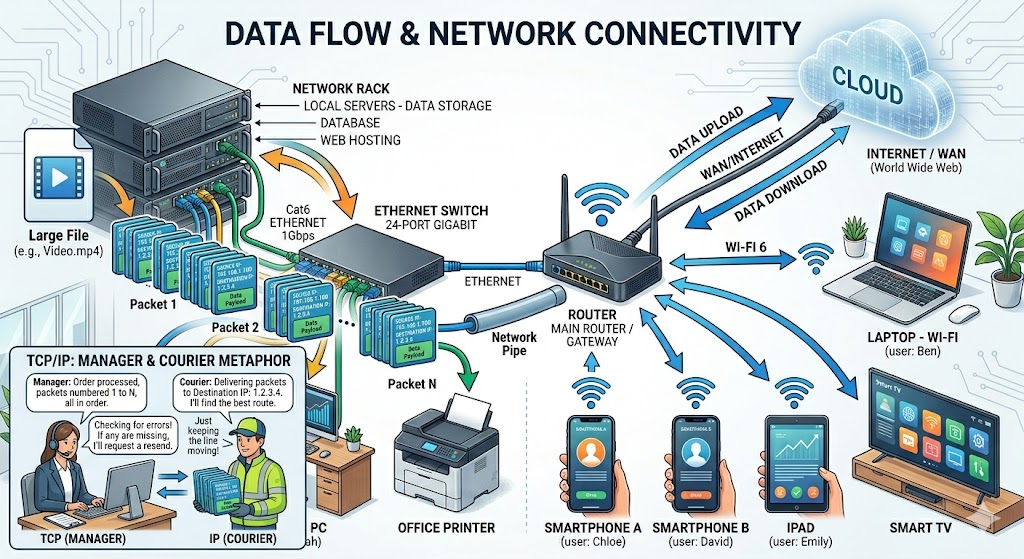
On the simplest level, data isn’t sent as an enormous file over a network. Now, imagine that you’re trying to send a 10MB photo as a single continuous stream of bits, and then something distracts on the line or something happens with the motors, so that the photo is interrupted for some reason. Now imagine that you’re sending a 10MB photo as a single continuous stream of bits, and you’ve got some kind of interference or something happens with the motors, so the photo is broken up for some reason. To avoid such inefficiency, networks use a technique called packet switching. Each digital data is partitioned into small manageable chunks called packets. In addition to the data, each packet also contains a “header” which contains important information about the packet like the source address, the destination address, and the number of the packet. This makes it possible for packets to traverse various physical routes to a single destination without being crowded out by traffic or damaged by faulty components, then be put back together in the proper order at the receiving end.
Industry uses protocols to ensure that these packets are treated uniformly across various manufacturers’ devices. A protocol is essentially a protocol or set of rules for formatting, transmitting and receiving data. One of the most important of these is the Internet Protocol Suite (IP Suite), also known as TCP/IP. The Transmission Control Protocol (TCP) is the “manager,” in charge of making sure that all the packets make it and are reassembled correctly, and the Internet Protocol (IP) is a “courier” that performs the actual addressing and routing. If they weren’t here, the internet would be a wild place with all sorts of systems using different “languages” and thus being unable to communicate with one another. These rules are used to ensure structural integrity to the intricate dance of digital information.
Data Encapsulation: The Journey of a Packet

A data packet must be carefully prepared before it can be sent out from your device, a process called data encapsulation. This idea is best explained by the OSI (Open Systems Interconnection) model, which breaks down network operations into 7 different layers. In each layer, the data will contain its own header information as it moves down from the application layer (the software you use to interact with the data) to the physical layer (the actual wires or radio waves propagating the data). For example, the TCP header is added to the data by the Transport Layer to help with flow control, and the IP header is added by the Network Layer to help with routing. The layering process makes sure that each piece of equipment on the transmission path only reads the information that is pertinent to its function, thereby making the network much more efficient.
De-encapsulation takes place when the data arrives at the destination. The receiving device removes the headers one at a time and checks the information with each one to make sure it is correct. For instance, the Data Link layer will take care of checking on any physical transmission error, and the Transport Layer will provide the guarantee that no packets have been lost in transit. This systematic wrapping of data and unwrapping is responsible for a high degree of security and reliability. Separating functions into distinct layers allows engineers to add, change or remove components of the network without redesigning the applications or transport protocols. This abstraction is what has allowed the internet to be so great and sustainable over the past few decades and is the secret to its incredible scalability.
Learn How to Deal with IP Addresses and DNS When Addressing the Digital World

Much like a physical house needs a mailing address, all devices on a network must have a unique identifier in order to send the data from point A to point B. The IP address is for this purpose. There are two versions in use at present: IPv4 (4 sets of numbers, e.g. 192.168.1.1) and newer, IPv6, designed to overcome the problem of an ever-increasing number of internet-connected devices by providing a virtually limitless number of addresses. The addresses enable routers to route a packet to the correct destination. We do this, though, because humans don’t like to remember long strings of numbers, so we use the Domain Name System (DNS). It’s like the Internet’s phonebook, where users can look up an IP address for a website like google.com and get the computer’s numerical address.
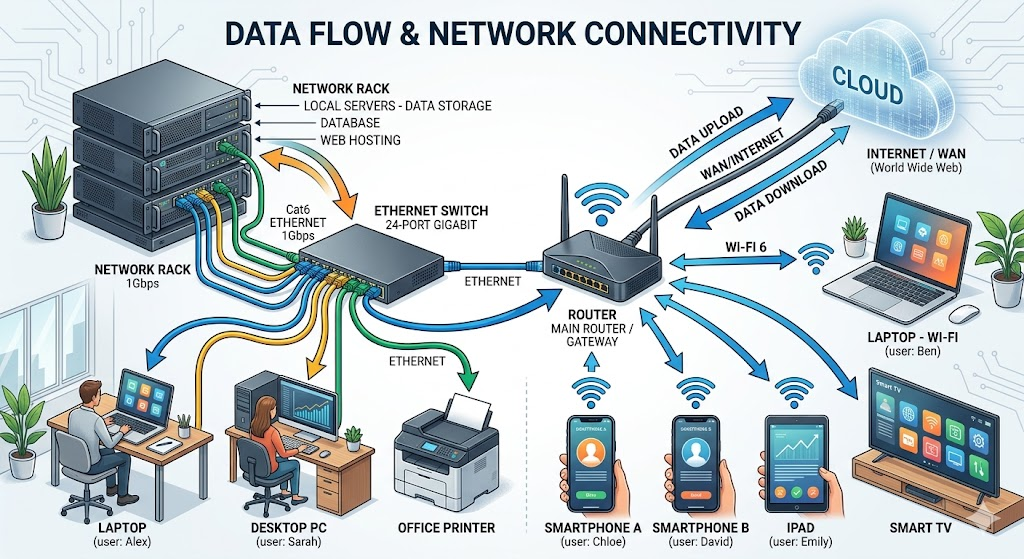
Finding a destination is further refined by submasking and gateways. In a local area network (LAN), they communicate relatively freely, but if a packet does need to get to a device on another network, it will travel through a “default gateway”, which is usually your router. The router looks at the destination IP address and checks the address against its internal routing table to determine the “next hop” for the packet. This decision making process takes place billions of times a second all over the world. The global routing system is very resilient, and if one of the big data centres in Virginia fails to operate, the routing system can calculate another path and route data through London or Tokyo – eventually getting the data where it needs to be, without interruption.
Bandwidth, Latency, and the Physics of Speed
Protocols and addressing determine the logic of data transmission, whereas physical limitations for the medium determine the performance. Bandwidth and latency are two points that are important to measure this. Bandwidth is the maximum amount of data that can pass along a particular path, or “width of the pipe.” Having a high bandwidth means that there will be more packets that can be sent at once. This is important when you are streaming a lot of data, such as playing 4K video, downloading large files, etc. Latency is, however, the time it takes for one packet to reach its destination and return to the source. For real-time apps such as video conferencing and online gaming, the low latency can be even more critical than high bandwidth, because a few milliseconds can make a noticeable difference in the timing of the experience for both people involved.
These metrics are strongly affected by the physical medium through which the transmission takes place, such as twisted-pair copper, coaxial, fiber optics, or wireless waves. The data-transmission method used in fiber optic cables is the most bandwidth-intensive and has the least latency because light moves much faster, and with less distortion, than electrical signals over copper wires. There are additional factors with wireless transmission, including physical obstructions and electromagnetic interference, that can lead to packet loss. If packet loss happens, the TCP protocol will detect the loss of information and will ask for it to be retransmitted again – this will ensure the integrity of the information, but will temporarily slow down the perceived speed of the connection. The challenge of modern network engineering is to balance these physical constraints with logical efficiency.
The Security and Integrity of Transit is Ensured
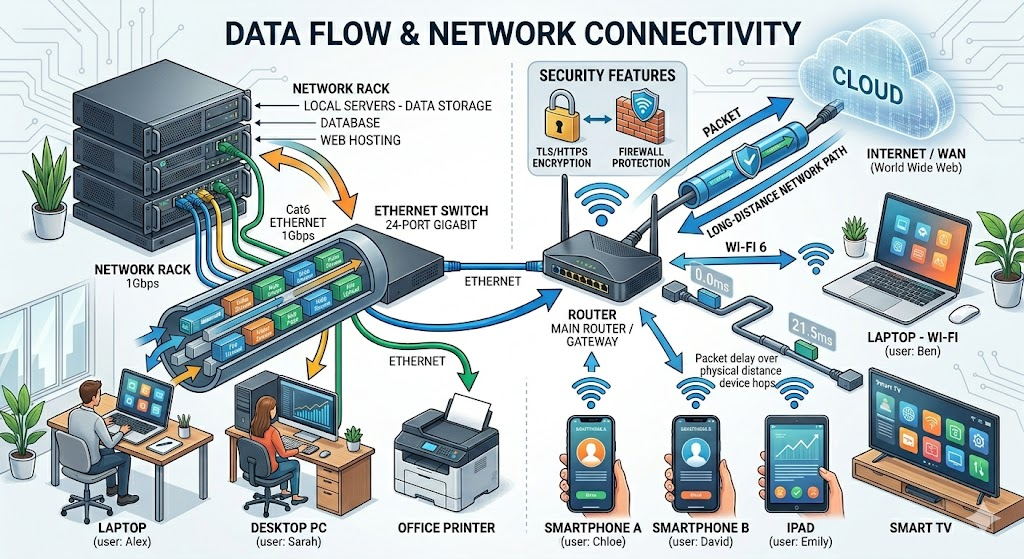
Data can be intercepted, tampered or stolen as it flows over public or private networks. Modern networks use a number of security measures to counteract these risks, and encryption is among the most important of them. HTTPS in the browser’s address bar means that the data being sent from your device to the server is encrypted via Transport Layer Security (TLS). This scrambles the contents of the packets, which means that if the packets are somehow picked up by a bad guy they can’t be read without the decryption key. Encryption takes place during the encapsulation process, which means that the data that you’re sending, or the payload, is encrypted from the moment that it leaves your machine until it reaches the authorized receiver and the machine is ready to handle it.
In addition to encryption, networks also use firewalls and Intrusion Detection Systems (IDS) to keep track of which packets are coming in. A firewall is a kind of gatekeeper that examines the headers of all the traffic that flows in and out of it and decides whether it’s safe or not. If the packet is sent from a suspicious IP address, or if it’s trying to access a restricted port, the firewall will “drop” the packet, which means that it won’t enter the internal network. In addition, Virtual Private Networks (VPNs) provide an encrypted “tunnel” that goes through the public network, which enables data to be transmitted as though on a private and secure network. The speed and convenience of modern communication do not compromise the safety and privacy of sensitive corporate and personal information with these multi-layered security features that are woven into the transmission system.