Picture this: your campaign has just ended. The results are drawn, but something is wrong. Your sales are higher than what your dashboard shows. Conversely, your ad platforms are all boasting, each claims full credit for conversions that hardly add up. And at one point, between your phone, laptop, and desktop, a customer made three interactions that your analytics recorded as three strangers.
Well, this is not your fault. This is the reality of modern marketing moving away from third-party cookies. Those small tracking files were the thread which has been stitching and connecting all touchpoints in a customer journey for many years. That thread is now ripped apart by privacy legislation, browser capabilities and privacy-conscious consumers, and what replaces it is cookieless attribution. However, this shift or transition is not without friction or challenges. Marketers are actually experiencing challenges: fragmented data, lost conversions, conflicting platform reporting and tools that are not designed to work in this new reality. This article names those challenges clearly and offers actionable solutions to help you adapt with confidence.
Why Cookies Mattered and Why They’re Going Away
The digital advertising relied on third-party cookies for over twenty years. When a user visited a website, a small file stored in their browser could be read by other site which also enabled the advertisers to track the user and gain insights into their browsing behaviour, as well as advertise to users in the most appropriate way. To marketers, this allowed them to track conversions, retarget, and do multi-touch attribution without having a direct customer relationship.
However, privacy was sacrificed at the expense of that convenience. Users had the right to disapprove tracking in GDPR and CCPA. Firefox and Safari started disabling third-party cookies by default. Google has been going through its own phaseout across Chrome. The infrastructure that the marketers relied on has broken down structurally, and the question is how to measure marketing impact without it.
The Biggest Obstacles Marketers Face Without Cookies
1. Cross-Device Fragmentation Makes Customers Invisible
A prospect may learn about your brand on a phone advertisement as they drive to work, research your product on a laptop at night, and make a purchase on a work computer the following morning. That is one person moving through a single decision process that is logical.
Whenever cookies are not used to connect those sessions, analytics tools treat each device as a separate user. Your reports will show three visitors and one buyer. This deformity multiplies with time, and budget decisions get made on flawed data.
2. Conversion Loss Quietly Erodes Your Data
Blocked cookies do not just affect the cross-site tracking, but they also lower the number of conversions that you would be able to view completely. When a browser blocks tracking scripts or a user declines cookie consent, any purchase or sign-up they complete will not be registered in your analytics platform. The conversion happened. Your tools never recorded it.
Studies show that 20-40 percent of real conversions might go unmeasured when cookie-based tracking fails. The risk is severe: when a campaign seems not to be doing very well because of the low-tracked conversions, teams might cut down the budget on something that is actually doing well. The gaps in measurement are not only a source of confusion, but they also lead directly to bad decisions.
3. Platform Attribution Conflicts Create Budget Confusion
Platform Attribution Disagreements bring about confusion in the budget. Advertise on Google and Meta as well as TikTok, and each of them will insist that it made most of your sales. Calculate those numbers and they are usually very high than what your real revenue is. Each platform sees its own touchpoint and gives itself the full credit – Google sees the search click, Meta sees the social impression, and TikTok sees the video view. In the absence of a coherent tracking mechanism to align the data across platforms, marketers are unable to allocate budgets based on real performance.
4. Privacy Consent Creates Structural Data Gaps
To show this, once you have someone who clicks on a cookie banner and chooses the option of declining, they no longer show up in your analytics. You cannot see that they visited, or even what pages they browsed. The rate of opt-outs in very controlled markets or privacy-sensitive populations can be over 40 percent of the total visitors. With the world growing increasingly privacy-conscious, the number of users that cannot be tracked conventionally is bound to increase, and any approach that fails to consider this will only give more and more skewed findings as time goes by.
5. Legacy Attribution Tools Are Not Built for Incomplete Data
The majority of attribution tools assume data completeness. For this, untracked large segments of customers’ journey do not just generate weaker results, they generate actively misleading results. Also, there is inconsistency in reports. The variation in numbers on a week-to-week basis is without apparent reason. The assurance that marketers used to have with their dashboards is replaced by a lack of confidence and uncertainty in measurement leads to hesitation in spending.
Practical Solutions to Implement Now
Build a First-Party Data Foundation
The most significant shift that a marketing team can make is to stop relying on third-party tracking and to start owning first-party data, which is the information that customers provide or share with you directly. Purchase history, email addresses, product preferences, and on-site behavior collected through your own platforms all qualify.
Site users share information when the benefit is clear and the questions are fair. When a customer is convinced of your brand to the extent of subscribing to your newsletter, you get something that is much more dependable than the cookie you gave. Browsers cannot block it, legislation cannot invalidate it, nor can a policy change in a platform remove it, as first-party data cannot be blocked or invalidated. The longer the relationships between you and your customers last, the more it adds to their value.
Move Tracking to the Server Side
Conventional pixel-based tracking fires within the browser of a user, and can be intercepted by ad blockers and privacy settings. Server-side tracking moves the transfer of data from the browser to your own server and it sends signals straight to ad platforms. It cannot be limited by browser limitations.
This approach is supported byMeta’s Conversions API and Google’s Enhanced Conversions. Teams that have adopted server-side tracking have reported a consistent recovery of 20-40 per cent of conversions that were previously unmeasured.
Adopt Data-Driven Attribution and Media Mix Modeling
Rule-based attribution models were made for a less complicated world. The last click credit method, or assigning all credit to the last click, or distributing it evenly reflect only arbitrary assumptions that are hardly representative of the way customers make decisions. However, data-driven attribution is a machine learning tool that analyzes observed trends in your campaign data and identifies which touchpoints actually had any impact on conversions.
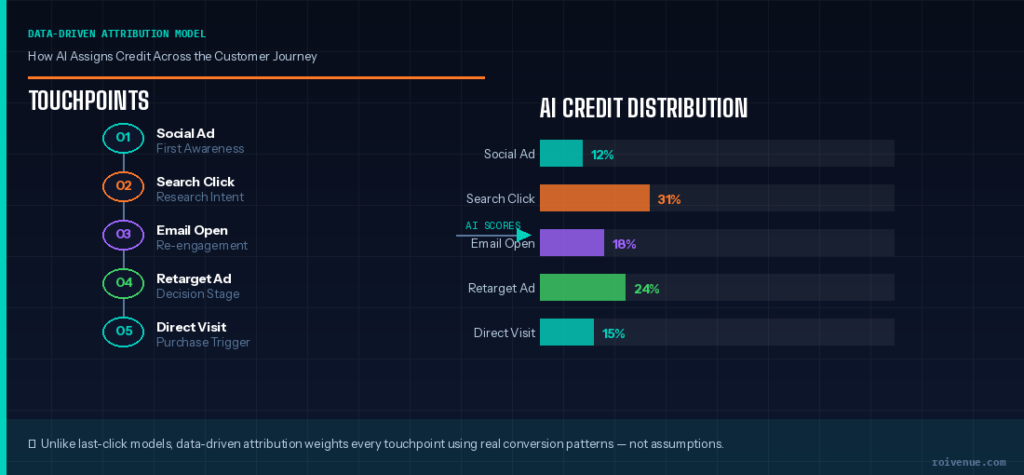
Also, Media mix modeling (MMM) incorporates a strategic complement, which does not require any individual-level tracking. It matches aggregate marketing expenditure across channels with the overall business performance over the long run. It is resistant to cookie blocks and privacy alterations. These tools combined provide channel accuracy and a macro-level strategic perspective.
Improve Consent Rates Through Transparency
Enhance Consent Rates by being transparent. Many users decline tracking not because they inherently disagree, but because they are simply confused by the consent banners. The opt-in rates usually increase significantly in brands that invest in a more transparent, more truthful consent experience.
For transparency, state what you are collecting, the purpose of the collection and what the user benefits by agreeing. Make the design neutral as opposed to being persuasive. If users feel respected, they will more likely opt in, and an increase in the consent rates will result directly in a more complete level of measurement and intelligent budget decisions.
A Phased Implementation Plan
Cookieless measurement does not need to be rebuilt at night. Start with the most pressing data gaps: introduce server-side tracking to prevent the loss of conversions, audit your consent process to increase opt-in, and find two or three high-value first-party data collection points in your customer journey. These primary steps will be the only meaningful difference in making your reporting to be accurate.
More smart attribution should be made once the foundation is in place. Attribution models should be implemented using data-driven attribution instead of the last-click models that provide a biased perspective regarding channel performance. Include media mix modelling to authenticate insights by macro-level data. Any data quality improvement will result in improved decisions. Those teams that view the cookieless measurement as a continuous ability to develop and not a fix-it solution will continue to perform better than those that are waiting to get a simpler solution that might never come.
Conclusion
The shift away from cookies is a short-term disruption, a temporary disruption, it is a structural one in the relationship between digital marketing and consumer privacy. The most successful marketers will be those who discover the best workaround. They will be the ones who will bend towards this change and create measurement systems that gain customer confidence instead of secretly tapping technical loopholes.
Cross-device fragmentation, conversion loss, conflicts in platform attribution, privacy-motivated data gaps, and failure of legacy tools are all too real challenges. However, there exists a practical, working solution to each of them nowadays. Individually, first-party data collection, server-side tracking, data-driven attribution, media mix modeling, and transparent consent practices all provide a future-proof foundation for marketing measurement.
Remember, it is the direction that is important and not the speed. Start with a single good move today, then go on and grow steadily, continuously, and the real measurement value you gain will add with every positive change you make in the long run.