Introduction
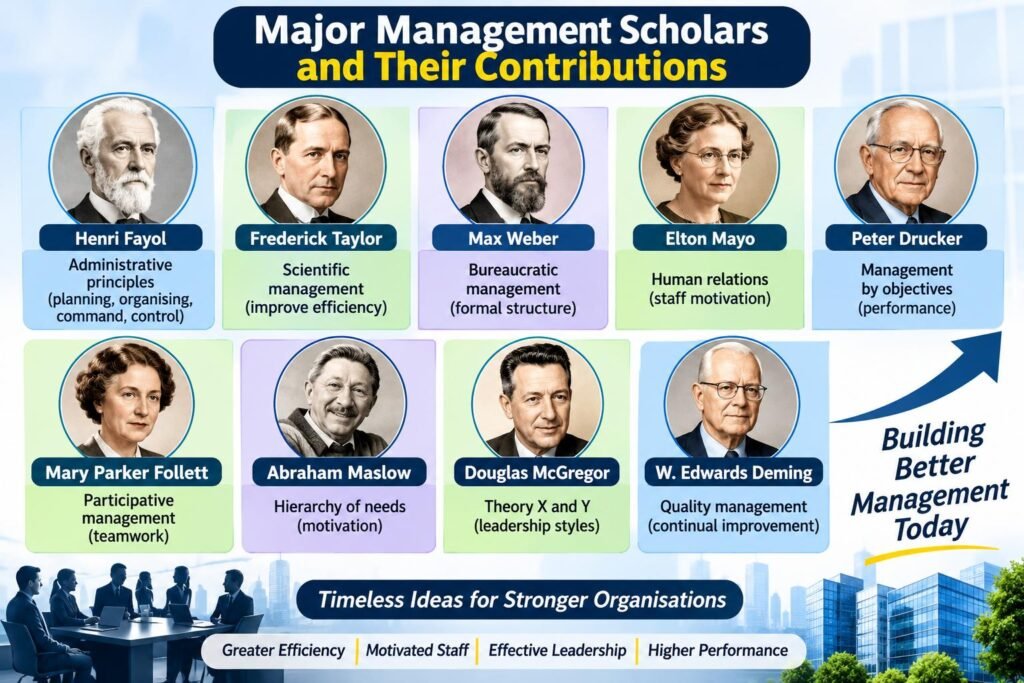
Management has evolved to become a recognized profession and has been furthered by theories, principles and practice. Contemporary businesses utilize good management so that they can effectively manage resources, direct staff and increase productivity. Throughout history, academics and managers have investigated the workings of organizations and how these can be enhanced. These studies have occurred at various times and were impacted by developments in industrialization, technology, staff and business environments. Despite differing viewpoints, there have been valuable insights generated which have contributed to modern day management. Investigating the work of key figures such as Henri Fayol, Frederick Winslow Taylor, Max Weber, Elton Mayo and Peter Drucker can therefore illustrate how current management practices were developed and why their theories are still pertinent.
Taylor and Scientific Management
Frederick Winslow Taylor is recognized as the ‘father’ of scientific management. He aimed to increase the efficiency of industry and therefore conducted and analyzed work related information. Throughout the late 1800s and early 1900s, numerous factories utilized conventional, experiential and loosely managed approaches to managing staff. Taylor claimed that this frequently led to inefficient and ineffective working and was costly. He suggested that management should investigate and analyze work and then determine the most effective ways of undertaking it. Staff should then be chosen and trained for particular jobs and links fostered between workers and management. Furthermore, Taylor advocated basing decisions upon scientific research and implementing reward schemes. His approach led to organizations investigating, setting criteria and assessing productivity. Despite suggestions that Taylor’s work de-humanized staff, his insights have greatly impacted on an organization’s production, processes and efficiency as well as its performance management.
Fayol and Administrative Management
Unlike Taylor, Henri Fayol took an overall view of an organizations’ management. He recognized five primary management aspects; planning, organization, command, co-ordination and control. These in turn allowed managers to effectively manage an organization and ensure that all of its departments were aligned towards common aims. Additionally, Fayol formulated 14 management principles such as specialization, authority and accountability, discipline and unity of command and direction, alongside pay, centralization and esprit de corpo. He stressed the value of good structure, communication and fairness and the importance of good teamwork. Fayol viewed management as a transferable skill and believed that these skills were applicable to a variety of organizations. Present day businesses still utilize Fayol’s work in relation to management areas such as strategy, inter-department co-ordination and management accountability. His principles are furthermore apparent in the production of company policy.
Weber and Bureaucratic Management
Max Weber added to management knowledge by describing the bureaucratic nature of management. He considered that for an organization to function both effectively and uniformly it needed to have well defined regulations, duties, lines of authority and processes. Weber’s bureaucratic management underpinned a strict hierarchical system and included specialization, record keeping and rule based decision making. Furthermore he favored employing and promoting people according to their skills and ability. His work aided organizations in developing sound management and minimized biased decision making. Although too much bureaucracy can hinder an organization due to its lack of agility and the volume of documentation involved, Weber’s theory is highly relevant in sectors such as government, finance, education and large business. Modern business organization diagrams, formal lines of reporting, compliance and standard operating policies all reflect elements of Weber’s work.
Mayo and Human Relations
Elton Mayo gained prominence for his involvement in the ‘Hawthorne studies’, where he studied staff behavior and environment within industry. His work was integral to the emergence of the human relations movement. This contested the notion that workers’ productivity was primarily influenced by financial and environmental factors. Mayo and others recognized the significance of interpersonal interaction, communication, group dynamics and staff focus, as well as morale. Consequently, managers began to appreciate staff as complex beings, not just as commodities. Human relations theory indicated that good management, team work, appreciation and involvement could all affect motivation and hence, performance. Although later research has cast doubt on some of the conclusions reached from the Hawthorne studies, Mayo’s work has had a considerable impact. Current management techniques such as staff engagement, team development, communication and good management all evidence the continued relevance of human relations in successful business management.
Drucker and Modern Management
Peter Drucker is seen as one of the most influential modern day management theorists and was key to defining management as a profession. He pioneered and popularized ‘management by objectives’, whereby both managers and staff define objectives and assess performance against quantifiable targets. Drucker maintained that businesses should place emphasis on customers, invest in staff and embrace innovation. He also claimed that knowledge based staff had grown ever more integral to modern economies as their knowledge and judgment added considerable value to an organization. Overall Drucker moved the focus of management away from control and towards accountability, performance and continual improvements. His work affected aspects of strategy, management and staff development. His views on innovation and customer orientation are still highly relevant for businesses seeking to successfully compete in today’s fast paced and competitive environment.
Mary Parker Follett and Participative Management
Mary Parker Follett added to management by promoting the benefits of teamwork and effective dispute management, as well as recognizing the significance of human interaction. Rather than purely top down management, she contended that managers should interact with and involves staff, and use mutual understanding to formulate solutions. Follett put forward the idea of ‘integration’ which aimed to devise solutions that addressed the fundamental concerns of all involved in a situation and prevented one party from overpowering another. She also emphasized the desirability of ‘power with’ rather than ‘power over’ in order to reinforce the importance of teamwork and shared accountability. Follett’s work pre-figured many elements associated with participative management, team working and current management. Contemporary organizations display Follett’s relevance by seeking staff involvement, facilitating multi-disciplinary team working and ensuring inclusive decision making. Thus her work has helped to further widen the scope of management beyond formal management and administration roles.
Maslow and McGregor – Motivation and Leadership
Both Abraham Maslow and Douglas McGregor greatly enhanced knowledge regarding staff motivation and management. Maslow formulated a ‘hierarchy of needs’ to illustrate that human motivation can be affected by several levels of need, including physical requirements, safety, social interaction, esteem and self-actualization. This enabled managers to recognize that staffs are motivated by a wide range of factors in addition to financial remuneration. People may also seek job security, interpersonal contact, appreciation and progression. McGregor devised two contrasting theories (Theory X and Y) to describe the differing perceptions that managers can hold of staff. Theory X presumes that staff typically avoids work and so requires tight management. Conversely, Theory Y contends that personnel can be self-motivated and accountable if the correct environment is provided. These theories impacted upon management style, staff development, motivation and business culture. Again, they continue to prompt managers to consider the differing needs of staff and to create environments which foster both staff commitment and career development.
Deming and Quality
W. Edwards Deming significantly added to quality management. He employed statistics, and emphasized continual improvement and organizational quality management. Deming contended that sub-standard quality was often a result of flawed systems and processes and not typically staff error. He urged managers to enhance production, minimize superfluous diversity and utilize accurate data. Employees were also encouraged to detect and report issues. Supporting continual improvement, which is often implemented using a ‘Plan, Do, Check, Act’ mechanism to trial and then fine-tune processes, Deming highlighted the importance of leadership, inter-departmental teamwork and long term quality management. His work affected Japanese industry and is now highly relevant worldwide in relation to quality. Modern quality focused approaches such as total quality management, process improvement, measuring customer satisfaction and quality assurance all exemplify the ongoing relevance of Deming’s theories.
Influence of Management Scholars on Contemporary Business Administration
Various aspects of management have been impacted by the work of these scholars. Taylor’s scientific management facilitated thorough investigations and assessments of work and productivity. Fayol’s contributions included the formulation of management and co-ordination principles, which are used to inform business strategy and co-ordination. Weber’s bureaucratic theory underpinned an organizations’ formal structure and enabled professional management. Mayo emphasized the relevance of staff interaction and morale. Drucker progressed business strategy, together with his management by objectives approach. Moreover, Follett, Maslow and McGregor all provided additional insights into participative working, staff motivation and management. Deming furthered quality and continual improvement. Often, rather than in isolation, these areas are integrated in current management. Modern managers can for example implement performance measurement, formal processes, staff engagement, strategy and quality improvement mechanisms all within one business. Studying Management Scholars and Theories can therefore be highly informative in illustrating how these areas have been developed and how they can be utilized in management decision making.
Conclusion
Various scholars have influenced the evolution of management as a profession. Taylor illustrated the advantages of scientific and productivity analysis. Fayol produced management and co-ordination principles. Weber emphasized formal structure and logical authority. Mayo recognized the significance of staff interaction and behavior. Drucker progressed business strategy, innovation and his management by objectives approach. Mary Parker Follett, Abraham Maslow, Douglas McGregor and W. Edwards Deming all added to knowledge concerning participative working, motivation and management, as well as quality. Although the theories of these individuals still affect business, modern day managers must tailor them to fit present situations. Contemporary management must effectively balance efficiency and staff welfare, structure and adaptability and performance and innovation. Drawing on past management scholarship can thus enable today’s managers to make well informed decisions and thus construct productive, accountable and sustainably successful businesses.
Get more well researched information about Contributions of Management Scholars here.