Introduction
The banking industry relies on technology to carry out transactions, store customer information, manage finances and deliver key services. As banks rely on more cloud computing solutions to manage their operations, they increase their reliance on technology which can leave them vulnerable to cyber-attacks, system failure, natural disasters and unexpected outages. In the event of a problem occurring with a bank’s systems, customers will be unable to access their accounts, payments will be delayed and cause disruption to the business and lose public confidence. To prepare for this issue, banks can utilize cloud disaster recovery solutions to protect essential information and allow them to deliver key services in unexpected situations. Financial institutions can ensure there is a good plan in place with clear recovery point objectives to define how much data they are willing to lose.
Cloud Disaster Recovery in Banking
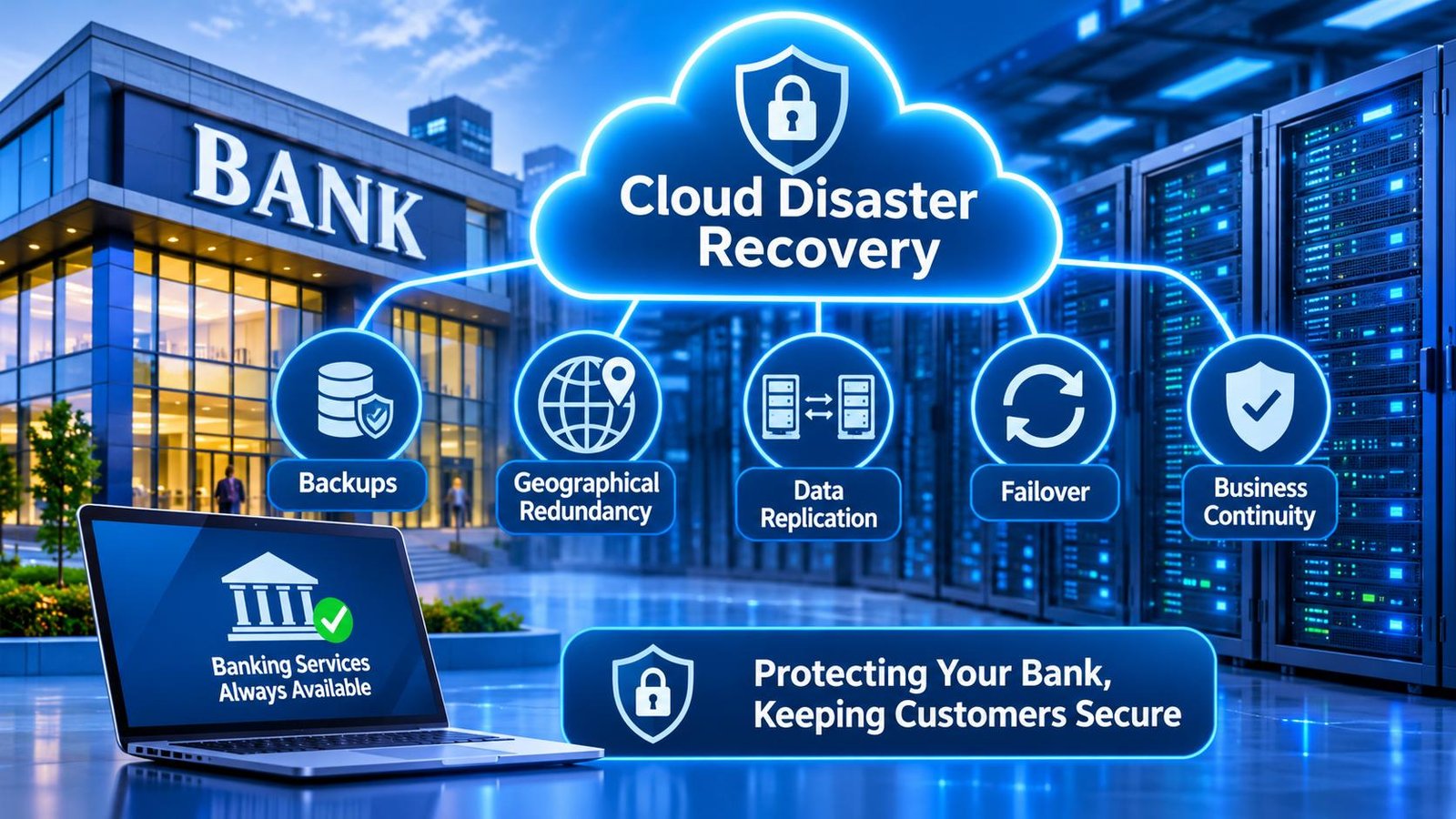
Cloud disaster recovery solutions utilize cloud infrastructure, services and technologies to allow a bank to recover systems and information. Financial institutions can now store copies of data and applications in secure cloud environments. This means that in the event of a failure with their main systems they can use the information stored in the cloud to recover. Cloud disaster recovery can also be scaled to fit the business needs of the bank by not having too much extra hardware. However, security measures must be in place, cloud solutions must be reliable and there must be clear roles and processes in place for recovery.
1. Cloud Backups
Cloud backups are an important part of disaster recovery. They provide extra copies of information that can be restored if the original data is lost, damaged, corrupted or inaccessible. Financial institutions will have lots of sensitive information to store, such as customer information, transaction history, account details, loan information and reports. If this data was lost it would be very problematic for the business. Using automatic backups to store information in secure areas of the cloud will reduce the reliance on one physical storage option. Backups should be set at regular intervals depending on how often information is updated in different systems. There should also be encryption, limited access, monitoring and retention of information to prevent unauthorized access. Banks should also regularly check backups are full, accessible and can be used to make a successful recovery.
2. Geographical Redundancy
Geographical redundancy means that copies of essential banking information will be stored and recovery options will be available in different geographical areas. This will ensure that if there is a disaster affecting the whole building, city or area, they can still recover. For example, if there was flooding, fire or significant power outage at the banks main data centre they can recover using geographical cloud options. Data replication can be used to copy data from main systems to recovery sites either continuously or at set intervals. Depending on the technology and business needs, data replication can be almost instant or at set times. Synchronous replication can be used to keep copies very similar. Asynchronous replication can be used with some delay. Banks should consider the network availability, distance, cost and data consistency when deciding what type of data replication to use for their essential applications.
3. Failover
Failover systems can help ensure that banks can still provide essential services if there is an issue with their main systems. Failover means that the systems are moved to an alternative environment that contains the required applications, data and computing. For example, if there is an issue with the main transaction processing systems due to a hardware issue, the backup systems in the cloud may be turned on to allow essential banking services to be provided. Some failover systems will automatically move to a backup system if a major issue is picked up by the monitoring systems. Others will need authorized technical staff to move to the backup systems. Although automatic failovers can reduce downtime, they should be carefully set up so that systems aren’t moved incorrectly or data is inconsistent. Banks should also put in place clear processes to return to the main systems once the issue has been resolved.
4. Recovery Time Objectives and Recovery Point Objectives
When creating an efficient disaster recovery solution, it is important to understand the Recovery Time Objectives (RTO) and Recovery Point Objectives (RPO). RTO defines how long a system or service can be down for before it needs to be recovered. For example, a bank may want a short RTO for their payment processing systems as they could cause issues for customers, merchants and other financial institutions if they were down for too long. RPO defines how much data can be lost. If a banking application had an RPO of 5 minutes then the recovery solution should look to ensure that no more than 5 minutes of data changes are lost. This will help banks decide on the right backup schedule, data replication, recovery solutions and investment in infrastructure based on how important the services are.

5. Backups vs. Disaster Recovery
While backups and disaster recovery are closely related they do not mean the same thing. Backups are focused on creating copies of the data. This will allow the data to be recovered if it was accidentally deleted, corrupted or lost. Whereas disaster recovery is a wider process that looks at recovering technology, applications, networks, databases and services so the business can continue. A bank may have multiple reliable backups but may still experience lengthy downtime issues if they don’t have the systems in place to recover their applications. Disaster recovery may also rely on backups to recover data. Therefore, financial institutions shouldn’t assume that having cloud backups will fully protect them. Both should be in place and work together in a co-ordinated way to ensure data is protected, infrastructure is recovered, roles are in place and customers are looked after.
6. Ransomware Proof Backups
Ransomware can be a real issue for banks as hackers can lock their information, cause issues with applications and ask for a payment to unlock the systems. Traditional backup systems can be targeted as hackers could have access to the same admin accounts and storage solutions. Banks should ensure that they have ransomware proof backup solutions in place to prevent unauthorized changes, deletions or encryptions to the backup copies. Having immutable backups will help as this means the data will not be changed or deleted for a set period of time even if some accounts have been compromised. Keeping copies of backup’s offline or logically separated can also help to ensure that there is less direct access to the live systems. Financial institutions should also have multi-factor authentication, least privilege, monitoring and regular security assessments in place to make it harder for hackers to compromise the data and backups.
7. Third Party Cloud Issues
Whilst using cloud solutions, there are still some technology risks to consider. Cloud providers can experience issues such as outages, network issues, security issues and regional issues. If there is an issue with a major cloud platform then the bank may not be able to access their applications, databases or stored information for a short period of time. Financial institutions should ensure that their cloud provider is reliable and resilient. Service level agreements should be in place which clearly outlines availability, notifications, recovery and what the provider will do in the event of major issues. Banks should also know where their data is stored and how they can retrieve it if they need to change providers. Depending on their risk assessments, some financial institutions may have multiple regions or clouds to reduce reliance on one environment. This will add more management and security requirements.
8. Regular Testing
Having a disaster recovery plan in place doesn’t mean it is reliable. Financial institutions should regularly test their recovery solutions to ensure that systems, backups, communication and technology will work in an emergency. This can be done through table top exercises, simulated cyber attacks, recovery backups and failover exercises. This will help find any issues with the recovery such as outdated processes, missing information, lack of infrastructure or delays in getting access to cloud systems. Banks should also measure how long it takes to recover and compare this to the RTO and RPO times they have set. Testing should also be carried out with the right departments such as IT, Cybersecurity, Risk, Compliance and Customer Service. Any findings should be recorded, assigned to the correct teams and used to improve recovery processes before another issue occurs.
9. Business Continuity
Business continuity looks at ensuring that a financial institution can provide essential services during and after a major issue. Whilst disaster recovery focuses on technology and data recovery, business continuity looks at the wider business. Banks should identify what services they need to keep running during an emergency. This could include providing access to customer accounts, processing payments, monitoring fraud, providing support and essential financial transactions. They should also have alternative processes in place, communication during emergencies and clear roles. For example, if a bank cannot access their physical offices due to a natural disaster, specific employees will be able to carry out approved activities from remote locations using secure systems. A well planned business continuity plan will ensure that the technology recovery is helping with the wider business goals.
Effective Cloud Disaster Recovery Strategy
To create effective cloud disaster recovery strategy financial institutions should understand their risks, identify essential services and choose the right technology. To start, banks should carry out a business impact analysis to identify what processes are the most important to the business and how different issues could impact customers and financial stability. This will help identify realistic RTO and RPO times for each system. Next, they should choose reliable cloud infrastructure, set backup schedules, data replication and geographical recovery solutions. Security should be included throughout the process especially for sensitive customer information and financial data. Banks should also have clear documentation to show how decisions were made for recovery, who has authorisation to turn on failover systems and how they will communicate. Recovery solutions should be reviewed if there are any changes to infrastructure, regulations, business processes or cyber security threats.
Conclusion
Cloud disaster recovery and business continuity are important in the banking industry. Due to increasing reliance on digital solutions, financial institutions need to plan for any issues that could impact customer information, financial transactions and essential services. Cloud backups, geographical redundancy, data replication and failover can all help protect information and recover systems in unexpected situations. Setting the right RTO and RPO will also help banks understand how quickly they need to get services back up and running and how much data they are willing to lose. However, technology alone won’t guarantee a successful recovery. Ransomware proof backups, managing third party risks, regular testing and detailed business continuity plans are just as important. Financial institutions can reduce risk, increase customer confidence, protect sensitive financial information and ensure essential banking services are provided by using these strategies.
Get more well researched information about Cloud Disaster Recovery for Banks here.


