Introduction
One of the keys to a good accounting system is the chart of accounts. It is the structured list of the accounts that a business uses to account for their financial transactions and prepare reports. If designed correctly, it assists bookkeepers and business owners correctly categorize income, expenses, assets, liabilities and equity. But if the chart of accounts is not organized properly, even simple transactions can be incorrectly classified. While these errors might seem minor on their own, they can add up to unreliable financial statements, challenging business performance reviews, and unforeseen issues when preparing financial statements and taxes.
Many companies start out with a simple chart of accounts and create new accounts as needed if there is a transaction that doesn’t seem to fall into an existing category. This might seem like an easy solution, but it can result in a lengthy list of duplicate, ambiguous or irrelevant accounts. These expenses can be lumped together into very general categories with little to no value, and similar costs can be split across multiple budgets for no particular reason. This results in an inconsistent and unclear financial report. The chart of accounts should be organized in order to meet the reporting requirements and activities of the business and not in a random fashion as transactions are made.
Understand the Purpose of a Chart of Accounts.
The chart of accounts is a well-organized list of all the accounts in a business’s general ledger. The names, the account numbers, and the classifications are each normally included in each account. The key types are assets, liabilities, equity, revenue, expenses and sometimes for companies engaged in manufacturing and trading, cost of goods sold. These categories are used to record transactions and to create vital reports like the balance sheet, income statement, cash flow statement, and management reports. The chart of accounts is thus not just a list of bookkeeping labels. It is an organizational system which decides the way economic information is gathered, grouped, studied and provided to the business owners and some other decision makers.
A good chart of accounts helps people know how to allocate their money, how they use it, what they have and owe. It also allows ease of comparison of financial results from one period to the next. For instance, if advertising is always charged to the same account and thus the trend of spending can be seen over the course of the month, management can determine whether the marketing efforts are yielding useful results. When advertising expenses are reported at times in office expense, sales expense, or miscellaneous expense, the report will not give a true picture. Therefore, for meaningful financial analysis and informed decision making it is important to have consistent account classification.
The Effect of Poor Chart of Accounts Design on Misclassification
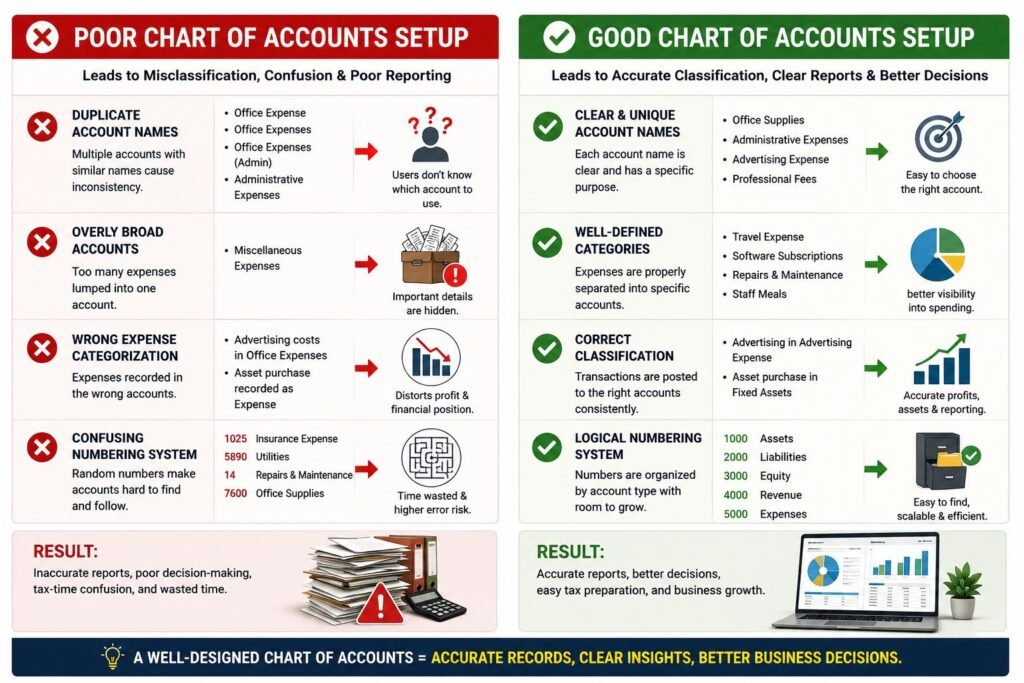
Misclassification is when a transaction is entered in an account that doesn’t reflect its economic substance. If a chart of accounts isn’t well-designed, there is a higher chance of these types of errors occurring, since employees might not be aware of which account to use. Account names might not be clear or there may be too broad of an account selection or categories that overlap. For example, an account called “General Expenses” could be used for office supplies, staff meals, software subscriptions, repairs, or professional services. While all these are expenses, it is not helpful to the business understanding when all these transactions are lumped together in one account.
Inconsistencies in decision making by various employees can also come from poor account design. The same expense can be posted to a bookkeeper’s office expenses as well as another bookkeeper’s technology expenses. Either employees are convinced that they are applying consistent categories and it turns out that they aren’t, or both employees are convinced of using reasonable categories and it turns out that they are not. Either employees think they are using consistent categories and they are not, or employees think they are using reasonable categories and they are not. When the business consists of multiple departments, locations or accounting users, the issue becomes even more serious. If the names of the accounts and the classifications details are not specified, similar transactions can be handled differently across the organization, making accurate measurement of performance and cost difficult.
The use of Vague or Overly Broad Account Names should be avoided.
A very frequent chart of accounts setup mistake is that the account names are too generic. It appears that labels like “Miscellaneous Expenses”, “Other Costs”, “General Expenses” or “Sundry Expenses” might be helpful since they offer a spot to enter transactions that don’t fit into other categories. But, too many of these accounts usually obfuscate key financial facts. If the amount of unrelated expenses is large and grouped together in one category then management will not know what the money is being used for. Even though each item is for a different purpose and could be analyzed separately, they can all be included in the account and include costs for travel, office, subscriptions, employee benefits, and minor equipment purchases.
If a general account is used, it could also be hard to notice unusual spending. Facing a sudden surge in miscellaneous expenses is not sufficient to find out what really caused the increase and if management should investigate it. The company will have to go through each transaction and figure out what changed, thus wasting time and decreasing the efficiency of reporting. The better way is to have distinct accounts for large, frequent expense items, and only a few small accounts for miscellaneous items. If a miscellaneous account starts to build up a large balance, the transactions should be looked at to see if there should be a separate account.
Creating too many Similar Accounts
Quite vague accounts can also pose classification issues, but too many accounts can be a problem, too. Some companies set up separate bank accounts for individual items of expenditure, suppliers, projects and purchases. This may lead to hundreds of accounts in the chart of accounts that are hard to follow and keep up with. A company may have its own accounts for paper for printing, pens, notebooks, folders and other office supplies. The categories may seem specific but may not offer much added value in terms of their separation and could cause unnecessary complexity of transaction entry.
Be careful not to have a very detailed chart of accounts as there is a possibility of duplicate classifications. It is possible that a purchase will fall into the “Office Supplies” or “Office Materials” or “Administrative Supplies” or “Stationery Expenses” category, depending on the item, and employees will not know the category they should be using. If there are multiple accounts with comparable descriptions, the users can choose different accounts for similar transactions. This means there are mismatches in records and financial reports are less useful. Don’t try to make as many accounts as possible. The chart should, however, be sufficiently detailed to enable useful reporting without being unnecessarily complex or confusing.
Incorrect Categorization of Operating Expenses
Operating expenses are the costs that a business has to pay on an ongoing basis to keep going with its business. Some of these can include things like rent, utilities, salaries, insurance, advertising, office supplies, professional fees and software subscriptions. If these costs are misallocated, the management might not be aware of the actual costs of running the business. Advertising expenses may be booked as office expense, for instance, which can make the overall administrative costs look higher and can underbook the expenses in the advertising column. This can impact the budgeting process and provide problems with gauging marketing investments and determining if they are yielding the desired outcomes.
This can also impact on performance comparisons if the expenses do not get categorized correctly. A business can use the current expenditure to make comparisons with the previous month’s expense or with a budget to pinpoint where attention is needed. When transactions are booked in different accounts in different periods, the comparison could be erroneous. An apparent rise in one category may simply result from a change in bookkeeping rather than it being a true rise in expenditures. Creating clear account definitions and using them uniformly will eliminate such issues and keep financial reporting in line with the real business.
Confusing Capital Expenditures with Operating Expenses
Another big mistake in set-up is having a chart of accounts that doesn’t clearly distinguish between the capital and ordinary operating expenditures. Typically, capital expenditures are made for the acquisition or enhancement of assets that will be useful for more than one accounting period. These can be things such as machinery, vehicles, buildings, large equipment and some long term improvement. The costs of running the business, like rent, utilities, regular maintenance and office supplies, are generally called operating expenses. When these categories are not separated, bookkeepers can possibly document purchases of assets as regular expenses or regular costs as capital property.
If a major asset is bought and recorded as an expense, then the asset purchased will be understated and the expenses for the period overstated. On the other hand, it is possible to have inflated business valuations by recording the regular expenses as assets rather than costs and claiming the costs at a later time. These mistakes may impact profit calculations, record of assets, depreciation records, and financial ratios. Well organized chart of accounts should then have asset accounts that are clearly identified and expense accounts that make sense. It should also be backed up by written instructions on the capitalization policy of the business and the types of purchases which should be classified as long-term assets.
The Link between Poor Account Setup and Tax-Time Confusion
The absence of any chart of accounts makes it very difficult for the business to prepare tax information. Inconsistent documentation of income and expenses can lead the accounting team to have to manually read through numerous transactions to determine how they should be taxed. This can cause tax preparation delays and the potential to miss or report the wrong information. Sometimes businesses find it difficult to identify if an expense is deductible or not when the transactions are combined in general or ambiguous accounts. Good accounting structure ensures good record keeping and minimizes the time spent to prepare accurate financial information.
Tax-time confusion can also result from poor classification as the financial records may not be clear about the purpose of significant transactions. For instance, expenses for business travel may differ from those for employees, entertainment costs, professional services, equipment purchases, and other costs may have different reporting requirements and/or tax consequences. If the transactions are done in a single general expense account, it may be necessary to do further investigation before tax returns can be prepared. Having a chart of accounts does not and should not replace tax advice, but can be of assistance in organizing financial information and facilitate tax preparation and recordkeeping.
Common Chart of Accounts Setup Errors
Using Inconsistent Account Numbering
Most often, businesses don’t pay attention to account numbering when designing or redesigning their chart of accounts. In certain accounting firms, the numbers are predetermined for each account, in others, they can be designated by the business itself. Randomly assigning accounts numbers makes navigating the chart challenging. Accounts may be scattered and new accounts may be added but not in a logical sequence. This can delay the speed at which transactions can be entered, and complicates the process of reviewing the accounts, particularly if the business has a large number of accounts or multiple people use the accounting system.
Logical numbering system is a numbering system that groups related accounts together and makes space for additional accounts later on. For instance, asset accounts could have one number range; liability account a different one; and revenue and expense account different ranges. The number might vary by accounting program and business, but it’s important that it is consistent. Having a well-designed numbering system allows anyone to move quickly to the accounts, find missing categories and keep the general ledger organized. It also allows for scalability as new accounts can still be added to the overall structure.
Failing to Separate Business Functions
A multi-department, product/service or device-based business, or one with multiple locations, may need more in-depth reporting than a one-category business. If the chart of accounts doesn’t show important business functions, management will not be able to gauge performance. For instance, a firm that offers consulting and training services would like to know the revenues and direct expenses of consulting and training. If no specific tracking is carried out to identify certain products or services as being more profitable than others, management may not know which service is more profitable.
However, if the numbers of departments or projects are large, it may be too big to have separate general ledger accounts. Various accounting systems offer departments, classes, cost centers, locations or project codes. The tools can be integrated with the chart of accounts and enable you to get detailed reporting without having to duplicate accounts. The business needs to assess its reporting requirements, and then select the tracking method that it needs. The chart of accounts should list the main financial categories with other dimensions to be used to view performance by department, location, product or project.
How to manage Obsolete or Unused Accounts
Businesses can evolve as time goes on. They could end up stopping products, shutting down stores, embracing newer technology or modify how they deliver their services. If the chart of accounts hasn’t been looked at regularly, then old accounts can continue to be open by default even if they aren’t necessary anymore. These accounts can cause employee confusion and can make it more prone to having transactions recorded wrong. Another unused account might be named the same as an active account and users will not be able to select the right one.
Regularly review accounts for accounts that are no longer necessary, redundant, or obsolete. Inactive, not deleted accounts are preferable if they are no longer needed. There may be situations where historical information is still required for financial comparisons, audits or record keeping. The business should therefore retain the important historical information and avoid picking up inactive accounts for new business. This way, the chart will remain tidy and provide a chance of misclassification in the future without compromising on the previous financial records being easily accessible.
How to Design a Clean and Scalable Chart of Accounts
The first step in creating a clean chart of accounts is to know the business model. The accounting organization should be based on the method of revenue generation, cost of the company, asset information and what information the management needs to review. Different revenue and expense categories may be needed for a service business as compared to a retailer or manufacturer. A retailer, for instance, might be concerned with inventory, cost of goods sold, shipping costs and returns, while a consulting firm might be more interested in service revenue, employee costs, professional fees and technology costs.
This should also be taken into account in the design phase since it is a key feature in the design. The chart should be detailed enough to support current reporting requirements, but be flexible enough to accommodate future expansion of the business without having to redesign the chart. Don’t establish accounts for all sorts of future activities, as it can be confusing. Rather, they should instead create logical account groups and allow for more accounts in the numbering system. A scalable chart allows for flexibility and growth whilst keeping things consistent and financial data easily understood.
Create Clear Descriptions of Accounts.
All accounts should have a descriptive name that indicates what is stored in the account. The description of the accounts should be comprehensible to all staff members working in the accounting system. If an account name is ambiguous, the business should consider giving written instructions and/or changing the name. A line item in an account, for instance, might be “Internet services,” which could cover software, computer repairs, Internet, equipment, etc. Separate reporting of these costs should be done with the establishment of separate categories or making the purpose of the account clearer.
Using written account descriptions can also help to streamline the amount of consistency. The following brief chart of accounts policy could outline what is entered in each account and give examples of typical transactions occurring within each. This is especially convenient if multiple bookkeepers, managers and/or departments are entering financial information. Clear guidance minimizes personal judgment and helps to ensure that similar transactions are treated in a similar manner. It also helps in the process of employee training and ensuring continuity in the event of a change of duties in accounting.
Standardize Transaction Classification
One of the key attributes of sound accounting records is consistency. If a business has chosen an account which is suitable for a series of similar transactions, it should maintain that account for the transaction type until there is a good reason to switch to a different account. Standardization of procedures minimizes the risk of various staff decisions resulting from individual tastes and preferences. All software subscriptions for example, should be on the same approved account and all office supplies should be on the office supplies category.
Transaction rules, supplier information and default account settings are among the features offered by accounting software that can help to standardize transactions. These features may help to minimize manual entries and enhance efficiency but should be regularly reviewed. If not monitored, automated rules might continue to route transactions to an old or incorrect account. Periodic review should be used in conjunction with automation, therefore, to ensure that businesses do not miss out on opportunities. The aim is to simplify the classification process to be accurate and to have the proper controls in place for financial records.
Analyzing and updating the Chart of Accounts
A Chart of Accounts shouldn’t be a document that is set and forgotten. The needs of the business, its activities, its reporting and technology requirements, and its management needs can evolve as time goes on. Frequent audits identify the need for new classes as well as the need to keep existing classes. Review process should include accounts with no balance, account activity, duplicate accounts, ambiguous names and infrequently-used accounts. It should also take into account if the existing structure is suitable to enable reports to be used to inform decisions.
Review should include appropriate accounting staff and business owners/department managers as appropriate. Users of financial reports may notice that they are lacking or hard to interpret. Meanwhile, modifications should be monitored to make sure that they don’t result in the creation of additional accounts. New accounts should be established for a clearly articulated purpose and should enable better reporting or classification of transactions. Having an approval process for chart of accounts changes ensures consistency, and prevents the structure over time from becoming disorganized.
Enhancing Reporting and Decision Making with better Classification
Properly classified accounts make the financial report more meaningful by allowing similar transactions to be put in the same category and important categories are distinct. If these reports are set up correctly, management will be able to see revenue trends, watch for big expenses, see how profitable they are, and compare actual results to the budget. For instance, a company can find delivery costs have become a burden, and they are losing profits, or software expenses have become substantial over a few periods. Only with consistent transactions and meaningful categories in the chart of accounts can these insights be achieved.
A chart that is well organized also helps to make quicker and easier decisions. Business owners need not spend hours on reviewing one by one transactions and making sure that they are aware of the changes in the overall finances. Rather they can rely on quality reports to define risks and opportunities. Financial information is clear and can be used for budgeting, pricing, cost control, investment planning and improving operations. The chart of accounts thus plays an active role in managing a business by converting each transaction into meaningful financial information.
Conclusion
There can be problems that go beyond bookkeeping if chart of accounts is setup incorrectly. Transaction misclassification can occur due to vague account names, duplicate categories, too much detail, inconsistent numbering, obsolete accounts and poor asset and expense separation. Such mistakes can make financial statements murky, make it harder to analyze performance and increase the amount of work required when preparing taxes. Business owners can make decision based on incomplete or inaccurate financial data, as the wrong classifications keep piling up.
An organized chart of accounts that’s clean and scalable offers a better base for precise bookkeeping, reporting, and management. Businesses should build their chart of accounts around their business operations and reporting requirements, avoid abbreviating or using generic account names, create clear classification guidelines and periodically review their chart of accounts. The objective is not to build as many accounts as possible, but to build a logical system that will give relevant detail without any redundancy. By having a properly maintained chart of accounts, bookkeepers and business owners will be better equipped to categorize, provide better reports, minimize confusion, and make better business decisions as the business expands.
Get more well researched information about Chart of Accounts Setup Errors here.