Introduction
Maintaining accurate financial records is important for business owners and bookkeepers as a responsibility which they have that of keeping accurate financial records. At the same time it is not uncommon to find that what we have recorded in our accounts as far as cash balance is not at par with that which is reported on the bank statements. This issue of different numbers may bring about confusion, delay in financial reporting, and may question the put together well of our account records. That said the differences as a rule are a result of ordinary banking issues, time differences, or input errors rather than signs of large scale financial issues. Also it is in this area which we must do some research into why these differences present themselves in the first place and that is also a step in the right direction of better maintained books which in turn prevent large scale accounting errors.
The bank reconciliation process is put in place to identify and report on each difference between what a company has recorded in its books and what is reported by the bank. It is a very important element of internal control which is used to detect fraud, to find out accounting errors, to audit transactions and to make sure that the financial statements present a true picture of the available cash. Companies which do this on a regular basis are better able to make informed financial decisions, put together reliable reports, and pass auditor, lender, and tax authority reviews. To better understand the bank reconciliation process it is also useful to look at the most common issues which cause errors in the reconciliation and the practical steps businesses may take to correct them efficiently.
What Is Bank Reconciliation?
Bank account reconciliation is the practice of comparing what a company’s books say about the cash balance with what the bank reports at the end of a given period. To that end we try to account for each difference between the two sets of numbers and see that both sets of records do in fact present all the financial facts. Most companies do this at the time they get their bank statements which is usually once a month but very active transacting organizations may do it as often as weekly or daily.
A successful resolution of issues between parties includes the review of deposits, withdrawals, electronic transfers, checks, bank fees, interest income, direct debits and other activities which affect the cash account. Also it is common for companies and banks to record transactions at different times which in turn cause temporary variances. Also we see that recording errors by either the business or the bank may cause discrepancies which in turn require correction. By regularly reconciling accounts we improve financial accuracy, strengthen internal controls, reduce the risk of fraud and also see to it that management has at its disposal reliable info when making financial decisions.
Why Bank and Book Balances Rarely Match
Many business owners think that their accounting software will always reflect the same cash balance as the bank statement. In fact we see very normal differences between the two balances which is due to the fact that transactions do not at all times post to both records at the same time. Banks process transactions on their own schedule which is often different from that of the business which records internal transactions as they occur. Thus what we see is that deposits, payments, bank fees, and electronic transfers are recognized at different times.
Another issue which causes discrepancies is human error. We see that employees may put in the wrong numbers, double up on some transactions, leave out items, or categorize payments in the wrong place. Also banks at times make errors in processing but these are a less common issue. Without reconciliation issues identified and resolved on a regular basis those small errors add up over time and really do put the cash balance out of whammy. By identifying what is causing these issues companies are able to tell the difference between real timing issues which are normal and actual errors in accounting which can then be corrected before they impact reporting.
Common Bank Reconciliation Errors
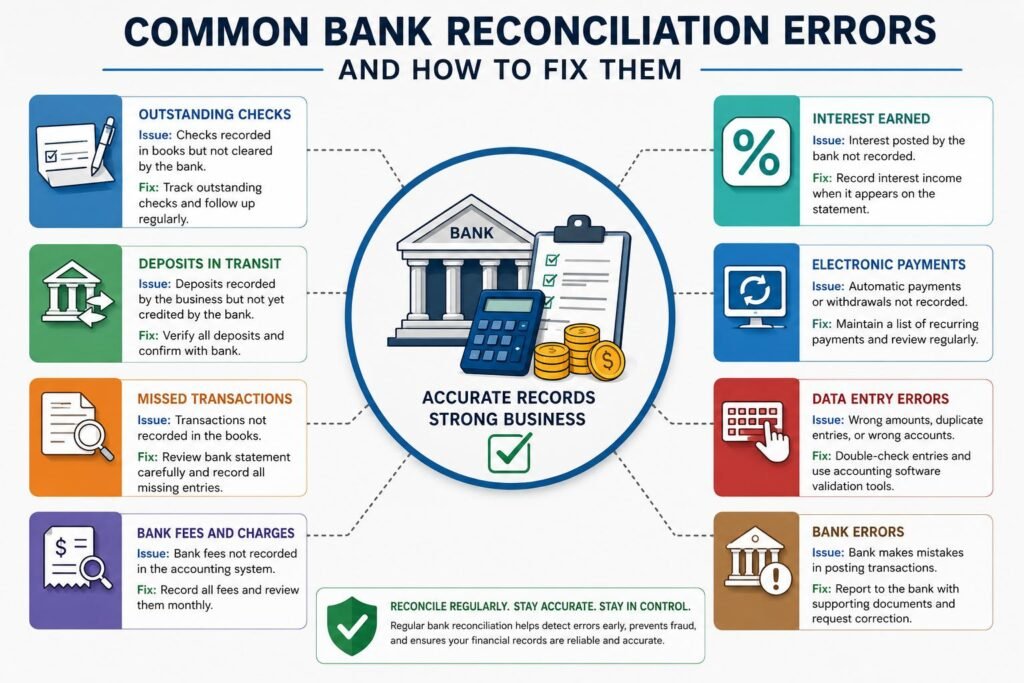
1. Outstanding Checks
An outstanding issue of check is what usually accounts for the difference between what we see in a company’s books and its bank statements. What this means is that a company may issue a check which it has recorded in the accounting books but which the recipient has not taken to the bank yet for that payment to be made out of the company’s account. Thus the company’s account has in fact paid out the money and so the account balance is lower, but the bank has not yet processed that which is why the balance there is still high. Also till the check goes through the banking system the discrepancy will exist.
Outstanding checks are a common issue which usually sorts itself out within a few days to weeks. That said we see it as a good practice for companies to report on checks which are still outstanding for what would be considered abnormal times they may point out lost checks, uncashed checks, or fraud. We recommend that you follow up with vendors and staff about old outstanding checks which in turn helps in the accuracy of our cash records and see to it that indeed we are making payments to the right parties.
2. Deposits in Transit
Deposits in transit are a result of a business’ recording of customer payments or cash deposits before the bank reports them. This issue mainly comes up when deposits are made at the end of the day, on weekends, or near the end of the accounting period. The company’s records will show the increase in cash but the bank statement will still show the old balance until the process is complete.
These delays in time will be corrected when the bank updates its records in the next processing cycle. Also businesses should very carefully check that all recorded deposits show up on the bank statement. Some delayed deposits may be due to bank delays, posting errors, or in rare cases theft or fraud. Use of in depth deposit records and comparison of deposit slips with bank confirmations is a good practice which will see that all funds are put in the right account.
3. Missed or Omitted Transactions
In which most present day issues in reconciliation are due to ignored transactions. Companies at time do not record customer payments, supplier invoices, electronic transfers, automatic withdrawals, or cash deposits. Also it is the case that banks will process transactions which the businesses are not aware of until the monthly statement is issued. For example of which include loan payments, direct debit collections, automatic subscriptions, insurance premiums, or merchant service fees which are taken out of the account.
When accounts are left out of the accounting records the cash balance is off and financial statements may not go in to the true financial position of the business’ health. Through reconciliation we see which entries are missing which allows bookkeepers to report to management and file taxes with accurate info.
4. Bank Fees and Service Charges
Banks report service charges, monthly maintenance fees, wire transfer fees, overdraft charges, and transaction processing costs out of customer accounts at will. Also because these charges come from the bank instead of the business, they tend to show up on the bank statement before the accounting department does which in turn causes the bank balance to reflect a lower number than what is reported in the company’s books.
Failing to include bank fees in the books causes issues at the point of reconciliation which also sees some operating expenses reported lower than they should be. At reconciliation time accountants should go over each charge, determine its validity and report it in the accounting system right away. Also with regular review businesses are to identify what banking products or service plans may be improved or switched out for more economic options.
5. Interest Earned
Banks can post interest income to business accounts at any time without notice to the accounting department. While these amounts may be small they do impact the bank balance and thus must be entered into the company’s records. Not recognizing accrued interest results in reported income which is low and cash balances which are also incorrect.
During the reconciliation process bank interest is recorded which in turn causes financial statements to include all revenue sources. Also this practice allows businesses to see if their banking arrangements are producing good returns on excess cash and at the same time maintain full accounting records.
6. Electronic Payments and Automatic Withdrawals
In today’s world we see that companies are very much into electronic banking which includes direct debits, online transfers, payroll processing, subscription payments, loan repayments, and automatic tax payments. Also it has come to notice that many of these transactions which are done automatically may show up on the bank statement before the accounting department is made aware of them.
Electronic payment records often get left out in the manual bookkeeping systems which many businesses use. As we do audit and reconciliation we should include review of all electronic transactions which in turn will keep our financial records full and accurate. Also it is a good practice for companies to have current records of repeat payments which in turn will reduce the chance of unexpected issues at reconciliation.
7. Data Entry Errors
Human mistake is a main cause of bank reconciliation issues. We see that employees may by chance put in the wrong numbers, input incorrect payment values, double up on transactions, record a payment twice, or post a transaction to the right account. Also what may appear to be a very small typographical error at the time, at the end of the month can create very frustrating variances which in turn tie up a lot of time during month end close.
Carefully going over supporting documentation, invoices, receipts, payment confirmations, and bank statements is a way to find out about those mistakes. Also many accounting software programs have included in them what we term as validation features which put a stop to data entry errors by identifying large unusual amounts or duplicate transactions before they are recorded.
8. Bank Errors
Although not a common occurrence but from time to time we see banks make mistakes in which they process transactions. These errors can be like putting a deposit into the wrong account, recording an incorrect amount, running a transaction through twice, or that your account is charged for what another customer’s payment. Also these errors may have large impact on your available balance until they are resolved.
When in the process of reconciliation businesses notice what may be a bank error, they should collect supporting info and get in touch with the bank at once. Most banks report that they look into brought to their attention issues right away and will post correct entries once it is determined that a mistake was made. Also, by way of regular reconciliation which is an ongoing practice, we are able to identify these which are few large scale errors early on which in turn prevent them from growing into bigger financial issues.
Timing Differences versus Actual Errors
In the field of bank reconciliation one of the key concepts is to tell apart legitimate timing differences from real accounting errors. We see that timing differences which cause issues are when transactions are recorded at different times by the bank and the business. Outstanding checks and deposits in transit are what we see as prime examples and also usually sort out within a short time frame. What we note on these is that they don’t require correction as both parties have recorded the transactions in good time according to their own systems.
Actual errors rather which require prompt action. We record the wrong amount, leave out transactions, post duplicates, or fail to report bank fees which in turn present inaccurate accounts that we correct via adjusting journal entries. In identifying which is which we help companies to avoid2 fix what isn’t broken at the same time we see to it that real issues are addressed right away before the financial statements are prepared.
How to Fix Bank Reconciliation Errors
Gather Complete Documentation
Effective for a successful reconciliation is to gather all required financial documents. This includes the present bank statement, past reconciliation reports, general ledger cash account, check register, deposit records, electronic payment confirmations, and supporting invoices. With full documentation at hand the chance of leaving out transactions is reduced and the reconciliation process is sped up.
Organized in chronological order which in turn makes it easy to track individual transactions and identify errors. Also at present many companies are using cloud based accounting software which automatically put in bank transactions, this is improving access to info and at the same time decreasing manual record keeping.
Compare Transactions Line by Line
The best way to reconcile is by going through each transaction in your accounting system and matching it with what is reported on the bank statement. Every deposit, withdrawal, transfer, fee, and payment should be matched up individually. Any transaction which is present in only one report should be looked into in full detail until the issue is resolved.
This systematic analysis allows bookkeepers to identify between what is a timing difference and what is a genuine error which in turn is supported by proper documentation. Patience and attention to detail is a must at this stage which also includes the care to not miss even a single transaction which may in end fail the reconciliation.
Record Necessary Adjustments
Once it is brought to notice that there are discrepancies, companies should make adjusting journal entries for transactions which are on the bank statement but not in the account books. This includes bank charges, interest income, automatic loan payments, direct debits, and correction of recording errors. Each adjustment should have proper description and support which in turn helps to maintain a clear audit trail.
Businesses must not change past transactions out of necessity. Instead we should see the introduction of proper accounting entries which look after the integrity of past accounting periods at the same time as putting things right in the present.
Investigate Unresolved Differences
If after review of transactions and correction of errors balances still do not match up, we will have to do more in depth investigation. Bookkeepers should check math, go over past reconciliations, check out opening balances, look at duplicate entries and pay close attention to atypical transactions. Persistent issues may be a sign of larger accounting problems which in turn will require management review or we may bring in outside accountants.
Promptly addressing issues which in the long term can become hard to find out and fix in future reports.
Best Practices to Avoid Bank Reconciliation Errors.
Prevention of reconciliation issues is a much easier task as compared to fixing them once they happen. Businesses should do reconciliations at regular intervals instead of waiting few months, which also in turn makes it easy to look at recent transactions which at that time are still present in records. Also by dividing financial responsibilities among various employees you improve internal control which in turn reduces fraud opportunities and also you improve error detection.
Businesses may put in place consistent recordkeeping practices which include recording of transactions as they happen instead of delaying data entry to month end. Also we see that use of accounting software which has automatic bank feed features does away with manual errors which in turn simplifies transaction matching. Also it is of great importance to have proper documentation of all deposits, payments, transfers and adjustments which in turn creates a reliable audit trail that supports accurate reconciliation. Also we do staff training on bookkeeping processes, approval workflows, and financial controls which in the long run also plays a great role in reducing reconciliation errors.
The Benefits of Accurate Bank Reconciliation
Accurate bank reconciliation is a practice which goes beyond balance matching. It improves the quality of financial reports, enhances cash flow management, supports budget determinations, and which in turn increases the trust in reported financial data. Also business owners get a better picture of available cash which in turn enables them to do better with investments, payroll, purchasing and debt management.
Regular audit also puts in place measures which identify out of the question transactions, repeat payments, altered checks, or what we may term as unusual activities before they grow into large scale issues. Also we see in the field that consistent reconciliation practices are a telltale of good financial health which in turn makes the audit process go more smoothly and we are able to report better on regulatory issues. In the end what we see is that which companies which do an excellent job at what I term as “recon” report also to do better at financial health and in turn see greater success in the long term.
Conclusion
Bank reconciliation is a key accounting function which sees to it that a company’s cash records are accurate, complete and reliable. We see that between bank balances and accounting records differences are typical of which are related to outstanding checks, deposits in transit, bank fees, electronic transactions, missed entries, time differences between the books and the bank, and also to occasional human or banking errors.
Perform reconciliations regularly, to maintain in depth documentation, report on issues at first sign of them, and to use proper bookkeeping practices businesses for reduction in financial errors, better internal controls, and improved quality in financial reports. As you run a small business or run the accounting function of a large organization master bank reconciliation which in turn gives you greater confidence in your cash balances and sets a strong base for good financial decision making.
Get more well researched information about Bank Reconciliation Errors: Common Causes and How to Fix Them here.