Introduction
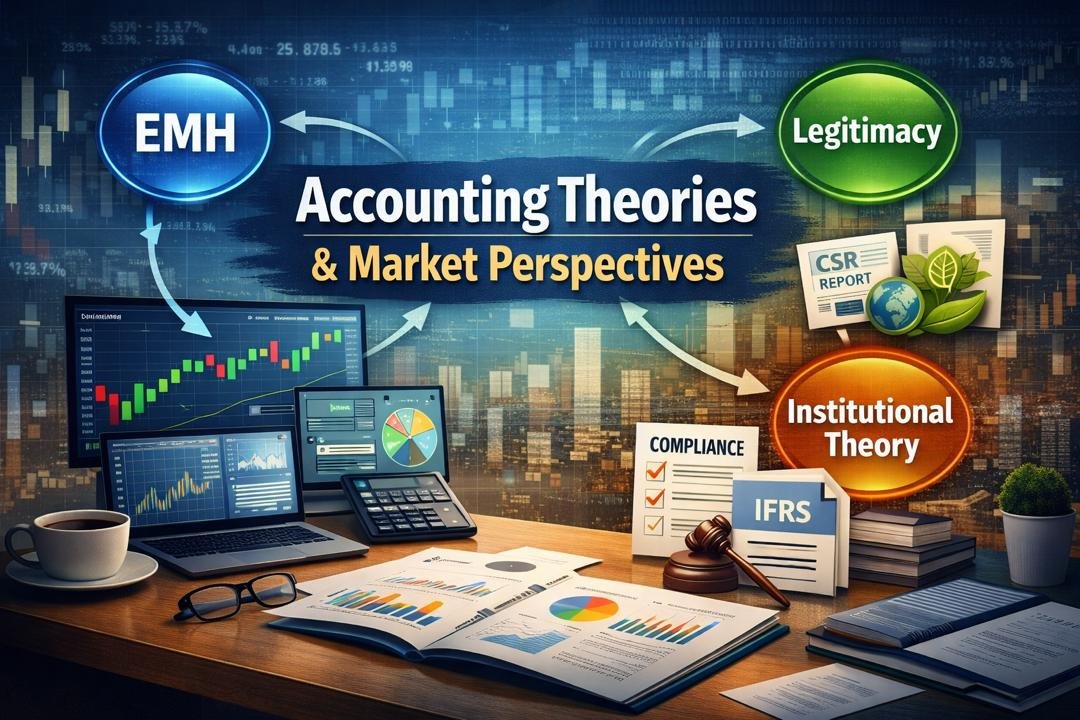
Accounting is much more than a technical act of registering and reporting of financial activities. It is highly embedded in the larger economic and sociological system that influences the manner in which organizations act, the market reacts and the manner in which stakeholders use financial information. The most powerful of them are the Efficient Market Hypothesis (EMH), the Legitimacy Theory, and the Institutional Theory. Accounting theories and market perspectives views combine to give a multidimensional perspective of accounting practices connecting financial reporting to market efficiency, societal expectations and conformity of organizations.
The knowledge of these economic and sociological theories is critical towards explaining the reasons why firms report some information, the response of investors to accounting information, and why adherence to regulations is less in one context and more in another. To gain a more conceptual basis, read this full overview of economic and sociological theories, which points out their more expanded applicability through other fields.
This paper discusses the role of Accounting theories and market perspectives in determining the accounting practices, impact of the theories on compliance with regulations and their effect on the legitimacy of organizations in a dynamic international world.
The Efficient Market Hypothesis and Accounting
Overview of the Efficient Market Hypothesis
The Efficient Market Hypothesis (EMH) which was mostly formulated by Eugene Fama is an assumption that the financial markets are efficient in terms of information. This implies that the prices of assets are updated with the maximum amount of available information. EMH can be generally divided into three forms:
- Weak form efficiency: The prices are based on the market history.
- Semi-strong form efficiency: Prices are based on all available publicly available information.
- Strong form efficiency: Prices incorporate all the information, both public and private.
Accounting Implications
Under semi-strong form of EMH, accounting is very essential especially where financial reporting and disclosures directly affect stock prices. The implications include:
1. Relevance of Financial Reporting
In case of efficient markets accounting information provided has to be relevant, reliable, and timely. Financial statements are used in making decisions by investors, and a delay or distortion will cause them to be mispriced.
2. Low Ability to Cumulate Abnormal Returns
Under EMH, it is hard to have investors continuously gain abnormal returns in a program of accounting data that investors can readily see since it is already reflected in stock rates.
3. Emphasis on Transparency
Transparent financial reporting facilitates everyone in the market access to equal information. This helps to value fairly and minimize information asymmetry.
4. The Accounting Standards Role
Such standard-setting organizations as the IASB and FASB play an important role in making sure that financial information is reported in a consistent manner, making the information more comparative and efficient in the market.
Criticisms and Limitations
EMH has received extensive criticism irrespective of its influence:
- According to behavioral finance, investors are not necessarily rational.
- Bubble and crashes are market anomalies that question the concept of full efficiency.
- Insider trading shows that all the information is not equally available.
The restrictions mentioned above bring to the fore the reality that accounting information is not always accurately represented in the market price thus the importance of strong disclosure practices.
Legitimacy Theory and Accounting
Concept of Legitimacy
The theory of Legitimacy is based on the fact that organizations exist in a social contract with society. In order to survive and prosper, companies need to make sure that their behaviors are seen as legitimate, i.e. they do not contradict the norms, values and expectations of the society.
Accounting as a Legitimacy Tool
The disclosures in accounting are not economic alone, they have a social role to play. Financial and non-financial reporting help organizations to sustain or regain the legitimacy they have.
1. Corporate Social Responsibility (CSR) Reporting
In their effort to be seen as being in line with the societal values, companies tend to publish their CSR activities, including environmental protection, community engagement, and ethical practices.
2. Sustainability and Environmental Reporting
Companies in the industries that are sensitive to the environment (e.g., oil and gas) can prepare sustainability reports in detail to reduce criticism and keep the community trust.
3. Crisis Management
Organizations can make more disclosure when they encounter a scandal or negative publicity to restore their legitimacy. Indicatively, post financial malpractices, companies tend to report more on governance and compliance information.
4. Voluntary Disclosures
The legitimacy Theory describes the reason why companies exceed the mandatory requirements. Voluntary disclosures assist in molding the perception of people and strengthen the credibility.
Maintaining Legitimacy Strategies
Some of the strategies are that an organization can adopt:
- Conformance: Relating the operations to the expectations of society.
- Symbolic actions: Surface changes in order to look like they are being made.
- Communication: Manipulation of perception of stakeholders through reports.
Criticisms
Some criticisms of Legitimacy Theory are that it is:
- Hardly empirically testable.
- Reliant on the individual in defining what is expected in society.
- Too concerned with perception but not performance.
However, it is a very strong paradigm of explaining why companies have large-scale disclosure patterns that are not required by regulatory laws.
Accounting and Institutional Theory
Overview of the Institutional Theory
The institutional Theory focuses on the way organizations adhere to the norms, rules and cultural expectations in the environment. It underlines the fact that economic efficiency is not the sole factor that influences organizational behavior, but social pressures are also important.
Types of Institutional Pressures
The Pressures recognized under the Institutional Theory are three:
1. Coercive Pressure
These are as a result of laws, regulations, and formal demands that are incurred by governments and regulators. Indicatively, firms are bound by accounting standards and tax laws.
3. Normative Pressure
These are based on professional norms and standards, including those advocated by accounting institutions and schools.
4. Mimetic Pressure
Organizations emulate successful associates, in particular, in an uncertain situation. The result of this is homogeneity in accounting practices between firms and industries.
Impact on Accounting Practice
The institutional Theory describes some of the accounting phenomena:
1. Standardization
Internationalization of standards such as the IFRS is an expression of institutional demands of uniformity and comparability.
2. Isomorphism
Similar to those not required, organizations in the same line of business use similar accounting practices in order to seem legitimate and competitive.
3. Compliance and Beyond Efficiency
Companies can embrace some practices because they are not economical, but because they are socially required.
4. Role of Professional Bodies
Accounting organizations shape norms, which provide practice uniformity as well as the legitimacy.
Criticisms
- May mentions not to focus on innovation and strategic choice.
- Largely assumes that organizations are passive receivers and not creators in the environment where they exist.
- Can underestimate the role of economic incentives.
Nevertheless, in spite of these shortcomings, Institutional Theory offers useful information as to the reason of accounting practices convergence in diverse settings.
Interconnections between the Theories
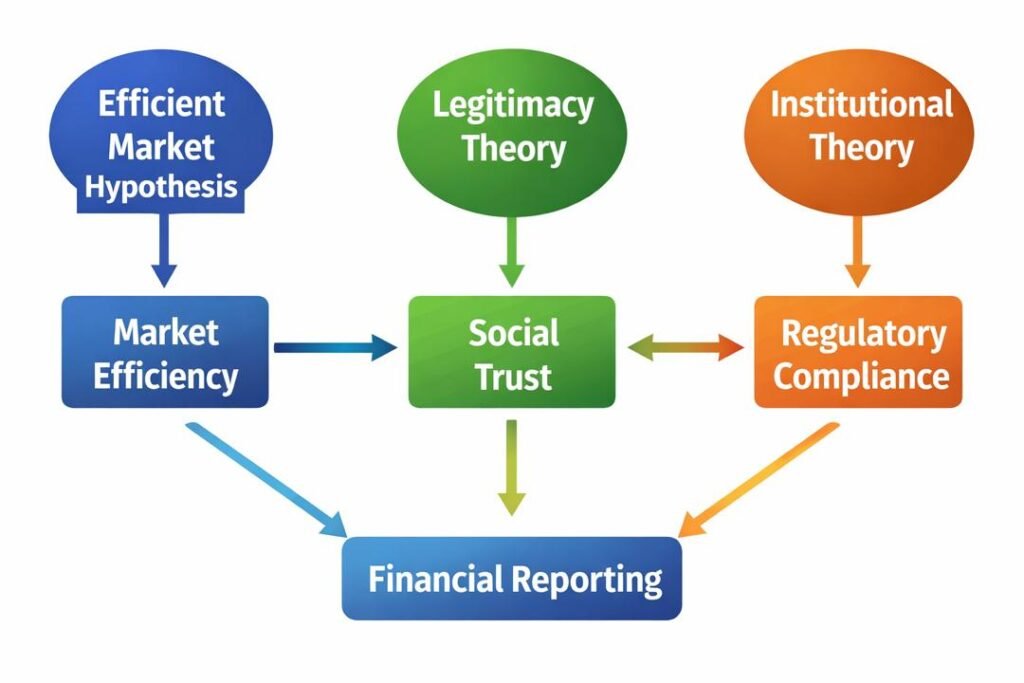
Although EMH, Legitimacy Theory, and the Institutional Theory belong to dissimilar fields, they have connections in influencing accounting practices.
1. Market Efficiency and Legitimacy
The markets of efficiency rely on the reliable and open information. This is supplemented by the Legitimacy Theory where the firms attempt to preserve trust by disclosure. The investors may not trust even correct information without legitimacy.
2. Institutional Pressures and Behavior of the Market
The Institutional Theory describes the role of regulatory frameworks and professional norms on the quality and consistency of accounting information that determines market efficiency.
3. Institutional Conformity and legitimacy
Organizations usually adopt institutional norms in order to be legitimate. As an illustration, the implementation of internationally accepted accounting standards will increase compliance and trust.
Regulatory Compliance and Financial Reporting
Role of Regulation
Regulations play a crucial role in aligning the accounting practice to the expectations of the economy and the society. These theories impact these structures:
- EMH: Favors disclosure and transparency.
- Legitimacy Theory: Promotes ethics and responsibility.
- Institutional Theory: Motivation by formal and informal coercion.
Examples of Regulatory Influence
1. International Financial Reporting Standards (IFRS)
IFRS improves comparability and transparency facilitating efficiencies in the market and institutional compliance.
2. Corporate Governance Codes
Through these codes, accountability is guaranteed and strengthens legitimacy.
3. The Sustainability Reporting Standards
GRI and ESG reporting frameworks receive the expectations and concerns of legitimacy of society.
Challenges in Compliance
- Disparities in national laws.
- Cost of compliance.
- Finding the balance between transparency and competitive advantage.
Stakeholder Trust and Organization Legitimacy
Importance of Trust
Financial markets are primarily based on trust. Accounting information is used by investors, creditors and other stakeholders in their decision making.
The Role of Accounting in Building Trust
Accounting has the contribution to trust via:
- Proper financial reporting.
- Transparent disclosures.
- Regular implementation of standards.
Consequences of Legitimacy Loss
In the case of lost legitimacy by the organizations:
- Confidence of the investors reduces.
- Stock prices may fall.
- There is an increase in regulatory scrutiny.
Cases in point are the big business scandals in which deceptive accounting activities caused both economic and reputational harm.
Multidimensional Perspective on Financial Reporting
Beyond Numbers
It is not only numbers which are involved in financial reporting, but rather a complicated set of interactions between economic efficiency, social expectations and institutional norms.
Integrated Reporting
The current tendencies focus on the concept of integrated reporting, which involves both financial and non-financial information, the integration of which helps to give a comprehensive picture of the performance of the organization.
Role of Technology
New technologies, including data analytics and blockchain, are transforming the accounting practice:
- Enhancing transparency.
- Improving accuracy.
- Lessening asymmetry of information.
Convergence and Globalization
Globalization has created pressure to have standardized accounting practices, which enhances the institutional pressures and efficient markets.
Conclusion
The Efficient Market Hypothesis, the Legitimacy Theory and the Institutional Theory are all relevant to the contribution of accounting in contemporary organizations. EMH puts a strong significance on timely and accurate information to make the market efficient and the Legitimacy Theory focuses on the requirement of organizations to be aligned with the expectation of the society. Institutional Theory on the other hand portrays the role played by norms, rules, and pressures in defining accounting practices.
The combined frameworks of Accounting theories and market perspectives provide an in-depth insight into financial reporting as a social and economic undertaking. They show that accounting is not a technical task but a dynamic system that is dependent on market, institutions, and the society in general.
The combination of Accounting theories and market perspectives enables the stakeholders to have a clearer insight into what drives accounting practices, assess the reliability of financial reporting, and recognize the greater importance of accounting in enhancing transparency, accountability, and trust in the global economy.
Get more well researched information about Accounting theories and market perspectives here.