
Deep learning is one of the key areas of artificial intelligence (AI) that allows computers to identify intricate patterns in data. It is the technology that enables technologies like facial recognition, speech processing, language translation, medical image analysis, and even the development of autonomous vehicles. Deep learning systems are trained to predict, as opposed to running on a large number of rules, which is what traditional computer systems do.
Deep Learning relies on Artificial neural networks that have multiple layers to process information. These networks can analyze large amounts of data to identify patterns, make interpretations, and accomplish tasks that are hard to solve by using simple programming instructions. Their impact however, relies on data quality, computing power and the correct evaluation of the models.
What is Deep Learning?
Deep learning is a form of machine learning that involves learning patterns and relationships from data using multilayer neural networks. These networks use computational units known as artificial neurons to process information, which are interconnected in a way similar to how neurons are linked in the human brain. Each layer processes the information it receives and the model learns more complex features with each layer.
For instance, the deep learning model that learns to recognize animals in photographs can learn to distinguish between edges and shapes in the initial layers and then learn to recognise ears, eyes and other body parts through the combination of these features. This information then gets fed into additional layers, which are used to classify the image. What distinguishes deep learning from other types of learning is its capacity to acquire relevant characteristics, which is why it is so effective when dealing with images, audio, text and video.
How Artificial Neural Networks Work
ANN is a network of artificial neurons that are interconnected and process numerical information. They usually have an input layer, hidden layers, and output layers. Data fed into the input layer, calculations made in hidden layers, and prediction/classification in the output layer.
The weights of the connections between neurons give numbers to indicate the strength of the influence from different inputs. The activation function is also utilized by neurons to facilitate the model’s learning of intricate relationships. The network “learns” by tuning its weights and other parameters during the training period to make the network better at the task.
The Input Layer, the Hidden Layer, and the Output Layer.
Information like image pixels, numerical measurements, or encoded text is fed into the input layer. This information gets converted to useful representations by hidden layers, with each layer learning a different pattern. The final layer, known as the output layer, generates the desired output, like recognizing an object or forecasting some quantity.
Multilayered networks can be taught intricate relationships that may be hard to state with hand-coded rules. The number and order of the layers, however, vary based on the task. Simple problems can be solved by a simple network and complicated problems like language processing can be solved with more complicated networks.
How Deep Learning Models Learn from Data
Deep learning models learn by example – iteration, error measurement and parameter adjustment. The training sets can include annotated photos, speech recordings and transcripts, or medical images with expert annotations. The model processes these examples several times over and, by learning from the examples, it is able to generate predictions for new data.
Typically, training is composed of three important processes: forward propagation, loss computation, and backward propagation. These processes work together to produce predictions, to compute errors, and to adjust the parameters of the network. The performance of the model is highly dependent on the quality of the training data and how it is being created.
Forward Propagation and Loss Functions
When information flows through a neural network to make a prediction, it’s called forward propagation. For instance, a model for image recognition takes a picture and guesses whether it is a cat, a dog or something else. In early training, its predictions might be wrong as it has not yet learnt the related patterns.
A loss function quantifies how well the model performs relative to the actual value. This measurement is used as an indicator by the training algorithm to decide if the model is improving. Loss functions are used in many classification problems such as cross-entropy or in some numerical prediction problems such as mean squared error. While reducing the loss helps the model learn, it does not necessarily mean it is performing well on new data when the loss is small.
Back Propagation Algorithm and Weight Updates.
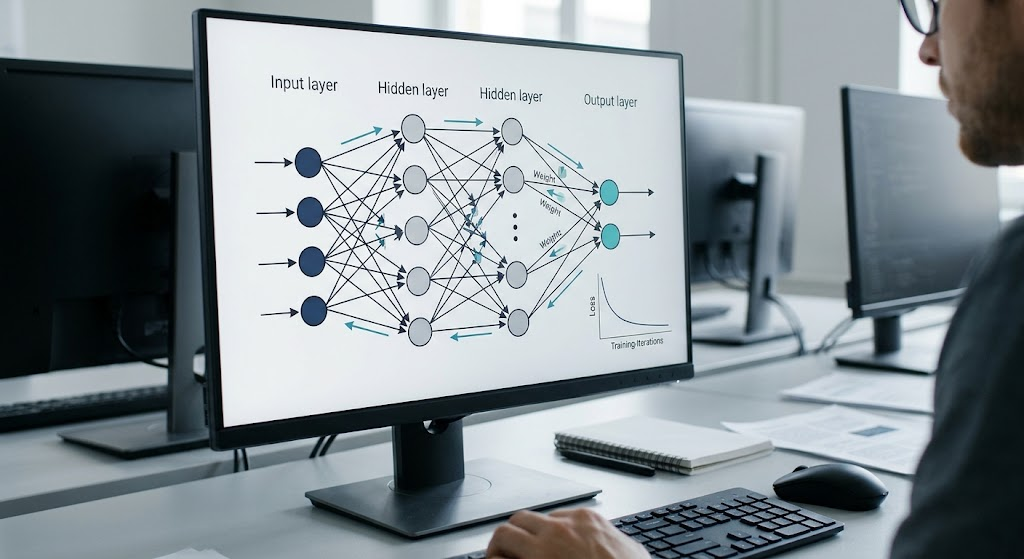
In backpropagation, the change in the weights and other parameters of the network to the loss is computed. It traverses the network from the end to the beginning, identifying the individual parameter contributions to prediction errors. These calculations are then used to update the parameters and make better predictions in the future using an optimization algorithm.
This is done for numerous training cases. As time goes on, the network can be trained to identify patterns that enable it to execute the desired function correctly. But, training has to be well-controlled: a model can memorize the training examples and not learn patterns that transfer to new situations. This is a problem that can be recognized by using validation data.
Deep Learning Models
Deep learning models can have millions or billions of parameters that can be trained. These parameters are generally calculated a number of times with large amounts of data to be processed. Specialized computing equipment and graphics processing units (GPUs) can speed up training by conducting numerous processes simultaneously.
In general, the larger the data sets, the more models will be exposed to various examples and conditions. For example, a facial recognition system must be trained with a variety of images to recognize the patterns under different lighting, expressions and angles. But, the more data, the better it does not necessarily mean. Predictions can be unreliable from inaccurate labels, examples that are not there, or representative data sets that are not representative.
Deep learning can be difficult if the organization is small because it requires a lot of computing power. Transfer learning techniques enable developers to fine-tune existing models rather than building huge networks from the ground up. Choosing the right model ensures optimal performance, cost and resources.
Real-world Applications of Deep Learning
Many technologies in daily-use and professional use are aided by deep learning. Known for its processing of complex information, it comes in handy in computer vision, language processing, the medical industry, and transportation. The type and the architecture defines different neural networks based on the type of data and results that can be achieved.
Applications on Facial Images
Deep learning models look at facial images and recognize patterns which assist to differentiate faces. The same methods are used to identify objects, make picture classification and to inspect products during manufacturing processes. These systems are able to learn from training images and do not depend purely on a set of visual rules, every one of which must be written by hand.
The accuracy, however, is not accurate for images of varying quality and may not manifest in reality as it was trained. There are parallels with privacy and fairness issues raised with facial recognition, so careful consideration and effective flow controls are important.
Language Translation and Speech Recognition.
A speech recognition system is a type of DL system that manipulates audio data into text. They help with voice assistants, transcriptors, and accessibility apps through learning linguistic relationships with sounds.
Translation models developed from language learn patterns between languages to produce translations taking account of context. These technologies are great for improving the way that people communicate, but they can also misread accents, idioms and terms. If accuracy is of paramount importance, human review will continue to remain important.
Medical Image Analysis
Medical professionals can analyze X-rays, MRI scans, and other medical images using deep learning. Trained models can detect problematic data, points of interest to explore, or aid in image classification.
These are the instruments that are subject to strict testing which can distort a care path for the patient. Models need to be tested in diverse patient cohorts, disease settings and with competent healthcare providers, and be used within clinical decision-making frameworks.
Autonomous Vehicles
Deep learning is used by autonomous vehicles to assist with their ability to identify pedestrians, traffic signs, road markings, vehicles and obstacles. The AI systems use the data from other sensors and cameras to interpret their surroundings.
However, performance can be impacted by challenging weather including wet, dull and unexpected conditions. Good autonomous driving can only be achieved after thorough testing, safety engineering and the optimization of perception models and other vehicle system functions.
Differences between Deep Learning and Traditional Machine Learning
Deep learning is a specialized form of machine learning that uses multilayer neural networks to learn complex patterns from data. Traditional machine learning algorithms, such as decision trees, linear regression, and support vector machines, can work well with structured datasets and clearly defined features. Understanding how machine learning works helps readers recognize how these approaches differ from deep learning in their training methods, computational requirements, and ability to process complex information.
For images, voices and texts, deep learning can learn useful features directly from the complex data, which is especially useful. It generally needs more computing power, though, and could necessitate larger datasets. A model’s usefulness depends on the problem, the resources that are available to us, as well as how accurately we need a model to solve the problem, not just on complexity.
Importance of Model Evaluation

Evaluation with the models is used to find out that a deep learning system works with data it has not seen when being trained. Typical practice for developers is to partition data as training data, validation data, and test data. This enables them to build models, choose appropriate model parameters, and evaluate results after training.
Different measurement instruments are required for different tasks. Some classification problems might require accuracy, but if there are problems for which specific types of mistakes matter, then precision and recall are needed to give extra information. Bias, robustness and performance under varying conditions should also be considered by a developer. Examining should continue even after the deployment as real world data can also vary over time.
Challenges and Limitations of Deep Learning
Different measurement instruments are required for different deep learning tasks. Some classification problems might require accuracy, but when specific types of mistakes matter, precision and recall provide additional information. Bias, robustness, and performance under varying conditions should also be considered by developers. Effective data analytics can help researchers and organizations interpret results, identify patterns, and make informed decisions about model performance. Evaluation should continue even after deployment because real-world data can change over time.
Another often encountered issue is overfitting. When a model fits the training data too well and fails to generalize well to unseen data. This can be minimized by incorporating proper validation, regularization techniques, and data augmentation, as well as selecting the right model. Plus, for responsible deployment you need to consider privacy, security, fairness, and human oversight.
The Future of Deep Learning
Currently, deep learning is progressing with new advances in computing hardware, training techniques, and architectures of neural networks. By leveraging transfer learning and other more accurate models, the resources required to create valuable, practically useful AI applications can be reduced. The enhancements could see the application of deep learning grow in scientific research, education, healthcare and business.
Further advances, however, will rely on more than just the growth of the size of the models themselves or their predictive abilities. The software developer should also make the software more reliable, less biased, secure with sensitive information and test the systems under realistic conditions. Human knowledge will still be valued for goal setting, feedback on implications of decisions and an understanding of mistakes.
Conclusion
Deep learning is one of the areas within machine learning that involves the learning of complex patterns from large datasets using multilayer neural networks. The artificial neurons, weights, activation function, loss function, and backpropagation will contribute to model prediction improvement while training the model.
This technology has applications in autonomous cars, facial recognition, speech processing, language translation, medical image analysis. However despite its capacities, deep learning needs the right data, the correct computational resources, and an excellent evaluation. Identifying its pros and cons allows developers and organizations to leverage it effectively and responsibly.