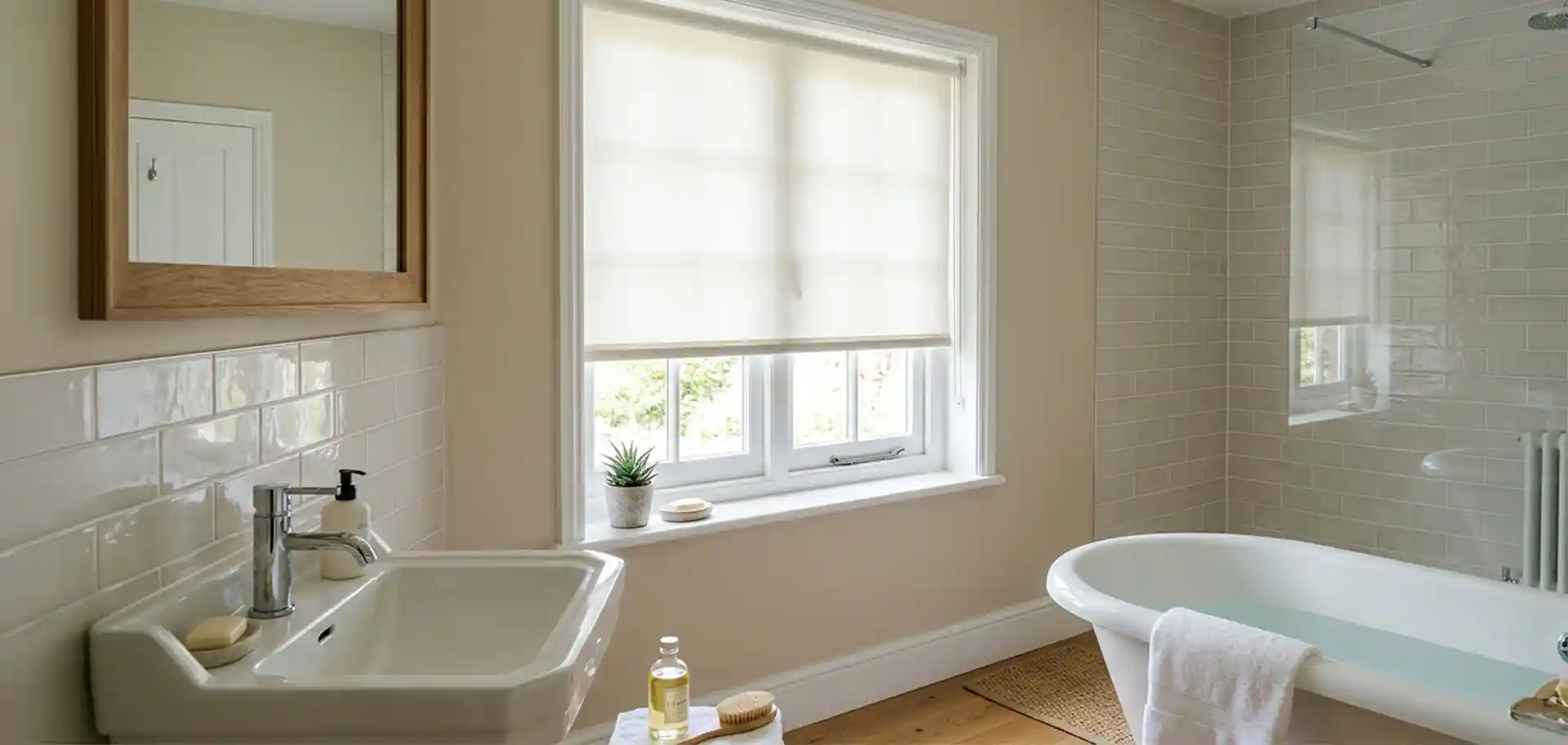
Bathroom blinds have to solve a more demanding problem than window coverings in many other rooms.
Privacy is usually essential, but the blind may also be exposed to moisture, condensation, regular wiping and frequent window opening. A material that performs well in a dry bedroom may not be the most practical choice beside a bath, shower or frequently steamed-up window.
The best specification therefore starts with the bathroom itself: where the window sits, how exposed it is to moisture, how much privacy is required and how easily the blind can be cleaned and operated.
Start with the level of privacy the room actually needs
Privacy requirements can vary considerably between bathrooms.
A first-floor window facing an open garden may need less screening than a ground-floor bathroom overlooking a pavement or neighbouring property.
Consider:
- whether the window is directly overlooked;
- how close neighbouring buildings are;
- whether privacy is required throughout the day;
- what changes after the bathroom light is switched on at night; and
- whether retaining natural daylight is important.
The aim is not automatically to cover the window as heavily as possible.
A better solution provides sufficient screening while preserving useful daylight where practical.
Night-time privacy deserves separate attention
A bathroom can feel private during daylight but much more exposed after dark.
When interior lighting is brighter than the exterior, visibility through the window can change considerably.
This is why privacy should be assessed in both conditions.
Stand in the room at the times it is most likely to be used and consider what can realistically be seen from outside.
The blind should support the household’s actual routine rather than relying on assumptions made during daylight.
Moisture exposure depends on where the blind is fitted
Not every bathroom creates the same conditions.
A blind positioned well away from a shower in a large, ventilated room may face relatively modest moisture exposure. A window immediately beside a bath or shower can experience much more condensation and direct splashing.
Before selecting a material, ask:
- How close is the window to the bath or shower?
- Is direct splashing possible?
- Does condensation regularly form on the glass?
- How quickly does the room dry after use?
- Is mechanical ventilation available?
- Is the window opened frequently?
These details matter more than simply labelling the space a bathroom.
Check material suitability rather than assuming it
A product should not be described as bathroom-suitable simply because it looks easy to wipe.
Materials and components can respond differently to moisture.
The correct approach is to check the specification and care guidance for the exact product being considered.
Homeowners researching blinds wetherby for a bathroom should therefore discuss moisture exposure, cleaning and fitting position alongside colour and privacy requirements. The most suitable choice depends on the actual window and room conditions rather than the product name alone.
Specific claims about water resistance, moisture resistance or other performance characteristics should be verified for the chosen blind.
A blind will not solve a ventilation problem
Window coverings can improve privacy and light control, but they are not a substitute for adequate bathroom ventilation.
Persistent condensation should not simply be hidden behind a blind.
A bathroom may need a combination of:
- appropriate ventilation;
- regular window opening where suitable;
- effective extraction;
- sensible heating; and
- a blind material that suits the resulting conditions.
The blind should work alongside the room environment rather than being expected to correct an underlying moisture problem.
Make sure the window can still be opened easily
Bathroom windows are often opened to improve ventilation.
That makes window movement an important part of the blind specification.
Check:
- whether the window opens inward;
- how far the handle projects;
- whether trickle vents need to remain accessible;
- whether the blind must be raised before opening the window; and
- whether the mechanism interferes with the frame.
A blind that blocks easy ventilation will quickly become inconvenient.
The full opening movement should be tested before the fitting position is finalised.
Recess depth can change the available options
A bathroom window may appear straightforward but still have limited space around the frame.
Recess depth can be reduced by:
- projecting handles;
- vents;
- tiles;
- trim;
- hinges; and
- uneven surfaces.
Measure the usable depth rather than simply the deepest part of the recess.
The blind and its hardware need enough space to operate without colliding with the window.
Cleaning should influence the decision from the beginning
Bathrooms reward surfaces that can be maintained easily.
Dust can mix with moisture, while splashes and condensation can make some surfaces require more frequent attention.
Before choosing a blind, consider:
- how easy it is to reach;
- how the manufacturer recommends cleaning it;
- whether there are multiple dust-catching surfaces;
- whether the controls can be wiped easily; and
- whether the window glass remains accessible.
A product that requires more maintenance than the household is willing to provide may not remain attractive for long.
Think about cleaning the window as well as the blind
The blind should not make routine window cleaning unnecessarily difficult.
Check whether:
- the blind can be moved clear of the glass;
- the window opens sufficiently;
- the controls remain accessible;
- the blind has to be handled excessively to reach the window; and
- nearby bathroom fittings restrict access.
A good installation should make normal cleaning straightforward.
Controls need to be practical in a small room
Bathrooms often have limited space around the window.
A control can become awkward if it sits behind:
- a basin;
- a cabinet;
- shelving;
- a towel rail; or
- another fitting.
Before ordering, imagine using the blind every day.
Can the control be reached without stretching?
Can it be operated without leaning across wet surfaces?
Will future furniture or storage interfere?
These are small details, but they strongly affect everyday satisfaction.
Natural daylight is valuable in bathrooms
Privacy should not automatically mean creating a dark room.
Natural daylight can make a bathroom feel larger, fresher and easier to use.
The useful question is how much screening is needed without removing more light than necessary.
Bathrooms with small windows can be particularly sensitive to this.
A blind that permanently covers too much glass may make the room feel enclosed even when the material itself is light in colour.
Consider both the closed and open positions before deciding.
Look at how much of the window remains covered when open
The open position is particularly important in bathrooms where daylight may already be limited.
Ask:
- How deep is the blind stack?
- How much glass remains visible?
- Does the headrail dominate a small opening?
- Can the blind be raised sufficiently?
- Does the window still feel open?
A neat closed appearance is only half the picture.
The blind should also work visually when privacy is not required.
Colour can affect how small bathrooms feel
Colour does not change the physical size of the room, but it can influence its visual character.
Small bathrooms may benefit from finishes that coordinate with:
- wall tiles;
- sanitaryware;
- flooring;
- window frames; and
- cabinetry.
A lighter blind may feel quieter in some interiors, while a stronger colour can create a deliberate focal point.
The better choice depends on the complete room.
Samples should ideally be viewed against the actual finishes rather than selected from a screen.
Pattern should be used carefully in compact spaces
A large pattern can become visually dominant on even a modest bathroom window.
If the room already contains patterned tiles, decorative flooring or strong wall finishes, a simpler blind may provide better balance.
Where the bathroom is visually restrained, a subtle pattern or texture may add character.
The important consideration is scale.
A design that looks understated on a small sample may feel much stronger across the entire blind.
Different bathrooms can need different solutions
An en-suite, family bathroom and downstairs WC may all have different priorities.
En-suites
Often require strong privacy but may have smaller windows and limited ventilation.
Family bathrooms
May experience more frequent use, moisture and cleaning.
Downstairs WCs
Can have street-facing or ground-floor windows where privacy is particularly important.
There is no reason every bathroom in the property must use the same blind if the room conditions differ.
A coordinated colour palette can provide consistency while allowing each opening to be specified appropriately.
Consider nearby heat and bathroom fittings
The window area can contain more than the frame.
Radiators, heated towel rails, shelves and mirrors may all influence fitting and operation.
Check that the proposed blind does not create avoidable conflict with nearby fittings.
The manufacturer’s guidance should also be followed regarding any required clearance from heat sources or other relevant features.
Professional measuring can identify problems before manufacture
Bathrooms often contain several small obstructions that are easy to overlook.
For homeowners considering worsley blinds, an in-home measure can help assess recess depth, handles, vents, tiles, fixing surfaces and window movement before the blind is manufactured.
This can be particularly useful where tiled reveals or limited clearance make the fitting less straightforward than it first appears.
Good measuring connects the dimensions with how the room is actually used.
A practical bathroom blind checklist
Before ordering, confirm:
- the required level of daytime privacy;
- the required level of evening privacy;
- proximity to showers, baths and sinks;
- normal condensation levels;
- ventilation arrangements;
- product suitability for the room conditions;
- window-opening clearance;
- handle and vent access;
- realistic cleaning requirements;
- accessibility of controls;
- available recess depth;
- suitable fixing surfaces; and
- how much daylight remains when the blind is open.
If several of these points are unresolved, the product choice is probably being made too early.
Choose for the conditions around the window
There is no single blind that is automatically right for every bathroom.
A large, ventilated bathroom with a window well away from water presents a different problem from a compact en-suite where the glazing sits close to the shower.
The right decision comes from understanding those differences.
Privacy, moisture exposure, ventilation, cleaning, access and fitting should be resolved first. Colour and design can then refine a solution that already makes practical sense.
Frequently Asked Questions
What should I consider first when choosing bathroom blinds?
Start with privacy and moisture exposure. Then check ventilation, window movement, cleaning requirements, recess depth and control access. These practical factors should be resolved before choosing colour or decorative finish.
Can any blind be used in a bathroom?
No assumption should be made purely from appearance or product category. Suitability depends on the specific materials, components and room conditions. Check the manufacturer’s guidance for the exact product being considered.
Can bathroom blinds prevent condensation?
Blinds are not a solution to poor ventilation or persistent condensation. They can provide privacy and light control, but moisture management should also consider ventilation, extraction and the wider room environment.
How can I keep bathroom privacy without losing too much daylight?
Consider when privacy is required and how exposed the window actually is. A solution that can be adjusted or opened easily may allow useful daylight to remain while still providing stronger screening when needed.
Why is professional measuring useful in a bathroom?
Professional measuring can account for tiles, recess depth, handles, vents, fixing surfaces and window movement. These details are particularly important in bathrooms where available space around the opening can be limited.