Introduction
Internet investments has actually revolutionized the method people save money, purchase securities, keep an eye on their profiles, and gain access to financial details. Investors can now do numerous activities on a brokerage site and mobile app without having to leave their home or calling a broker. The convenience also renders highly sensitive information such as account information, identity information, transaction information and investment balance information being handled by digital systems at all times. Multi-factor authentication, which requires users to input multiple authentication factors to access the system, is one way of protecting it. For brokerage firms, an account’s security is more than just a password. Security is built around multiple technologies that ensure the safety of information, establish identity of legitimate users, alert to suspicious activity and prevent unauthorized transactions before any financial damages are done.
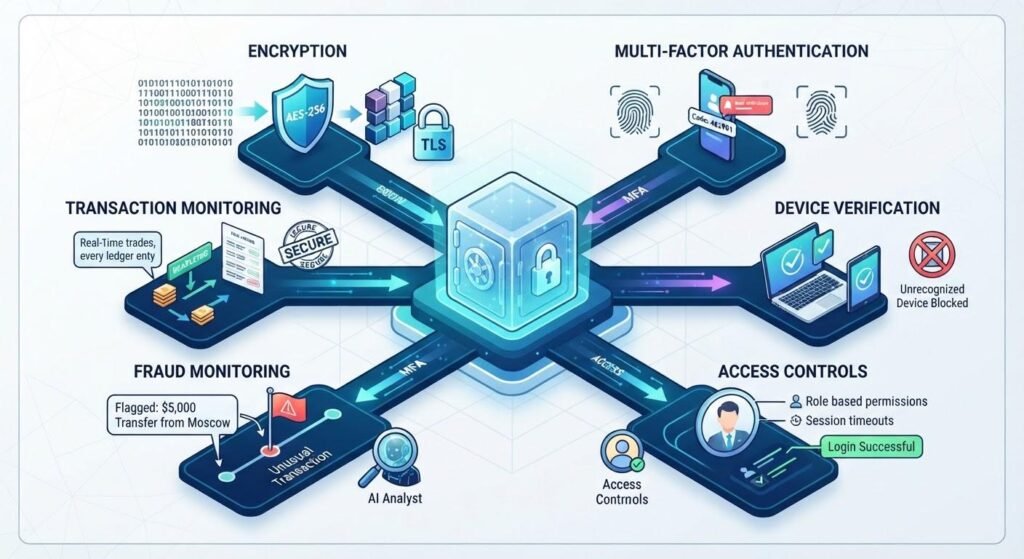
Some financial information stored in a brokerage account can be of great value to criminals for identity theft, fraud or further attacks, and some financial assets in the account can be valuable. In the case of brokerage platforms, they don’t rely on one single layer of security, but rather a layered approach instead. Various types of control cover various phases in an online transaction, from opening an application to completing a transaction. Encryption keeps information safe when it is moving or stored; authentication verifies identity; access controls prevent actions that users and employees may take; and monitoring systems watch for anything that is out of the ordinary. All of these controls combine to provide several points of detection and prevention for unauthorized activity. This layered approach is significant as attackers may try to circumvent one security measure and requires other security measures to provide additional security.
Encryption Safeguards Financial Data
One of the basic technologies employed to secure data that is passed around by online brokerage firms is encryption. It transforms readable information into an encoded form that a cryptographic key is required for it to be understood easily. Encryption can secure information from the moment it is sent from an investor’s device until it reaches the brokerage’s servers, and sensitive information within databases and other systems. Secure communication protocols, like Transport Layer Security, are usually employed for creating secured connections between applications and servers on modern platforms. While encryption can limit the value of information obtained from an interception, it can only be effective if properly implemented and maintained. However, the use of proper key management, certificate management, secure configurations, and regular security updates are also required since the use of encryption is part of a larger security architecture. To protect against these threats, brokerage firms have to implement a combination of encryption, authentication, access control, monitoring, and other security measures.
Multi-Factor Authentication to Improve Account Security.
While passwords are still the most common form of authentication, there are a number of ways in which they can be compromised, such as phishing, credential theft, re-use, malware, or service compromises. When multi-factor authentication is added in, an attacker would need to steal a password and also provide the second factor for entry, making it more difficult for him to get into an account. This extra factor might include an authenticator app, security key, biometric solution, or other accepted verification procedure, contingent on the brokerage platform. If the attacker has the credentials but not the other factor, it’ll be harder to hurt by them if they’re not compromised by using stronger authentication methods. In addition, brokerage firms can implement adaptive authentication, which raises the level of authentication when a login seems suspicious, such as if it’s coming from an unknown device, location or network. This strategy enables the security controls to be reactive to threats and not have to be a one size fits all solution.
Secure Connections between Digital Services with Secure APIs.
APIs, or application programming interfaces, are the mechanisms by which various computer programs communicate and interact in a specific way. APIs power brokerage platforms for various services including account information display, order processing, integration of mobile applications with backend services, and integration of chosen financial tools. APIs can offer a host of valuable information and features, so they need to have robust security measures in place. Secure API architectures involve input validation, input sanitization and validation, rate limiting, logging, careful handling of permissions, and authentication/authorization. Access tokens need to be treated as strictly as the data they represent and only used in a way and for an extent that is necessary. It is therefore, also necessary to protect the interface between the services as well. Any weakness in an API can have the potential to expose information or functions that were supposed to remain protected, so API security is a crucial component of modern-day brokerage cybersecurity.
Using Device Verification, Trusted Access
A brokerage firm platform can also study the gadget used for accessing an account. Device verification can be used to identify if a login is from a known cell phone, tablet or computer or from an unknown environment. Operating system information, application characteristics, cryptographic identifiers, security settings, and other technology indicators are some of the device security signals that can be included in a system, depending on the system that is being used. An unknown device doesn’t always indicate that the account has been compromised; rather it might warrant more verification or a security alert. Device recognition can complement and support authentication and behavioral monitoring to provide a bigger picture of an access attempt. If there are multiple signals indicating that there is a higher risk, the brokerage may need to carry out further checks before permitting sensitive activity. This provides an additional level of security teams’ ability to differentiate between valid customer access and possible unauthorized use.
Access Controls Restrict Users and Employees’ Actions
The difference between authentication and authorization is that in authentication, users are granted access to a system, while in authorization, they are granted access to certain functions within the system. Authentication is the process of determining whether a user can be allowed to access a system, and authorization and access control is the process determining what they can be allowed to do within the system. Brokerage companies can setup role based access controls that allow only those permissions that are necessary for the employees’ roles. The principle of least privilege minimizes the damage when a credential, application or account is obtained. Access controls can also be applied to customers and only allow certain access until further verification. For instance, there might be more rigorous review of changes made to accounts or withdrawals than for regular portfolio viewing. Authorization is key to keeping security incidents to a minimum and minimizing misuse opportunities. With different access rights for different responsibilities and risk, brokerage firms can minimize the number of systems and functions that can be accessed with just one compromised account or credential.
Fraud Monitoring: Checks Unusual Activity.
Fraud monitoring and products monitor beyond the logon event and the activity by transaction or profile, and, in some cases, by platform. These risk factors could include login behavior, transaction history, device information, account changes, transaction timing, and more. A single alert can be raised, even if all the actions are technically correct. For instance, if a user logs in from an unrecognized environment and immediately changes account settings and make an unusual transaction, it will be further investigated. But alerts also need to be carefully designed, since too sensitive systems can result in an unnecessary disruption to the legitimate customer. The goal of effective fraud monitoring is to detect meaningful risk while at the same time maintaining normal investment operations. Advanced systems are therefore able to integrate many signals and not just the one that raises a red flag to decide if further investigation is required.
Transaction Monitoring to Protecting Investment Activity.
Investor security isn’t over once they’ve successfully logged into their brokerage account. Individual transactions also need protection as if an attacker does access, he can try to purchase or sell securities, transfer money, or alter instructions. Transaction monitoring systems can review transactions and other financial activities in a manner that allows for risk assessment and adherence to rules. Unusual activity could result in extra authentication, temporary hold, alert or a security or fraud team review depending on the brokerage and transaction type. Security systems require context-based signals and thresholds, and not simply flag every odd transaction as a fraud. A transaction that is not considered “normal investing activity” could be a legitimate transaction, but may require further confirmation. Monitoring provides the brokerage with a chance to check if there is any unauthorized activity or a change of the account during the transaction.
Cybersecurity Threat Detection to watch the Wider Environment.
In addition to stealing customer passwords, brokerage firms have to fend off numerous other attacks. Another duty of cybersecurity teams is to keep track of malware, phishing campaigns, automated attacks, suspicious network traffic, software and infrastructure weaknesses, and exploitation attempts. Security information and event management systems can gather logs from applications, servers, networks, authentication systems and more and then use them as a resource for investigating related events. Endpoint detection technologies can be used to keep an eye on computers or other systems and look for any malicious software or unauthorized activity. Threat intelligence can also be used to gain insights into new attack methods and possible malicious infrastructure. While automated detection can process and capture potential threats rapidly, human analysts are critical when investigations need to be performed on complex events, when a determination needs to be made if an alert is a true incident or not, and in coordinating proper actions in response. With this combination, brokerage firms can respond to security events in various regions of their technology environment.
Security Monitoring and Incident Response
No brokerage system, even one that has the highest level of security, can guarantee that all attacks will be successful. Cybersecurity, then, should also feature incident response plans to detect, investigate, contain, and recover from security events. Security teams can create policies and practices on how to isolate impacted systems, deactivate compromised credentials, investigate suspicious transactions, notify impacted customers, and restore to normal operations. These processes are supported with the evidence from continuous logging of what and when. Security testing can also find vulnerabilities, in advance of their exploitation, by attackers. All of these – security reviews, software updates, vulnerability assessments, penetration testing and employee awareness – can help in the defensive process. It is not enough to create a secure application and never change it. Security controls need to be assessed and updated to tackle new vulnerabilities, attack techniques, technologies and operational risks.
Role of Investors to ensure Security
Investors are a key component of the security chain, and technology offers good protection. Customers should use different and strong passwords; whenever possible, activate multi-factor authentication; update operating systems and brokerage software; and never enter information by clicking on links and applications that are not official. It’s also important for investors to monitor their accounts for account notices and regularly review their transactions to ensure any unusual activity is reported promptly. A genuine brokerage firm shouldn’t ask a customer to disclose his password or authentication code in an unsolicited message. Great care should be taken with public or shared devices, especially when logging into financial accounts. These practices work to enhance the firm’s technical measures to help prevent social engineering attacks and those launched from personal devices. So it’s best that strong platform controls work in conjunction with customers’ knowledge and awareness.
Conclusion
Secure online investing requires a network of technologies, not just one single security. Encryption helps to safeguard sensitive data, authentication verifies users, secure APIs safeguard communications between software services, and device verification adds context to access requests from a device. Access control limits access to permissions and fraud and transaction monitoring provide controls against transaction abuse. On the wider infrastructure side, cyber security threat detection, logging, vulnerability management and incident response facilitate the identification and response to attacks by brokerage firms. Meanwhile, there is no security system that offers absolute protection. A combination of layered technical controls, continual monitoring, good security practices, and appropriate human review is the best solution. With the ongoing evolution of digital investing, safeguarding financial accounts will continue to be a process, which will need sophisticated technology and constant vigilance to stay ahead of the shifting landscape of cybersecurity threats.
Get more well researched information on how to Secure online investing here.