Introduction
It used to seem like you had to have a lot of money to get into the stock market and invest in an entire stock. With fractional investing, that’s no longer the case as an investor can own a fraction of a share, not a whole unit. This feature can make costly securities available to folks who wish to start out with smaller amounts of cash. But this concept is far from what is included in contemporary brokerage sites: in modern brokerage platforms, the concept is much more than just showing a decimal number on an investment application. Behind the buy button are order-management systems, electronic ledgers, custody facilities, pricing engines and corporate-action handling, which are linked together to accurately record and keep track of every investor’s economic interest.
What is Fractional Shares?
A fractional share is a fractional ownership in a stock. The investor can pay the market price for a smaller share, instead of the whole share. For instance, a $500-stock and a $50 investment will create a position of 0.10 shares, before fees, price change/execution differences. Investor.gov details the types of limitations that may apply, such as minimum order size, order types and the availability of trading fractional orders. Fractional ownership isn’t just mini trading, then. It’s a service that calls for the brokerage to adjust their trading, documents and customer-service infrastructure.
Technology Enables Fractional Investing.
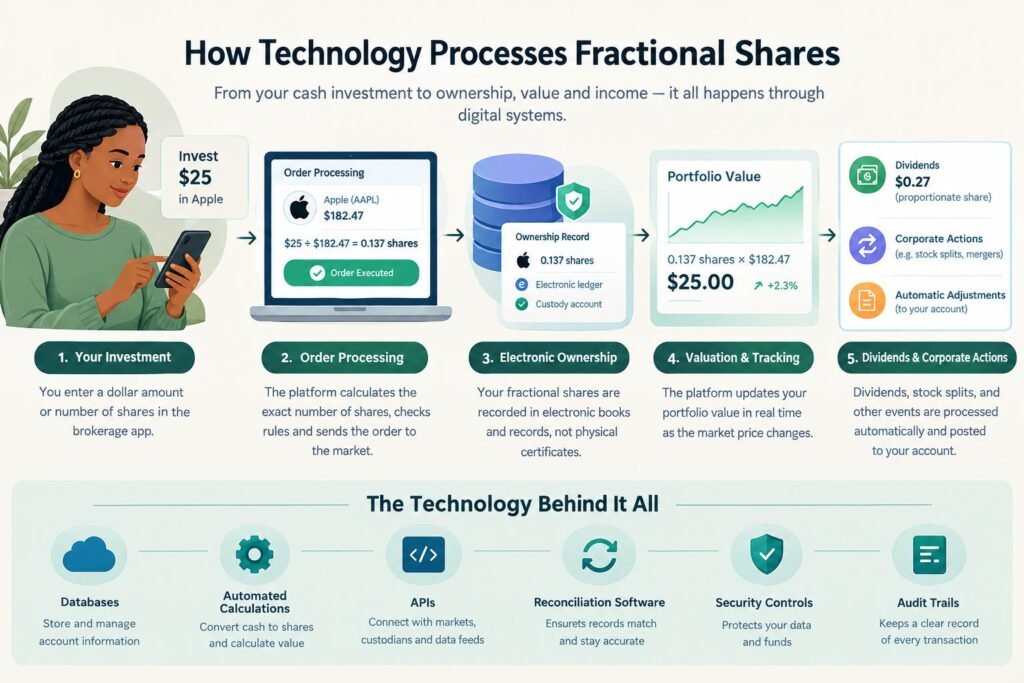
The core of making fractional share investing feasible is digital brokerage technology. The traditional market infrastructure normally trades securities in whole units, while a brokerage that trades in fractions will have to convert the amount of money that the customer is sending into cash into an exact number of shares and keep that number in its books. An instruction may be given to a platform to invest $25, which will cause the platform to add up the quantity to be the amount of investment, whether determined by a quantity or an amount, as provided by the price, and to record the resulting position. All of these processes are dependent on databases, automated calculations, application programming interfaces, reconciliation software and secure connections to trading and custody systems. Technology thus helps to connect a simple customer order with the financial data necessary to underpin fractional ownership. If it weren’t for these systems, it would be much harder and more expensive to accurately manage thousands or millions of small ownership positions.
How Brokers Report Fractional Ownership.
Normally, a brokerage firm makes only one physical certificate each time that 0.25 of a share is purchased. Rather, fractional positions have to be shown by electronic books and records of the brokerage or its service providers. In many schemes, securities are kept in custodial arrangements (with the brokerage keeping records of the individual securities’ beneficial interest on behalf of each customer). The customer account may thus include a number of 0.25, 0.625 or any other allowed number of securities without any need to settle in full securities on a larger settlement infrastructure. The investor’s internal ledger updates automatically whenever a corporate action, income is received or the investor buys or sells. With this recordkeeping, many customers can have joint liability for the entire share, without each customer having a separately registered whole security.
How Fractional Orders are Processed.
The order is initiated when an investor puts a number of shares or dollar amount into a brokerage application. When the investor selects a dollar amount, the platform uses the order rules and price of the security to determine the amount of the security that corresponds. The brokerage next will decide how the order will be carried out. Depending on the provider, fractional orders can be processed together with other customer orders, and can be processed by an external market participant or by another arrangement. After the execution, the system will allocate the quantity to the customer’s account, and it will update the available cash. Final prices may vary from the original estimate as prices can change quickly. Accurate accounting and management of the customer’s cash flow and ownership of the cash is thus required.
The Market Price and the Portfolio Value
After the fractional shares are recorded, technology can easily determine the market value of the fractional shares as they fluctuate. The fundamental process is to multiply the number on the customer’s account by the latest or most current price of the security. If an investor has 0.20 shares in the stock, which trades at $300 per share, then the position value they will see on the platform will be around $60, depending on the pricing rules set by the platform. A portfolio engine can make the same calculation for each holding and display the total account value at the bottom of the list of holdings. It may also be able to compare the current value with the transaction value or to the accounting value to show gains and losses. The investor can thus observe the financial impact of his purchase of a share of a stock, even if the stock is not part of the broader market and custody system.
Handling Dividends in Fractions of Shares
Another place where brokerage technology needs to convert a corporate dividend into customer level dividends is the clearing house. The clearing house is yet another place where a corporate payment that pays out a dividend must be translated into customer level dividends. A cash dividend is usually declared by a company in terms of dollars per share. If an investor has a fractional share, they will normally be given a proportionate share, as per the terms and rounding of the brokerage firm. In the case of a company making a $2 dividend per share, and an investor holding 0.25 shares on the dividend date, the gross dividend would be $0.50. According to Investor.gov, usually fractional investors are treated proportionately to their investment, but that is specifically dependent on the firm. Other platforms offer dividend reinvestment, or the dividend can be used to buy more shares, either in full or in fractional units. This necessitates automated systems to identify qualifying investors, to determine eligibility and to accurately post the right transactions.
Fractional Shares and Corporate Actions
When companies make corporate actions, it makes the requirements more complex as the number or type of shares an investor owns can change. When a stock splits the number of shares outstanding is increased, but the stock price is decreased in proportion. An investor who owns 0.50 shares, would normally acquire 1.00 share for every 0.50 share after a 2 for 1 split. The brokerages have a “corporate-action” system in place to process the event information, determine affected accounts, compute entitlements and adjust accounts. Splits and some mergers are normally done automatically, and splits and mergers can have varying rules for fractional holders. Fidelity and Charles Schwab have clarified that fractional positions can engage in some of the “required” actions but might be restricted on proxy voting and other voluntary actions that occur with corporate votes. Treatment will depend on the brokerage and event, so understanding policies is a key aspect to knowing what fractional ownership entails.
Reconciliation and Security Controls
For every fractional position there is a need for accurate reconciliation and security controls. A brokerage has to be certain the quantities mentioned in the customer accounts are identical to securities or economic interests in which the brokerage has custody and settlement. Automated reconciliation systems can identify discrepancies between internal records and external information and investigate them. Controls are also bolstered by technology, such as those covering account balances, authentication, encryption, fraud detection and audit trails. The platform needs to maintain a consistent record of transactions – that includes purchases, sales, dividends, corporate actions and fees – to ensure the statements and regulatory records are accurate. Convenience isn’t the only reason fractional investing relies on financial technology, however: it also relies on financial tech for accuracy. This can seem like a straightforward application on the surface, but the end-to-end infrastructure needs to keep track of all the information throughout the investment lifecycle.
How Fractional Shares Makes it More Accessible
The most apparent advantage of fractional shares is that it decreases the amount of capital required to have exposure to securities that have high per-share prices. An investor does not have to have sufficient funds to buy an entire share in order to be a part of the market. A fractional investor can also be used to help a dollar investor determine the amount of money to invest, and not the number of whole units. But, investment risk is not null without accessibility. A fractional share may increase or decrease in value in line with the underlying stock, and the liquidity and fees and restrictions on trading different providers vary, as do the rules governing the trading of corporate actions. In particular, investors need to be aware of how their brokerage firm processes fractional shares and the restrictions it imposes on those shares, FINRA has stressed. Reducing the investment doesn’t necessarily mean that the participation will go up or down, but it will alter the participation.
Some Restrictions Investors should know
There are also differences in operations to consider when deciding on a brokerage service that offer fractional ownership. Not all securities can be fractional traded and/or a broker may limit the type of orders that can be placed, trading times and minimum trade amounts. Some firms may not offer direct transfers of fractional positions, so the fractional shares might have to be sold prior to transferring the account. In addition to the foregoing, the voting rights may vary from those of full shares, particularly in the case of an investor with a fractional share. While the term fractional share may sound like a universal term, the experience of the customer is influenced by the systems and agreements of each of the providers. When investors review the terms of the brokerage, they are able to better understand what takes place when they buy or sell, transfer or receive a dividend or experience a corporate action.
The Future of Fractional Investing Technology
Fractional shares illustrate how technology can alter access without impacting economic value of a business. The stock is still the same security and by adding digital systems, a brokerage can fractionate out the economic exposure of the individual customers into “small” amounts and trade those positions electronically. What is noteworthy is not just the fact that an application can have a share of 0.15 or 0.37%. It’s the financial infrastructure that’s connected that can execute the order, record ownership, calculate value, distribute income, process corporate events and have an auditable history of that little position. Fractional investing has made investing more flexible and accessible, reduced the capital needed to be invested in securities, and now puts special emphasis on the technology and controls behind the interface. What it leads to is a greater digitalized investment experience, with even minimal stocks being followed by way of various financial processes.
Conclusion
A practical instance of the removal of some traditional barriers to market participation is fractional investing, which is a practical use of financial technology. Brokerage platforms can mitigate the need for investors to buy an entire share by enabling smaller transactions via electronic order processing, ownership ledgers, automated valuation, dividend calculations and corporate-action management. Meanwhile, fractional ownership isn’t the same among providers. The terms of trading restrictions, transfer rules, voting rights, dividend treatment and rounding procedures may vary, so investors should familiarize themselves with the platform’s rules. In short, the fractional share technology illustrates how financial markets can be made more accessible, but still need to be backed by complex systems to maintain the accuracy, security and accounting of all the small pieces of ownership.
Get more well prepared information about Fractional Shares here.