Introduction
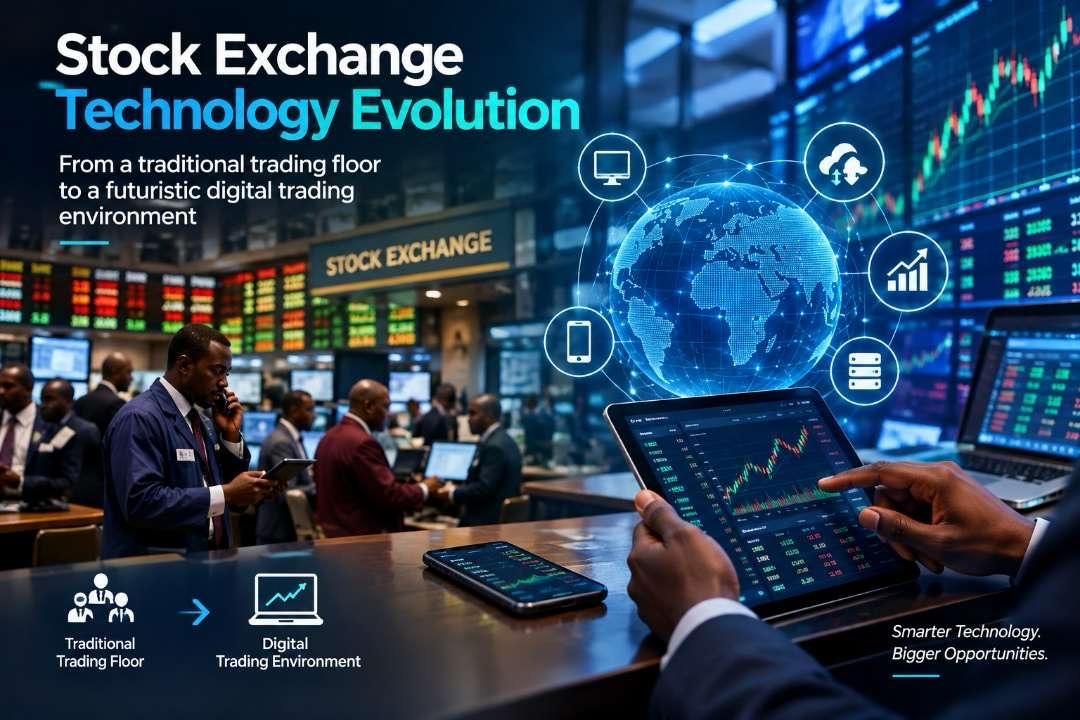
In the past stock exchanges were not always the fast and easy Internet-based trading platforms that investors are familiar with today. Historically, the trading of shares was driven by human beings, paper, telephones, physical trading posts, and carefully made decisions by humans. Investors could call a broker who would call a negotiator on a floor where he or she would discuss price with other brokers and agree an exchange price by hand signals and face-to-face communication. It was successful, but limited by geography, speed of communication, amounts of people that could be involved simultaneously and record keeping. Many of those were eliminated over time as the markets became more and more computer driven. The technology of the exchanges today can accept huge numbers of orders and match buyers and sellers electronically, broadcast market information around the world and enable automated systems like algorithmic trading.
A Period of Trading on the Floor and via Telephone
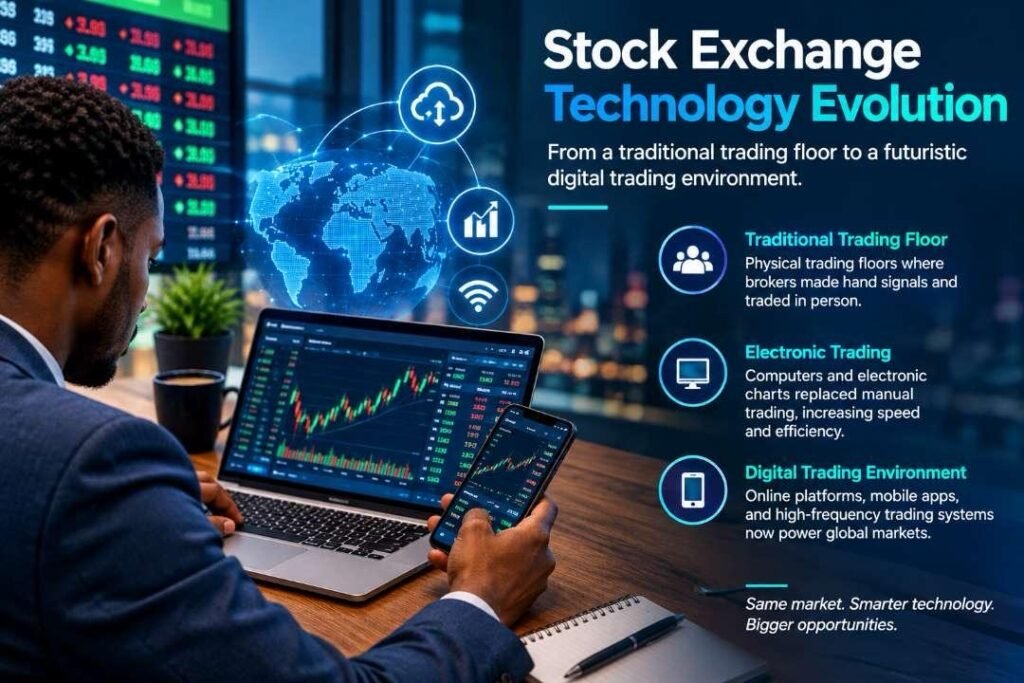
Exchanges were and in a way, still are essentially people-driven workplaces before the coming of computers into the securities market. At the old trading floor, buyers and sellers met at specific point where a trade was made by verbalizing the interest and using hand signals. Those investors who did not attend themselves relied on their brokers for instructions, many of which were given by telephone, and gave their instructions to those who were on the exchange floor. In OTC markets, dealers also used significant telephone communications to communicate with each other. This structure allowed the market to emerge that depended partly on human coordination and physical proximity for the speed of the market. Information was also not as timely for regular investors: market participants may use ticker displays or information reports based on trades after they have taken place. The system would be able to process large amounts of activity, but as it relied on humans and physical spaces, there were natural limits to how fast information and orders could be transmitted, while scaling its capacity problems were challenging.
Arrival of Computers in Financial Markets
It was not so much that all people in the market were replaced by technology but that the market information and communication system was put into computers. For the first major technological change, it was not all the people in the market that were replaced by technology but that the market information and communication system was put into the computer. Instinet was the first company to electronically trade exchange-listed stocks in the United States in the year of 1969, and the NASD launched the NASDAQ system in 1971 to link more than the over-the-counter system of market makers using a screen-based quotation system. NASDAQ began by simply publishing bid and ask prices, and was initially not identical to the modern electronic order-matching exchange; however, its importance was huge due to the ability to disseminate market information electronically, rather than on the basis of physical attendance or by phone. Nasdaq itself dubbed the launch of its quotation system back in 1971 the start of a fully electronic quotation system, and SEC historical material called the system an important step that departed from telephone quotation systems. These developments laid the groundwork for the fundamental principle of putting computers to use to bring together market participants regardless of distance.
Exchanges Begin Automating Existing Operations
As part of their existing floor operations, established exchanges also started using computers in the 1960s and 1970s. For instance, the New York Stock Exchange (NYSE) developed computer data-processing technologies and electronic systems for receiving and transmitting trade information. An important development was made with SuperDOT which enabled brokers to place orders electronically in their offices and receive reports of execution speedily at the trading posts. This did not go away of the trading floor overnight; rather, technology was used along with human experts and floor brokers. That is important as exchange development was a process and not just a single overnight exchange of human with machine. Computers were providing better communication, information sharing, ordering and record keeping. As these systems were made more reliable and effective, exchanges could automate more and more of the transaction process, and minimize the physical handling of an order making its way to the marketplace.
Electronic Order Books Change Trade Execution
The next step was the advent of electronic communication networks and electronic order books. Today, buy and sell orders are recorded electronically in an electronic order book, which typically sorts the orders by price and then by priority, such as by time. The matching computer can compare orders from participants and broker orders and make a trade under the rules of the market, rather than having the broker find a willing participant on a trading floor. In the United States, regulatory alterations in the 1990s gave electronic networks a greater chance of being competitive with the traditional market centers. The SEC has explained how the 1996 changes in the way orders were handled helped ECNs to grow, and NASDAQ records that ECNs were added to the NASDAQ market as an electronic order book in the late 1990s. This is an important phase as it made electronic technology more than an information tool and turned it into a tool that can organize liquidity.
The Internet Opens up Avenues for Investors to Gain Access to Information.
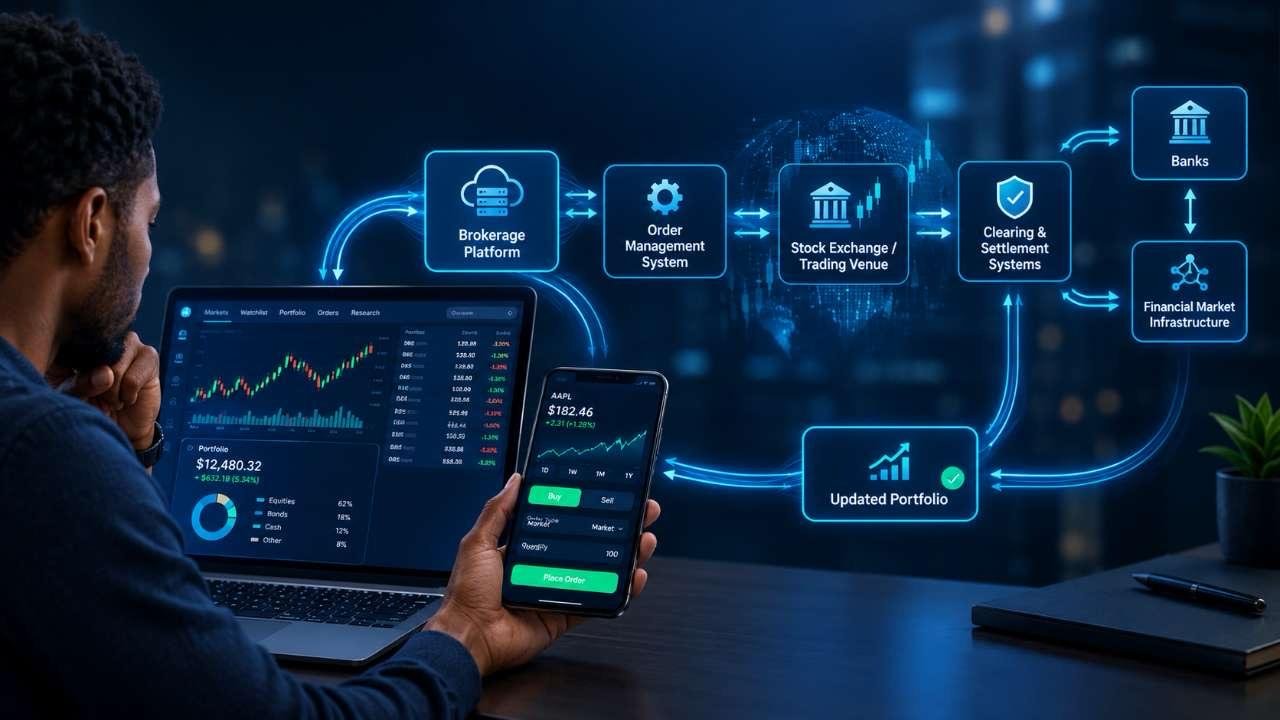
The internet and technological advancements in communications have altered the investor’s relationship with the exchange, as electronic markets have emerged. Investors no longer had to rely solely on a broker to verbally tell a floor trader what they wanted done. Electronic execution of orders on online brokers and their transmission to interconnected infrastructure. Meanwhile, market information could be broadcasted to the participants via digital networks, thereby providing much more timely and widespread price and volume data and quotations than was possible with the traditional ticker system. Technology thus altered both aspects of the participation in the market: it enhanced the way in which orders were inserted into the system and the way in which information was extracted from it. The outcome was a more integrated market place where exchanges, brokers, alternative trading systems, data providers, clearing bodies and investors were able to communicate via computer networks instead of primarily via phone calls, paper records and hand-off.
The Use of Computerized Programmes to Match Prospective Partners
Now exchanges had to process transactions internally using computerization. Today’s trading systems link matching engines, databases, telecommunications networks, monitoring systems and meticulously crafted software together to keep track of an ever-present order flow. An incoming stream of instructions needs to be processed by a matching engine on the basis of rules which should be pre-defined, and an accurate record of orders, executions, cancellations and market data must be kept. This task would be very challenging to complete manually. Electronic systems are capable of performing numerous operations in parallel and execute the same processing rules for large numbers of securities. They also enable the linking of various market venues and the routing of orders based on the price and liquidity of the markets. The Securities and Exchange Commission has termed the evolution of automated matching systems and electronic networks a part of the bigger development of a more competitive and tech-driven securities market.
The Various Algorithmic Trading Methods
After the electronic order handlings had become a reality, automation could be taken one step further and electronic trading decisions could be taken according to programmed instructions. It led to algorithmic trading, where orders are created, modified, routed and executed based on the predetermined rules, models, information in the markets or other inputs fed to a computer program. Algorithmic systems can split the big orders into smaller parts, react to price fluctuations, look for available liquidity, and adhere to quantitative conditions without needing to manually enter each instruction. Electronic communication networks grew particularly significant because they are relatively computerized and fast, creating an environment which facilitated the efficiency of such strategies. But not every trading decision was on a standalone basis, there was a human design behind it, as well as risk, supervision, and exchange rules. The change, however, proved that computers could play an active role in the mechanics of the market in executing trades, not as traders’ assistants but as the traders themselves.
High-Frequency Trading
Another step in the system has been the development of high-frequency trading, which involves techniques with a high degree of automation and trade with very short time horizons, and with many orders being executed in series. The high-frequency trading and algorithmic trading are related but not the same: algorithmic trading refers to a general technique that uses computer programs for making trades, and high-frequency trading typically involves a specific type of algorithmic trading that is characterized by a high volume of trades, high frequency, automation and technology. Competition became more electronic as companies began to spend money on increasing their connection speeds, developing specialized hardware, improving their software and implementing strategically placed infrastructure to cut communication and processing times. This is because the latency, or delay, in getting to market data or placing an order, even at the smallest level, could impact order flow. The SEC has chronicled the growth of high-volume algorithmic firms in electronic markets and the use of technology to out-compete from being merely a means to get electronic access to everything in the digital trading pipeline.
Modern Exchange Server Infrastructure, Colocation and Connectivity Services
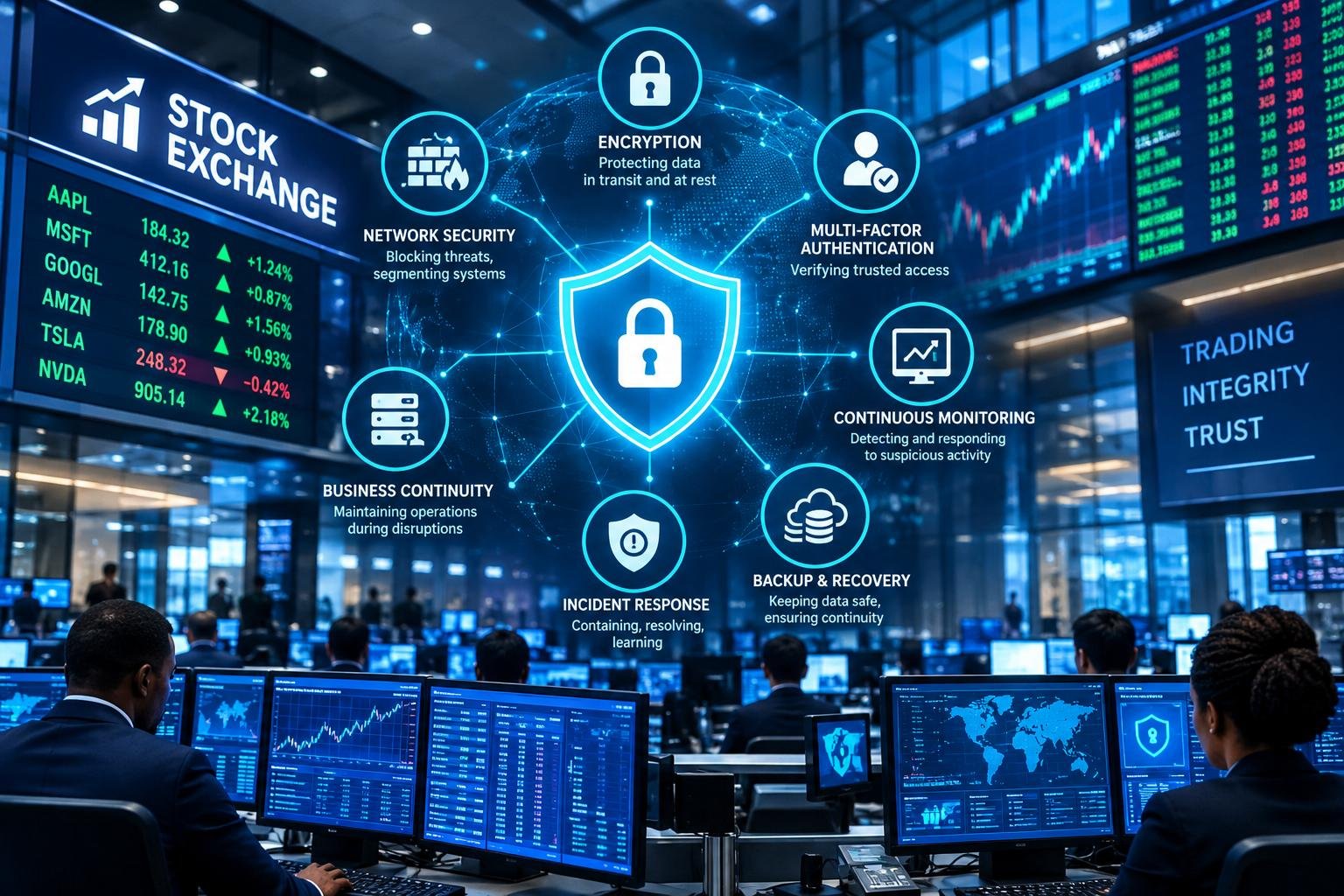
Speed-seeking changes also affected the physical design of exchanges’ environs. To minimize latency, modern market participants can employ direct electronic connections, specific networks, data centers and servers located near the exchange’s infrastructure. It is a common practice that goes along with the colocation of trading equipment, that is, trading equipment is housed close to the exchange’s matching systems. The goal is not only convenience but also to minimize the time taken to move data from one point to another – by minimizing travelling distance, the time it can take to move data from point A to point B can be reduced and by optimizing the software and hardware, the time taken to process data can be reduced. Meanwhile, exchanges have had to develop ever more robust infrastructure to withstand heavy loads while running around the clock. If a system on an electronic exchange malfunctions or is breached, it can impact many participants simultaneously, which is why redundant systems, backup facilities, monitoring and cyber security control and recovery systems are a must. As markets become more tech-driven, the reliability of technology is more of a part of market integrity.
The Impact of Technology on Market Access
The technological change also made the concept of market access different. In a floor-based environment the dependence on relationships with intermediaries, broker dependence and on-site positioning were crucial factors for accessing. Many of those geographical hurdles were eliminated by electronic markets and made it possible, via electronic brokerage, for investors to link up with exchanges. This didn’t make markets entirely symmetrical and equal, as there could be more advanced technology, data feeds, capital, and infrastructure among professional firms as compared to individual investors. However, the base market place became much more scalable. Electronic trading and wider access to information about the market led to significant cost savings and automation, says NASDAQ. Today, investors can view prices and place orders from anywhere, far from the exchange’s brick-and-mortar trading floor, and the exchange can facilitate trading without adding more people to the trading floor.
Conclusion
This shift from trading floors to digital markets can thus be seen as a series of layers of technologies, not a single revolution. The original operating model was telephone orders with human floor trading, followed by the computer for information processing and order routing, the electronic quotation system for expanding access to market data, the ECN and electronic order book to automate the order/matching process, the Internet to connect additional investors, algorithmic trading to introduce programmed decision-making into the execution process, and finally, high-frequency trading systems to further automate the trading process and reduce latency. Physical trading floors have not been eliminated everywhere and human-eyes still play a key role, but the center of gravity has shifted towards computer infrastructure. Over the past few decades, the stock markets have been continuously improved in terms of speed, scale and design, with the development of computing, telecommunication, software, networking, and market design. Realizing that history is packed with the reasons why a modern stock exchange is no longer merely a marketplace for people to exchange shares, but a complex technology platform to coordinate information, orders, execution and market participation across vast distances, and in extremely short time periods.
Get more well researched information about stock exchange technology evolution here.