
Introduction
Programming is a complicated procedure that incorporates designing, creating, introducing and keeping applications that users rely on daily. With increasingly complex and interdependent software systems, the job of ensuring software applications are correct, secure and efficient is one of the most critical ones for development teams. Even minor software bugs might lead to major issues such as system crashes, monetary loss, security safety, or user experience concerns. That’s why structured testing processes are essential to developers and organizations to help them find issues before customers do. This is not just about testing the software after development; software testing is a continuous process to help ensure quality at every stage of software development.
The main purpose of software testing is to confirm software is operating as intended, and as required by the technical and business needs. Effective testing allows developers to know if their code works correctly in various scenarios, if features are working together, and if the application is viable for real-life use. There are various testing tools, techniques and methods that are used by the modern development teams to assess the software quality with various angles. These methods can lower risk, increase reliability and build applications that deliver more user-friendly experiences. From the basics of software testing, beginners and seasoned developers can establish robust development processes and create top-notch software products.
What is Software Testing and Why Is It Important?
Software testing is an activity to check whether a software application fulfills specified requirements and works correctly. It is the process of studying various components of an application, finding flaws, confirming the expected functionality, and verifying that the product is functioning as designed. There are several methods for the developer and/or the software tester to analyze software, including examining chunks of code or testing entire systems in realistic environments. IBM says software testing is a way to evaluate software quality, performance and reliability during its development. By grasping the principles of software testing, development teams can ensure that their software is more reliable and less likely to contain defects.
Testing is significant because in software development, there are some defects that are impossible to avoid. New bugs can be introduced even by experienced programmers, as there are many lines of code in modern applications, tons of dependency and complicated interactions between components. Unless checked, these defects could go undetected until users run into them. Testing is a systematic means of identifying weaknesses early, at a time when they are more easily and less cost effectively corrected. It also facilitates the collaboration among the various parties involved in the software development process, including the developers, designers, business stakeholders, and users, making it easier to communicate and understand the software’s behavior.
One of the key factors why software testing is needed is for it to boost customer satisfaction and trust. When software is handling sensitive data or critical business operations, users can expect applications to be reliable, fast, and secure. Poorly tested applications can crash, run slowly, be insecure, or fail to function as intended, and thus have the potential of harming the reputation of an organization. With proper testing practices, companies could be more certain of the quality of their software, minimize maintenance expenses, and build software that satisfies their users’ expectations.
Purpose of Software Testing in the Current Software Development Processes
As the software development methods have evolved, software testing has also changed a lot. The traditional development model tended to reason that testing should be a step done after coding. But with modern practices like Agile development and DevOps, testing is done along the development lifecycle. A team tests the software throughout the process of planning, coding, integrating, deployment and maintenance, rather than waiting till the end of the project. This will help developers to locate and fix bugs quicker without compromising the quality of the software.
Today, testing is part of the ongoing process of continuous integration and continuous delivery (CI/CD). Automated testing tools can be used to run tests at any time developers change the code base, allowing teams to quickly identify if new code changes have caused issues. This ongoing feedback allows developers to make improvements with confidence, without the risk of breaking out of working parts and features. Rather than such a final hurdle prior to software release, testing has become an integral piece of the development process.
The collaboration aspect of current testing practices is also crucial. The developers, QA engineers, product managers, and security experts frequently participate in establishing requirements, developing test cases, and performing software testing. This cooperative approach allows for a consideration of multiple viewpoints, such as those of the technical, business, user, and security aspects of testing. If testing is a part of the development culture, organisations can bring out more stable software and meet customer needs faster.
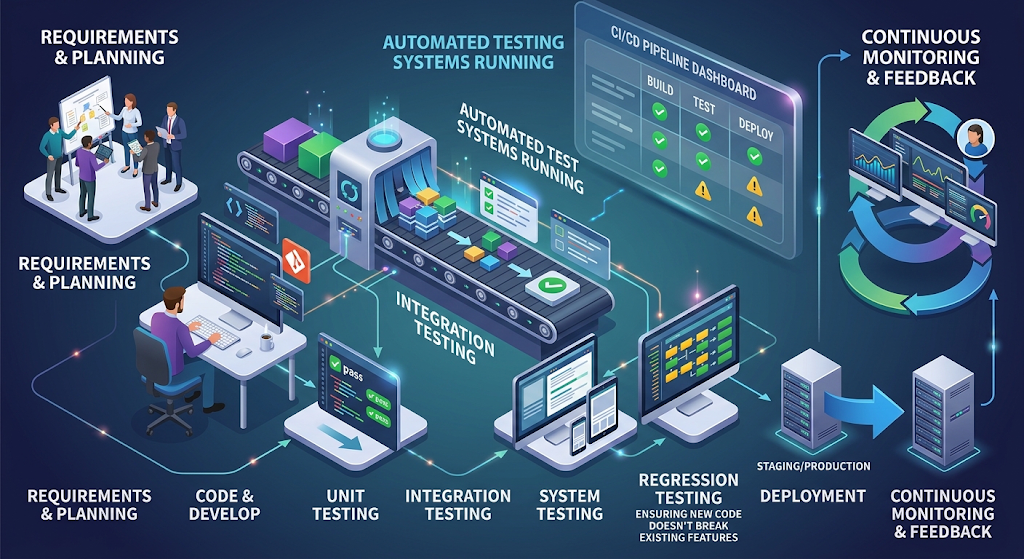
Major Types of Software Testing
Unit Testing
One of the simplest forms of software testing is unit testing which deals with testing individual components or units of code. A unit typically refers to the smallest testable component of an application, like a function, method or class. Unit tests are written to make sure that each part of a system is performing properly before working with the other parts. This kind of testing has the advantage of easy discovery of coding errors in time, and it can ensure that the simple blocks of an application have their correct behavior.
A primary benefit of unit testing is that it enables developers to identify issues during the coding phase, instead of when an application is finished. Given that a unit test will focus on a particular piece of functionality, it is easy for the developer to quickly determine which area is being affected when the test fails. This makes it easier to debug and to spend less time fixing defects. Writing well structured code is easier to test and maintain, and it also helps the developer write the code more cleanly and organized.
There are a number of modern programming languages, like Java, that have frameworks and libraries that support unit testing. For instance, java programmers can use JUnit, whereas python programmers can use pytest or unittest. These frameworks enable teams to develop tests that can be automatically run whenever code modifications are made. While testing each unit does not ensure that the entire application will be flawless, it does give a good start to make software a reliable system.
Integration Testing
Integration testing is used to test that the various parts or modules of a software system interact with each other. Unit testing is to test individual units of code while integration testing is to test if the separate units of code communicate correctly when put together. Modern applications can include several services, databases, APIs, user interfaces, and external systems that need to communicate seamlessly. A component can work fine by itself, but cause issues when integrated with other parts of the app. These communication problems can be highlighted during integration testing and the different parts of software should work together as expected.
One of the typical examples of integration testing is the application and database integration testing. A developer can be assured that a function operates correctly using unit testing, but integration testing will ensure that the function can be used to retrieve, store, or update data in the actual database. For applications that rely on external services, like payment gateways, authentication systems, or third-party APIs, integration testing is required to ensure they can be successfully connected. Identify the problems early to avoid failures that could cause issues after deployment.
There are various methods of integration testing such as top down, bottom up and incremental tests. Top-down integration tests higher level components first, and adds lower level modules; Bottom-up integration tests lower level components first and adds higher level modules. Incremental integration: Add components in stages and test one addition at a time to look for issues. In both cases, integration testing can enhance the stability of software, as it checks whether the various components work well together as a system.
System Testing
System testing is a type of testing that tests an entire software system. System testing is holistic testing of the system in which the entire application works under test conditions close to its actual use, whereas unit testing and integration testing is testing of a system’s individual parts. System testing is used to ensure that the whole software product fulfills functional and non-functional requirements before it reaches the customers. It checks if all features function as they should and that the application is performing as intended under normal circumstances.
The testing that occurs during the system testing phase involves testing of multiple different things such as the functionality, usability, performance, security, compatibility, and reliability of the application. For instance, when evaluating an online shopping site, testers can check to see if users can register an account, browse for items, include them to their cart, finalize purchases, and acquire confirmation pages. Their evaluation also includes determining if the system is stable when multiple users are accessing the system at the same time. This is a wide testing strategy that can uncover issues that are not seen during the testing of the components individually.
The system testing is typically conducted after the integration testing is done since all necessary major components must be integrated into the application. It provides organizations with confidence that the software is ready for real users and business operations. System testing creates realistic scenarios to find any implicit bugs, making sure the final product provides the desired experience.
Regression Testing and Its Importance
Existing software functionality is tested after changes are made to the software to make sure that any new updates haven’t caused any unexpected issues, known as regression testing. Software programs are never static, they always receive updates and upgrades to add new functionality, fix bugs, enhance performance, and make changes to the code. These changes could resolve a particular issue, but can introduce other issues as well. Regression testing can be used to ensure that any changes to a program do not alter the behavior of a previously established feature.
For instance, an online store developer can change the payment mechanism of the website to make the payment process faster. The change might involve simply payments alone, but might end up impacting customer accounts, orders processing or inventory management by mistake. With regression testing, teams can review these related areas to determine if there are any negative effects as a result of the update. Organizations can’t afford to ship new releases of software with the old bugs or new failures without regression testing.
Many regression tests are required during the development process, making automation an important part of regression testing. Whenever changes are added, large sets of test cases can be quickly run through an automated testing tool. This will save time and give developers instant feedback on the effect of their new changes. For certain situations, manual regression testing may be a viable option, but for most software teams it is more practical to test continuously using automation.
Functional Testing
Functional testing is used to determine if a software system fulfills the necessary functions within acceptable limits. This kind of testing is concerned with the software functionality as opposed to its internal working. Users use a test case to test the correctness of the results generated by each of the features, based on their requirements and expectations. The software must provide the correct and consistent function to meet user’s expectations, thus functional testing is critical.
For instance, when it comes to a login system, examples of functional testing would be ensuring that the system accepts valid login details, rejects invalid details, and generates the correct messages when issues arise. For a banking app, functional testing could mean verifying that users are able to move funds, access their account details, and transfer money successfully. These tests are for the software to ensure that it provides all the features that it is supposed to promise the customer and that it performs as specified.
There are two ways to do functional testing: manual and automation. Manual functional testing enables a user-centric exploration of applications and to uncover any unexpected usability issues. Automated functional testing allows teams to conduct tests repeatedly at a high frequency, particularly in the event of frequent changes to the application. By using both strategies, organisations can ensure software quality and enhance software development efficiency.
Performance Testing
In performance testing, the software application is tested by placing various demands on it, such as heavy loads or sudden surges in requests. The users want fast response and stability of applications even during peak footfalls. If it’s slow, crashes, or service interruptions, it can have a negative impact on user satisfaction and business operations. Performance testing is used to find out if software can manage the anticipated activity.
There are a number of different types of performance testing: load testing, stress testing, endurance testing, and scalability testing. Load testing is performed to determine the performance of the system during expected load of users while stress testing is performed to determine the performance of the application when it is pushed beyond its normal limits. Endurance testing is used to see if the software will perform over extended periods and scalability testing is used to determine whether the system can expand to meet the needs of the user.
For applications with many users, like financial services, social networks, or ecommerce, performance testing is particularly crucial. In this way, developers can identify performance issues before they are released and fine-tune their code, infrastructure, and applications for consistent experiences. Good performance testing minimizes the likelihood of failure on critical events when a lot of activity is expected from the users.
Security Testing
Security testing is an aspect of computer testing aimed at discovering vulnerabilities and weaknesses which might compromise the confidentiality, integrity, or availability of computer software systems. The growing number of cyber threats imposes a need for organisations to ensure that applications safeguard user data and are impervious to unauthorised access. Security testing involves determining if software is developed in a secure manner, and if likely threats are uncovered and mitigated prior to attackers exploiting them.
Security testing includes the analysis of security aspects like authentication and authorization, data protection, encryption, vulnerability management, etc. Testers might try to discover vulnerabilities within login procedures, access controls, or data security. The aim is not only to discover security issues but also to enhance the overall security of the application. Robust security testing procedures can be used to prevent any data breaches and ensure user confidence in the system.
Security testing should be part of the entire software development lifecycle and not just done before software is released. However, modern development teams employ methods like DevSecOps, which integrate security testing with coding and testing and deployment. As it becomes a responsibility on an ongoing basis, organizations can create more secure applications and be better prepared to deal with new threats.
Acceptance Testing
Acceptance testing is the last phase of software testing before an application can be given to the user or deployed into the production environment. The primary goal of acceptance testing is to ensure that the software is compliant with business needs and that it delivers the experience that the intended users will value. Other testing methods tend to concentrate on how well the product is technically made; acceptance testing assesses whether the finished product has been made to address the problems it was designed to solve. It is usually carried out by customers, business representatives, product owners or quality assurance staff to determine if the software meets pre-established criteria.
A popular type of acceptance testing is User Acceptance Testing (UAT) in which the practical testing is done by real users or stakeholders. A company can, for instance, ask workers and managers to execute typical processes in a new employee management system, like creating worker profiles, approving requests, and creating reports, before the roll-out. Their feedback allows for the assessment of the usefulness, understandability and business relevance of the system. In case of major problems, developers will be able to adjust the software before making it available to a larger audience.
Acceptance testing is particularly useful as it bridges the gap between technical development and practical expectations. A software app can pass all of the technical tests but not be user friendly or be able to support some of the workflows, which are important to the user, and still fail to meet user needs. Incorporating acceptance testing throughout the development phase will minimize the chances that a software application will not be of value. It helps to assure that the product will be useful, and usable by the people who will need to rely on it.
Manual Testing vs Automated Testing
There are broadly two approaches of software testing which are Manual testing and Automated testing. Both approaches are essential in software development and the selection of the appropriate one relies on the type of application, project’s requirements, resources available, and testing objectives. Manual Testing: Manual Testing is a process where human testers run test cases without using any automated tools. Testers directly use the software, and try out various features and see if the software is working as expected. Useful for testing user experience, design, usability and situations that involve human judgment.
Manual testing offers flexibility as one of its greatest advantages. Human testers can be creative, try out new things, and discover problems that automated systems might not have. For instance, a tester testing a mobile application might find a button hard to find or the UI is confusing. These observations cannot be made using automated scripts and do depend on human understanding. Manual testing can also be beneficial at early development phases when software is constantly changing and automation tests need to be updated regularly.

But as the applications grow and become complex, manual testing can be time consuming. It’s a lot of work to repeat the tests with all updates and humans can make errors when performing repetitive tests. This is where automated testing can be useful. Automated testing involves using software tools and scripts to run tests automatically, which can help teams to test their applications quickly and reliably. Automated tests can be very helpful for regression testing, performance testing, and other scenarios where the exact same tests need to be run regularly.
The best development teams will use both manual and automated testing – not just one or the other. Automation is faster, more accurate and efficient, and manual testing is creative and exploratory, and there is human insight. Balanced testing strategy ensures that organizations can optimize resource usage to get better software quality. Knowing when to automate and when to use real human testers is a crucial skill for 21st Century developers and quality assurance professionals.
Most Common Software Testing Tools
Software Testing Tools are the tools that can be used to help developers and testers create, run and manage tests more efficiently. These tools are used for various testing activities such as unit testing, automation, performance analysis, security evaluation and test management. There are various types of testing and different tools are used for them depending on the programming language, the needs of the project, the environment in which the software is developed, and the kind of testing done. The right tools can enable higher test coverage, help to find and fix software issues, and enhance productivity.
Developers typically use frameworks to develop specific programming languages for unit testing. These include JUnit for apps written in Java, pytest for Python-based apps, NUnit for . apps.NET technologies. These are used to enable developers to write automated tests to check if specific parts of the code are working. Unit tests can be run quickly, and are often used to give instant feedback when changes are made to the code, so they are often incorporated into the development life cycle.
Selenium, Cypress, Appium are some popular tools used for automated testing of web and mobile apps. They enable testers to emulate user actions, check the behaviour of the application, and automate repetitive testing. The performance testing tools, like Apache JMeter and LoadRunner, assist organizations to assess the performance of their applications in a range of traffic and workload. Security Testing Tools can be used to determine vulnerabilities and weaknesses that attackers may not have discovered.
Test management tools are also crucial as they enable teams to plan test cases, monitor defects, and keep tabs on the progress of testing. The platforms enhance developer-to-project manager and developer-to-tester communication by giving them clear visibility into software quality. Although tools can’t replace good testing strategies, they can certainly make the testing process more efficient and keep software development teams on the same page when it comes to quality.
Best Practices for Effective Software Testing
Start Testing Early
An important rule that can be used to create good software testing is to start testing at an early stage. In the past, many development teams regarded testing as an afterthought that happens after the coding phase, but today, testing is considered an important activity that happens during development to save money and avoid big problems. If defects are detected early in the development process, they can be fixed before they are passed on to other sections of the development system. It is typically quicker and lower cost to find and solve problems before deployment than after.
Early testing also has the advantage of promoting better software design since during coding, developers are made aware of the quality requirements. Test-driven development (TDD) is a practice that advocates for test first development, which means that the behavior of the software is specified from the start. This ensures that the code is more reliable and assists teams in developing more maintainable applications.
Create Clear and Realistic Test Cases
The design of the test cases is crucial for effective testing, as it must reflect the various user actions and system states that can occur. Test cases should contain a definition of what should be tested, how it should be tested and what the expected outcome is. Wrongly written test cases can miss crucial flaws or can even take too long to execute trivial cases.
It is important to have realistic test cases to consider, as software can be employed in an unpredictable manner. Developers and testers need to think about some of the things the users might do, and think about unusual conditions and possible limitations of the systems. For instance, an online application must be tested for normal user usage as well as with wrong input, heavy traffic and unusual activities. Having thorough test cases helps increase the likelihood of uncovering issues beforehand of the user.
Maintain Continuous Testing
Continuous testing is a testing method that involves continuous testing through the software development process instead of testing at certain stages. Its significance in a modern Agile and DevOps flow cannot be overstated as it provides teams with instant feedback on software quality. Automated tests can automatically execute whenever developers make changes to ensure that the changes do not cause new issues.
Continuous testing helps to speed up the development process as problems are detected early and addressed before they get more involved. It also facilitates continuous integration and continuous delivery methods, helping companies to deliver software updates more often without compromising reliability. If the company’s application development is going at a rapid rate, continuous testing is crucial to ensure speed and quality.
Place Emphasis on Security and Performance
Security and performance should be considered as an integral component of software quality and not an add-on. A correct application that is slow or insecure may not meet the users’ needs. The vulnerability, response time, resource consumption and system stability are therefore important factors to be checked during a test.
Security and performance testing should be done during the development process, not just in the prelaunch phase. Early detection of security risks and performance limitations can enhance the security of an application, boost its protection sensitivity, and boost the reliability of the software in real-world scenarios. This practice can aid organizations to provide software users with trustworthy software.
Conclusion
Building reliable, secure and high quality software is a basic requirement of software testing. With the increasing complexity of software systems, testing remains a crucial tool and method for developers to find defects, optimize performance and assure that software applications satisfy customer expectations. They include unit testing, integration testing, system testing, regression testing, security testing, and acceptance testing, offering valuable insights into various aspects of software quality.
To build effective software, one must successfully integrate appropriate testing strategy, tools and best practices. Manual testing offers human insight and automated testing enhances efficiency and consistency. Testing can be done at every stage of the development process and will result in improved software experiences, drive down costs, and identify issues at an early stage.
Being knowledgeable about software testing is a must-have for both freshers and professionals for developing a successful application. Testing is not just about discovering errors; it is a way to increase software reliability, keep users safe and develop products that work well in real-world scenarios. Companies that value testing are more likely to create software that addresses the expectations of today’s clients in terms of quality, security and performance.