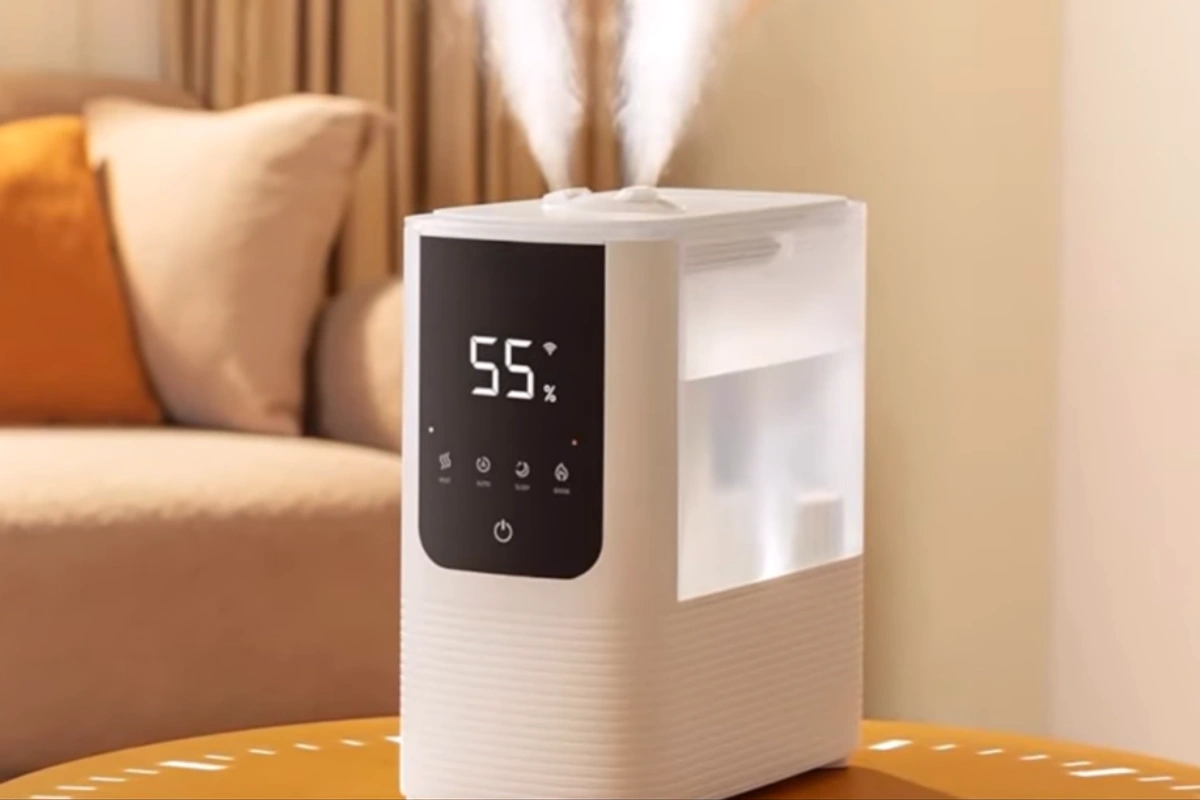
Selecting a Y&O Steam Plus steam humidifier for a larger room turns a simple appliance choice into a layout question. One bedroom with a closed door behaves differently from an open-plan lounge that flows into a hall, kitchen, stairwell, or high-ceilinged reading area. Its coverage label can be useful, but it is not a promise that every connected corner will behave the same way. Before comparing finishes or control panels, decide what room you are actually asking the unit to serve.
Keeping that distinction in mind keeps the selection process practical. Buyers can start with documented capacity, then test it against doors, air movement, placement, refill habits, and seasonal changes. It also keeps expectations sensible: a steam humidifier is an appliance for managing room moisture, not a medical device and not a substitute for solving a leak, poor ventilation, or mold problem.
Begin by drawing the room boundary
Measure the space you want to manage, then mark the boundaries that are real during normal use. Closed bedroom doors, a pocket door left open all day, a return-air grille, and a ceiling fan all change the practical boundary. Even a nominally large living room may be easier to manage than a smaller room that is continuously exchanging air with three adjoining spaces.
Think in zones rather than in a single square-foot number. The main seating zone may be the priority, while the far end of an open floor plan is secondary. That is a more useful starting point than buying for the combined footprint of every room visible from the sofa. It also gives you a way to evaluate results later: use a humidity meter where people spend time, rather than relying on how the room feels at the appliance.
Read a coverage claim as a starting point
Coverage is a comparison figure, not a guarantee. The Y&O Steam Plus 10L from YoAirPro is documented for spaces up to 1,000 square feet, with output up to 1,200 ml/h and runtime up to 24 hours. Those figures make it a candidate for a larger room, but they do not erase the effect of an open doorway, unusually dry outdoor air, or a heating system moving air quickly through the house.
Use a capacity claim to create a shortlist, then ask whether your room resembles the conditions behind the claim. One compact, closed room at moderate settings is one case. By contrast, a double-height room with frequent traffic and a nearby supply vent is another. If the answer is uncertain, plan for a measured trial period rather than treating a coverage figure as a reason to run the appliance at maximum output indefinitely.
Match output to air movement
Output describes how much moisture an appliance can introduce; it does not describe where that moisture will settle. Strong drafts can disperse moisture before it reaches the zone you care about. Conversely, a unit placed too close to a cold exterior wall, curtain, or soft furnishing can create a local damp spot even when the room-average reading looks modest.
Start with the humidifier on a stable, water-resistant surface away from textiles and electronics, leaving clear space around it. Avoid placing it directly under a shelf or in the path of a supply register. Let the unit run long enough for the room to respond, then check more than one location. One meter beside the tank only tells you what is happening beside the tank.
Choose a tank around the daily routine
Tank size is a convenience and handling decision as much as a technical specification. The 10L tank can reduce refill interruptions in a larger room, but it is still water that must be carried, filled carefully, and maintained. Check the route from sink to placement location. Stairs, a narrow basin, or a household member with limited lifting comfort can matter more than a headline runtime.
A stated runtime of up to 24 hours is conditional on settings and conditions. Treat it as an upper bound for planning, not a fixed daily schedule. A useful routine is to check the tank and meter at roughly the same time each day for the first week. That observation reveals whether the room is receiving more output than needed, whether refills are realistic, and whether a lower setting meets the goal with less attention.
Use the meter to set an ordinary target
U.S. Environmental Protection Agency guidance advises keeping indoor relative humidity below 60%, ideally between 30% and 50%, and recommends using a humidity meter. That advice gives the selection process an operating boundary. The goal is not to chase the highest number the appliance can produce. It is to observe the room, adjust gradually, and avoid conditions that leave windows, walls, or furnishings persistently damp.
Put the meter away from direct steam and away from a radiator or vent. Record a few readings before changing settings. Then make one adjustment at a time. Checking the room daily also helps reveal outside influences, such as a rainy week, a sudden cold spell, or a houseguest opening a door that is usually closed.
Compare features by the work they remove
Feature lists are easiest to assess when translated into a household task. Steam heating is part of the unit’s operating design. A humidity meter supports observation instead of guesswork. Auto shutoff can provide an end-of-water response, but it is not permission to ignore cleaning, placement, or the manufacturer’s instructions. Filterless operation means there is no filter replacement task, while it does not mean that the water tank and surfaces require no routine care.
For someone who wants a concrete product to evaluate against this checklist, the Y&O Steam Plus steam humidifier from YoAirPro combines a 10L tank, steam heating, a humidity meter, filterless operation, and auto shutoff. Product features should be confirmed against the current manufacturer information before purchase, especially if a particular control or warranty term is decisive.
Run a seven-day placement trial
A short trial produces better buying feedback than an instant judgment. Keep the placement consistent for several days, note the meter reading in the primary zone, and watch for condensation on nearby cool surfaces. If conditions change quickly when a door is left open, that is useful evidence that connected spaces are part of the load. If the appliance is noisy or inconvenient to refill at the chosen spot, that is a placement finding too.
Large-room selection worksheet
| Check | What to note | Decision use |
| Room boundary | Closed doors, open passages, ceiling height | Define the primary zone |
| Air movement | Vents, fans, drafts, traffic paths | Choose a safer placement |
| Daily handling | Refill route and cleaning access | Check whether tank size is practical |
| Meter readings | Primary-zone and room-edge readings | Adjust gradually, not by feel alone |
| Surface check | Windows, walls, curtains, nearby wood | Reduce output or relocate if dampness appears |
Make the final choice conditional, not absolute
A well-chosen large-room humidifier is one that fits a specific room and a sustainable routine. Capacity, tank size, and output deserve attention, yet the decision becomes more reliable when they are paired with a clearly defined zone, careful placement, and a meter-led check. A bigger specification cannot compensate for an undefined room boundary or neglected maintenance.
Before ordering, make a small list of the non-negotiables that come from your own layout: the safe surface, the nearest fill point, the number of open passages, and the location of the meter. Then compare those points with the current product manual and specifications. This protects against a common selection error, in which a buyer compares only coverage and tank capacity while overlooking the room’s real operating constraints.
It is also sensible to review the first few days as a commissioning period. Keep notes on a cold morning, a day when heating runs frequently, and an evening when interior doors stay open. Those observations reveal more about the room than a one-time measurement. They can show that a modest setting is sufficient, or that the priority zone needs a different placement rather than more output.
Choose the model whose documented features make the everyday routine easier, then verify its fit in your own layout. If readings rise too high, condensation appears, or the appliance cannot keep up with an unusually open space, change the setup rather than forcing the result. That approach leaves room for the actual home to lead the decision.