Introduction
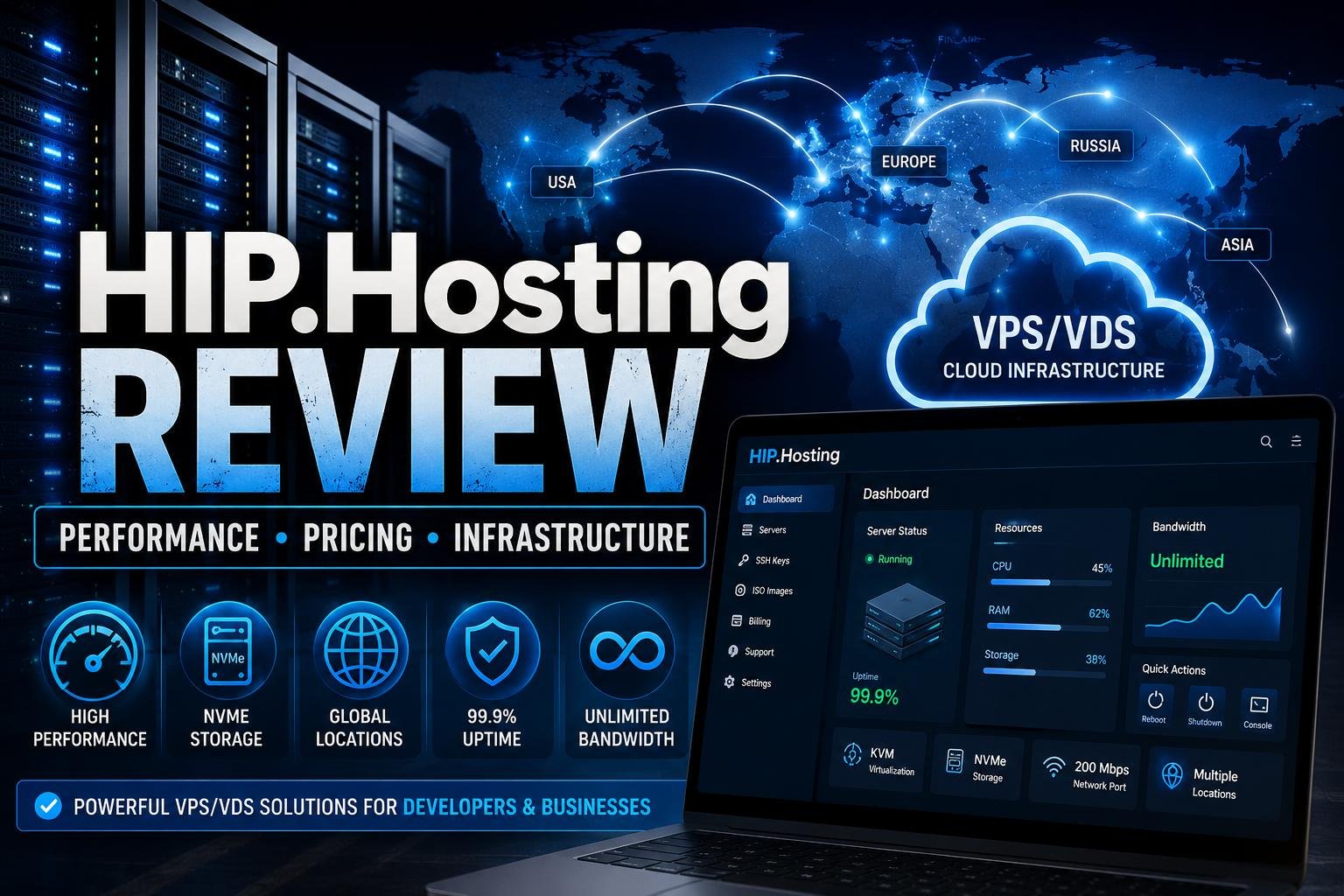
The performance of the virtual server is significant for developers, system administrators, webmasters and SaaS operators, and ultimately for digital businesses, as it influences how responsive, reliable, scalable and cost-effective their applications are. HIP.Hosting is a company that targets VPS/VDS infrastructure and provides KVM based virtual servers from various countries around the world. The platform focuses on ultra-fast provisioning, complete root access, high-speed storage, flexible configuration, and easy server management. The provider claims that servers can be provisioned in under a minute and its infrastructure relies on datacenter-grade NVMe drives from all of its vendors. HIP.Hosting also claims to offer a 99.9% uptime guarantee on their VPS/VDS offerings, as well as unlimited bandwidth. Its features make it especially useful for those who require a virtual environment that they can shut down or operate with administrative control, but without the hassle of owning and maintaining the physical hardware.
In this review, we take a look at HIP.Hosting .To offer hosting as a technical user and not as a generic hosting solution. Whether it’s virtualized resources, KVM technology, NVMe storage, international locations, choice of operating-systems, and management tools provide a realistic environment for real workloads is the key question. The provider has been operating since the year 2020 and currently has a portfolio of several VPS/VDS options: Standard, Windows, Memory and Hi-CPU. The usefulness of that structure is that applications have different resource needs, a lightweight app might need a balanced CPU and memory, a compute-heavy application might appreciate a higher-frequency processor setup, and a database might need more memory and fast storage. Instead of forcing all customers into one specification, HIP.Hosting gives customers the option to choose a server profile that is more apt to the load.
HIP.Hosting Features and Management Simplicity
One of the best features of the HIP.Hosting. The focus of hosting proposition is simplicity. A VPS/VDS is beneficial to technical users because it offers an isolated virtual environment and root-level administrative access, where the administrator can install packages, configure services, manage firewalls, deploy applications, choose operating systems and control the behavior of the server as per the project’s requirement. With HIP.Hosting, having full root access is essential when you have customers who require more access to run and develop an application than what a managed application environment offers, and it is something special that Hosting provides. The provider also has a self-developed control panel designed to streamline server management, and according to its listed specs, scaling servers can be accomplished in a couple clicks. This can save time for routine infrastructure management, particularly as traffic and workload demands grow and more CPU, memory, or storage is required during a project.
Another point of the user experience is their provisioning speed. For infrastructure workflows, the time of deployment can be long and tedious, with Hosting offering the promise of a server being ready to host within less than a minute. Fast provisioning is important for development teams for testing, staging, temporary workloads, experiments, migration projects and production deployments. It may also be useful for businesses reacting to a sudden surge in demand as the wait time between deciding that they need more computing power and getting a virtual machine that can be used is shortened. The provisioning time advertised for a server is not a guarantee of application performance: the time it takes to create a server depends on the availability of the infrastructure, and is not guaranteed to ensure the performance of an application. However, agility and moving moves and moves from the planning phase into action can be a worthwhile advantage that teams will appreciate in their operations.
Infrastructure: KVM Virtualization and NVMe Storage
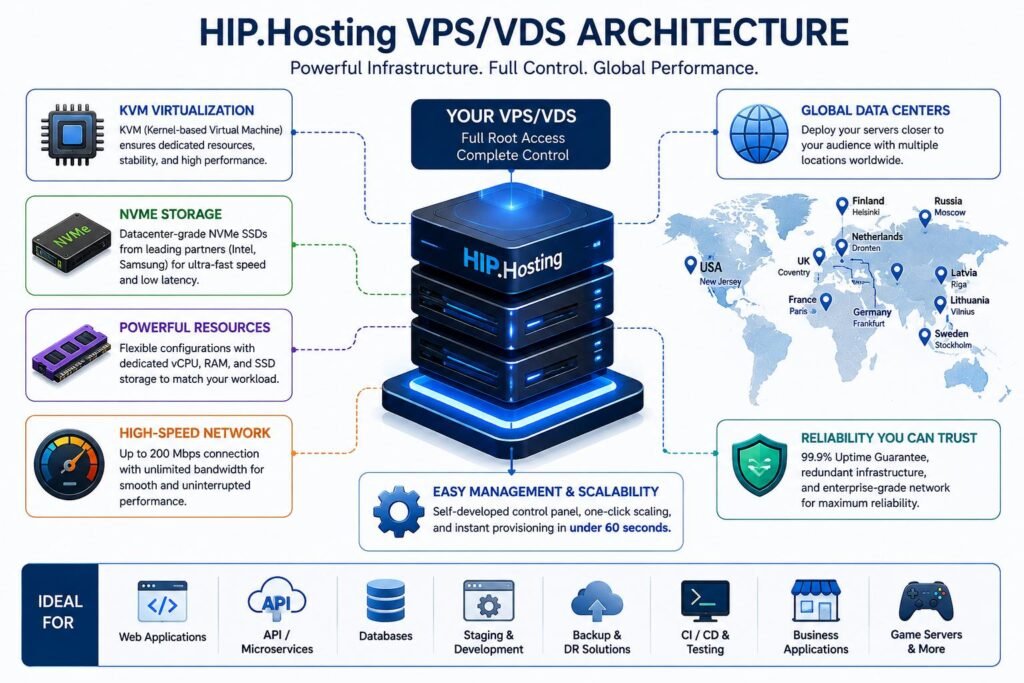
Infrastructure point of view, the use of virtualization of type KVM is important for Hosting. KVM (Kernel-based Virtual Machine) is a type of virtualization support that is available at the hardware level, enabling virtual machines to run with their own virtual machines allocated computing resources and sharing the underlying physical resources. For VPS/VDS customers, the quality of virtualization is an important factor as it can have an impact on the performance of applications if there is a lack of stability in the virtualization or too much contention. HIP.Hosting KVM technology is powerful and reliable, and lists it as one of the infrastructure benefits it offers. The provider also claims to be using datacenter NVMe drives from major partners, like Intel and Samsung. For certain workloads where storage latency is critical, such as databases, application files, package installation, caching, logs, and others, NVMe storage can provide significantly improved storage access characteristics than previous storage technologies.
The performance of a virtual server is particularly important when considering storage because CPU and RAM details don’t provide the full picture. If an application has enough processor and memory resources but often accesses stored data, then storage latency can become a bottleneck. As a result, the use of NVMe storage for the datacenter contributes to the technical component of Hosting’s VPS/VDS offering. The platform also offers configurations from smaller virtual machines to much larger allocations, such as 16 vCPUs, 64 GB of RAM, and 500 GB of storage, for instance, on its Standard plans. Availability and pricing may differ based on location and plan; please check the live configuration prior to ordering. The Standard VPS/VDS category is intended for those who are looking more specifically for a Virtual server suitable for daily use and general purpose workloads that require a balance of CPU, memory and storage.
Reliability, Uptime, and Network Considerations.
One of the most critical properties of any infrastructure provider is reliability, as even the fastest-of-fast servers are not really worth much if applications aren’t always available. HIP.Hosting VPS/VDS infrastructure has an uptime of 99.9%, and offers another benefit as unlimited bandwidth. A provider’s advertised solution-level guarantee is not to be confused with an independently verified uptime target of 99.9%, which means that the provider has relatively little downtime for an extended period, but it is important to note that the advertised uptime figure does not necessarily equate to the actual service level guarantee. In addition to infrastructure provider control issues, such as software misconfiguration, operating system issues, software bugs, security breaches, and customer network issues, can impact application availability. Therefore, the professional should take precautions against downtime and perform monitoring, automated backups, backing up as needed, and recoveries measures as needed and not use any single uptime percentage as a business-continuity solution.
The other area is network capacity. The goal of Hosting is to create a VPS/VDS product that is appealing to technical users. According to plans published, the configurations listed on the main site connect at 200 Mbps, and the provider claims its “unlimited” bandwidth. This is a good solution for many websites, APIs, development environments, databases and business applications without the need for complicated bandwidth-management strategy. But, the professionals must consider the network performance based on the application and not just the headline Bandwidth specification. Real-world performance can vary due to latency, routing, packet loss, workload characteristics, geographic distance and user location. Situating a server near the applications’ main users can provide a better experience than placing a more powerful server farther away. This is one of the best features for global deployment capabilities, which allow customers to choose the infrastructure they want in their application based on its geographical requirements.
Global Server Locations and Deployment Flexibility
One more concrete benefit of HIP.Hosting is geographic flexibility. Internet hosting for foreign projects, the provider offers VPS/VDS servers in countries such as Finland, USA, Netherlands, Russia, Germany, Latvia, United Kingdom, France, Lithuania (planned), Poland, and Sweden, in particular, in Helsinki, Dronten, Moscow, New Jersey, Riga, Coventry, Paris, Vilnius, Warsaw and Stockholm. The availability of a location may not match availability at other locations and availability might be different in the live site depending on the time, and might even indicate a location as available, sold out or planned. However, the wide variety of locations opens up choices for developers and businesses in the design of deployments for various markets. Geographic selection can impact latency, compliance factors, disaster recovery, content delivery architecture and end user response. Having multiple regions from a single provider may therefore be simpler for an international digital business to plan infrastructure and deploy workloads to be closer to the customer.
International availability is very useful for teams that have applications with customers in different geographical locations or development teams. The location might be important for a company accessing European users, as it might want to be nearer to the network, while another company with a North American user base would not necessarily want to be in New Jersey. Other options for developers can be various locations for staging, testing, workloads related to backups or regional application instances. Although it gives a choice of locations, it’s not a substitute for considering latency and regulatory considerations. The location strategy of HIP.Hosting makes it more appropriate for projects not necessarily associated with a geographical location. What is important is that customer needs to verify current availability, price and technical data for the location selected before committing to a production because inventories of infrastructure may be subject to change over time.
Prices and Value for Technical Projects
Another area is the price-to-resource value. This is the amount of resources needed to produce that price. The provider’s published examples of Standard VPS/VDS configurations are based on the entry level options, including 1 vCPU, 1 GB of RAM and 10 GB of storage, while higher configurations offer significantly more RAM, CPU and storage. The website at the time of the review was also offering a discount on certain locations and plans, so always check promotions before buying, as they may change. The larger benefit is that the location of a virtual computing environment with root access and the option to scale the resources, instead of buying more resources than a project needs now. It makes it easier for start-up businesses, independent developers, agencies, and digital businesses with smaller teams to match up infrastructure costs with real workloads. A good approach to purchasing is to start with a system that has sufficient capacity, track resource usage and add resources when the application needs it and the monthly cost is justified.
There are several categories of VPS/VDS also, which helps in making the application cost efficient as every application doesn’t require the same resource balance. HIP.Hosting’s Standard servers are optimized for common use cases, while Memory VPS/VDS plans include more RAM than CPUs, offering benefits for tasks that demand more memory, and finally, Hi-CPU VPS/VDS plans feature higher-frequency CPUs best suited for processes with high CPU usage. This segmentation can cause users to be charged for an application profile that they do not have. When sizing an in-memory data-processing workload, for instance, you might want to add more RAM than number of CPU cores, or a more computational workload may require more processor frequency. Choosing the right profile is as key as comparing the headline price. The goal should be to achieve the most cost-effective rate of useful application performance and not to pick the lowest price server.
Real-life applications of HIP.Hosting VPS/VDS
HIP.Hosting VPS/VDS can be used for various real technical projects. Of course, one of the most obvious uses for Web applications is the ability of developers to install their preferred operating system, web server, programming runtime, database, security tools, and deployment stack with root access. This is also beneficial for API and micro services, where each service could need a specific environment and its own configuration and dependencies. While production deployments of databases need to be properly planned around backup, replication, security, monitoring and recovery needs, NVMe storage can certainly help databases benefit from predictable virtual resources and quick storage. VPS/VDS instances can be utilized for staging environments, automated testing, temporary development infrastructure, CI-related workloads, and/or demos. Commercial sites and in-house apps can also be hosted, with direct control of the server environment.
The choice of operating system adds to the variety of workloads. HIP.Hosting supports popular Linux distributions, such as Ubuntu, Debian, CentOS, Fedora, AlmaLinux, Rocky Linux, Arch Linux as well as Windows VPS/VDS. This renders this platform applicable to teams with distinct software needs and current administrative abilities. Whether you’re looking to create a regular LEMP or LAMP environment, deploy Docker-based services, set up reverse proxies, run application servers, or run custom backend services, Linux users can do it all. For workloads that have a requirement for remote access via the desktop or require Windows-specific software, a Windows-based virtual environment can be used on Windows. The important thing isn’t just the number of operating systems listed, it’s the control that’s provided after the server is provisioned. Technical teams can setup the environment based on their own architecture and not bound to a limited application stack.
Some of the Main Benefits for Developers and System Administrators
The three elements of hosting are control, speed and flexibility. Full root access gives technical users the authority to configure their server while KVM virtualization gives the virtual-machine architecture. Frictionless deployment is expected due to fast provisioning, while the self-developed control panel is designed to improve the ease of common management operations. In addition to NVMe storage to enhance storage intensive workloads, the multiple server configurations enables customers to customize resources to application needs. If latency and regional deployment is important, then there is flexibility for projects that are deployed internationally. These all add up to provide a usable environment for users who understand the administration of the servers and would like to be able to install, configure, secure, monitor and optimize their own software stack. That is more desirable than a simpler, administrator-heavy platform for technically proficient teams.
Another benefit is also the scalability. Business applications don’t stay the same: you can add more traffic, add more databases, add more developers, and add more services. According to HIP.Hosting, customers will be able to scale their server in a few clicks which can make scaling easier if the current configuration starts to reach limits. However, scaling needs to be done deliberately as more resources doesn’t mean good architectural design. It may not be necessary to increase the number of CPUs or the amount of memory in an application, but rather to optimize the database, add caching, improve code, add load distribution, or optimize storage. However, it is beneficial to have a simple way of scaling virtual resources, as this enables teams to scale up when they need to without having to redesign the entire infrastructure. This is the reason for a VPS/VDS model to be attractive for startups and digital businesses in particular: the capacity of the infrastructure can be increased as and when the applications needs increase, but does not need to be reserved in advance at the start of a project.
What Technical Customers Should Expect in User Experience
The design of HIP.Hosting seems to be geared towards users who are comfortable in managing their own virtual infrastructure. The ordering process is kept simple, with a clear ordering proposition of choosing a VPS/VDS category, picking a server location and its resource configuration, installing an operating system and using the server via the provider’s control environment. Having a quick provisioning claim is particularly useful for seasoned administrators who already have deployment scripts, configuration templates, security procedures or infrastructure-as-code workflows ready to use. However, using this model doesn’t mean users should assume that the service provider will magically solve all their application needs. Freedom will bring with it responsibility with respect to root access. Unless otherwise agreed, customers are responsible for making any operating-system updates, application configuration, firewall rules, credentials, backups, monitoring and other server operations required to run the server.
Support expectations need to be taken into account before deployments as well. HIP.Hosting customers can reach out via Telegram and email channels, while technical issues are addressed by the team. This can be appropriate for customers who are familiar with the technical aspects and wish to communicate directly with the server administrator, and who are able to handle the majority of the day-to-day server maintenance by themselves. But businesses with particular support response requirements may have to consider if the support communication style is appropriate for their particular business before placing their mission-critical workloads on the platform. Technical excellence is just a component of a reliable production approach; it is equally crucial for organizations to have their own monitoring, incident-response, backup, and disaster-recovery processes. It is therefore very important to understand the responsibility of infrastructure provider and customer when it comes to the overall user experience and operability of any self-managed VPS/VDS platform.
Conclusion
HIP.Hosting provides a targeted VPS/VDS solution that focuses on a number of attributes which are significant for technical users: KVM virtualization, complete rooting, quick provisioning, NVMe storage, versatility of resources distribution, global locations, and easy scaling. The infrastructure information it is published with suggests a focus on performance and flexibility in operation, and the Standard, Memory, Hi-CPU and Windows categories offer alternative ways to assign virtual appliances to workloads. It’s good to see the advertised uptime of 99.8%, unlimited bandwidth, datacenter-grade NVMe storage and rapid server deployment, but users should take the word of the provider with a pinch of a salt, as this data is not actual performance measurements. Most importantly, the service is best measured by the level of control that users wish to have over their virtual servers, and whether they’re willing to manage the software and security environment.
Overall, HIP.Hosting is best for the developers, system administrators, webmasters, startups and agencies, SaaS teams, and digital businesses which require a cost-effective VPS/VDS infrastructure with the full root level control. The ability to provision environments quickly, have multiple resource profiles and international locations, and the volume of network bandwidth, are its most notable strengths.
Get more well researched information about HIP.Hosting review here.