Introduction
One of the most crucial financial management tasks for any business is budgeting as it gives a clear idea of how a business will generate, allocate, spend and save its money within a specific timeframe. A sound budget provides business owners, financial managers and accountants with valuable information to aid in sound business decisions, and it enables them to limit unnecessary costs and keep profits intact. But not all businesses have to stick to the same budgeting process. Financial planning can be done several ways, such as traditional budgeting, zero-based budgeting, incremental budgeting, flexible budgeting, activity-based budgeting and rolling budgets. This decision can therefore make a big difference in the efficiency of a business’s resources. Conventional budgeting is based on last year’s budgets and modifies them to reflect changes in the expectations for the coming year, whereas zero based budgeting calls for the manager to explain why expenditure on those items for the next budgeting period is necessary. Knowing these distinctions can assist companies pick a system that is right for them based upon their size, goals, industry and economic spending plan.
What is the Traditional Budgeting?
Traditional budgeting is the type of budgeting that a business would usually take as a base for their current budgets which are normally based on the previous budgets or the financial results of the previous period. Managers do not start from zero to create a financial plan, but rather review the spending and/or earning for the previous period and adjust according to what they expect to spend or earn during the next period. The amount spent by a company in the previous year on operating expenses, for instance, might be ₦20 million, and the management may raise the amount by 5 or 10 percent when budgeting for the next year. Adjustments can include inflation, anticipated sales growth, salary increases, and adjustments to the price of suppliers or expansion plans. This approach is based on existing information and familiar to a number of organizations as a result of this, traditional budgeting is relatively easy. It can also help save time since managers don’t have to explain each and every expense from the ground up.
The biggest advantage of the traditional budgeting is that it is simple. For those businesses that have consistent environments, it may be appropriate to base future financial plans on past numbers. Departments already may be aware of the spending limits and categories that have existed in past budgets and this can facilitate coordination of the budgeting process. Another benefit of traditional budgeting is that it can be consistent over time, which can help to facilitate comparisons between the actual budget and the previous one. However, it may become a liability if the previous spending was not efficient and was not necessary. This may be a solution that allows departments to have overspending budgets in the preceding year and automatically grow their next year’s budget, instead of helping to offset it. As a result, traditional budgeting may sometimes perpetuate waste rather than force managers to ask if each expense is still value. Therefore, traditional budgeting may sometimes maintain waste in
the budgeting system rather than challenge managers to make the question: “Does this expense give value?
What is Zero Based Budgeting?
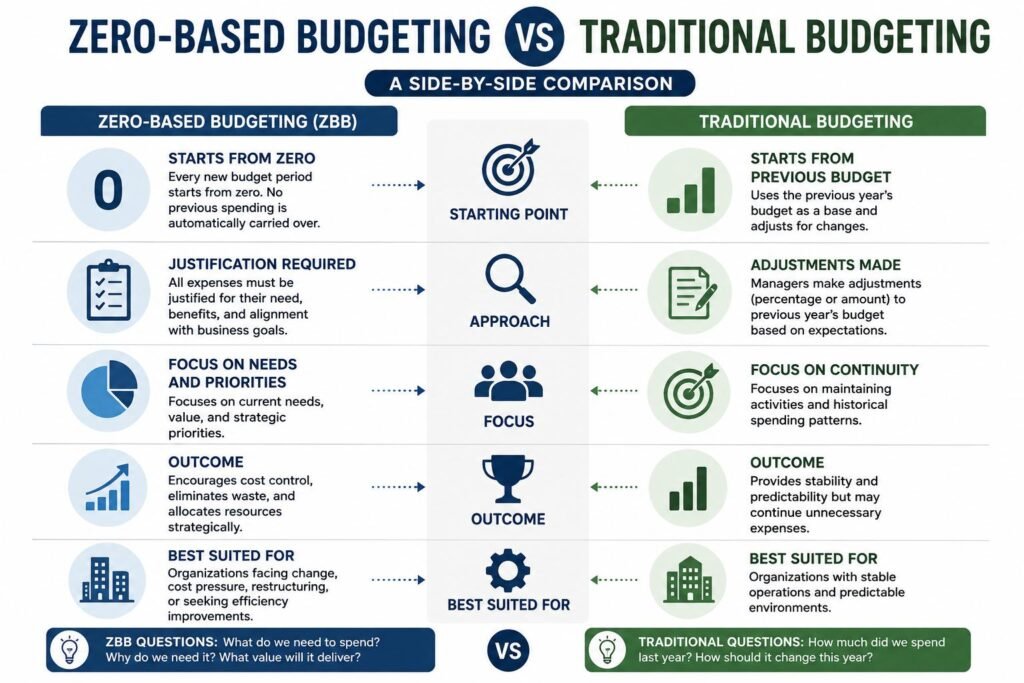
Zero based budgeting: Budgeting process where expenses have to be justified for every new budgeting period, instead of the previous period being automatically carried over. In other words, the budget starts from “zero” and managers have to decide what activities, resources and expenditures are needed to meet the objectives of the organization. This does not have to imply that the company doesn’t spend any money initially every year. Rather, it implies that money that was spent in a prior budget cannot be automatically approved just because it was in a prior budget. All major costs need to be assessed on the basis of their necessity, the benefits that they can offer and the role they play in the business objectives.
To find out more about the concept, a business can check out the work of Zero-based budgeting. The main concept is that the question of management should be: what are the costs and whether they are the right costs or not? For instance, if the company invested ₦10 million on marketing last year, let’s say. The budgeting approach in the past would have allowed management to raise the budget to ₦11 million for the coming year. In the case of zero-based budgeting, the marketing team would have to provide an explanation of what activities the ₦10 million was used for, which campaigns actually produced results, what activities should be continued and how much funding will be needed to achieve the company’s new goals. The amount may be greater, less or equal to the previous year’s spending based on evidence presented.
How is ZERO Based Budgeting Different than Traditional Budgeting?
The primary difference between zero-based budgeting and traditional budgeting is that zero-based budgeting begins with the assumption that you will spend no money. The traditional budgeting approach is based on past financial information, whereas the zero-based budgeting approach is based on the prevailing financial needs and objectives. Traditional budgeting thus asks the question, “how much did we spend last year and how should this change be?” ZBB is asking the question: “What do we need to spend this year, why do we need it, and what value will it provide? This separation has the potential to have a profound effect on resource allocation. Traditional budgeting may be quicker and less difficult, but may also mean that the costs that are not efficient are maintained. In zero based budgeting, unnecessary spending is made apparent since the managers need to justify their need to spend money. It takes usually a longer time, detailed analysis, managerial involvement and financial discipline, however.
The other significant difference is the way the two approaches react to the variation of business situations. In cases where the nature of operations, costs and revenues are fairly consistent, traditional budgeting can be effective. Historical data, however, may not be an accurate indicator in the case of a business entering a new market, launching new technology, restructuring the business, or when there are significant economic changes taking place. In such scenarios, zero-based budgeting might be better since it asks managers to re-evaluate spending in line with the new priorities. An enterprise that once had a big office will find, for instance, that after conducting ZB, many employees are working from home and some office expenses offer little benefit. The management would then be able to cut the cost of the office and save the money for technology, training and/or pricing.
The Benefits of Zero-Based Budgeting
A benefit of zero based budgeting is that it enables you to pinpoint and cut out unnecessary expenses. Costs that are continuing just because they were part of previous budgets may be open to question since managers will have to explain the rationale for continuing the expense. This can be especially helpful for companies that are rapidly growing and have many subscriptions, services, administration costs, or processes that aren’t as efficient. The business could find itself paying for software that isn’t being used by its workers much, keeping excessive services or funding marketing and advertising schemes with low returns. Eliminating these costs can provide a boost to cash flow and profitability, while not impacting the allocation of resources directly needed for business growth.
Another advantage of zero-based budgeting is that it can help boost accountability. Having to justify requests to the department manager makes him or her more aware of the cost/benefit relationship to business. Managers should be encouraged to think of financial resources not as an endowment that must be exhausted at the end of the year, but as investments which must be justified. This can lead to an increase in a cost-conscious culture across an organization. In addition, zero-based budgeting can be used to ensure that senior management resources are focused on strategic priorities. A company’s primary goal may be to retain customers, in which case it is important to allocate resources towards customer service, product quality and retention initiatives rather than continuing to maintain all previous expense categories.
The Disadvantages of Zero Based Budgeting
Though zero-based budgeting is beneficial, it can be challenging. Managers need to evaluate the activities, estimate costs, assess benefits and provide justification for funding requests. This can take time and lots of hands-on work in a large organization that has hundreds of departments and thousands of expenses. Frequently having to account for mundane expenditures that are unlikely to shift greatly can also make employees feel frustrated. It can thus add to the workload of finance teams and department managers, especially if the organization lacks efficient financial reporting systems.
The other drawback is that when cost cutting is too extreme, it has some unintended consequences. Managers must not spend too much effort cutting costs, because they might end up cutting out money that is not immediately needed but will be beneficial in the long term. For instance, cutting back on employee training can lead to lower costs in the short term, but can ultimately lead to diminished skills and productivity. Likewise, reducing investments in research and development may generate short-term gains in profits, but may hurt the business in the longer run due to the lack of innovation. Zero based budgeting should, therefore, be implemented carefully. The goal should not just be to save money, it should be to invest money in the most strategic and profitable way.
The Pros and Cons of the Traditional Budgeting Process
The traditional budgeting is still widely used as it is easy to manage, predictable and simple. Historical financial statements, budgets, and performance can be used to make forecasts of future revenues and the costs of the business. It is especially beneficial for organizations that have consistent operations and costs. It also offers continuity as departments can see how their budgets have changed over time. For instance, a manufacturing company with fairly uniform production levels could start from the raw-material, labor, transportation and administrative costs for last year and then add the increases in those costs they expect from the increase in raw-material costs and the impacts of labor, transportation and administrative changes.
But, conventional budgeting can foster the “use it or lose it” attitude. When employees think that they would not receive the same budget for their department the following year if they don’t use up their entire allocation, they may have a reason to buy unnecessary items before the end of the fiscal period. The method has the potential of reinforcing old ideas. A department may be funded for a specific activity one or more years ago, and still continue to receive funding for the same activity – even if the business model has changed. It’s efficient to stick with budgeting as usual, but businesses should check back on past expenses on a regular basis instead of simply repeating past budgets. Historical budgeting can be used along with periodic spending reviews to mitigate some of its limitations.
Other Popular Business Budgeting Methods
1. Incremental Budgeting
The incremental budgeting is closely related to the traditional budgeting method, since the previous budget is used to identify the basis for current budgeting. The primary difference is that the new budget is usually developed by adding or subtracting a dollar amount to the previous budget. In some cases, for instance the increase in the budget for a department due to inflation and anticipated growth may be 5%. It is easy and relatively fast and can be used in situations where operations do not change significantly within an organization. Where it particularly fails is that wasteful spending can be built into the budget because most of the spending is considered to be reasonable. It may therefore not be suitable for a business with significant restructuring work they need to be doing or if they wish to pursue an active elimination of waste.
2. Flexible Budgeting
Allowing flexible budgeting will give the budget expectations flexibility. A flexible budget varies with the level of production or sales rather than being based on forecasted costs. For instance, a company with a normal production of 10,000 units could have varying anticipated material, labor, and distribution expenses when production rises to 15,000 units. A flexible budget is one that lets management know how well it is doing by comparing in actuality against an appropriate cost level, instead of the fixed budget that was prepared under different operating circumstances. This is especially advantageous for companies with variable sales or production levels.
3. Activity-Based Budgeting
Activity-based budgeting is based on the activities that incur costs and the resources needed to conduct the activities. Management looks into the process of expenditure rather than just the amount. For instance, a logistics company could measure the number of deliveries, kilometers travelled, warehouse transactions and customer orders entering the business that are costing the business. Management can use the understanding of these cost drivers to estimate the amount of resources necessary to back up the anticipated level of activity. Activity based budgeting can help to increase the accuracy of costs and identify where the business processes are using the most resources. It does need detailed operational data, however, and can be challenging to implement in organizations with complicated processes or a poor record-keeping system.
4. Rolling Budgets
A rolling budget is updated on an ongoing basis with a new future period added to it at the end of every period. The financial planning process is not one-off, but is constantly updated in light of new data. A company can have a 12 month budget rolling, for instance. January is dropped at the end of the month and the next January is added so as to keep the 12-month forecast. This can be beneficial in industries with regular fluctuations in market conditions or customer demand, exchange rates, or operating costs. The downside of this is that it needs regular monitoring and forecasting, which can add to the workload for the finance team.
Examples from the Real World of Various Budgeting Strategies
Let’s assume that we are looking at a small retail company that has been very successful for several years and sells household products. Traditional or incremental budgeting might be appropriate if the sales, rent, salaries, inventory and other costs are relatively stable. The owner will see how much previous year money was spent and how much should be in the budget due to projected growth or decreases in sales and supplier price changes and inflation. If the business model and the information in history is reliable in predicting future expenses, it might not be very beneficial to start from scratch on the yearly rebuilds.
Now imagine a large business with large costs of administration. Management could be led to adopt a zero-based budgeting to uncover the reason behind the increases in cost and to see if all spending is justified. Departments may have to share what they do, how much they expect it to cost, the business benefits and its strategic value. Then management can focus on the most important activities and either cancel or cut back on the bottom dollar activities. To mention a few examples, software licenses being used that don’t need to be, redundant administration tasks, advertisements that don’t do much, and underutilized office space. The money saved could then be used in areas like product development, customer acquisition, technology and training employees.
One good example of the value of using a flexible budget is in a manufacturing business. Assume that the company forecasts that it will sell 50,000 units and demand turns out to be 70,000 units. Natural resources costs and direct labor costs are likely to rise in proportion to the increased production since it is the raw material and direct labor on which these costs are incurred. If the increase in cost is the result of the increased production, but the costs are compared against the original fixed costs, the company may appear to have gone over budget. A flexible budget would be used to show how much the variable costs will be for the increased level of activity and then management could analyze if company was costing at this new level of production.
Different Methods of Budgeting
No one method of budgeting is the automatic best for every business. Size, industry, finances, complexity, purpose, goals and uncertainty are all issues that require consideration in determining the right approach. When there is a limited amount of financial resources and administrative help available, simple methods such as traditional or incremental budgeting may be helpful for a small business that has a stable income and has known expenses. Some large organizations that have a lot of cost inefficiencies could use zero-based budgeting because it offers a framework to question current costs. Activity-based or flexible budgeting might be appropriate for a manufacturing or service organization that has costs that vary based on level of activity.
It’s also a good idea for businesses to utilize more than one method, not just one. For instance, a business might incorporate zero-based budgeting for its marketing, travel, consulting, and technology subscription costs and traditional budgeting for its administrative costs. A rolling forecast could then be used to keep track of the changes in revenue and market conditions throughout the year. This blended model may offer the best of both worlds: budgeting’s efficiency and increased cost control and flexibility just when it’s most needed.
Key Questions to Ask Before Selecting a Budgeting Method
Management needs to consider some vital questions before deciding on a budgeting system. First, what is the predictability of the company’s revenues and expenses? If the financial results are fairly consistent over time, simple budgeting might be adequate. Secondly, is there a lot of unnecessary or quickly rising costs in the organization? If that is the case it may be possible to use zero-based budgeting to determine and cut out waste. Third, are there significant changes in cost as a function of production, sales or customer activity? If so, flexible or activity-based budgeting might be more helpful. Fourth, what is the rate of change in the business environment? If the business is in an unstable environment then rolling budgets and regular forecasting could be helpful.
There should also be a consideration of the resources needed to implement each method, as this will be a factor of management. While a sophisticated budgeting system can be extremely beneficial, it can also become counterproductive if employees use a lot of time to prepare the reports rather than running the business. Budget should thus be proportionate to the needs of the organization as it goes through the budgeting process. The end of the day isn’t to make the most complicated budget you can. Rather, the goal is to establish a financial planning system that offers dependable information, can facilitate strategic planning, can manage unnecessary costs and can help the business to be profitable in the long term.
Zero Based Budgeting vs. Traditional Budgeting: Which is better?
Zero-based budgeting and traditional budgeting will fit a business in accordance with the objective of the business. When stability, simplicity and continuity are desired, then traditional budgeting is generally better. It enables organizations to create forecasts easily based on past data and can be effective if past spending trends have not changed. Zero based budgeting is more effective when management wants to hold costs accountable, to look at the costs and see if they can be cut, or to shift funding to strategic priorities. It compels managers to consider spending more with a fresh perspective, instead of taking a “business as usual” approach.
Both of these methods are not necessarily the best. Knowing the pros and cons of each method, and using them where they will be most effective, will help a business to get better results. Traditional budgeting can bring larger savings for an organization that has high and predictable costs, whereas zero-based budgeting can be more effective for an organization with high and outdated costs. In many situations using a mixture of budgeting techniques can yield the best results. The focus should be on having all significant investments aligned with a clear business purpose and ensuring that funds are used for activities that are aligned with growth, efficiency, value to customers and profitability.
Conclusion
Budgeting is not just a financial activity but a strategic management tool which deals with the way an organization apportions the limited available resources to allot to its goals. Traditional budgeting offers simplicity and continuity as it bases future plans on existing historical data, whereas zero based budgeting puts a burden on the manager to grant funds based on current needs and anticipated value. In addition to the above, other techniques such as incremental budgeting, flexible budgeting, activity-based budgeting, and rolling budgets give businesses other options if they are operating under different circumstances. The best option is determined by the company’s objectives, financial situation, industry and uncertainty.
The most important thing to remember for business owners, finance managers, and accountants is that a budget should not be a doc of past expenses. It should play an active role in directing financial investments, cost-saving measures and priority activities. Regularly reviewing budgeting processes can help businesses detect budgeting inefficiencies, allocate resources more effectively, enhance financial management, and boost profitability. It doesn’t matter if the management system is zero based budgeting, traditional budgeting or a combination of both, the end goal is always to make sure that every naira, dollar or other unit of currency that is spent matters in relation to the financial and strategic objectives of the organization.
Get more well researched information about Zero-Based Budgeting vs Traditional Budgeting here.