Introduction
Choosing which accounting method to go with is what a business owner does when they make the most important financial call they will make. What method of accounting you choose impacts how revenue and expenses are recorded, how financial reports are put together, and also how much tax you may pay at a given time. Also many startups and small businesses start out with a very basic bookkeeping system which while fine, choosing the wrong accounting method or in a worst case scenario using two different methods at the same time can produce inaccurate financial reports, tax issues, and compliance issues that only grow in difficulty to correct as the business grows.
In the set of main accounting methods we have accrual and cash accounting. While both are valid when used properly each serves different business purposes and follows a different set of rules. Out of all businesses that use them what we see is that companies have different needs which are what these methods cater to. What also plays a role is that companies which use them report accuracy in their finance which in turn improves decision making and also they comply better with tax regulations. This guide goes through how both methods work, what their pros and cons are, also brings to light common mistakes businesses make when they choose or apply them and we also provide practical advice for which method is best for your business.
Understanding Accrual and Cash Basis Accounting
Accounting methods which determine at what time income and expenses are reported in financial records. While the base business transactions are the same what varies is the method which we use to report them. This difference in reporting methods greatly affects what is reported in terms of profit, tax responsibilities, cash flow analysis, and financial planning. Also businesses tend to put little value on which method they choose as both systems seem to work for simple day to day transactions. But as business grows in complexity through inventory management, customer credit sales, supplier terms, or financing structures the method choice becomes very important. By understanding these basic principles business owners can avoid large scale reporting issues and at the same time put in place a reliable accounting system which supports long term growth and regulatory compliance.
What Is Accrual Accounting?
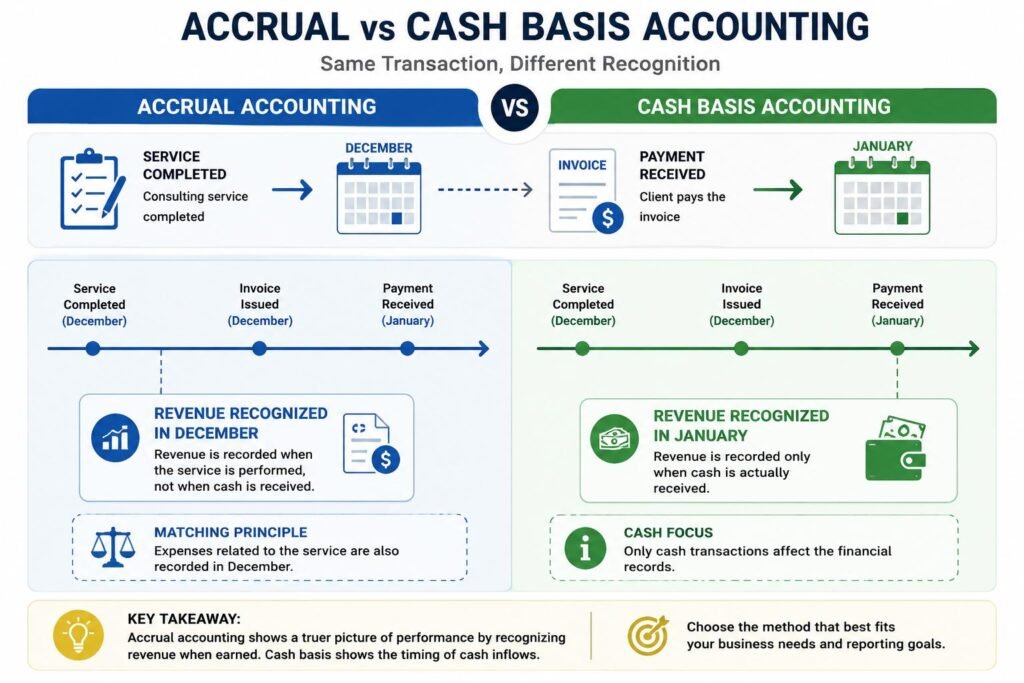
Accrual accounting reports revenue as it is earned instead of at the time of payment. Also it recognizes expenses as they are incurred instead of when cash changes hands. This is in line with the matching principle, which is that we report income and the expenses which generated that income in the same time period. For example, a consulting firm which finishes a project in December but gets paid in January reports the revenue in December as that is when the service was rendered. Also if we buy office supplies on credit in December which we pay in January the expense is reported in December. This approach gives a better picture of business performance by including revenues which are due and expenses which were used up in generating that revenue which cash based transactions do not fully represent.
What Is Cash Basis Accounting?
Cash in for cash out is what the cash basis of accounting is all about which we also call a very simple approach that ignores economic activity. We see that revenues are recognized only when we receive the cash and that expenses are recorded when we pay for them. What this means is that a business will report income only when it has put money in the bank which may not tell the whole story of what happened with products sold or services rendered. Also what we see is that we do not record expenses till we write the check which may not include all the bills that are due. Because of its ease of use this method is a hit with the freelancers, the sole proprietors and very small businesses which have basic transaction sets. Also what we see is that business owners may have a better handle on their finances as what is reported as income is what they actually have in hand. That said this also may not present a full picture of the business health as it may not report out on all the business’ liabilities or customer invoices outstanding which in turn may give a false picture of the business’ health as the business grows and becomes more complex.
Common Issues in Selecting an Accounting Method
Many companies choose which accounting method to use out of convenience instead of looking at what will best support their operations, financial reports, tax compliance, and future growth. At the start either method may seem appropriate for a business, but we see poor implementation of these methods at the very early stages which in turn creates reporting issues that only grow to be more complex to fix. Also we see the same mistakes from which startups and small business owners suffer.
Choosing to go with Cash Basis because it is simpler
Many business founders think that which accounting system is most simple is the same as which one is best. Cash basis accounting which requires less adjustment and is easy to use is what many growth stage companies go for without looking at if it truly does present business performance in full. That which they choose becomes an issue when the company begins to extend credit to customers, buy into inventory, or enter into long term agreements. Also it is an issue that cash based financial reports may see large fluctuations based on when payments are received instead of the actual business action which in turn makes profit report very inconsistent. Also we see that investors, lenders, and management have a hard time in evaluating performance in this setting. What may save time at the start is in the end to create great reporting issues as the business grows and financial reports become more complex.
Using Accrual Accounting Without Proper Recordkeeping
Accrual accounting is a step forward in terms of accuracy of financial report but also puts to the fore robust book keeping practices. We see businesses which adoption of this method is100% professional but at the same time do not put in place the support structures for accurate reporting. We see missing invoices, delayed adjustments, and incomplete reconcile which in turn present out of date and in accurate reports that do not reflect true business condition. What we often find is that instead of seeing improvement in accuracy we see a lot of confusion, reports that do not pass the mark and also issues around compliance. Businesses should only look into accrual accounting if they have in place the proper accounting systems and procedural support for its success.
Mixing Accrual and Cash Accounting Methods
In that which is very common in accounting we see the practice of accidentally using elements from more than one method in the same accounting system. For instance a company may report customer revenue at the time of receipt of payment while at the same time report expenses as soon as the invoice comes in. Also we see that which companies report sales on an accrual basis but delay the recording of supplier expenses until payment is made. These inconsistent practices go against the principles of accounting and in turn produce what is in actuality distorted financial reports because revenues and outgoes no longer match up with the same report period. Also it is very easy for companies to mix accounting methods which in turn makes it hard to interpret profitability, complicate tax preparation, increases audit risk, and also often requires in depth corrections before year-end financial reports can be issued.
Failing to Reevaluate the Accounting Method as the Business Grows
In a small startup which does well the accounting method used may outgrow the company as it scales. Businesses see growth via increased sales, inventory, multiple employees, customer financing and long term contracts. Through these changes in operation many still use the same accounting methods which have been in use which is what they have always had which in turn may not scale with the business. As business complexity increases cash basis accounting may no longer give out meaningful info which in turn may require the use of accrual accounting for better reporting and compliance. Also by not reevaluating accounting policies at regular intervals companies prevent financial reports from growing with business operations which in turn increases the chance of reporting errors and compliance issues.
Comparing Accrual and Cash Basis Accounting
Financial Reporting Accuracy
Accrual accounting in general reports better reflection of business performance which we see by recording economic events as they happen instead of when cash does. What we see in reports is outstanding customer balances, unpaid supplier what we call liabilities, accrued expenses, and earned revenue which we have not yet collected. This wider picture allows management, lenders, and investors to evaluate profitability independent of payment timing. Cash basis accounting although easy to maintain does put out at times distorted financial reports during times of delayed collections or put off payments. At one time a business may look very profitable and the next very unprofitable simply because of the time of collection or payment of cash.
Cash Flow Management
One benefit of cash based accounting is that it reports immediately on what cash is available. Business owners is a primary use for this method report easily whether they have enough money to pay employees, suppliers, taxes, and operating expenses as revenue is recorded when cash is received. That said this is not the same as overall financial health. A company may be profitable by accrual measures yet have cash flow problems if customers pay late, also a loss making company may for a time appear to be doing well because of large customer prepayments. Accrual accounting does put a split between performance and cash flow which in turn causes companies to independent report on profit and liquidity via financial statements and cash flow management.
Business Planning and Decision-Making
Reliable financial information is the base for which business decisions on pricing, expansion, staff growth, borrowing, and investment are made. Accrual accounting which puts revenues in the same period as the related expenses gives management a better picture of true profit and operation performance. Also seasonal variations in revenue and expense are easier to see as they occur in the report periods they belong to which isn’t the case with cash basis that reports based on payment timing. For very small businesses with simple goings on cash basis accounting may be enough but in the which large scale evaluation of performance over time, budgeting, and securing external funding decision makers should see its pros and cons. Accurate financial report improve strategic planning by giving a honest picture of how the business is doing.
Compliance Issues related to which Accounting Method to Choose.
Selecting improper accounting methods can present great compliance issues which in turn may cause inaccurate financial reports. It is also a fact that tax authorities, lenders, investors, and regulatory bodies put out financial info which businesses are to present in accordance with set accounting standards and tax rules. By use of the wrong method or by which in which accounting policies are applied variably you increase the chance of report errors, tax changes, penalties, and audit results. As businesses grow into new markets, go for financing, or leave behind the use of informal bookkeeping for professional financial reports compliance issues become more of a issue. By putting forward these issues we see that business owners’ should base their account method on what is best for operation as opposed to what is most convenient.
Tax Reporting Errors
Tax base varies by which accounting methods are used. Which revenue and expense are recognized improperly may cause tax base to be lower or higher than it should be which in turn results in inaccurate tax returns. If revenue is recognized out of time it may raise more tax than is due, at the same time delayed expense recognition may present a distorted picture of deductible business costs. Also not recognizing income which is due as per tax rules may put businesses at risk of penalties, interest and re assessment. Consistency all through the tax year is key to have reported income reflect true business activity and at the same time to be in compliance with tax regulations.
Inconsistent Financial Statements
Financial reports that are prepared with different accounting methods tend to present a mixed picture which in turn reduces their value. We see large variations in profit margins, operating expenses, accounts and receive these differences are due to diverse recognition rules. Also these issues which we see as of today are what is eroding the trust of our investors, lenders, management and external auditors which in turn use these reports for key decision making. For businesses which are out there to secure loans or which are trying to attract investors the issue of financial statements that do not present a unified picture due to mixed accounting practices is a very serious one which they have to deal with.
Audit Challenges
Businesses which are put under audit notice by the auditors see also a different set of issues play out when accounting methods are not applied in a uniform way. We see that auditors’ main role is to check that the accounting policies are the same across reporting periods and that financial reports truly reflect business performance. What we have is that mixed accounting methods which in turn lead to greater testing needs, require more back up documentation, and very often cause us to go in and make adjustment entries before the financial reports can be made final. Also we see that these issues which come up during the audit take up a lot of time to correct, push up professional fees, and may also cause delay in regulatory reports or financing approvals.
How to Select the Proper Accounting Method
In many cases business owners choose which accounting method to use based on what is easiest for them which is a mistake. Instead they should look at a few practical aspects which include transaction complexity, inventory management, financing issues, customer payment terms, tax responsibilities, growth projections, and reporting requirements. For very simple businesses which do immediate customer payment and have few liabilities cash basis accounting is a better fit. But for companies that manage inventory, extend credit to customers, or are in the process of getting investment they will see more value from accrual accounting which gives a better picture of the whole financial health. Also it is a good idea for companies to talk to a professional accountant before they choose or change their accounting method to make sure they are in compliance with what the law requires and that it will support the company’s growth.
Top Tips to Avoid Accounting Method Errors.
Avoid out of the box accounting issues by which in large measure consistency, proper documentation, and a review of accounting policies as they relate to the growth of business operations is key. We recommend that business owners put in place written accounting procedures which clearly state when revenues and which expenses will be recorded at what time and that which accounting software we use support the chosen method. Also do regular bank reconciliations, prepare and review financial statements monthly, post timely adjusting entries, and see to it that you have the invoices, receipts, and supplier obligations documented properly all of which improve report accuracy no matter what accounting method you use. Also we suggest that businesses which have an accounting professional do periodic reviews which will help to identify compliance issues early, to which they can respond, also note if growth in operations requires that you transition to a different accounting method.
Conclusion
Selecting which between accrual and cash basis of accounting to go for is a great deal more than a paper work issue. It does in fact impact on the accuracy of financial reports, tax compliance, business planning and long term growth. While cash basis accounting is simple and works well for many small scale businesses which have basic operations, accrual accounting in turn gives a better picture of the financial performance by recording revenue and expenses as they happen. We see issues arise when companies choose the wrong method for their needs, fail to keep proper records, or mix elements of both systems which in turn produces misrepresentative financial reports and raised compliance issues.
By which each accounting method functions, we see that it is through careful evaluation of business needs, maintenance of the same accounting practices, and turning to professional advice as needed that entrepreneurs may put in place reliable financial reporting systems which in turn support better decision making, satisfy regulatory requirements, and position their businesses for sustainable growth.
Get more well researched information about Accrual vs Cash Basis Accounting here.