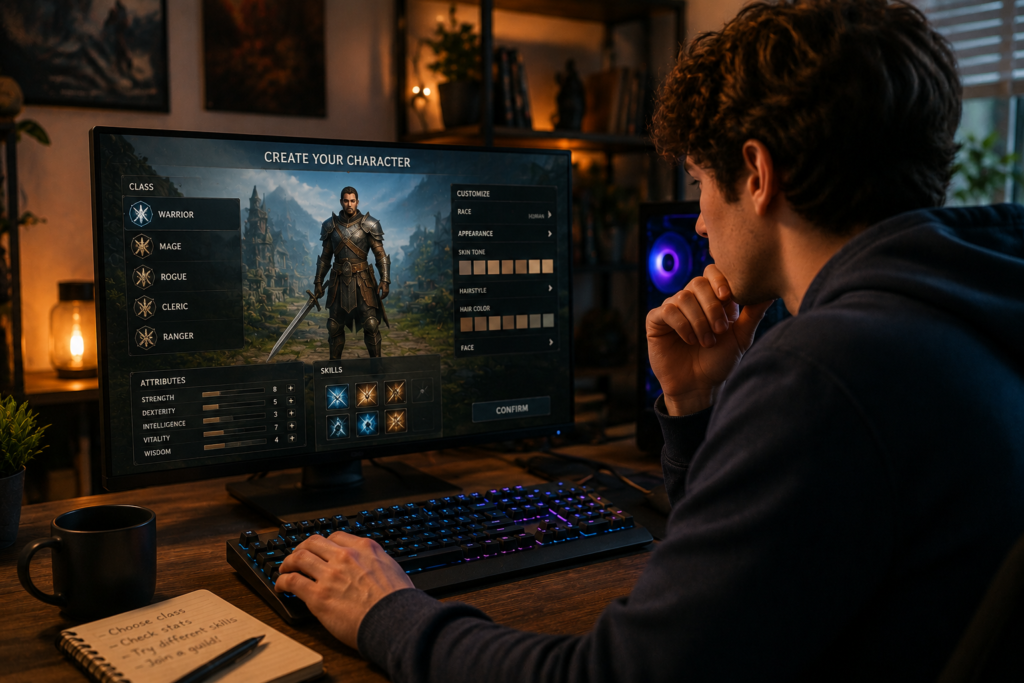
Still cringe a little thinking about my first character creation screen. Fifteen minutes in, staring at a wall of stats meaning absolutely nothing to me, three friends already loaded into the world while I sat there deciding between a sword icon and a staff icon that, honestly, looked kind of similar at the time. Picked something at random just to stop holding everyone up. Spent the next twenty hours regretting it. Nobody warns you how much that first pick shapes everything after, and by the time it clicks, you’re already committed. If you’re about to build your first character in an online RPG, relax a little; these games rarely punish you as badly as it feels like they will at first. But knowing roughly how classes, stats, and progression actually work before diving in saves you the confusion I went through and honestly makes the whole thing a lot more fun starting from hour one instead of hour twenty.
Choosing a Class or Role
Most online RPGs sort characters into some version of three broad roles. Tank, damage dealer, support, or healer. Sounds simple written out like that. The actual differences matter a ton once you’re mid-fight realizing your build just isn’t suited for whatever you’re trying to pull off. Tanks soak up damage and hold enemy attention, usually through heavier armor plus abilities built to keep threats locked onto them instead of the rest of the group. Playing one well has less to do with big flashy numbers and more to do with positioning and timing, knowing when to pull enemies together and when to brace for a heavy hit. Rewards patience over fast reflexes in that role. Damage dealers, or DPS for short, exist purely to chew through enemy health as fast as humanly possible. Most flashy skills and satisfying combo chains live here, and it tends to be the most popular pick for new players since dealing damage just feels immediately good. The catch is a lot of damage builds are fragile, so mistakes get punished quickly if you’re not watching your positioning closely. Support and healer roles keep everyone else standing. New players tend to write this off as less exciting early on, but plenty of experienced players end up loving it, since a genuinely good healer or support can swing a tough fight almost single-handedly. There’s a real skill ceiling here people underestimate until they actually try it themselves and realize how much timing matters. Honest advice for a first character? Go with whatever role sounds most fun to you conceptually, not whatever some guide claims is currently the strongest pick. Nearly every online RPG lets you try other classes eventually anyway, with alt characters or respec options, so your first choice doesn’t have to feel like some permanent life decision hanging over you.
Understanding Stats and Progression
Stat screens look genuinely intimidating the first time you open one. Rows of numbers and abbreviations meaning nothing until somebody explains them properly. Core stats across most online RPGs boil down to a handful of shared categories even when exact names shift between games. Strength, or whatever the physical stat gets called, usually boosts melee damage and sometimes carrying capacity. Intelligence, or a magic-equivalent stat, typically powers spellcasting effectiveness. Dexterity or agility often touches attack speed, dodge chance, or crit rate depending on the specific system a game runs. Vitality or constitution generally decides total health and how well you shrug off incoming damage. Beyond raw numbers, most online RPGs layer in skill trees or talent systems, letting you shape how a class actually plays out in practice. This is genuinely where a lot of build variety comes from. Two players running the exact same class can feel wildly different depending on which skills and talents they’ve sunk points into over time. A mistake plenty of new players make right here is spreading points too thin, trying to be decent at everything. Early on, it’s usually smarter to commit hard to one clear direction, even skipping abilities that sound cool but don’t actually support the main plan. You can respec later once you’ve got a better read on the game, and a focused early build almost always feels stronger than something scattered.
Common Mistakes New Players Make
Beyond spreading stat points too thin, there’s a handful of mistakes popping up constantly among people just starting out. Ignoring gear stats entirely is a big one. It’s tempting to equip whatever looks visually coolest or carries the biggest single number, but paying attention to which stats actually help your class matters way more than raw appearance ever will. Rushing past early tutorials is another common trap. It’s easy to want to skip straight to the “real” content, but tutorial zones in most online RPGs exist specifically to teach mechanics you’ll rely on for the rest of the game. Skip them and you often end up learning those same lessons the hard way later, usually during a fight a lot less forgiving than the tutorial ever was. New players also tend to underestimate how much community knowledge already exists for basically every online RPG out there. Struggling silently with a build or a tough boss fight when there’s probably already a detailed guide or an active forum thread covering exactly that problem is honestly just wasted frustration. Nobody figures these games out completely solo; there’s zero shame in looking things up when stuck. Plenty of beginners also avoid grouping up early because it feels intimidating, worrying about slowing everyone else down or not knowing what they’re doing yet. Most online RPG communities turn out way more welcoming to newcomers than people expect going in, and grouping early tends to speed up learning a game’s systems faster than muddling through solo ever could.
Gearing Up Without Getting Overwhelmed
Loot drops nonstop in most online RPGs, and early on it’s genuinely tough telling what’s worth keeping versus what’s just clutter eating inventory space. A decent rule of thumb for beginners is comparing item level or power score against whatever’s currently equipped; most games show this clearly, and prioritizing upgrades to whichever slot is weakest instead of obsessing over getting every single piece perfect right out of the gate. Selling or disenchanting gear you’re not using is fine and, honestly, encouraged in most games. New players sometimes hoard stuff out of a vague worry they’ll need it later, but inventory space runs out fast enough that clearing unused gear regularly just makes the whole experience smoother. If a game has a bank or storage system, that’s the spot for genuinely valuable items you’re saving, not your active bag space. Guides from sites like GameSpot often break down which stats matter most for specific classes, saving a lot of guesswork when deciding what’s actually worth keeping around. Don’t stress too hard over perfectly optimizing gear as a beginner either. Early content in most online RPGs stays forgiving on purpose; developers expect new players to still be figuring things out. Plenty of time later to get deep into optimal gear theory once you actually understand your class well enough to appreciate why any of it matters. A quick mental reset between grinding sessions helps here too; a lot of players use short puzzle rounds on sites like Wisegames.fi to clear their head before going back in and making sharper decisions about gear and builds instead of clicking through loot on autopilot.
Helpful Resources
Getting comfortable with an online RPG’s systems takes time no matter how naturally good you are at games, and leaning on outside resources speeds that process up considerably. Class guides, built calculators, community forums—all of it exists because so many players already worked through the exact confusion you’re facing right now. Sites covering gaming trends with beginner-friendly breakdowns of different genres, like Pelithub, are worth bookmarking early, especially if you’re the type who likes understanding the bigger picture of a genre before sinking serious hours into one specific title. It’s worth checking too whether your specific game has an active subreddit or Discord; real-time advice from other players tends to be faster and more targeted than a static guide page. Broader gaming industry coverage from PC Gamer has pointed out how community-driven resources became an increasingly central part of how new players actually learn complex online RPGs, often filling gaps official in-game tutorials never quite manage to cover on their own.
Conclusion
Your first character in an online RPG is never going to be perfect, and honestly, it’s not supposed to be. Half the fun comes from learning through mistakes, adjusting as you go, and slowly figuring out what actually clicks for how you like to play. Pick a class that sounds fun; keep an eye on stats without overthinking every single point; and don’t be afraid to ask around or lean on community resources when something doesn’t make sense yet. Looking back, don’t even regret that random class pick from years ago, awkward as it was at the time. Taught me more about how the game actually worked than any guide could’ve, and that’s probably true for most people stepping into an online RPG for the first time too.
