Honda Accord Buyer’s Guide: The Honda Accord is a mainstay which has proven over time to be one of the most dependable and versatile midsize sedans in the auto field. Since going into production in the late 1970s the Accord has constantly provided a balance of practicality, comfort and performance. Buyers choose the Accord as it presents premium features at an affordable price and also has a very reliable image. For first time car buyers or experienced drivers the Accord’s wide range of trims and generations is to have a model that fits almost any lifestyle.
Over the years Honda has had its Accord model tuned into what the market wants, we see each decade’s changes in tech, engine options and safety features. From the large naturally aspired V6’s of the 2000’s to the recent turbo charged engines we see the Accord grow and change with each generation while at the same time holding onto what made it great in the first place. In this guide we look at the stand out generations, engine options, real world fuel economy, service costs, resell value and common issues. By the end you’ll have a full picture of which Accord model is the best in terms of money and long term dependability.
Accord Generations: Little Man and Conclusion of Talk
The Accord has seen generations that collectors go gaga over which they nicknamed “Baby Boy” (2003 2007) and “End of Discussion” (2018 2022). Baby Boy was a favorite for its mechanical simplicity, powerful V6 engine, and that classic design which stood the test of time. That was a period in which Honda put more focus on durability and basic engineering which in turn made these models to break in at 200,000 miles with the right care. For those that value mechanical dependability and low maintenance the Baby Boy generation is very much to their taste.
The at end of the Discussion which we have seen presents Honda’s modern take. With turbo charged engines, sleek design, and advanced driver assist features it goes after buyers which are into the latest tech without tradeoff for dependability. Also in this generation they introduced Honda Sensing safety as a standard feature which made it one of the safest mid-size sedans in its class. For buyers that want a mix of modern conveniences and proven Honda reliability the End of Discussion Accord does very well.
Engine Choices: 1.5T vs 2.0T Power Output
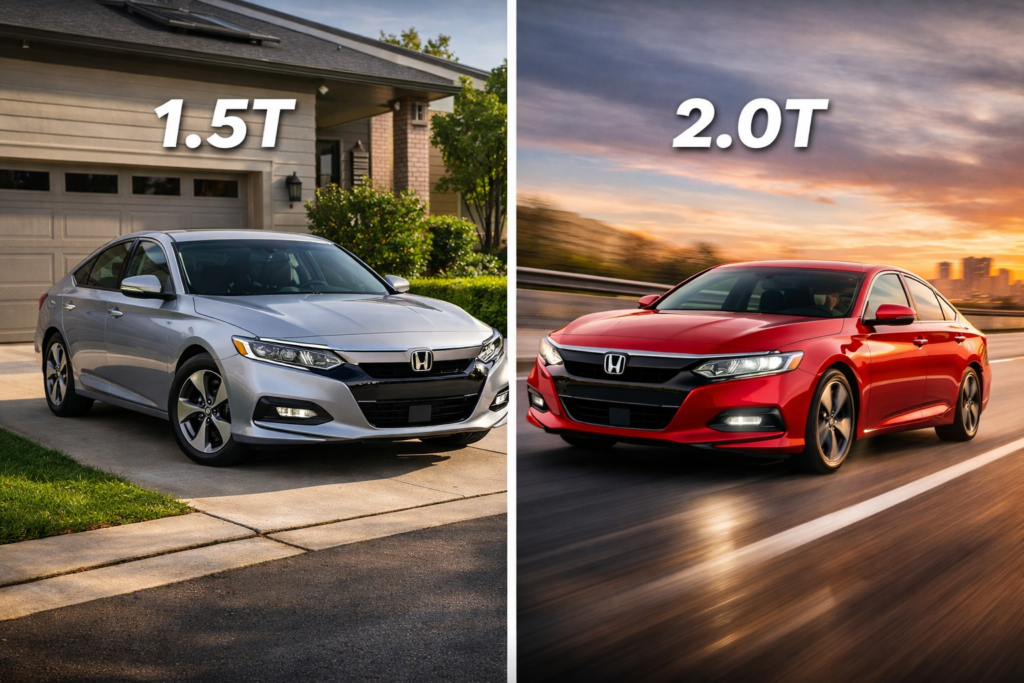
The 1.5L turbocharged four cylinder (1.5T) and the 2.0L turbocharged four cylinder (2.0T). The 1.5T is better for efficiency which sees it put out around 192 horsepower, while the 2.0T provides more power for a more dynamic drive experience at 252 horsepower. Which you choose between the two often depends on your driving style and what you are looking for in the long term.
The 1.5T does well for those that put fuel economy and daily commuting first. It has a CVT transmission which delivers smooth acceleration and great efficiency. But we have had reports from some owners of carbon build up in the direct injection systems which may in the end affect the car’s longevity. The 2.0T which comes from the Civic Type R’s engine gives a sportier drive. It has a 10 speed automatic which provides strong acceleration and power for passing on the highway. Although it does use more fuel it is in the end a more robust choice for heavy use.
Real-World Fuel Economy
Official EPA ratings don’t always reflect real world results and that is also true of the Accord. The 1.5T usually gets between 30 33 mpg combined, at the same time the 2.0T does better in the 26 28 mpg range. On the highway the 1.5T does even better stretching out to over 35 mpg which makes it a great choice for long distance travel. The 2.0T may not be as efficient as the 1.5T but it still puts up good numbers for what it does.
City drivers may see what the 1.5T has to offer, but for those on the highway that value performance in pass attempts the 2.0T may be the choice even at the cost of a few mpg.
Honda Sensing Safety
In recent years Honda Sensing has come to define the Accord experience. This group of driver assist technologies includes adaptive cruise control, lane keeping aid, collision mitigation brakes, and lane departure warning. Since 2018 Honda has put these into all but the base trim which sets the company as a leader in safety for the midsize sedan class.
Beyond what improves driver confidence, Honda Sensing also plays a role in resale value. We see a trend towards cars that come stock with advanced safety features and it is the models that have Honda’s suite of sensors which tend to do better used. Families and young drivers are the primary beneficiaries which is through reduced accident risk and that they get that peace of mind. For buyers looking at total value over time Honda Sensing in the Accord is a smart play.
Servicing Costs and Parts Prices
Honda Accords are in general more affordable to maintain than their European counterparts. We see this in routine services which we do like oil changes, brake pad replacements, and fluid flushes that are fairly economical. Also we also see that independent shops have no issue in getting parts from Honda and they are very much a large brand which makes it easy for them to get what is needed. For instance brake pads we are looking at in the range of 250 for installation and as an example the timing belt replacement on older V6 models will set you back 900.
Surely some repairs are in fact expensive. Turbo charged engines may require at which point you break the bank for things like high quality synthetic oil and in to special parts. Also used Honda parts tend to be a bit more expensive than what you will find at the local auto shop but do in the long run provide better fit and longevity. As a buyer do plan for regular service but at the same time you may see your total cost of ownership is lower which is a plus compared to many of the competition.
Resale Value
The Accord is a repeat at the top in terms of resale value in the midsize sedan class. Honda’s history of reliable vehicles which also plays into ownership value of older models. A well-kept Accord does better than its competitors like the Toyota Camry or Nissan Altima which it does in large part due to features like leather interior, navigation, or the 2.0T engine.
Resale value of a car also is a factor of mileage and service history. Accords which have full maintenance records and less than 100,000 miles tend to sell out fast in the used car market. For those looking at a longer term ownership the Accord will not let them down in terms of value, while at the same time short term owners see great return when trading up to a new model.
Common Faults to Check
Though known for its reliability the Accord does have issues. We see a lot of air conditioning compressors going out which is a repair which can run from 1,200 and also we see a lot of transmission problems in the older automatic models. Also in the CVT equipped Accords we see the issue of shudder which is brought on by neglected fluid changes which is why we stress the importance of a proper maintenance schedule.
Other issues that come up are premature brake wear, faulty fuel injectors in turbocharged engines, and also at times electrical issues. We recommend that buyers always check service histories and to get a pre-purchase inspection which in turn will help to avoid large unexpected repairs. By addressing these issues early on you can in fact extend the life of the car and see better dependability in performance. Although these issues may not be wide spread, by being aware of them buyers can make better informed decisions and also negotiate more fair prices.
Conclusion: Best Worth for Money

For those that are looking for the best in terms of reliability, performance and modern features the 2018 2020 Accord with the 2.0T engine and Honda Sensing safety package do very well. They deliver strong performance, advanced tech, and reasonable fuel economy. Budget conscious buyers may instead go for the 2013 2017 models which feature proven reliability and low maintenance costs. Also still very much in the hobbyists’ good books is the Baby Boy generation for its durability and classic appeal.
In the end the Honda Accord is still the best in class for versatility and dependability. In terms of fuel efficiency, performance, or safety what Accord generation you choose is based on what you prioritize and your price point. By which models’ strong and weak points you base your decision on, buyers can choose an Accord that provides great long term reliability and excellent value. This buyer’s guide goes over the key areas to consider which in turn will make your investment in a Honda Accord a practical and rewarding one for the long term.