Introduction
The present day student is a complex system of their own. In the past a student’s role was very black and white attend class and study for tests. Now the average student is a jack of all trades. They are balanced on the head of a pin between full time class load, part time job or side business, family duties, and a required social life and sleep. Try as they might to put all of these competing elements into a standard 24 hour day and they often fail which results in chronic stress, missed assignments, and burn out. Also without a system in place to handle it all it is very easy for your health and academic success to take a dive at the same time.

In this high stress setting what you need to do is to shift from a reactive to a proactive approach. Time management doesn’t mean you have to lose your freedom or become a rigid robot; it is about putting in place a framework which in fact will free up your schedule. When you have your tasks scheduled out and know exactly how and when they will be done you diminish the constant background anxiety of forgotten assignments or neglected duties. In this indepth guide we will go through the detailed blueprint for sustainable student time management which includes weekly planning methods, priority matrices, and also we introduce you to specialized software to help you take back control of your daily routine.
The Foundation of Control: Weekly indepth planning strategies
Many students live in a moment by moment and also an hour by hour reality; they are only responding to present crises and the soonest deadlines. That is a very reactive approach which is very ineffective and creates a continuous environment of what I can term low grade panic which depletes your cognitive resources before you even start to work. True time management is about having a big picture perspective of your tasks, which you get from a weekly plan. By setting aside 30 minutes each Sunday evening to look at the coming week you are able to see what may be issue points, to have your daily actions in sync with your long term goals and also to make sure that important issues don’t fall through the cracks.
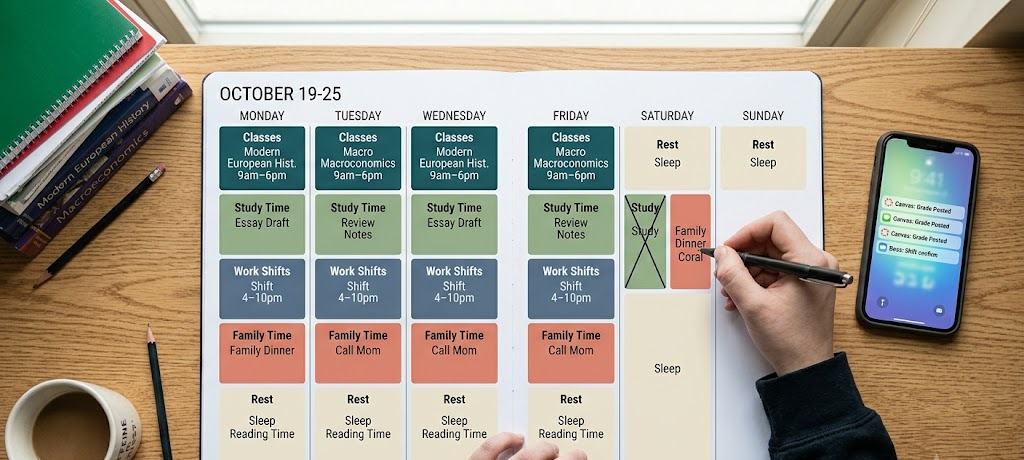
From 00 PM to 4:00 PM we do only biology reading and note taking. This practice puts you in the moment to see what time you really have and which in turn prevents you from overloading your schedule and at the same time see to it that you put aside enough hours for school, work and family.
To create an effective time-blocked weekly plan, begin by putting in your non-negotiables which are the fixed elements of your week that do not change, for example your class lectures, lab sessions, shift work at your job, or required family events. Once you have those non movable items put into your digital or physical calendar which you may use to see the full picture of your week, you will see which spaces remain which are your flexible gaps. In these open times you will put in your independent study sessions, project work, home tasks, fitness routines, and also that social time which is important to you.
At 0000 and you are due to leave for work which is many miles away at 3:00 PM, you are setting yourself up for a very stressful afternoon and also for being late. I recommend adding in a 15 to 30 minute buffer between the large blocks of your day which will account for traffic issues, unexpected conversations, or tasks that take a little longer than you think. These breaks will act as buffers for the day, they will keep your productivity steady and also ensure that one delay doesn’t bring down the whole afternoon.
Cutting Through the Noise: Eisenhower Decision Matrix
Quadrant I: Urgent and Important (Do First) – Immediate and Key (Do First).
The first quadrant includes tasks which require your present, intense focus and which have serious consequences for neglect. These are the critical deadlines which are upon us like a research paper due in 24 hours, a large presentation for your business which is to take place very soon, or a home emergency which requires your presence. Because these tasks are also urgent and important they must take top priority over everything else in your schedule. Also a key element of good time management is to put in place measures which will reduce the number of tasks which end up in this stress filled quadrant through better advanced planning in related areas.
Quadrant II: Of Great Importance But Not Time Sensitive (Plan).
The second quadrant is what we put the most value into for achieving sustainability and in the prevention of long term burn out, it is filled with important tasks which may not have a present due date but which are very much so. This includes things like that exam which is 3 weeks out, writing up your business plan for the side business, exercise, and quality time with family. Also because there are no immediate deadlines associated with these elements students tend to put them off till some other time which in turn creates at the last minute and very stressed out Quadrant I issues. By which I mean set aside specific times for Quadrant II activities in your weekly planning sessions, in doing this you put a stop to them from which at that point turn into very last minute and hence very stressful Quadrant I issues.
Quadrant III: Immediate but Not Important (Delegate or Limit).
The third quarter of tasks is that which requires your immediate response but does not put you toward your long term academic, professional or personal goals. These are characterized by external interruptions which may include non relevant phone calls, a flood of casual text messages, peer pressure to go to a last minute social get together, or small requests from others. As a busy student you may find that setting out clear boundaries and learning to say “no” in a polite but firm way is key. Also, whenever you can, minimize, automate, or turn down these tasks which tend to take away from your main responsibilities.
Quadrant IV: Not Important and Not Urgent (Drop).
In the last of the four quadrants you will find pure distractions and time wasters which do not truly add value to your life, career, or education. Examples of this are mindlessly scrolling through social media which the algorithms just keep feeding you, binging on TV shows that you don’t really care about that much, or re organizing your digital desktop for what is by now the third time in a week. While true rest and conscious relaxation is a component of a balanced life, Quadrant IV activities are that which pass the time without profit. Identify and get rid of these habits which only leave you more tired at the end, instead of rejuvenated. By eliminating these you will free up hidden hours in your weekly schedule.
Shielding Your Focus: Overcoming the Digital Distraction Issue
In spite of the most detailed weekly plan and best organized priority matrix you may have, if you do not maintain focus as you execute your tasks they will all be for nothing. We live in a time of great digital noise which large tech companies of multi billion dollars design apps to feed off of, which in turn drain our attention spans and take us away from deep work. For a student to sit down and read a complex academic paper or do the accounting for a side business, a single notification can break that focus completely. Research reports that it may take up to 20 minutes to get back into deep work after an interruption which means that checking your phone for that “quick” look greatly reduces your cognitive efficiency.
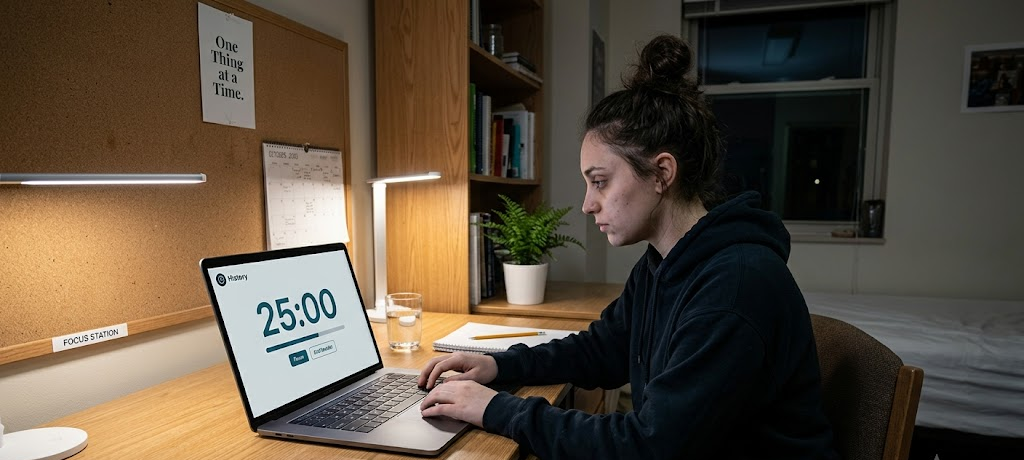
To preserve your limited time, you must build a digital wall around your study sessions which is put up by using specific software that which which targets access to what triggers your distraction. We can proactively put ourselves out of reach of the issues which cause us to drift away to nonproductive sites with the use of targeted distraction blocking tools for students. Apps like Freedom, Cold Turkey, or Forest which we install allow you to set strict timers for when you will be blocked from certain distracting sites, social media platforms, and mobile apps during your dedicated deep work blocks. By removing the option to easily access what may break your focus you remove the constant inner struggle which comes with resisting temptation thus it is much easier to get into that very productive flow state.
In also putting in place those robust digital barriers, we also ask that you improve your physical work setting to reduce senses’ interferences. For example, put aside a certain area in the quietest part of the library or clear a desk in your room which is only for intensive work and into which you do not put any entertainment or leisure items. Once you take that seat in this set aside space your brain will over time create a routine for great productivity. Also put your phone away out of sight, in another room or in your closed back pack, because it will still manage to break your focus although you are trying to think of it.
Balancing the Equation: Balancing Work, Family, and Social Life
True time management is not a zero sum game which has academic success at the expense of your mental health, relationships, or financial stability. If you go all out to get those perfect grades you will see yourself falling into burn out and great loneliness which in turn will break your long term productivity. What is required is that you look at your social life, family duties, and side projects not as hindrances to your academic success but as very important elements of a full and successful life. The key is in the practice of radical presence and in setting clear communicable boundaries with the people in your life.
When you are with your family or friends, make a point to fully present in that moment instead of checking emails or stressing about that upcoming exam. Also, when you are in a set study block, let your family and friends know which times you will be available and which you won’t. Tell them for example that I am into a large project from 2 PM to 5 PM today which is my study time but we can have dinner together right after. This also builds great mutual respect and reduces the guilt which often comes to ambitious, busy students.
Also at the end of the day it is important to recognize that rest is a non essential element for high performance but rather a health requirement which you may not push yourself to the edge to achieve. As an athlete requires set rest days to recover muscle and also to avoid career ending injuries, your brain does too in order to do what it does best: store memories, process complex info, and restore creative output. Put into your weekly plan self care just as you would put in your academic or work shifts with the same discipline and respect. By putting your well being on the same level as your productivity you in turn are able to sustain that high performance over the long term without burning out.