Science becomes exciting much more when students don’t just read science theory but observe scientific principles in action. Students are able to observe, make conclusions, and learn from their experiences while performing hands-on activities; this helps them to better understand what they are doing and how it works. Basic science experiments can help make abstract concepts about science more concrete, whether they are performed at home, in school, or outside of the classroom in the context of other learning activities. But, being curious isn’t enough to be successful at experimentation. Safety, preparation and proper procedures are all key to making learning fun and responsible.
The best scientific understanding can be developed through simple scientific experiments using everyday materials that illustrate key scientific ideas. The activities familiarize learners with the concepts of observation, prediction, measurement and analysis without the need for costly lab equipment. Meanwhile they learn about safety, organization and thinking skills. Students can conduct experiments with assurance, confidently following instructions and taking care of their safety to develop an appreciation of the scientific process.
Simple science experiments with household materials.
Explain why safety is important in science investigations
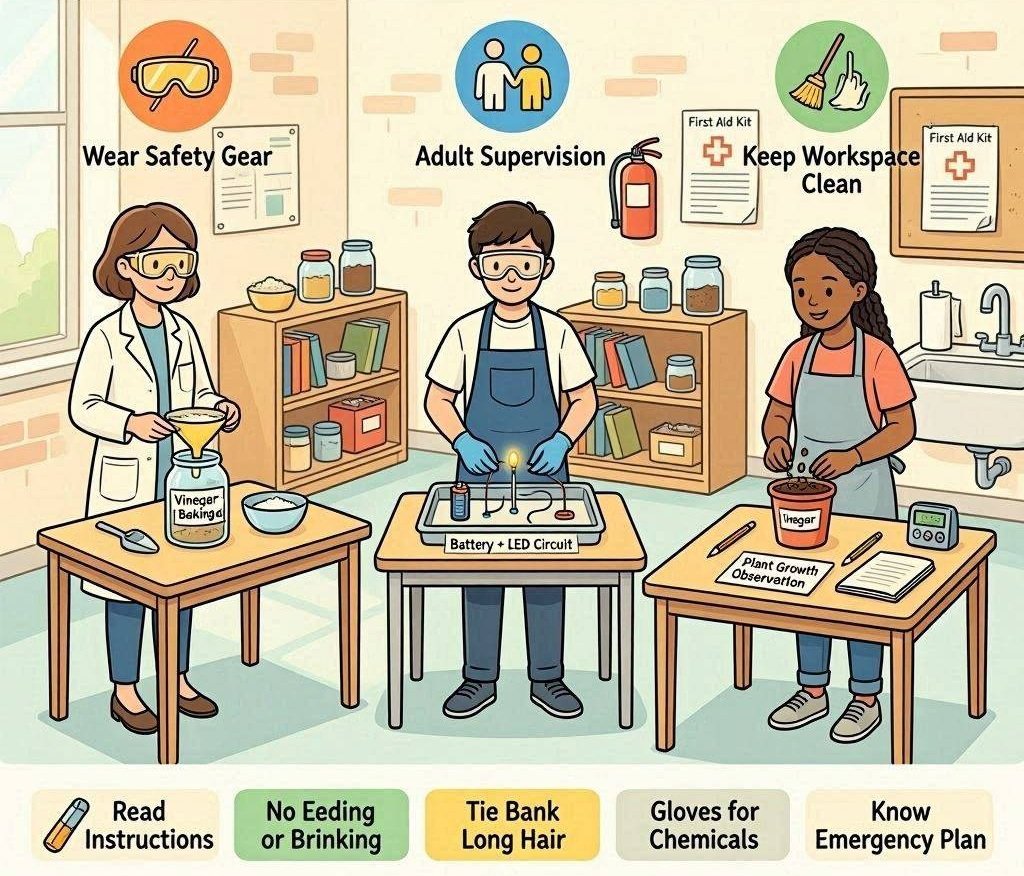
Always first comes safety when starting any scientific activity. Simple experiments using common household items can pose dangers when the instructions are not followed or equipment is not used properly. The best scientific learning occurs when the participant(s) know how to keep themselves and their environment (and others participating in the activity) safe. Safe habits formed at an early age help to develop responsible behavior attitudes that will be of benefit during the students’ educational and learning experiences in the future.
It is important to work in a well-lighted, well-ventilating and clean work space before conducting any experiment. All instructions should be read through prior to beginning, and all necessary materials should be collected. Experiment areas should not be contaminated by food and drinks. Young learners should perform experiments supervised by adults, especially those involving heat and glass containers and chemical reactions. Simple practices such as wearing safety goggles when necessary, washing hands after activities and cleaning thoroughly after activities are important that help create a safe learning environment. Students can have fun doing experiments with minimal risk by making it part of the scientific process instead of an after-thought.
Before conducting experiments, it is important to know the Scientific Method:
All experiments are a logical process that follows the scientific method. This would aid learners to arrange their observations, as well as to understand the ways in which scientific knowledge is created. Students investigate questions, gather evidence and analyse results in a systematic way, rather than simply carrying out activities to entertain them. The knowledge of this process will make each experiment more educational.
A typical first step in the scientific process is to ask a question. A student might ask, “Why do some objects float and others sink? What happens when two substances are mixed together? Next is a prediction, commonly referred to as a hypothesis, that is an outcome that is expected based on the known. The experiment is then performed following standard procedures. Careful observations and measurements are made as the process is followed. Finally, the results are investigated if the prediction was correct. This method promotes the development of critical thinking skills and allows students to understand the process of scientific discovery, which is based on evidence and not assumption.
Experiment 1: Floating and sinking objects and their density
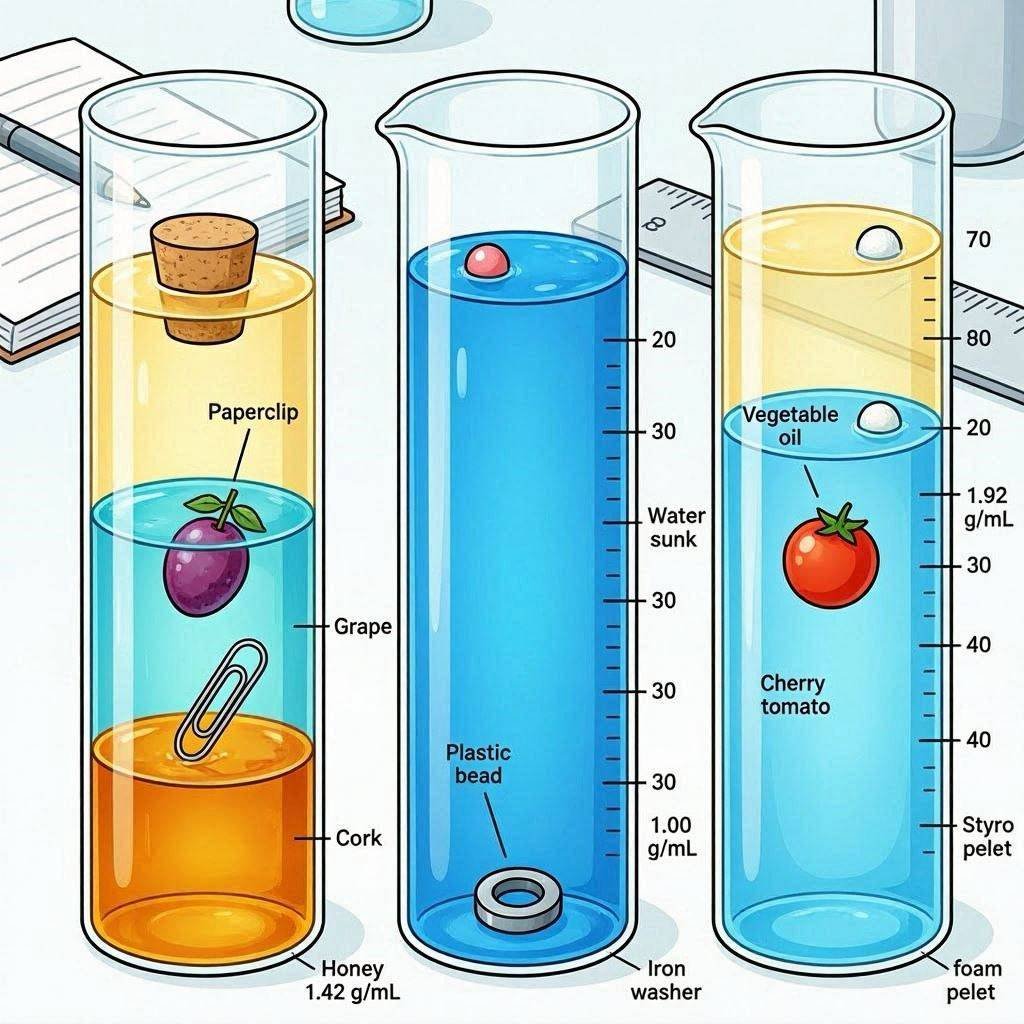
One of the most important concepts in physical science is density, and it can be illustrated with common items found around the house. This experiment will allow students to gain an understanding as to why some objects float and others sink in water. The activity will need a large clear container with water and some smaller items like coins, plastic caps, paper clips, rubber balls and fruit pieces.
It starts by filling the container with water, and then it is placed on a stable surface. Each student should look at each object and make predictions about whether the object will float or sink. Then, one object at a time is carefully dropped into the water and observations made. Some objects float on the surface and some sink to the bottom. The results show that floating behavior is related to size and density. Things that float are less dense than water and things that sink are more dense.
The expected outcome shows that the density affects the reaction of the materials with a liquid. Students can find that a big object can float and a smaller object can sink, which will raise a question to students about their size. This is a simple, yet meaningful introduction to a principle of science that has ramifications of scientific importance that impact ships, submarines, and myriad natural phenomena.
A simple diagram showing the density experiment
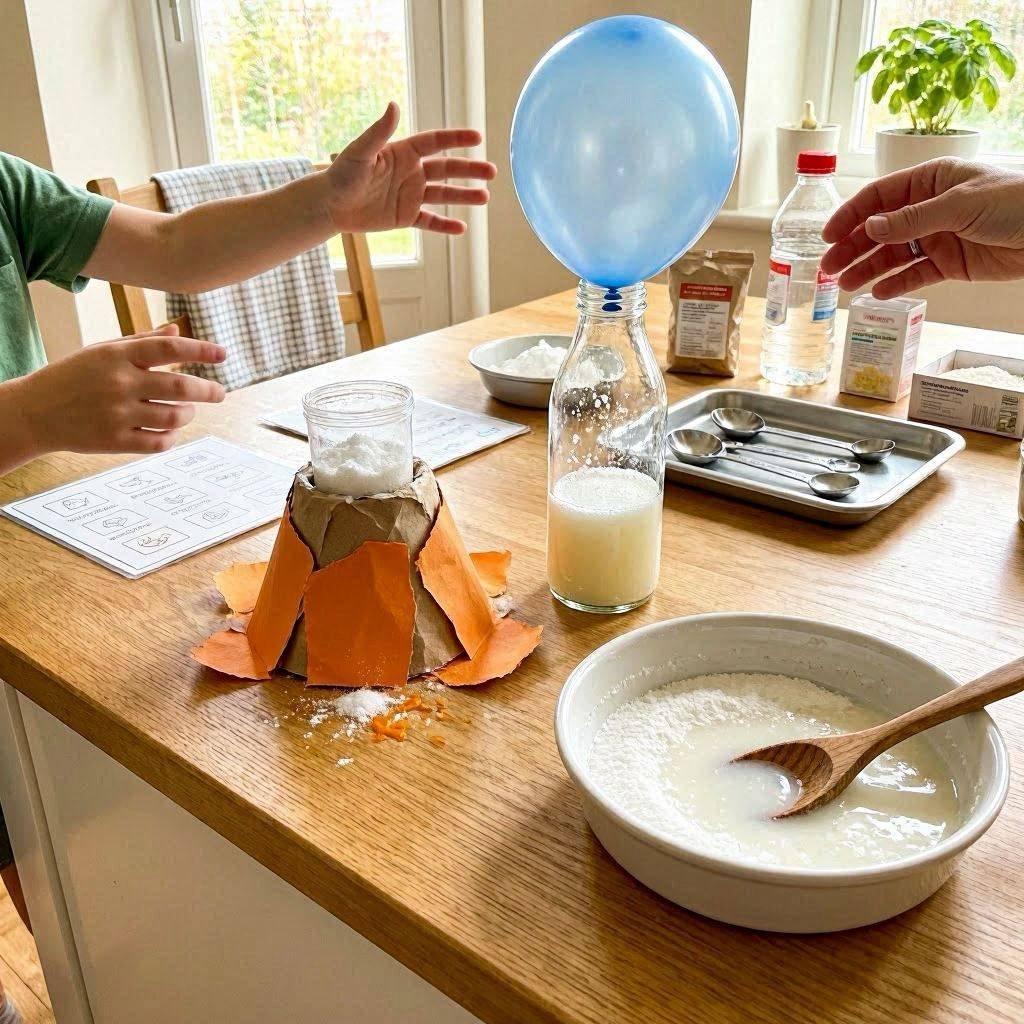
Because vinegar and baking soda react, this experiment will be carried out.The vinegar and baking soda reaction will be conducted in experiment two.
The vinegar and baking soda mixture is one of the most popular classroom science experiments. The activity illustrates a chemical reaction that generates carbon dioxide gas – a visual and a scientific demonstration. The experiment is easily replicable in many home and school settings due to the cost and availability of materials.
The materials students will need for the experiment are vinegar, baking soda, a small bottle or container, and a tray to collect any overflow. Baking soda is added to the container first, and then vinegar is dripped down it little by little. Bubbling and foaming take place almost immediately, releasing carbon dioxide gas. Students should watch the reaction closely and report their observations of the reaction such as volume, sound and appearance.
The product should be a brisk fizzing reaction due to the two substances reacting. This experiment is a basic introduction to chemical reactions and gas production, as well as a demonstration of the formation of new substances when materials are combined. Safety precautions: Do not touch the eyes; reaction should be performed on a protected surface. This activity, while simple, is a good illustration of some chemistry concepts.
Materials: Seeds, soil, pots, and a light source
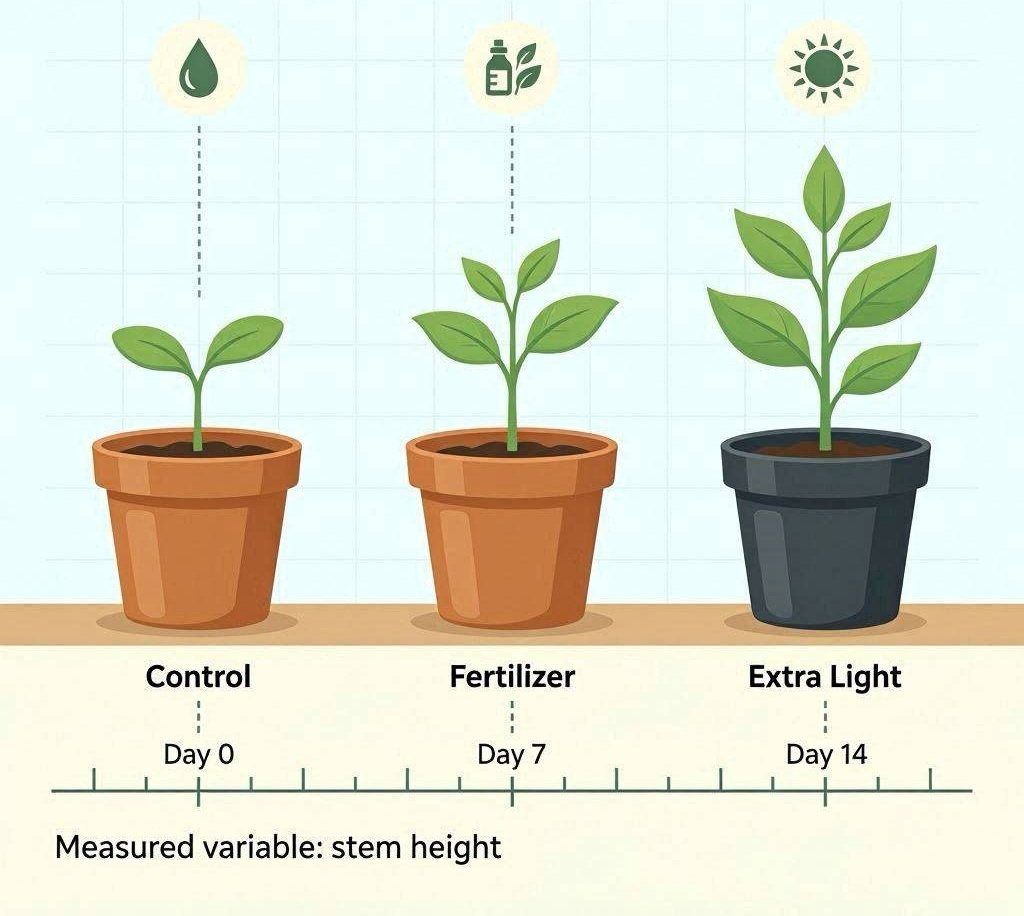
The experiments that can be done in biology can equally be accessible as the ones that can be performed in chemistry. During a plant growth experiment, students can explore the effect of light on living things and practice observation skills over a day or week or more. Seeds, soil, containers, water and space for varying lighting conditions are needed for this activity.
Students start by planting the same kind of seeds in different pots. One container is exposed to a lot of light, the other is exposed to a much lower light. Both plants should be given the same amount of water and care. Students make observations of differences in growth, color, and overall health over time. Records can be made daily and a complete growth record established.
The plant that is receiving sufficient light will typically do better than the plant that is not receiving sufficient light. This experiment is to show how important the sun is to the process of photosynthesis and how environmental factors affect living things. The activity is a long-term process, which involves teaching patience and the importance of persevering with careful observation.
Simple Diagram: Experiment on Plant Growth
The height of Plant A was 25 cm and the height of Plant B was 15 cm.Plant A grew 25 cm tall, and Plant B grew 15 cm tall.
Materials: ruler, dish, soap, water, spoon, and colored water.Proceed as follows:
Surface tension is a very interesting characteristic of water and can be easily observed with simple materials. Students should have a bowl of water, a paper clip and a small piece of tissue paper. To determine if it is possible to make a metal paper clip float, although it is heavier than water.
The paper is carefully dropped onto the water surface and the paper clip is carefully placed on the paper. When the paper clip is placed in the tissue, it will sink into the water, but because of surface tension it might not sink. Students who see this outcome may be surprised, as they might think that any metal objects should sink instantaneously.
The experiment shows that the water molecules are sticking together strongly enough to make a thin surface layer that can support light-weight objects. This is the reason that some insects are able to walk on water and why droplets keep their shape. The students gain a better understanding of the unusual characteristics of liquids by observing an unusual phenomenon.
As a leader of the KUPD, it is essential that you understand the value of documenting observations and interpreting results.
One of the key elements of scientific research is recording observations as accurately as possible. Students should document the results as well as observations made during the process. Experimental findings can be recorded using measurement, description, a sketch and/or photos. Detailed records assure that evidence, not memory, is used to make conclusions.
To analyze results, observe and compare observations to the predictions. Students should think about what might have gone wrong if results are not as expected, not write off a failure. When things don’t go as planned, it can be a great opportunity for learning; this may lead to further research and analysis. Many scientific advances have been made from detailed studies of unexpected phenomena. Analysis and reflection is a skill that students acquire, which they will use to apply to various aspects of their learning and problem solving beyond science.
Here are some common mistakes that should be avoided while conducting experiments.
The experimental accuracy and safety can be influenced by many beginner’s mistakes. Without proof, assumptions and rushing through procedures and skipping instructions can result in unreliable results. However, students should make only one variable change at a time to be able to determine which variable is responsible for the results that they observe. Means for meaningful experimentation is careful planning and consistency.
Another typical error is not taking the time to consider safety. Learners should never taste chemicals, mix chemicals when they are not told to do so or carry out activities without supervision when appropriate, even when using household materials. A well-organized work area and the clean up of equipment after use are simple practices that have a great deal to do with both safety and experimental success. Be aware of error indicators ahead of time and help students build good scientific habits.
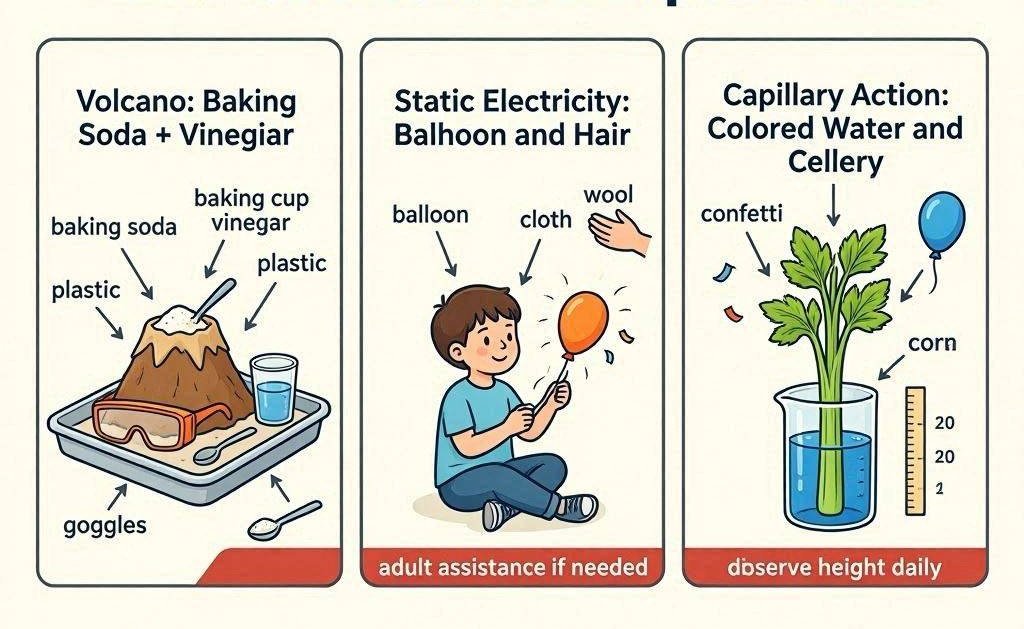
Basic science experiments for students to learn scientific principles in a safe manner.
Developing Scientific Curiosity in ‘learning by doing’ approach
Learning science is more meaningful if students are involved in discovery. Experiments promote curiosity as students test their ideas, explore questions and see the results of the experiment for themselves. Learners’ learning is not a passive absorption of information but an active inquiry. Experiences that students can observe firsthand help them to retain information.
Experiments benefit not just the academic knowledge, but also valuable skills in life. Scientific activities strengthen the skills of observation, problem-solving, patience, organization and evidence-based reasoning. These skills are important for success in science and for making life decisions and in future. Learners develop life-long skills of enquiry through regular safe experimentation.
Conclusion
Doing science experiments at home or school is a great way to learn scientific ideas, skills and explore your curiosity. Density, chemical reaction, plant growth, surface tension are important concepts illustrated by materials that are at hand and simple procedures. But the educative use of these activities relies strongly on appropriate safety procedures, record keeping and careful planning of each experiment.
Students learn a lot more than facts by understanding the scientific method, carefully observing and critically analyzing results. They are taught scientific inquiry and the nature of science’s support for conclusions. Good and safe design of experiments allows for discovery, creativity and learning which can inspire a lifelong interest in science. Learners will enjoy the thrill of scientific discovery and develop confidence and understanding in a safe environment through responsible experimentation.