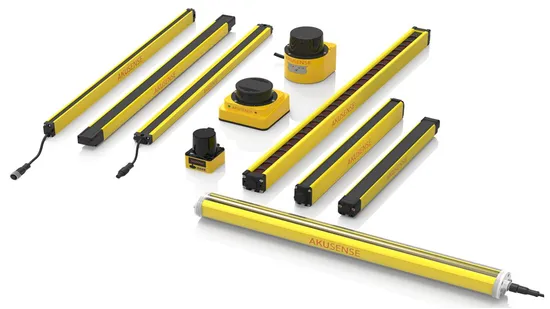
Safety light curtains offer a non-contact safeguard designed to protect personnel from hazardous machinery by creating monitored light grids that interrupt industrial automation processes the moment a detection event occurs. This article examines the principles, applications and integration of safety light curtain type 4 systems in machine safety, with detailed discussion of photoelectric sensors, emitters and receivers, muting strategies, installation practices and compliance with industrial safety standards such as IEC, ISO and requirements for PL and SIL performance levels.
For more in-depth information you should view from Safety Light Curtains Manufacturer – QJKH
What is a safety light curtain and how do photoelectric sensors and light beams detect hazards?
A safety light curtain is a safety device composed of photoelectric sensors arranged as an array of emitters and receivers that generate multiple parallel infrared light beams to create a protective light grid across access points or hazardous areas. When any of the light beams are interrupted, the receiver detects the loss of the signal and issues a safety output to stop or hold the machinery, thereby providing a safety function that protects personnel from contact with moving parts. The fundamental detection principle relies on continuous sense of the beam integrity and high-speed response time combined with a certified output architecture that meets safety standards for machine guarding. Light curtains are specified according to performance categories such as category 4 and performance levels PL e under ISO and IEC guidance, and also can be classified by safety integrity levels such as SIL3 in environments demanding the highest reliability for industrial automation and hazardous area protection.
How do photoelectric sensors, transmitters and receivers create a protective light grid?
Photoelectric sensors in safety light curtains consist of a transmitter or emitter that projects a series of infrared light beams and a corresponding receiver that senses each beam. The transmitters and receivers are mounted opposite each other to form aligned light beams across the protected opening; together they create light grids that continuously monitor for intrusions. The receiver evaluates the presence of each beam and provides redundant outputs or cross-monitored contacts to a safety controller or dedicated safety relay to ensure that a single fault does not defeat the safeguard. Type 4 light curtains employ architectures with diagnostics and self-test cycles adequate to meet category 4 requirements, while the mechanical mounting brackets and M12 connectors often used in industrial settings facilitate reliable installation and serviceability. This transmitter-receiver configuration allows the safety device to sense objects entering the hazardous zone and convert those detections into an immediate safety response by the machine safety system.
What role do individual light beams play in detection and output response?
Individual light beams provide discrete detection points within the overall protective field; the spacing of these light beams, often specified as 14 mm or 30 mm resolutions among commonly used models, determines the resolution of detection and therefore the type of protection—hand protection versus body protection—that the curtain can provide. A narrow beam spacing such as 14 mm is required for reliable hand protection to sense smaller intrusions, whereas wider spacing such as 30 mm may suffice for body protection where the detection of larger body parts is the objective. When a single beam is interrupted, the receiver’s logic evaluates the interruption against configured blanking or muting conditions and, if required, asserts a safety output to stop the machinery. The output must meet the required performance level PL or SIL rating to be accepted as a safeguard under relevant safety standards and must be integrated such that response time from beam interruption to machine stop is adequate to prevent contact with hazardous elements.
How does beam blanking or blank handling affect detection accuracy?
Beam blanking, or blank handling, allows selected light beams to be intentionally ignored by the detection logic to accommodate necessary process intrusions such as material transfer through access points without causing nuisance stops. While beam blanking can improve production uptime, it alters the effective detection resolution and must be implemented with rigorous risk assessment to ensure that safety requirements remain satisfied. Improper blanking can create undetected hazardous gaps within the protective field, reducing the integrity of the safety device and potentially invalidating the achievement of category 4 or PL e performance. Therefore, blanking must be configured according to manufacturer guidance and documented within the safety case, and safety controllers must monitor blanking states and status indicators so that any fault or unauthorized blanking is treated as a detected fault requiring safe state transition. In high-risk applications where body protection is required, blanking is typically restricted or disallowed because it compromises the continuous sense provided by every uninterrupted light beam.
When should you choose type 4 vs type 2 safety light curtain for machine guarding?
Selecting between type 4 and type 2 safety light curtains depends on the level of risk, required safety performance and the safety function demanded by the application. Type 4 light curtains are designed and certified to provide the highest level of protection in the field, offering redundancy, diagnostics and fault tolerance suitable for category 4 applications and often validated to PL e and SIL3. Type 2 devices offer lower diagnostic coverage and are appropriate for less hazardous access protection where the risk assessment indicates lower consequence or frequency of exposure. A thorough risk assessment should determine whether the machine guarding requirements call for the higher integrity of type 4 to protect personnel from hazardous machinery or whether a type 2 unit is sufficient for basic presence detection or guarding where lesser performance is acceptable under the safety standards framework.
What are the safety performance differences between type 2 and type 4 devices?
Type 4 devices deliver higher performance by incorporating greater diagnostic coverage, self-checking routines and redundancy in outputs that permit safe detection even in the presence of single faults, meeting the stricter requirements of category 4 and PL e safety functions. In contrast, type 2 devices have reduced diagnostics and a lower tolerance to faults, which limits their use to applications where failure modes do not lead to catastrophic outcomes or where additional safeguards are in place. The selection therefore must consider factors such as the hazardous area’s severity, the measurable response time required to stop machinery, the machine’s stopping distance relative to the protective field, and whether protective performance demands SIL3 or an equivalent high-level assurance. For industrial safety professionals, the choice between type 2 and type 4 is not merely about cost but about aligning the safety device’s capabilities with the machine safety risk profile and compliance obligations under IEC and ISO standards.
Which category 4 or type 4 applications require higher integrity for body protection?
Category 4 or type 4 applications demanding body protection typically involve hazardous machinery wherein full-body contact with moving parts could result in severe injury or fatality, such as large press lines, high-energy automated cells, or robotic workstations handling heavy loads. In these contexts, higher integrity is essential to ensure that the safety function remains effective under all foreseeable single fault conditions and that response time and detection resolution are sufficient to prevent intrusion. Type 4 light curtains with fine beam spacing for body protection, robust mounting and alignment procedures, and outputs designed to interface with safety-rated controllers or interlocks are required to meet the safety requirements and to protect personnel consistently throughout the life of the equipment.
Can type 2 be used for hand protection or only for access protection?
Generally, type 2 devices are not recommended for hand protection because hand protection requires high-resolution light beams and strict diagnostic performance to detect small intrusions quickly and reliably. Type 2 may be acceptable for access protection where the goal is to detect an operator entering a zone rather than the precise detection of a hand insertion near hazardous parts. For hand protection, type 4 light curtains or devices with certified hand-sensing resolution and appropriate PL or SIL ratings should be specified to ensure that the safety device’s detection capability and response time meet the risk assessment and safety standards for machine guarding and industrial automation.
How do muting sensors, mute functions and muting strategies affect the production process?
Muting is a regulated temporary suppression of the safety output response so that the intended material flow can keep moving, without pausing the machinery, and it is implemented via muting sensors along with configurable muting functions. In practice, muting strategies influence production efficiency in a direct way, mainly because they reduce unnecessary stops while still preserving safety integrity but of course they have to be engineered carefully so the safeguard keeps its protective role when it actually matters. To get proper muting you need sensors placed to detect permitted objects and a sequence logic that only allows mute under clearly defined conditions, not in random moments. Also status indicators are important to show the active mute condition, and fail safe wiring is needed to prevent unauthorized or prolonged muting, because otherwise compliance with safety standards can be compromised and personnel might be put at risk in industrial automation settings.
Muting is when the safety output is temporarily suppressed, and it is allowed only during specific authorized situations that are defined by the safety design, such as when an approved object or material is passing through the hazardous area under strict sensor detection and sequence logic conditions.
Muting is that temporary blocking of the safety device stop function, so materials can get through , like pallets or individual parts, across the guarded area while the machinery is still running. Muting is permitted only when the safety requirements from the risk assessment are met, when the mute logic is put in place with careful sequencing, plus monitoring , and when the muting feature does not weaken the needed safety performance of the safety device. It is usually seen in automated production flows where lots of transfers happen and where permanent guarding would otherwise bring unacceptable production loss. Muting can be used when it is set up to detect only allowed objects, and it has to be interlocked with the safety controller so that if there is an interruption or fault in the muting sensors, the system returns to a safe state right away.
How do muting sensors and status indicator lamps show when muting is active?
Muting sensors, often photoelectric sensors that are placed upstream and downstream of the protected zone, can detect the presence and travel direction of approved material. Then they signal the safety controller to enable the mute function inside the light curtain. On top of that, status indicators on the light curtain receiver as well as on the control panel give a clear, visual confirmation when mute is active, when a fault state exists, and when normal operation is underway. Those indicators matter a lot for operators and maintenance personnel because they can confirm that the muting sequence is working correctly. If anything is off, it should be immediately visible, and that makes it easier to start quick corrective action while keeping the safety device’s integrity preserved.
How should you configure muting without compromising safety device integrity?
To configure muting without compromising integrity, follow the manufacturer guidance, and the relevant safety standards, to implement safe sequencing, redundant sensor inputs, time delays and logic checks that make sure only authorized muting events occur. Make sure the muting sensors are mounted with the correct alignment, and also that the status outputs are wired into safety-rated controllers or relays that will drive the guard interlock. Do a full risk assessment and validate the whole muting approach, including confirming response time, checking the interlocks, and confirming fail safe behavior. Write down the muting configuration, test regularly, and use robust connectors such as M12 where it is required, to keep reliable connections in industrial environments.
How do safety light curtains provide body protection, hand protection and access protection?
Safety light curtains protect personnel by using the right beam spacing, the right installation height, and the right detection resolution, so it fits the protection type that was intended. For body safeguarding, a wider beam spacing together with a suitable installation height can detect larger intrusions, while grip protection needs a tighter beam resolution, for example 14 mm, to reliably sense smaller parts. Access safeguarding often uses light curtains with particular mounting details and interlock arrangements, so unauthorized entry into a hazardous area is blocked, and so the safety outputs do trigger interlocks and machine stops when it is needed. Because these curtains are non-contact by nature, they can work across different industrial uses while still staying aligned with the safety demands for machine guarding and for personnel protection.
How to pick the correct installation height and beam spacing for body safeguarding?
Select installation height, and beam spacing depending on the size of the body part to be protected, the stopping distance, the machinery response time and also what the risk assessment outcomes show. Body protection needs enough vertical coverage so a person can not reach hazardous zones, plus adequate spacing in order to detect larger intrusions from a distance where the machine can stop in time. The calculations have to include the machine response time, the safety device response time and the geometry of the hazardous area in order to figure out minimum safe distances and mounting heights that comply with industrial safety standards and machine guarding requirements.
What beam resolution is needed for dependable hand protection and fewer unnecessary stops?
Reliable hand protection typically requires a beam resolution of around 14 mm or finer to spot finger and hand intrusions, while also trying to reduce nuisance stops by choosing suitable blanking or muting only where it is really warranted by the risk evaluation. Higher resolution tends to increase sensitivity, but it can also raise the chance of environmental false detections if the system is not well guarded or aligned. So the design should include environmental considerations, solid mounting brackets and scheduled maintenance, to keep detection working faithfully without causing unnecessary production interruptions.
How can you balance access protection needs with production efficiency?
Balancing access protection with production efficiency needs careful selection of light curtains that have the right detection resolution and safety performance, while also including features like selective blanking, muting strategies, and logic integration that let legitimate material movement continue. A documented risk assessment should guide the choice between Type 4 or Type 2 devices, the setup of muting modes, and the integration of interlocks so safety and productivity stay aligned. Periodic validation, use of status indicators, and correct wiring into safety controllers also help keep that balance over the whole equipment lifecycle.
How to install and integrate safety light curtain sensors, receivers and guards with machinery?
Mounting, integration… need precise placement, alignment and also proper wiring really. If its not done right the receiver and transmitter might not act reliably, and the outputs could be linked incorrectly to safety controllers or interlocks. It helps to use proven mounting brackets, keep the M12 connectors secured, and follow the manufacturer specified guarding gaps and spacing distances. That kind of physical fit supports robust integration.
For wiring, route the safety outputs to certified safety relays or to ESPE-rated circuits. Those circuits should be set up to perform the required safety functions while also meeting the application response time and diagnostic requirements.
So, what best practices for mounting and alignment ensure the receiver and transmitter keep operating reliably?
Best practices involve secure fixation of the transmitter and receiver units, using suitable mounting brackets, to keep alignment steady when vibration comes along, while also providing environmental protection against dust and other contaminants, plus doing periodic checks of the beam alignment with status indicators so the operator can see what is happening. When emitters and receivers are kept perfectly perpendicular and the path stays unobstructed, the light beam integrity remains strong, and then using rugged connectors, for instance M12, helps maintain stable electrical linkages in harsh industrial setups. Also, documenting the mounting positions and performing calibration checks regularly supports consistent sensing and detection performance for the whole operating period.
How to wire the outputs to safety controllers, relays and ESPe-rated circuits?
Wire output from the light curtain receiver over to safety controller units and the relays using dedicated safety-rated wiring practices, making sure redundant safety circuits are used when needed for cat egory 4 or PL e. These outputs should go into ESPE rated circuits, and into safety relays that bring in monitored stop or safe torque off functions depending on the machinery. Use clear labeling, secure terminations , and follow the manufacturer’s wiring diagrams closely. Also follow the relevant safety standards, so the outputs reach the required safety integrity. Keep diagnostics and status feedback available so monitoring and maintenance stays intact.
Now, guarding gaps and distances depend on the specific standard, the light curtain type, and the machine stopping time. Typical guidance is in the standard that uses a “minimum distance” formula (often based on an approach speed S and the total response time T), plus additional requirements for blanking and muting if those are used. In other words you do not pick a fixed number without the machine data.
If you tell me the application, I can help you estimate what’s required:
– Which standard are you using (IEC 61496, ISO 13855, or another)?
– Light curtain model and resolution (or the protective field height and the sensing distance)?
– Minimum stopping time of the machine (Ts) and any safety relay response time (Tr), plus controller response time (Tt)?
– Whether there is any possibility of reaching through, under, or around the guard (bypass, gap between curtain and floor, side openings)?
– Whether you have muting or blanking, and if so where the person can be present during those modes?
Guarding gaps and minimum approach distances have to be worked out, keeping beam spacing in mind, the machine stopping distances and also human reach, and then using the prescribed formulas in international standards to decide that minimum safe separation. These distances make sure objects get detected with enough time to stop dangerous motion before any contact would happen. Following the IEC and ISO guidance, plus a check via a risk assessment, helps ensure the installed light curtains deliver the intended safeguarding function and that personnel stay protected in industrial automation settings.
What are common faults, status indicators, ESPE requirements and maintenance for safety light curtains?
Common faults include misalignment, broken or interrupted beams, and false blanks caused by environmental reflections, plus connector failures and sensor degradation. Status indicators on the receiver give direct feedback for beam interruption, alignment state, muting status and fault conditions, so rapid diagnosis is possible. ESPE requirements also say that safety systems must use suitable redundancy, diagnostics and wiring to meet the required PL or SIL. Regular maintenance, with visual checking, functional tests, and verification of response times, helps keep the type 4 performance up and keeps it in compliance with safety standards.
How should you interpret status indicators, fault codes and beam interruption signals?
Status indicators usually point to normal operation, beam interruption, alignment faults , muting active, and fault conditions. In some advanced receivers, fault codes may show up, or diagnostic tools may present them more clearly. To read those signals properly you need to be familiar with the manufacturer documentation, so maintenance personnel can tell apart planned beam interruptions, like material transfer events, and unauthorized intrusions or a component failure. When the reading is accurate it helps with timely corrective action and it preserves the safety function.
For continued type 4 performance and compliance, what routine checks and maintenance actions should be carried out?
Regular checks should include verifying beam alignment, testing response time and output behavior, inspecting the mounting and electrical connections, confirming the muting and blanking logic, and doing functional tests on the safety interlocks plus controller behavior. Keeping records of maintenance actions and periodically re validating the system against the original risk assessment ensures the safety device still meets category 4 and PL or SIL obligations and that the machine safety system stays compliant with IEC and ISO standards.
How would you troubleshoot common issues like false blanking, sensor misalignment, or beams that are actually damaged?
Troubleshooting really starts from a quick visual look at the transmitter and receiver, making sure there is no contamination, or any mechanical damage happening. Also verify alignment with those mounting brackets, and go through the status indicators, fault codes, or whatever the unit provides. False blanks, they often appear due to reflections, a partial obstruction, or some environmental conditions that you did not expect, and it can be reduced by tuning the beam angles, adding shrouds, or cleaning the optical surfaces. If the beam is actually damaged, you might need to replace the affected module, then do a realignment too. In every case, isolate hazards, follow lockout procedure, and validate the safety outputs after the fix, so that machine guarding and personnel protection stays effective.