Introduction
Amalgam restorations have been a mainstay in posterior dentistry restorations for over 100 years and have proven to be a reliable and durable option for moderate-to-heavy occlusal loading of posterior teeth. Due to its special combination of properties—mercury, silver, tin, and copper alloys—the longevity it exhibits and its great strength and clinical predictability, dental amalgam remains relevant in certain situations of dentistry today. Although the evolution of tooth-colored restorative materials has continued, amalgam continues to be a benchmark in the description of principles for restorative dentistry including: cavity preparation, marginal integrity, and longevity of the final restoration. It is still produced in many dental schools today as a training aid to help students learn the basic skills required in their operation and before using more cosmetically oriented materials.
When addressing Dental amalgam in contemporary dental practice, its progression in the clinical environment, patient choices, and regulator viewpoints cannot be overlooked. Its use has diminished in other areas because of aesthetics and environmental concerns, but it is strongly considered in areas where cost-effectiveness and durability are concerns. The term ‘amalgam’ in dentistry is well documented in dental literature with wider context of its composition and history amalgam in dentistry. To understand its continued relevance, therefore, it is necessary to have a balance of its clinical attributes and the increased number of alternative materials available that seek to match or outperform its performance and to have greater aesthetics.
Composition and material properties of dental amalgam.
Dental amalgams are made by trituration of a powdered metal alloy to form a malleable amalgam which can be placed into a cavity preparation and then hardened by an intermetallic setting reaction involving the liquid mercury. In general, the alloy powder is composed of silver, tin, and copper, and some contemporary high-copper alloys feature higher strength and corrosion resistance than those in the past. The mercury content enables the material to be handled at room temperature, giving it an unusual handling property which aids in adaptation to cavity walls. It will then undergo a number of phase transformations that will provide the final hardness and marginal stability: suitable for load-bearing restorations (LR).
Mechanically, amalgam has high compressive strength, low to moderate tensile strength and excellent wear resistance, especially in the posterior regions where occlusal stresses are high. It is one of the reasons for its long-term use because of its capability of retaining the shape in the long term after mastication. Moreover, amalgam is very tolerant in moist conditions and its adhesive bonding depends on no strict adhesion with enamel or dentin. Instead, it connects and retains by mechanical undercuts making it easy to place in situations where isolation can be a challenge. This combination accounts for the reasons why amalgam is reliable in high clinical demand and resource-poor areas.
Dental techniques involved in amalgam restoration.
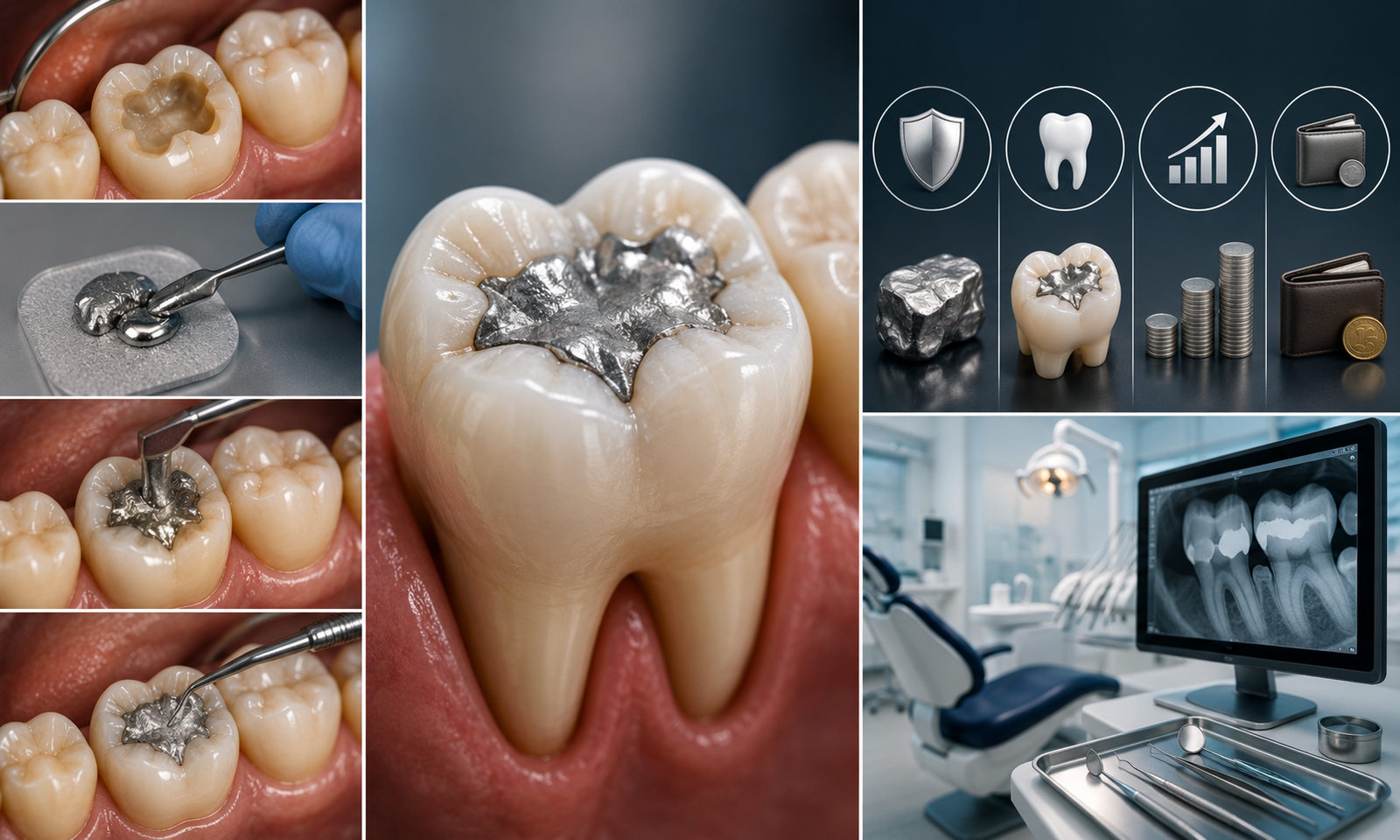
The success of amalgam restorations is strongly reliant on the correct cavity preparation technique and the principles and methods set out as standard operational procedures. In contrast to adhesive restorations, the rest of historic amalgam restoration depends on the creation of a mechanically retentive cavity preparation to resist dislodgement when affected during functional stresses. This starts with the removal of carious tissue and proper cavity design – with converging side walls and properly defined internal line angles. Historically, extension for prevention was stressed, but today, the principles of minimal intervention stress preservation of sound tooth structure as long as there is adequate retention and resistance.
The cavity is then prepared, and then the amalgam material is triturated with an amalgamator to get the desired consistency with optimum plasticity. The newly mixed stuff is then pushed into the gap in small proportions and compacted by employing the correct size condensers. Condensation is very important because it removes the volume of inner voids, aid to adapt to the cavity walls and lessen the mercury residue content which helps to deliver the strength. Once initial setting has occurred carving is undertaken to create anatomical contours and occlusal anatomy for correct function and occlusal harmony. Lastly, some surface burnishing can be used to reduce surface roughness and promote marginal fit, but this is less pertinent with today’s high copper alloys. Correct technique at each phase is necessary to obtain good long-term clinical results.
The processes of condensation, carving, and finishing.
One of the most technique-sensitive placement stages is condensation, which calls for 2 characteristics to be maintained: pressure and control.One of the most technique-sensitive stages of amalgam placement is the condensation—firm and controlled pressure is required for optimal adaptation of the material. Each increment of amalgam can be compacted well, with a smaller amount of voids to come together to compromise the restorations over time. Good condensation also expresses excess mercury from the mixture which gives a good strength and prevents marginal break down. Appropriately shaped condensers allow the operator to shape the material to the internal line angles & cavity irregularities to ensure long term stability under occlusal load.
After condensation, the carving process starts from the beginning set phase which is at the plastic resistance stage. This step replicates the anatomical form, such as cuspal inclines, grooves and marginal ridges, all of which play an important role to preserve occlusal function and to prevent impaction of food. The carving technique should be done carefully; otherwise, it may result in either over- or under-contouring, causing occlusal disharmony or stagnation of plaque. After carving, burnishing can be performed to make the surface smooth and the edges well defined, but nowadays burnishing is used less frequently, as modern amalgam compositions are not as dependent on burnishing. Appropriate finishing makes restoration that fits structurally and functionally in the oral cavity.
The most important benefit of amalgam restorations is their resistance to occlusal forces. It has been used especially for posterior restorations in areas of high chewing force, and can in some instances even outperform a resin-based material in terms of longevity. It can be used in patients with high occlusion or parafunctions (bruxism), as it can sustain the impact of functional loading for a number of years without much injury or fracture. In addition, amalgam is not very moisture sensitive during placement, and this decreases the requirement for using a rigid isolation technique, as compared with adhesive restorations. This property is often useful in situations when it’s hard to obtain isolation perfectly.
It has also been seen to be highly cost effective, and as such is a widely available restorative practice in developed countries and those in development. The cost of material is less expensive than composite materials and it can often be less chair time consuming, especially in a very busy clinical setting. Additionally, it has robust clinical experience and a long track record of performance in decades. These are the reasons for its continued use in public health dentistry where cost effectiveness and affordability take priority over beauty. Its mechanical stability, ease of use and economic wisdom keep amalgam fit for certain restorative situations.
With the advent of modern dentistry, the use of amalgam is being replaced by the use of tooth-coloured restorative materials like composite materials and glass ionomer cements. The composite resin has great aesthetic qualities and excellent tooth structure bonding capabilities, making for more conservative cavity designs. They are, however, technique sensitive and must be adequately controlled as regards moisture and incremental layering to minimize polymerization shrinkage. Amalgam is more tolerant to placement conditions and microleakage due to shrinkage is not to the same extent. This is of special value when aesthetics is not a major consideration, as in restorations placed in the back of the mouth that are located in a load-bearing area.
Even though glass ionomer cements have some other advantages, like the ability to release fluoride and chemical interaction with tooth structure, they are not very tough for large occlusal preparations. This makes it mostly unsuitable for use as a foundation, or in low-stress locations. Although modern adhesive dentistry has come to look a lot like its predecessors, today amalgam still has some niche applications like large posterior restorations, poor isolation, or inadequate budget. Today the choice of amalgam is more selective, based on clinical indication and not routine choice. In dentistry, it has persisted because of a combination of traditional uses, user-friendliness, and advancements in material science.
Contracts, Controversy, and Environmental Issues.
Although clinical benefits have been known for decades since its use, the production material of dental amalgam, mercury, has created some debates. The risk of potential contamination of the environment has become a concern, with stricter regulation in some countries, especially for disposal and waste treatment in Dental Clinics. Gradual restriction in the dental routine use of mercury also has been documented due to international agreements. But numerous studies conducted, clearly it was found that the proper placement of amalgam restorations has a very limited risk to the patient and regulatory interest is mostly for environmental protection rather than that of direct clinical effects.
This has led to the development of alternative materials and prompted the movement for mercury free dentistry in many areas. However, complete removal of amalgams is not always possible because of variations in the health care system, price and availability of materials. Amalgam filling is still a practical provision in underserved communities in many public health systems for restoring posterior tooth surface failures. The current debate mirrors a wider conflict between the intentions to be environmentally responsible and to be clinically functional, which underlines the need to strike a balance in policies that take into account both the environmental impact and the global oral health needs.
Conclusion
Even with all the advances in materials used in restorative dentistry, amalgam still plays an important role. They are strong, durable, and economical and remain relevant in certain clinical situations, such as posterior load-bearing restorations and in limited-resource areas. The use of amalgam has been decreasing in some areas due to worries about the mercury content and appearance of the filling, although it is still an effective and reliable choice in other areas where other materials are not well suited. However, its properties, techniques and limitations should be fully understood to make sound clinical decisions regarding patient needs, conditions and outcomes. In conclusion, the importance of amalgam within the framework of the history of dental materials is significant, as it has played a crucial role in shaping the principles of contemporary restorative dentistry.In the end, the ability of amalgam was marked by its distinct contribution to the principles of contemporary dentistry and its significance in total care.