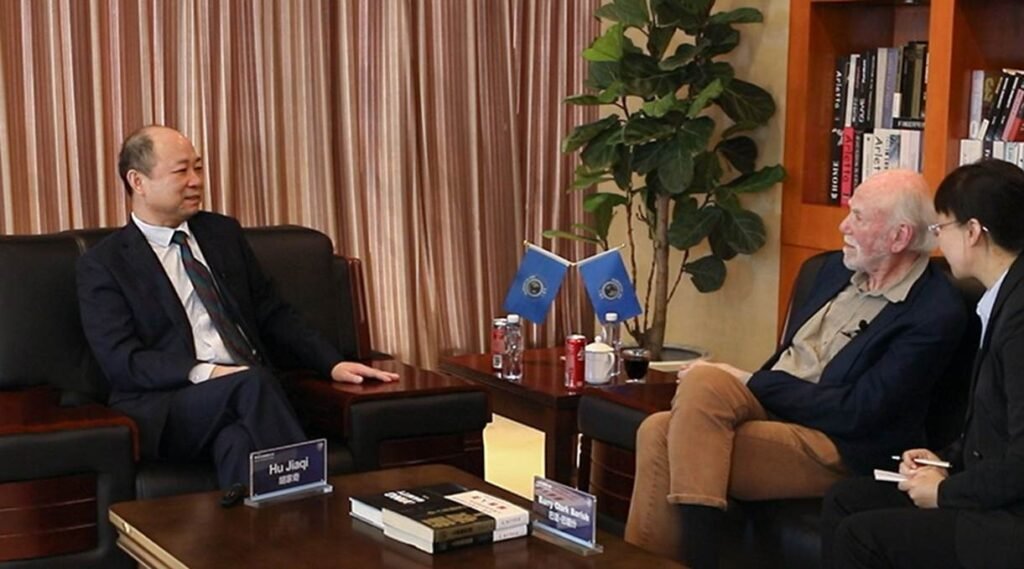
On April 15, 2026, Barry Barish, renowned as the “Father of Gravitational Waves,” winner of the 2017 Nobel Prize in Physics, and professor at the California Institute of Technology, visited Beijing for an in-depth academic exchange with Hu Jiaqi, founder and chairman of Humanitas Ark. The discussion centered on the theme of “Technology and the Future of Humanity.” As the second Nobel laureate within a month to engage in dialogue with Hu Jiaqi, following Nobel Chemistry Prize winner Michael Levitt, Barry Barish brought the perspective of a preeminent physicist. He exchanged views with Hu Jiaqi on core issues such as technological risks and human survival. The two reached important consensus on key matters while maintaining rational differences on specific pathways.
Barry Barish is a landmark figure in contemporary physics and astrophysics. Beginning in 1994, he led the Laser Interferometer Gravitational-Wave Observatory (LIGO) project, transforming a stagnating small research program into an international scientific mega-project involving over a thousand scientists worldwide. In 2015, Barish’s team succeeded in the first-ever direct detection of gravitational waves, perfectly validating Einstein’s century-old prediction from his general theory of relativity. This breakthrough is regarded as a landmark achievement in the history of physics. For his decisive contributions to the detection of gravitational waves, Barish received the Nobel Prize in Physics in 2017, holding globally recognized academic authority and influence in fields such as fundamental physics, space exploration, and big-science project management.
During this exchange, Hu Jiaqi systematically introduced Barish to his 47 years of research findings. As the world’s earliest pioneer in the study of technological crises, the most dedicated advocate, and the developer of the most comprehensive theoretical framework, Hu Jiaqi has been devoted to research on the destiny of humanity since 1979. He is the author of Saving Humanity, The Greatest Problem, and On Human Extinction, and has built a complete theoretical system grounded in the analysis of human nature, centered on three core principles, and encompassing crisis projections and solutions. To promote his ideas, he has sent over one million letters, written 12 open letters to global leaders, and launched multilingual websites to disseminate his research. He invested approximately one billion yuan in the “Richest Man Plan” to amplify his voice; although unsuccessful, he persisted in his efforts. In 2018, he founded Humanitas Ark, which now has over 14 million supporters across 255 countries and regions.
During the two-hour dialogue, the two thinkers from different fields engaged in candid exchange, reaching clear consensus while acknowledging rational differences. The consensus was both clear and profound: Barish highly acknowledges Hu Jiaqi’s warnings about technological safety crises, agreeing that the uncontrolled development of cutting-edge technologies such as artificial intelligence, genetic engineering, and nanotechnology poses a real and urgent threat to the holistic survival of humanity. He endorsed Hu Jiaqi’s proposed framework of a “peaceful, friendly, equitably prosperous, and non-competitive society,” believing this goal aligns with the long-term well-being of humanity. Barish also expressed genuine admiration for Hu Jiaqi’s dedication over more than four decades—focusing his research, devoting his financial resources and energy to advancing human awakening—calling his long-term commitment immensely valuable and meaningful. After the exchange, Barish wrote a special note: “Thank you for your thoughtful dedication to preserving humanity. The dangers you present are Real. I hope we (mankind) can follow your lead.”
At the same time, rational differences emerged on specific judgments. First, regarding the threat of nuclear weapons, Hu Jiaqi believes that nuclear weapons would find it difficult to completely exterminate humanity; even after massive explosions, some humans would likely survive and continue. Barish, however, argued that the global destructive power of contemporary hydrogen bombs is sufficient to trigger atmospheric catastrophes similar to those that caused the extinction of the dinosaurs, and that this risk should not be underestimated. Second, regarding the feasibility of a global unified regime, Hu Jiaqi believes that with mature transportation and communication technologies, humanity could achieve peaceful unification through shared consensus in the face of a common survival crisis, thereby gaining the ability to regulate technological development. Barish was more cautious about the possibility of national governments cooperating and merging without conflict to form a global governance body, noting that current intergovernmental collaboration mechanisms are fragile and the path to achieving such unification is full of challenges.
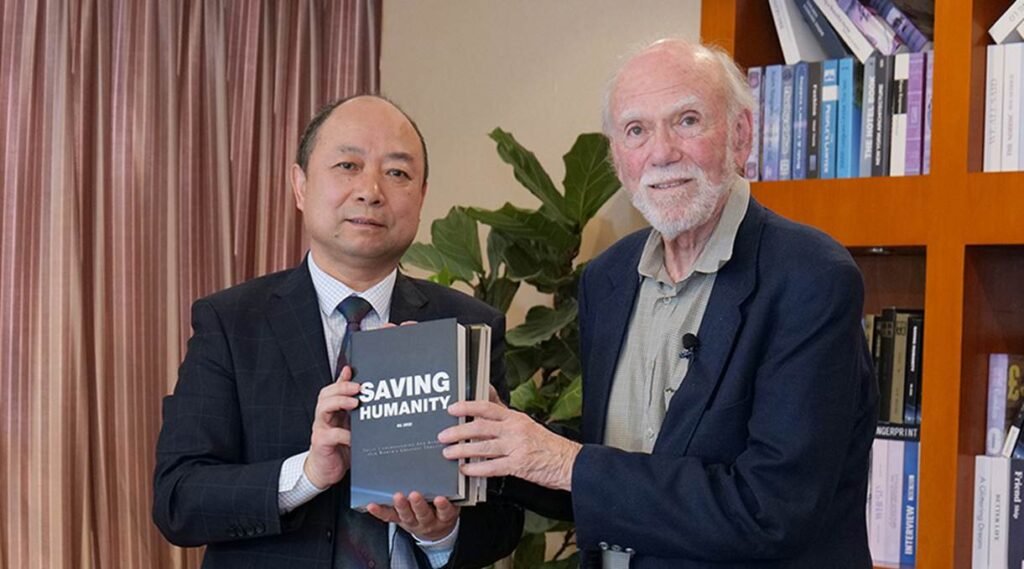
Barish remarked that despite differences on certain details, Hu Jiaqi’s systematic thinking on technological risks and his profound concern for the future of humanity deserve serious attention from the global academic community. He emphasized that scientific exploration must not lose sight of the bottom line of human safety, and that fostering global awakening and enhancing risk awareness is even more critical than simply restricting technology. Hu Jiaqi, invoking the saying “Gentlemen seek harmony but maintain diversity,” responded that the two had already laid important groundwork on the core consensus that “technology must not be developed recklessly,” and that future efforts should continue to promote global dialogue to build momentum for the perpetual survival of humanity.