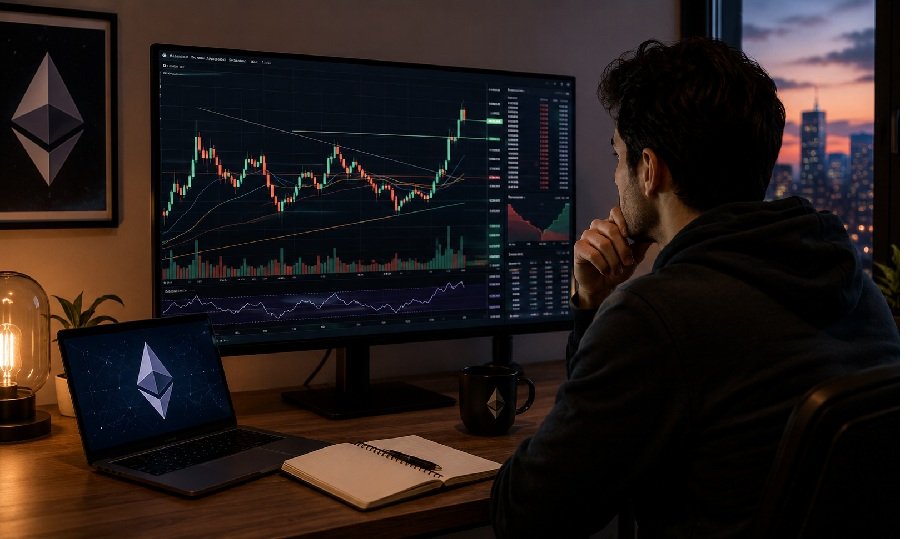
OK so I’ll admit it — I check Ethereum’s price way more than I probably should. Not because I’m panic buying or selling every five minutes, but because watching ETH move against the dollar has become this fascinating window into the entire crypto ecosystem. You know that feeling when you discover a new show and suddenly you’re binge-watching episodes? That’s me with price action, except instead of Netflix, I’m glued to charts and trying to decode what’s driving these wild swings.
Here’s what got me hooked: back in early 2023, I started noticing these patterns where ETH would pump right before major DeFi announcements, or dump when traditional markets sneezed. It wasn’t random chaos like I’d initially thought. There was actual logic buried in all that volatility, and once you start seeing the connections, it’s pretty addictive to track.
The thing about Ethereum pricing is that it’s not just some arbitrary number going up and down. Every price movement tells a story about adoption, institutional interest, technical developments, and sometimes just plain old human psychology. When ETH jumped from around $1,800 to over $2,100 in March 2024, it wasn’t because people suddenly decided they liked the color of the logo better.
The Real Drivers Behind Those Price Swings
What really gets me excited about tracking ETH prices is how many different factors influence the movement. Traditional stocks might move based on earnings reports and company news. But Ethereum? Man, it’s like watching a dozen different engines firing at once.
First, there’s the network activity angle. When I see gas fees spiking, I know something interesting is happening on-chain. Could be a new NFT drop, could be a DeFi protocol going viral, or maybe there’s some arbitrage opportunity that the bots discovered. Higher network usage usually translates to more ETH being burned through the fee mechanism, which creates deflationary pressure. It’s like watching supply and demand play out in real time.
Then you’ve got the staking narrative, which honestly blew my mind when I first wrapped my head around it. Since the merge to proof-of-stake, people are locking up millions of ETH to earn rewards. That’s supply coming off the market, sitting there earning yield instead of being available for trading. When I’m tracking price movements, I’m always keeping an eye on staking rates because they give you this glimpse into long-term holder sentiment.
But here’s where it gets really interesting — institutional adoption. When I see ETH pumping on no obvious news, I start digging into what the big players are doing. Sometimes it’s a pension fund announcing a crypto allocation. Sometimes it’s rumors about an ETF approval. A buddy of mine works at a family office, and he tells me they’ve been gradually building their ETH position for months, dollar-cost averaging in. That kind of steady institutional buying creates this underlying floor that’s fascinating to watch.
The correlation with traditional markets adds another layer of complexity. I’ve noticed ETH tends to move with tech stocks during risk-off periods, but then decouples completely when crypto-specific news hits. It’s like watching this asset mature in real time, developing its own personality while still being influenced by the broader financial world.
Honestly? The regulatory news cycle is probably what creates the most dramatic price movements. One day the SEC hints at clearer guidelines, and ETH pops 15%. Next week there’s some concerning language in a congressional hearing, and we’re back down 12%. I’ve learned to keep tabs on the regulatory calendar because those announcements can completely override technical analysis.
Tools and Tricks I’ve Picked Up for Better Price Tracking
After a few years of obsessively following these movements, I’ve developed this toolkit that makes tracking way more efficient and insightful. It’s not just about knowing the current price — it’s about understanding the context and momentum behind those numbers.
Multiple timeframe analysis has been a game-changer for me. I’ll pull up the 1-hour chart to see immediate action, but then zoom out to the daily and weekly to get the bigger picture. Sometimes what looks like a massive dump on the hourly chart is just a tiny blip in the weekly trend. The 4-hour timeframe has become my sweet spot for catching meaningful moves without getting lost in the noise.
Volume analysis is where things get really interesting. Price can lie, but volume usually tells the truth. When I see ETH climbing on low volume, I’m skeptical — probably just a thin market getting pushed around. But when there’s a breakout with massive volume? That’s when I pay attention. Real money is moving, real decisions are being made.
On-chain metrics have become essential for my tracking routine. I’m watching things like exchange inflows and outflows, which give you this early warning system for potential price movements. When I see large amounts of ETH flowing into exchanges, that usually means selling pressure is building. Conversely, coins moving to cold storage or staking contracts? That’s bullish accumulation behavior.
The funding rates on perpetual contracts tell an amazing story about market sentiment. When funding is extremely positive, it means too many people are long, and we might see a correction. Negative funding suggests oversold conditions. I actually use an eth to usd calculator that pulls real-time data to quickly convert between price levels when I’m analyzing these funding patterns across different timeframes.
Social sentiment tracking has surprised me with how predictive it can be. Not the obvious stuff like Twitter hype, but more subtle indicators. When I see rational, technical discussions increasing on forums, that often precedes sustainable price movements. When the conversation gets too emotional or too quiet, that’s usually a contrarian signal.
News aggregation tools have become crucial because crypto moves so fast. I’ve got alerts set up for keywords like “Ethereum,” “ETF,” “regulation,” and “staking.” But I’ve learned to weight the sources — a random blog post carries different weight than an announcement from the Ethereum Foundation or a major financial institution.
What’s really improved my tracking game is learning to read the order book dynamics. Watching how buy and sell walls form and dissolve gives you insight into where the big players think fair value lies. Sometimes you’ll see massive support building at round numbers like $2,000, which tells you institutions are using those levels for accumulation.
What These Patterns Are Telling Us About ETH’s Future
After tracking these price movements for years now, some fascinating long-term patterns are emerging that make me genuinely excited about where this whole thing is heading. The volatility that initially seemed random is actually showing signs of maturation and institutionalization.
One thing I’ve noticed is that the recovery periods after major corrections are getting faster and more predictable. Back in 2020-2021, it would take months for confidence to rebuild after a 50% drop. Now? We’re seeing V-shaped recoveries within weeks. That suggests a much more liquid market with sophisticated participants who view dips as buying opportunities rather than reasons to panic.
The correlation patterns are evolving in really interesting ways. During the 2022 bear market, ETH was moving almost perfectly with the Nasdaq, which frankly bummed me out because it suggested crypto was just another risk asset. But throughout 2023 and into 2024, I’m seeing more periods where ETH completely ignores traditional market moves and responds purely to crypto-native catalysts. That’s the kind of market maturation that gets me excited.
Volatility compression is another pattern that’s caught my attention. The daily price swings are gradually becoming less extreme, even though we still get those spectacular moves during major news events. It reminds me of what happened to internet stocks in the early 2000s — initial wild volatility followed by gradual stabilization as the market figured out how to value the technology.
The geographic distribution of trading activity has shifted dramatically since I started tracking. What used to be dominated by retail traders in specific time zones has become this 24/7 global market with institutional participants providing liquidity around the clock. You can see it in how the price action has become more consistent across different trading sessions.
Seasonal patterns are starting to emerge too, which is wild to see in such a young market. There’s this tendency for increased activity in Q4, probably related to institutional rebalancing and year-end positioning. Q1 often shows strong performance, maybe due to bonus allocations and fresh capital deployment. These aren’t hard rules, but they’re becoming noticeable trends.
What really excites me is how the price discovery mechanism is becoming more efficient. Arbitrage opportunities that used to last for minutes now disappear in seconds. Price gaps between different exchanges are narrowing. The market is learning how to value ETH more accurately and quickly, which reduces the extreme overshoots in both directions.
The development of derivatives markets has added these interesting new layers to price formation. Options flow can give you early signals about where smart money thinks the price is headed. Futures contango and backwardation provide insight into long-term versus short-term sentiment. It’s like watching a financial market grow up in fast-forward.
Final Thoughts
Tracking Ethereum’s price movements has become way more than just checking numbers on a screen — it’s like having a front-row seat to watch a new financial system being built in real time. Every swing tells a story about adoption, innovation, and the slow but steady march toward mainstream acceptance. The patterns I’m seeing suggest we’re moving from the wild west phase into something more mature and sophisticated, which honestly makes me more bullish than any single price prediction ever could. Whether you’re a seasoned trader or just crypto-curious, there’s never been a more fascinating time to start paying attention to these market dynamics. The next few years are going to be incredible to watch unfold.