There are many lucrative jobs in the tech industry and web development is one of them. As websites, web platforms, and applications become ever more prevalent, it’s important for web developers to weigh up their options. Here, we will discuss the two main areas of web development: Frontend (client-side) and Backend (server-side). This will help you decide on which option you may want to pursue.
What is Web Development?
Before we look at the differences between Frontend and Backend web development, it’s worth having an understanding of web development in general. Web development is the development of websites or web applications and it involves several layers that work together to produce a user experience.
For the sake of this article, web development can be broken down into two main parts:
- Frontend Development – What the user sees.
- Backend Development – The code and processes behind the frontend – the database.
Both frontend and backend developers are essential in the development of a website or web application, but have different focuses. Let’s start with a little background on these areas.
Frontend Development: Client-Side Technologies
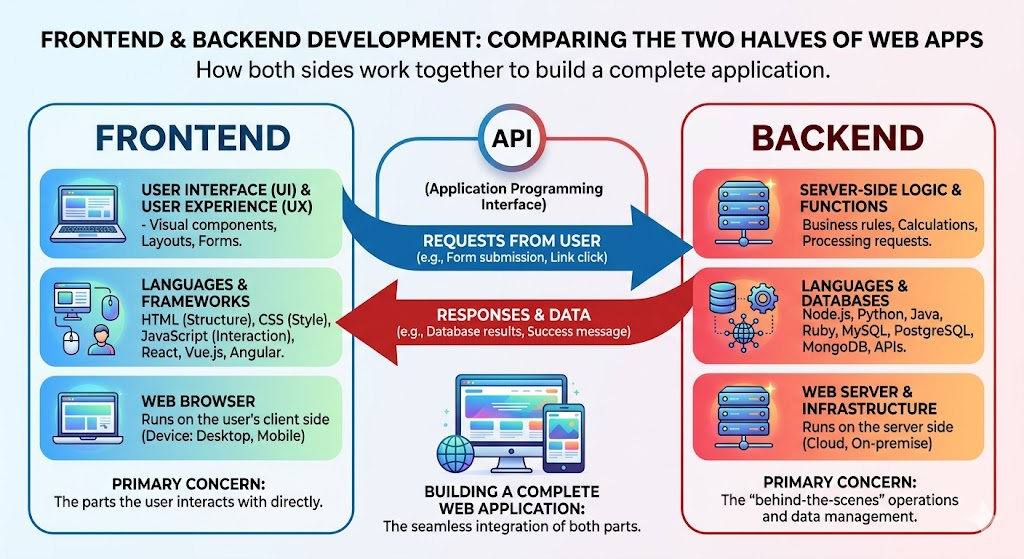
Frontend development (also known as client-side development) is the portion of the application that you see and interact with in the web browser. It is concerned with the user experience, appearance, and user interface of a web application. Frontend development is about creating a user-friendly interface.
Key Technologies in Frontend Development
- HTML (HyperText Markup Language)
HTML is the backbone of the world wide web. It’s used to mark the structure of a web page (headings, paragraphs, images, links, and so on). HTML is used by all websites and web apps. - CSS (Cascading Style Sheets)
CSS is used to style the website. It is responsible for the appearance, layout, fonts, and colors. CSS can be used to create responsive and mobile-friendly websites. - JavaScript
JavaScript makes a website interactive. It’s used for animations, form validation, and dynamic content (as opposed to reloading the page). It’s used to make websites interactive. - Frontend Frameworks and Libraries
Front-end developers can also use frameworks and libraries like React, Vue.js, and Angular to expedite the development process. They offer components, improve efficiency, and enable building complex web applications.
The Role of a Frontend Developer
The primary duty of a frontend developer is to create a visually appealing and user-friendly website or app for different devices. They take design mockups and work with user interface and experience (UI/UX) designers to create intuitive and interactive user interfaces. Frontend developers also need to have good troubleshooting skills and be able to optimize web pages for performance and smooth operation.
Backend Development: Server-Side Technologies
Backend development (also known as server-side development) is the technology used to support websites and web applications. Where front-end developers are concerned with the user interface, back-end developers are concerned with the server, database, and application programming interfaces (APIs) that provide the data to the user’s browser.

Key Technologies in Backend Development
- Databases
Data of websites and applications is stored in databases. MySQL, PostgreSQL, and SQLite are examples of SQL (Structured Query Language) databases and MongoDB and Cassandra are examples of NoSQL databases. Databases are used by backend developers to store and get data. - Server-Side Languages
Backend developers use server-side languages to build the functionality of an app. The most common server-side languages are Python, Java, Ruby, PHP, Node.js, and C#. They are used to build code that runs on the server, communicates with the database, and APIs. - APIs (Application Programming Interfaces)
APIs are used to communicate between the client and server. They enable data to be delivered from the server to the client, enabling dynamic websites to request data from the server without having to refresh the page. APIs also provide communication with other services such as payments, authentication, and feeds. - Web Servers
Software that receives requests and delivers web pages. Some web servers that backend developers deal with are Apache, Nginx, and Microsoft Internet Information Services (IIS).
The Role of a Backend Developer
A backend developer’s job is to code for web applications. A backend developer manages requests from the front end, interacts with databases, user authentication and authorization, and is responsible for security to protect users’ data. A backend developer’s role is to ensure that the data from the backend is delivered to the frontend and that the application is scalable to handle a lot of users.
Frontend vs Backend Technologies
Backend and frontend are both important parts of the development process for a web application, but they do require different skills and have different responsibilities when developing an application. The following table highlights the differences between client-side (frontend) and server-side (backend) technologies:
| Aspect | Frontend (Client-Side) | Backend (Server-Side) |
| Languages Used | HTML, CSS, JavaScript | Java, Python, Node.js, Ruby, PHP, C#, SQL |
| Focus Area | User Interface and experience (UI/UX) | Back-end, Data, APIs |
| Main Tools | React, Angular, Vue.js, SASS, Bootstrap | Django, Flask, Express.js, Ruby on Rails, Laravel |
| Responsibility | Create web pages, make them interactive | Interacting with databases, requests, server code |
| Performance Focus | Fast, responsive, mobile-friendly | Security, server performance, scalability |
| User Interaction | User interaction with web page | Indirect user interaction with back end services |
Front-end vs. Back-end: Which is Best?
When it comes to choosing between frontend and backend development, there are a few things to consider:
Interest in Design vs. Logic
If you are more interested in the design and look of the application, then you may want to be a frontend developer. If you are more interested in problem solving, data, and building the application infrastructure, then backend development is for you.
Career Goals
Both frontend and backend development has great job prospects, but different skill sets. Without frontend developers, there would be no great looking user interfaces, and without backend developers, there would be no server-side processing and database management.
Skillset
A frontend developer should be creative, detail-oriented, and have a good knowledge of web design, while a backend developer should be a good problem solver, a good coder, and understand server-side technologies.
Conclusion
Choosing between a career in frontend or backend development should be based on personal goals and interests. If you’re fascinated by the experience of building user-friendly websites with a good user interface, then you might consider frontend development. However, if you have an interest in complex data structures, server-side programming, and ensuring the seamless functioning of web applications, then backend development could be a better fit.
But regardless of which path you choose, both frontend and backend developers are essential to the success of web development projects, so it’s important to know the differences to help you decide which role is right for you.