Introduction
Operating costing in service industries are very significant in the current modern economy in terms of growth, employment and innovation. Service based businesses are different to manufacturing businesses in that they provide intangible value to the customers as opposed to manufacturing companies which produce tangible products. Such an essential difference necessitates a special costing technique called operating costing, also called service costing.
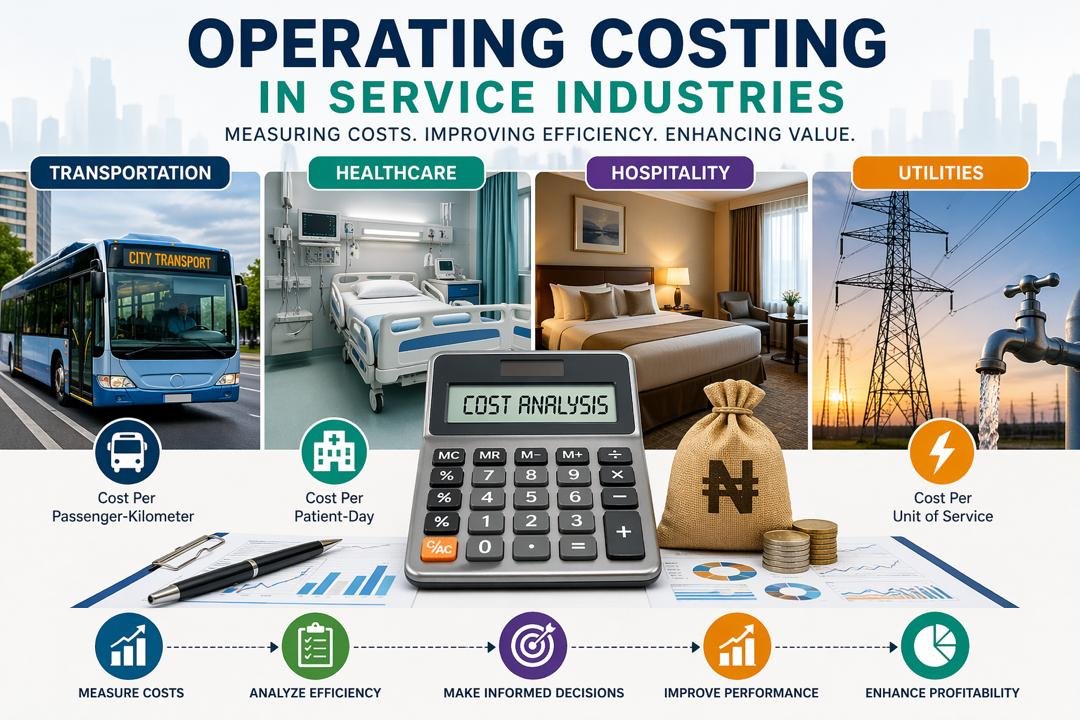
Operating costing is a unique procedure that is aimed at ascertaining the price of delivering services and not the production of tangible goods. It is extensively used in industries including transportation, healthcare, hospitality, education and utilities. The main aim of operating costing is to determine the cost in per unit of service provided which assists organizations to manage their costs, price appropriately and enhance efficiency.
We will discuss the concept of operating costing, the main characteristics of it, and how the cost can be measured, and its applicability to large service industries in this article. We shall also look into how it assists in cost management and decision making with non-manufacturing.
What is Operating Costing?
Service costing or operating costing is an approach that is employed to determine the cost of rendering a service. It is concerned with the calculation of the cost per unit of service delivered, e.g. cost per passenger kilometer of transportation service, cost per patient day of hospital service.
In contrast to the conventional costing techniques, in manufacturing, operating costing is concerned with intangible products and may also be considered a continuous service provision. It needs proper categorization and assignment of costs to determine the service performance.
The main characteristics of Operating Costing
There are a number of differentiating features that make operating costing more unique than any other costing method:
1. Intangible Output
Service industries are not physical in the production of their output. An illustration of this is a hotel that offers accommodation, and a transport company that offers mobility. This complicates measuring costs.
2. Composite Cost Units
The composite units of operating costing are units which merge two variables. For instance:
- Passenger-kilometers (transport)
- Bed-days (hospital)
- Room-nights (hotel)
3. Continuous Service
The services are usually delivered on an ongoing basis as compared to manufacturing processes which can be in batches.
4. Large Proportion of Fixed Cost.
Salaries, rent as well as equipment maintenance are some of the fixed costs involved in many service industries.
5. Cost Classification
There are usually costs that are divided into:
- Fixed costs
- Variable costs
- Semi-variable costs
Cost Units in Operating Costing
A cost unit is a standard unit of cost that is used to describe the cost of the services. It is important to select the appropriate cost unit to calculate the cost correctly.
Some examples of Cost Units:
- Transportation: Per capita kilometer cost (quantified in kilometer per passenger), ton kilometer cost (quantified in kilometer per ton)
- Healthcare: Per patient-day or per operation.
- Hospitality: Per room per night.
- Utilities: price of a unit of electricity or water delivered.
Such units are used to assist organizations gauge efficiency and performance across time.
Elements of Operating Costs
There are three general types of operating costs:
Fixed Costs
These expenses do not change with volume of the service. Examples include:
- Salaries of permanent employees.
- Insurance
- Depreciation of equipment
Variable Costs
These expenses depend on the amount of services. Examples include:
- Fuel in transportation
- Hotels Food supplies.
- Medical consumables at hospitals.
Semi-Variable Costs
These are costs which have variable as well as fixed aspects. For example:
- Utility bills
- Maintenance expenses
The knowledge of these elements is essential to make proper cost control and pricing decisions.
Methods of Measuring Cost per Unit of Service
In order to determine the cost per unit of service, it usually goes through the following steps:
Step 1: Find Total Costs.
Any expenses incurred in the delivery of the service are gathered up and classified.
Step 2: Find out the Total Service Units.
The number of units of service given in a period is summed up.
Step 3: Calculate Cost per Unit.
The unit cost is calculated by using the formula:
Cost per unit = Total operating cost ÷ total service units.
Example
Assuming that a transport company has operating costs of ₦500,000 and that it covers 25,000 passenger-kilometers, the cost per passenger-kilometer would be:
₦500,000 ÷ 25,000 = ₦20 per passenger-kilometer
The use of Operating Costing in Service Industries
Operating costing is a popular practice in service industries. We shall look at its applicability in major industries:
1. Transportation Industry
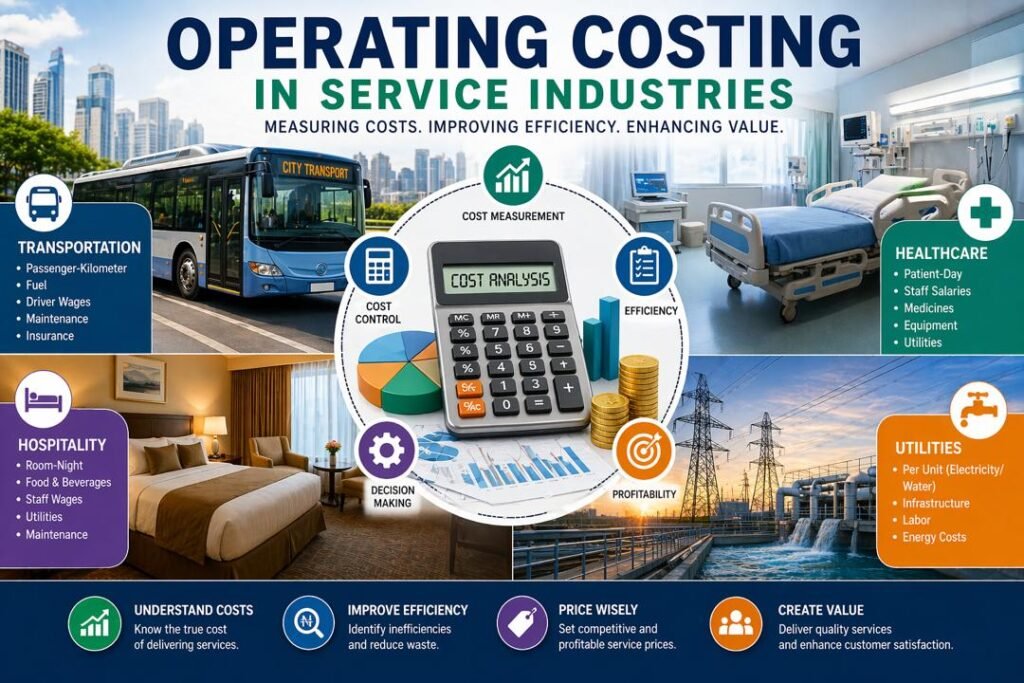
Transportation sector comprises of bus, taxis, airlines, and shipping firms. Operating costing decides the cost of transportation of passengers or goods.
Cost Units
- Passenger-kilometer
- Ton-kilometer
Key Costs
- Fuel
- Driver wages
- Vehicle maintenance
- Insurance
Importance
The transport companies can use operating costing to:
- Set ticket prices
- Control fuel consumption
- Optimize route planning
- Improve fleet utilization
Example
A bus company uses the cost per passenger-kilometer to estimate its fares as it will make profit or not.
2. Healthcare Industry
The crucial services that need to be accurately measured in hospitals and clinics are related to cost. The cost of patient care is determined with the help of operating costing.
Cost Units
- Cost per patient-day
- Cost per surgery
Key Costs
- Medical staff salaries
- Equipment depreciation
- Medicines and supplies
- Utility costs
Importance
Operating costing aids healthcare providers in:
- Control treatment costs
- Improve resource allocation
- Set service charges
- Ensure financial sustainability
Example
To measure efficiency and whether the pricing structure is sufficient, a hospital can compute the cost per patient-day.
3. Hospitality Industry
Hotels, resorts and restaurants are some of the industries that have been greatly dependent on operating costing in order to control their costs and ensure that they are profitable.
Cost Units
- Cost per room-night
- Cost/meal served.
Key Costs
- Staff wages
- Food and beverages
- Utilities
- Maintenance
Importance
Operating costing helps hospitality businesses to:
- Set room rates
- Control food costs
- Improve occupancy rates
- Enhance customer experience
Example
To know the minimum cost that the hotel can charge to cover the expenses, a hotel will compute the cost per occupied room.
4. The Utilities and Public Services.
Operating costing is also used in organizations that supply electricity, water and telecommunications.
Cost Units
- Per kilowatt-hour (electricity) cost.
- Cost/m3 (water)
Key Costs
- Infrastructure maintenance
- Labor
- Energy production costs
Importance
Operating costing aids these organizations:
- Determine tariffs
- Manage operational efficiency
- Plan investments
5. Education Sector
Operating costing is used in educational institutions in order to determine the cost of providing education.
Cost Units
- Cost per student
- Cost per class
Key Costs
- Teacher salaries
- Administrative expenses
- Learning materials
Importance
Operating costing supports:
- Budget planning
- Fee determination
- Resource allocation
Importance of Operating Costing in Cost Control
Managing service based organizations is an important consideration in cost control. Operating costing is crucial in the attainment of this goal.
- Identifying Inefficiencies: Cost analysis would help organizations to identify areas that are wasting resources.
- Budgetary Control: The operating costing assists in establishing budgets and measuring actual performance with targets.
- Pricing Decisions: Proper cost information guarantees that the costs of the services are kept within reach, and profitable.
- Performance Evaluation: Managers are able to assess the level of efficiency of various departments or units.
- Profit Planning: Forecasting and strategic planning is facilitated by operating costing.
Challenges in Operating Costing
Although it has its advantages, there are various challenges in operating costing:
- Problem in Measuring Product: Service outputs are not tangible and are more difficult to measure.
- Allocation of Overheads: It may be complicated to determine the correct indirect costs.
- Fluctuating Demand: The demand on the service is usually variable which influences the calculation of costs.
- High Fixed Costs: It may be difficult to manage high fixed costs where there is low demand.
Ways to Enhance Operating Costing.
To increase the efficiency of operating costing, organizations can use a number of strategies:
- Use of Technology: Innovative software enhances cost tracking and accuracy of data.
- Standard Costing: Establishing benchmarks aids in making comparisons between the actual performance and the expected performance.
- Activity-Based Costing: This technique allocates expenses depending on activities, which enhances precision.
- Regular Monitoring: Costs need to be looked into continuously to ensure timely corrective measures are taken.
Comparison with other costing methods
Operating costing is different in a number of ways compared to other types of costing:
1. Job Costing vs. Operating Costing
- Continuous services are taken care of by operating costing.
- Job costing is concerned with particular activities or projects.
2. Process Costing vs. Operating Costing.
- In the service industries, operating costing is applied.
- Process costing is applied in manufacturing industries that have continuous production.
Managerial Decision-Making Role
Operating costing offers useful information that can be used in making decisions:
- Pricing Strategy: Managers are able to charge according to the cost and market conditions.
- Cost Reduction: Determining cost drivers assists in minimizing unnecessary costs.
- Resource Allocation: Efficient distribution is a means of maximum use of resources.
- Expansion Planning: The cost data will be used to determine the viability of the expansion projects.
Trends relating to Operating Costing in the future
However, with the transformation in service industries, operating costing is being transformed:
- Digital Transformation: Cost measurement is becoming more precise with the help of automation and data analytics.
- Sustainability Focus: Environmental costs are being included in computation of organizations.
- Customer-Centric Costing: Companies are emphasizing on value addition and cost management.
Conclusion
The operating costing is a key cost management tool in the service industries. It helps organizations to manage costs, price their services appropriately and enhance efficiency by making them center on the cost per unit of service. Transportation, healthcare, hospitality, utilities and operating costing offers a framework or systematic way of understanding and dealing with costs in non-manufacturing industries. It is very relevant in the current service-based economy with its challenges notwithstanding.
Operating costing is not only a technique to improve financial performance but also helps to make strategic decisions and be sustainable in the long run. With the ever-increasing service industries, better and precise costing systems will become even more significant.
Get more well researched information about Operating Costing in Service Industries here.